
You are currently viewing Private Trust in India: A Step-by-Step Legal Guide for Asset Protection and Estate Planning

Private Trust in India: A Step-by-Step Legal Guide for Asset Protection and Estate Planning

Establishing a private trust is a practical and legally sound way to protect assets, manage wealth, and ensure smooth succession planning for future generations. Whether the objective is to preserve family property, provide for dependents, or protect assets from potential business risks, private trusts provide a structured and reliable legal framework under Indian law.

The legal provisions governing private trusts in India are mainly set out in the Indian Trusts Act, 1882, which applies in situations where no specific local or religious law takes precedence. Private trusts are created for the benefit of one or more identified individuals and are not formed for charitable purposes.
Private Trust in India: A Step-by-Step Legal Guide for Asset Protection and Estate Planning

Why Form a Private Trust?

Creating a private trust in India is an effective legal method for long-term asset protection, succession planning, and financial management.

One of the main reasons individuals establish a private trust is to support proper estate planning, enabling the smooth and conflict-free transfer of wealth from one generation to the next. By clearly identifying beneficiaries and defining how assets should be distributed, the settlor can reduce the risk of disputes and ensure that assets are utilized according to their intentions.

Private trusts also provide asset protection, particularly for business owners or professionals who may face legal claims or financial liabilities. Assets transferred to an irrevocable trust are generally separated from personal ownership, offering protection against potential creditor claims or financial risks.

Another important benefit is the option to appoint a qualified trustee to manage assets on behalf of beneficiaries. This arrangement is especially useful when beneficiaries include minor children, elderly family members, or individuals with special needs.

In addition, when properly structured and managed in compliance with applicable regulations, a private trust can support tax efficiency by allowing income to be distributed in a manner that reduces the overall tax burden, subject to relevant tax laws. Together, these advantages make private trusts a valuable tool for individuals seeking control, privacy, and continuity in managing and transferring their assets.

Who Can Form a Private Trust?

Settlor (Author of the Trust):
Any individual who is legally competent to enter into a contract under Indian law can establish a private trust.

Trustee:
Any person capable of holding property can be appointed as a trustee. This may include individuals, companies, or other legal entities.

Beneficiary:
Any individual or group of individuals who can be clearly identified at the time the trust is created can be named as beneficiaries.

Private Trust in India: A Step-by-Step Legal Guide for Asset Protection and Estate Planning

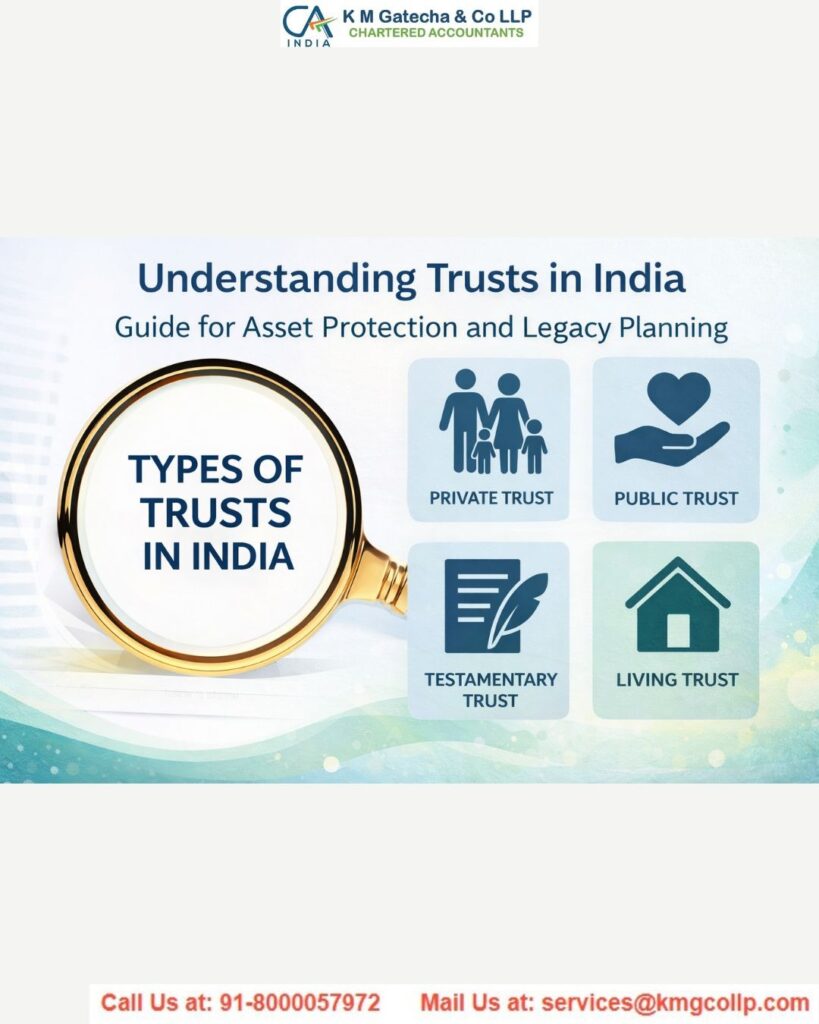
Types of Private Trusts

Revocable Trust:
A revocable trust can be modified or cancelled by the settlor during their lifetime. It provides flexibility but generally offers a lower level of asset protection compared to irrevocable trusts.

Irrevocable Trust:
Once established, an irrevocable trust cannot be changed or terminated without the consent of the beneficiaries. This type of trust provides stronger protection for estate planning and asset security.

Testamentary Trust:
A testamentary trust is created through a will and becomes effective only after the death of the settlor.

Inter Vivos Trust (Living Trust):
An inter vivos trust is established during the lifetime of the settlor and becomes operational immediately after its creation.

Step-by-Step Procedure for Creating a Private Trust

1. Drafting the Trust Deed

The Trust Deed is the primary legal document that defines the terms, conditions, and management of the trust. It should clearly specify the following details:

  • Name of the Trust
  • Details of the Settlor, Trustee(s), and Beneficiaries
  • Purpose and objectives of the Trust
  • Trust Property (movable or immovable assets)
  • Powers and responsibilities of the Trustees
  • Method of distribution of benefits
  • Termination clause of the Trust

A properly drafted trust deed provides legal certainty and helps prevent disputes in the future.

2. Stamp Duty and Notarisation

Under the Indian Stamp Act, 1899, or the applicable State Stamp Acts, the trust deed is subject to stamp duty, which differs depending on the state.

  • For immovable property, stamp duty is generally calculated as a percentage of the property’s market value.
  • For movable property, a nominal stamp duty is usually applicable.

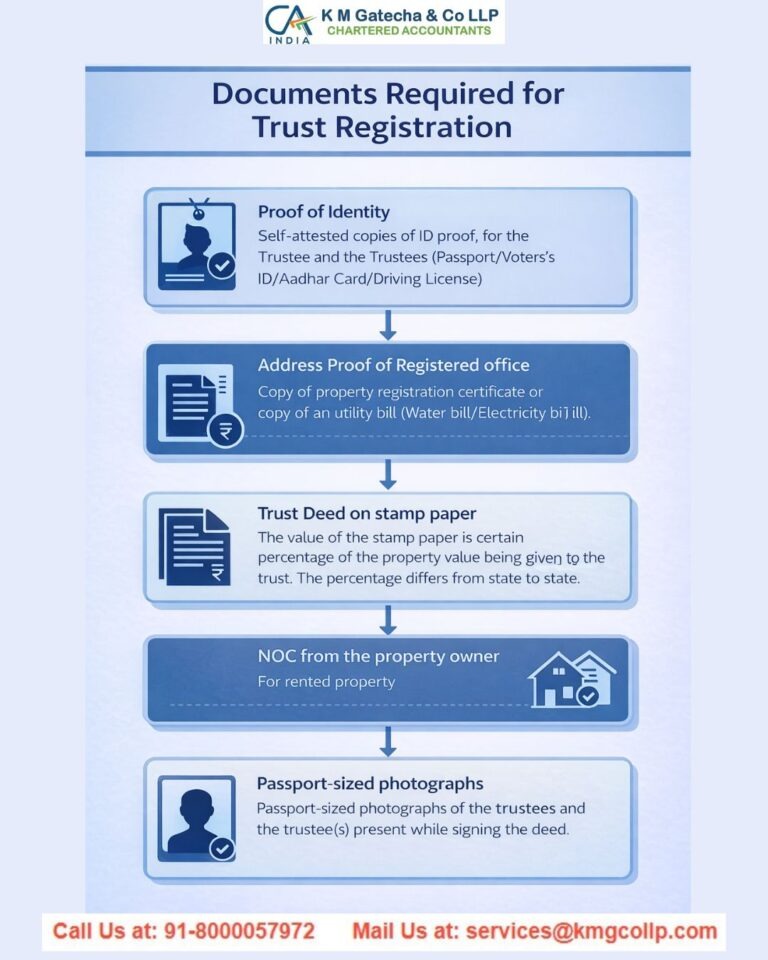
The trust deed must be executed on the appropriate stamp paper and should be notarised in accordance with legal requirements.
Private Trust in India: A Step-by-Step Legal Guide for Asset Protection and Estate Planning

3. Registration of the Trust Deed

According to Section 17 of the Registration Act, 1908, registration of the trust deed is compulsory when the trust includes immovable property.

Procedure:

  • Visit the local Sub-Registrar Office along with the settlor and two witnesses
  • Submit identity and address proof of the settlor and trustees
  • Pay the applicable registration fees as prescribed by state regulations
  • Obtain the registered copy of the trust deed

4. Obtain PAN and Open a Bank Account

For taxation and financial transactions, a private trust is treated as a separate entity.

  • Apply for a Permanent Account Number (PAN) in the name of the trust through the Income Tax Department
  • Open a bank account in the name of the trust to manage funds, income, and distributions

5. Tax Compliance and Filing

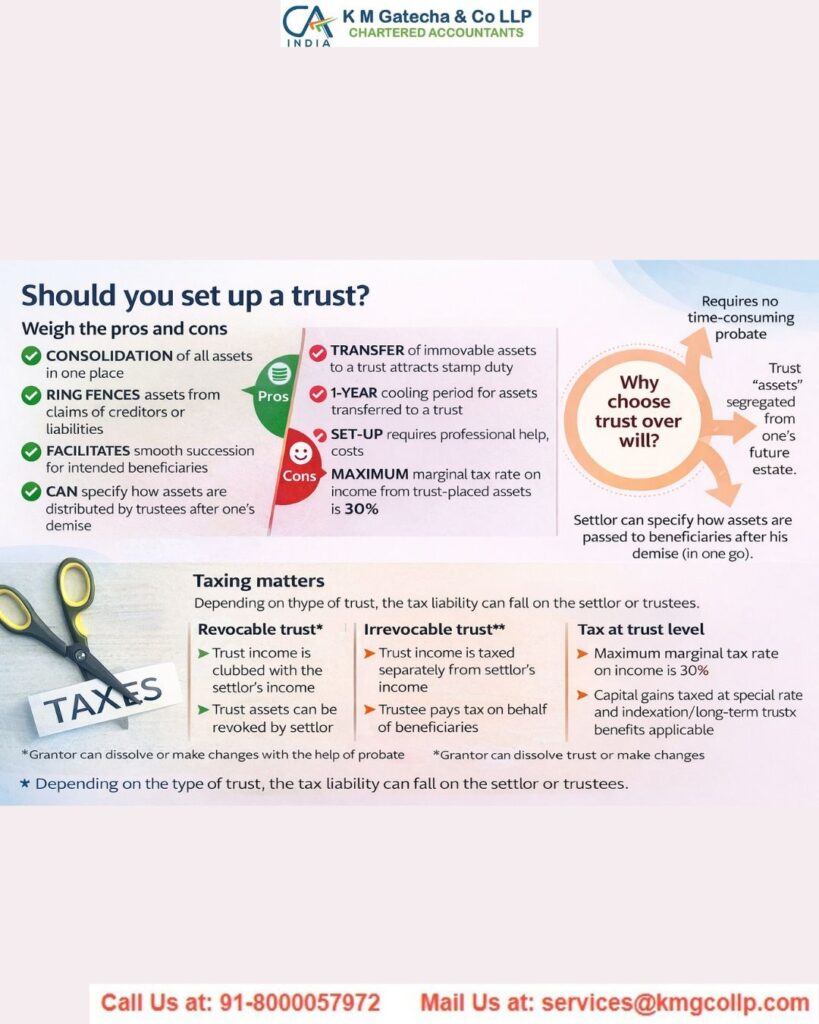
Under the Income Tax Act, 1961, a private trust is classified as either a specific trust or a discretionary trust, depending on whether the beneficiaries and their respective shares are clearly defined.

Taxation Highlights:

  • Specific trusts: Income is generally taxed in the hands of the beneficiaries according to their respective shares
  • Discretionary trusts: Income is usually taxed at the Maximum Marginal Rate (MMR), subject to certain exceptions

Private trusts are required to file annual income tax returns, and trustees must maintain accurate financial records, accounts, and supporting documentation.
Private Trust in India: A Step-by-Step Legal Guide for Asset Protection and Estate Planning

Advantages of Creating a Private Trust

1. Asset Protection

Private trusts offer legal protection for personal or family assets. By transferring assets to a trust—particularly an irrevocable trust—the settlor can protect them from potential claims by creditors, divorce settlements, or business-related liabilities.

2. Succession Planning Without Probate

Assets held in a trust are generally not considered part of the settlor’s estate at the time of death, which helps avoid probate procedures. This enables a quicker and more private transfer of assets to the beneficiaries.

3. Flexibility and Control

Trusts provide the settlor with the ability to set specific conditions regarding how and when beneficiaries will receive their assets. This is especially beneficial when managing inheritance for minor children, financially inexperienced beneficiaries, or dependents with special needs.

4. Continuity and Management of Family Wealth

Unlike a will, which becomes effective only after the death of the individual, a private trust—particularly a living trust—ensures continuous management and smooth transfer of wealth even during the settlor’s lifetime.

5. Tax Planning Opportunities

Although discretionary trusts may be taxed at the maximum marginal rate, specific trusts can provide better tax planning opportunities when income is distributed directly to beneficiaries in lower tax brackets, subject to the provisions of the Income Tax Act.

Legal Safeguards to Ensure Trust Validity

To maintain the validity, enforceability, and effectiveness of a private trust, the following legal measures should be considered:

Drafting by a Qualified Legal Professional

Engaging a legal professional with experience in trust and estate law helps avoid drafting errors and ensures compliance with applicable legal requirements.

Clear Identification of Beneficiaries

Beneficiaries should be clearly identified without using vague or general descriptions. Proper identification ensures that the trust can be legally enforced without confusion.

Trustee Accountability

Trustees should be selected based on reliability and integrity. Regular audits and proper record-keeping help maintain transparency and accountability in trust management.

Registration Where Required

If the trust involves immovable property, registration of the trust deed is legally mandatory. Failure to register the document may make the trust unenforceable.

Tax Filings and Documentation

Timely submission of income tax returns, obtaining a PAN, and maintaining accurate financial records are essential to ensure compliance with regulatory authorities.

Conclusion

When properly structured and managed, a private trust serves as a strong legal instrument for individuals and families in India seeking asset protection, succession planning, and effective wealth management. However, careful legal planning, responsible trusteeship, and continuous compliance with regulatory requirements are essential for its successful operation.

As legal and tax regulations continue to change, seeking guidance from experienced legal and tax professionals remains important for anyone considering the establishment of a private trust as part of their long-term estate planning strategy.

Disclaimer: The content on this website is for informational purposes only and does not constitute legal, financial, or professional advice. Please consult qualified experts before acting on any information. K M GATECHA & CO LLP accepts no liability for errors, omissions, or outcomes from the use of this content. This site is not an advertisement or solicitation.

Need Help?

FREQUENTLY ASKED QUESTIONS

A private trust is suitable for high-net-worth individuals, business owners, and families with significant assets who want to ensure structured wealth transfer, protect assets from creditors, provide for minor children or dependents, or avoid disputes during succession. It is also useful for NRIs who own assets in India and want a clear legal framework for management and inheritance.

There is no statutory minimum asset value prescribed under the Indian Trusts Act, 1882. However, given the costs involved in drafting a trust deed, stamp duty, registration, professional fees, and ongoing compliance, a private trust is practically viable when the asset base is significant enough to justify these expenses — typically upward of ₹50–75 lakhs.

Technically yes — the Indian Trusts Act does not mandate professional involvement. However, a trust deed is a complex legal document with long-term financial and tax consequences. Errors in drafting can invalidate the trust or create unintended tax liabilities. It is strongly advisable to engage a qualified lawyer and a chartered accountant when setting up a private trust.

Drafting the trust deed typically takes 1–2 weeks depending on complexity. Once the deed is ready and stamp duty is paid, registration at the Sub-Registrar’s Office can be completed in 1–3 working days if all parties and documents are in order. Obtaining the PAN for the trust takes an additional 7–15 days. End to end, you should plan for 3–6 weeks.

Once assets are transferred into an irrevocable private trust, they cease to be the personal property of the settlor. Creditors of the settlor generally cannot attach trust property to satisfy personal debts, provided the transfer was not made to defraud existing creditors. Similarly, personal creditors of a beneficiary cannot attach trust corpus — only the beneficiary’s right to receive distributions (and only to the extent permitted by the trust deed).

Yes. By transferring business shares or assets into a private trust, the settlor separates personal wealth from business risk. If a business is sued or faces insolvency, trust-held assets are generally shielded provided the trust was set up well in advance and was not a fraudulent conveyance. Many promoters hold their shareholding in operating companies through a family trust for this reason.

A spendthrift clause restricts a beneficiary from voluntarily transferring or alienating their interest in the trust, and prevents creditors of the beneficiary from reaching trust assets before they are actually distributed. It protects improvident or financially vulnerable beneficiaries. If any of your beneficiaries are minors, have debt problems, or are likely to face financial difficulties, including a spendthrift clause is strongly recommended.

This is a nuanced area. Trust corpus held in a properly structured irrevocable trust is generally not treated as the personal property of a beneficiary spouse and is therefore not directly subject to matrimonial property division. However, income distributions received by a beneficiary may be considered in calculating maintenance or alimony. The specific outcome depends on the facts and the court’s discretion.

Yes — this is one of the most powerful uses of a private trust. Assets transferred into a private trust no longer form part of the settlor’s personal estate and therefore do not pass through intestate succession or even a will. The trust deed specifies exactly who gets what and when, making it significantly harder for disgruntled heirs to challenge compared to a will, which is subject to probate and can be contested.

A will takes effect only on death, is subject to probate (a court process that can take years), is a public document once probated, and can be challenged by heirs. A private trust takes effect immediately upon creation, avoids probate entirely, remains private, is far harder to challenge, and allows the settlor to lay down detailed conditions on when and how beneficiaries receive assets. A trust is also more effective for managing assets for minor beneficiaries.

Yes. A private trust can hold virtually any asset class — immovable property (land, house, commercial premises), movable property (gold, jewellery), financial assets (shares, mutual funds, bonds, FDs), bank accounts, intellectual property rights, and business interests. Each asset class has specific transfer and documentation requirements. Immovable property transfers require a registered deed; shares require a share transfer form and updating company records.

A trust does not die with its trustee. The trust deed should specify a mechanism for appointing a successor trustee. If the deed is silent, the court can appoint a new trustee under Section 73 of the Indian Trusts Act. To ensure continuity, it is best practice to appoint at least two trustees and name a procedure for succession in the trust deed itself.

Yes. It is perfectly legal for the settlor to be one of the beneficiaries of a private trust. However, if the settlor is also the sole trustee and sole beneficiary simultaneously, the trust collapses as the legal and beneficial interests merge. For tax purposes, if the settlor is a beneficiary of a revocable trust, trust income may be clubbed with the settlor’s personal income under the clubbing provisions of the Income Tax Act.

Absolutely — this is one of the most compassionate uses of a private trust. The settlor can create a trust specifically to provide for the long-term financial security of a differently-abled beneficiary, specifying how funds are to be used for their care, medical expenses, and day-to-day needs. The trust continues to protect and manage assets even after the settlor’s death. Note also the provisions under the Rights of Persons with Disabilities Act, 2016, which may be relevant.

Minors cannot legally hold or manage property directly. A private trust is an ideal vehicle — the trustee holds and manages the assets on behalf of the minor, investing prudently and making distributions for the minor’s education, health, and welfare. The trust deed can specify the age at which full control passes to the beneficiary (e.g., at 21 or 25 years). This prevents premature inheritance and mismanagement of assets.

Typically required: the executed trust deed on appropriate stamp paper; identity proof and address proof of the settlor, all trustees, and witnesses (Aadhaar, PAN, passport); recent passport photographs of all parties; proof of ownership of the trust property (title deed, share certificates, etc.); and a demand draft or payment receipt for registration fees. Requirements may vary slightly by state.

Yes, ideally. Under the Registration Act, 1908, the document must be presented at the relevant Sub-Registrar’s Office and executed in the presence of the registering officer. All executing parties (at minimum the settlor and accepting trustee(s)) along with two witnesses must be physically present. If a party cannot be present, a duly authorized Power of Attorney holder may appear on their behalf.

It depends on whether the trust is revocable or irrevocable. A revocable trust can be amended per the procedure laid down in the trust deed. An irrevocable trust generally cannot be amended once created — though courts may allow modifications in exceptional circumstances (e.g., changed circumstances affecting beneficiaries). Any amendment to a registered trust deed relating to immovable property must itself be registered.

Key ongoing compliances include: maintaining proper books of accounts; filing annual income tax returns in the name of the trust (using its PAN); TDS compliance on distributions and payments; maintaining minutes of trustee meetings; keeping records of all trust transactions; and ensuring trustees act within the powers granted by the trust deed. If the trust holds shares in companies, compliance with Companies Act requirements (share transfers, forms, etc.) is also necessary.

Yes. After obtaining the trust’s PAN, the trustees can open a bank account in the name of the trust (e.g., “ABC Family Trust, through Trustees”). All trust income and corpus should flow through this account. The trust can make investments — in FDs, mutual funds, listed shares, bonds, and other permitted instruments — as authorized by the trust deed. SEBI’s KYC norms apply for capital market investments.

The tax treatment depends on the type of trust. In a specific trust (where each beneficiary’s share is fixed), income is taxed in the hands of each beneficiary at their applicable slab rates — similar to how they would be taxed on their personal income. In a discretionary trust (where the trustee decides distributions), the entire income is taxed at the maximum marginal rate of 30% (plus applicable surcharge and cess) in the hands of the representative assessee (trustee), under Section 164 of the Income Tax Act.

The Income Tax Act contains anti-avoidance provisions in Sections 60–65 that can attribute trust income back to the settlor. These apply when: (a) the trust is revocable; (b) the settlor transfers assets to a trust for the benefit of their minor child (income is clubbed with the transferor parent); or (c) the settlement is without adequate consideration for the direct or indirect benefit of the settlor’s spouse. Proper structuring with legal advice can help minimize the application of clubbing provisions.

This is a complex area. The transfer of a capital asset into a trust may be treated as a transfer under Section 2(47) of the Income Tax Act, potentially triggering capital gains tax in the hands of the settlor. The applicability and quantum depend on the nature of the asset, its cost, and the consideration (if any) paid. For family settlements or transfers without consideration, some positions exist that no capital gains arises, but this is disputed and should be evaluated by a tax professional on a case-by-case basis.

Yes. Non-Resident Indians must comply with FEMA (Foreign Exchange Management Act) regulations in addition to trust law. Transfer of immovable property in India through a trust structure by an NRI involves FEMA compliance. Repatriation of trust income or corpus abroad triggers RBI regulations. Additionally, if the NRI is a tax resident of another country, double taxation avoidance agreement (DTAA) provisions and that country’s foreign trust reporting rules (e.g., FATCA or CRS disclosures) may apply.

Yes, but it is significantly harder to challenge than a will. A trust can be challenged on grounds such as: the settlor lacked capacity (unsound mind) at the time of creation; the trust was created under coercion, undue influence, or fraud; the trust was created to defraud creditors; the trust purpose is unlawful; or procedural requirements (writing, registration) were not complied with. A properly drafted, registered, and independently witnessed trust deed greatly reduces vulnerability to challenge.

If the sole trustee becomes incapacitated or insolvent, the trust property does not vest in the trustee’s creditors — trust property is legally distinct from the trustee’s personal estate. The court can appoint a new trustee to ensure continuity. This is why best practice dictates appointing two or more trustees and clearly specifying succession in the trust deed, rather than relying on court intervention.

This is not straightforward and is generally not permitted without specific legal steps. A private trust exists for the benefit of specific beneficiaries, while a public charitable trust benefits the general public. Converting one to the other would effectively change the legal nature, beneficiaries, and applicable law — and could trigger tax consequences. Any such restructuring requires detailed legal advice and potentially court approval.

“Family trust” is not a legally defined term under the Indian Trusts Act — it is a colloquial term used to describe a private trust created for the benefit of the settlor’s family members. All family trusts are private trusts, but not all private trusts are family trusts (e.g., a private trust created for the benefit of employees). The legal framework, registration requirements, and tax treatment are the same as any other private trust.

Table of Contents