

GST Registration in India – Documents Required
Every business must comply with the provisions of the Central Goods and Services Tax Act, 2017 and related GST laws. GST registration helps legally recognize a business and enables it to collect and remit tax. Upon successful registration, the taxpayer is allotted a unique 15-digit GST Identification Number (GSTIN) by the Government of India.
The GSTIN contains key details about the registered business and is mandatory for issuing GST-compliant invoices and claiming input tax credit.
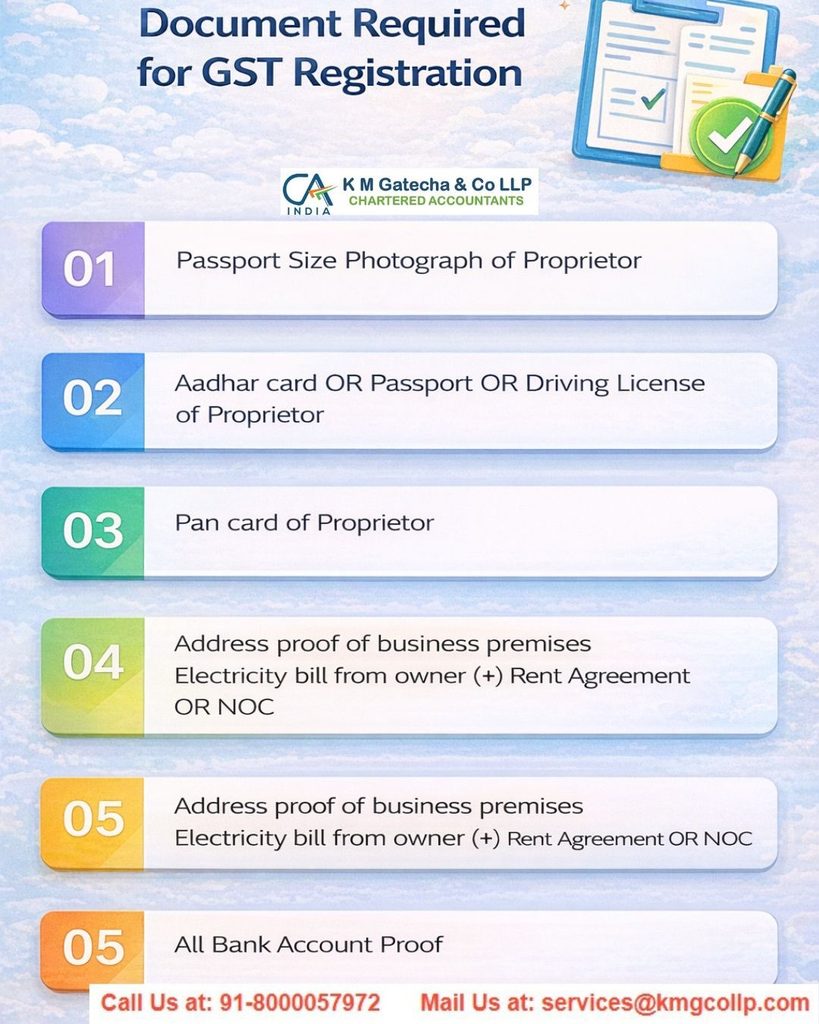
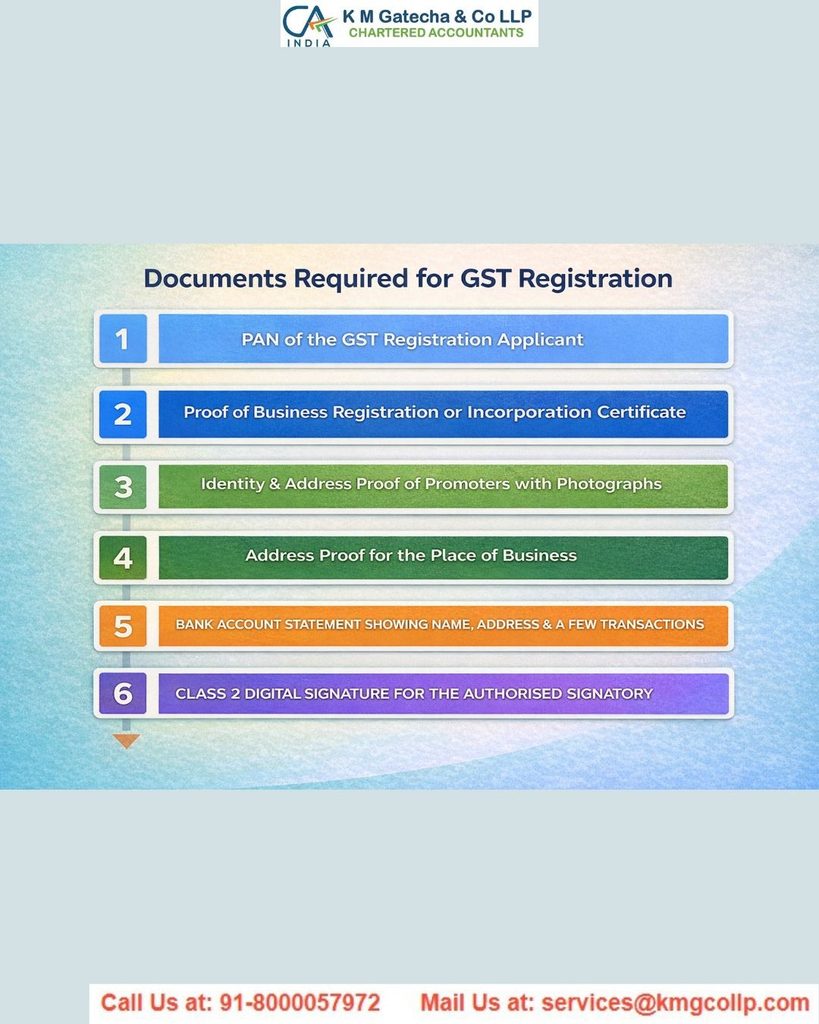
Documents Required for GST Registration
To obtain GST registration in India, the applicant must submit the following documents:
- PAN card of the business or applicant
- Aadhaar card of the applicant/authorized signatory
- Certificate of Incorporation or business registration proof (for companies/LLPs)
- Authorization letter or Board Resolution for the authorized signatory
- Address proof of the principal place of business (electricity bill, rent agreement, etc.)
- Identity and address proof with photographs of Promoters/Directors
- Bank account proof (bank statement or cancelled cheque)
- Digital Signature Certificate (DSC) (mandatory for companies and LLPs)
Why GST Registration Is Important
- Legally authorizes a business to collect GST
- Enables claim of Input Tax Credit (ITC)
- Enhances business credibility
- Required for inter-state supply of goods and services
- Mandatory once turnover exceeds the prescribed threshold
Proper documentation and accurate filing ensure smooth approval of GST registration and timely issuance of GSTIN.
Digital Signature for GST Registration
For companies and LLPs, a Digital Signature Certificate (DSC) is mandatory while applying for GST registration on the GST portal. The DSC ensures secure authentication of documents and validates the identity of the authorized signatory during online filing.
GST Registration in India – Complete Guide
Online GST registration is mandatory for eligible businesses operating in India under the Central Goods and Services Tax Act, 2017. The introduction of GST has streamlined indirect taxation by consolidating multiple taxes into a unified structure.
Businesses expecting an annual turnover of ₹40 lakhs or more (₹20 lakhs in certain cases, and ₹10 lakhs for special category states) are generally required to obtain GST registration.
Operating without mandatory GST registration is an offence and may attract heavy penalties under GST law.
GST registration can be completed online through the official GST portal with professional assistance if required. Once registered, businesses must file periodic GST returns and comply with all regulatory requirements to avoid penalties.
What is GST?
GST (Goods and Services Tax) is a comprehensive indirect tax levied on the supply of goods and services across India. It was implemented on 1st July 2017, replacing multiple indirect taxes such as:
- Excise Duty
- Service Tax
- Value Added Tax (VAT)
GST follows a dual model:
- CGST (Central GST) – Collected by the Central Government on intra-state supplies
- SGST (State GST) – Collected by the State Government on intra-state supplies
- IGST (Integrated GST) – Applicable on inter-state supplies
This system creates a unified tax structure across the country.
Who Needs to Register for GST?
GST registration is mandatory for:
- Businesses exceeding prescribed turnover limits
- Inter-state suppliers of goods or services
- E-commerce operators
- Non-resident taxable persons
- Persons liable under reverse charge mechanism
- Casual taxable persons
Even businesses below the threshold may opt for voluntary registration to avail benefits such as Input Tax Credit (ITC) and enhanced business credibility.
Types of GST Registrations
- Regular Taxpayer (Normal Registration)
- Composition Scheme Registration
- Non-Resident Taxable Person Registration
- Casual Taxable Person Registration
- Input Service Distributor (ISD) Registration
- TDS/TCS Registration
- E-commerce Operator Registration
- OIDAR (Online Information and Database Access or Retrieval) Services Registration
Benefits of GST Registration
- Legal recognition of the business
- Ability to collect GST from customers
- Eligibility to claim Input Tax Credit (ITC)
- Easier inter-state trade
- Access to e-commerce platforms
- Improved credibility and compliance standing
- Participation in government tenders and schemes
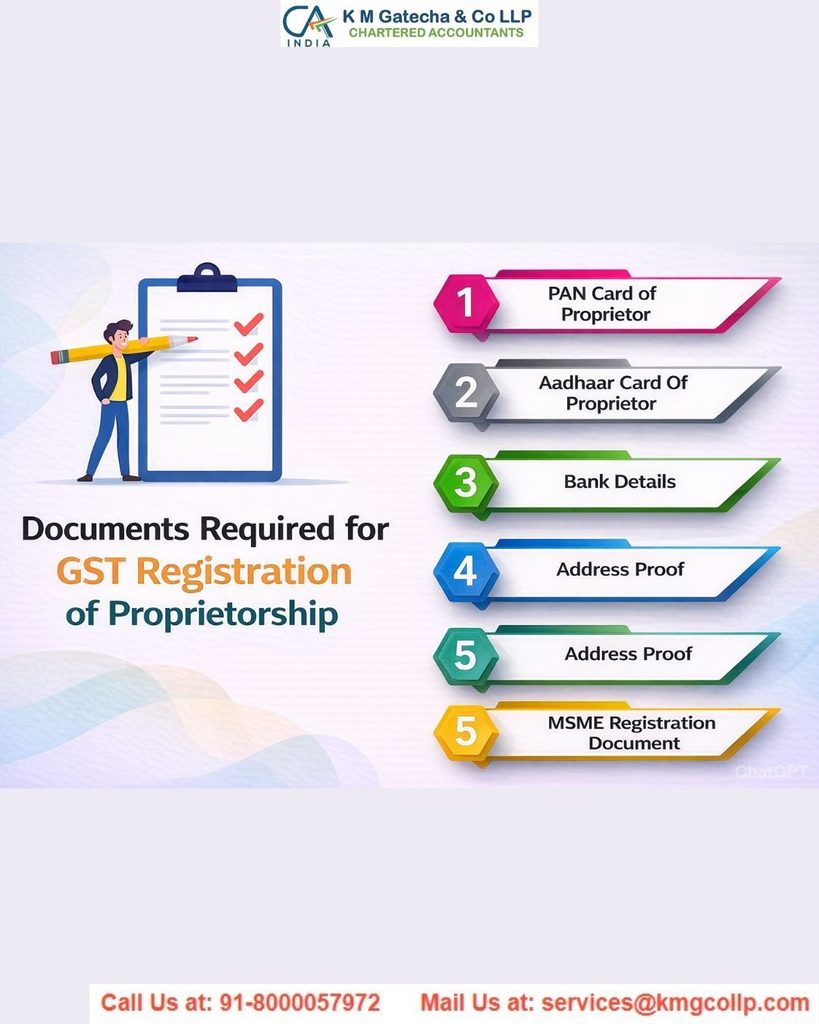
GST Registration Process
The GST registration process involves the following steps:
1. Eligibility Check
Determine whether the business crosses the prescribed turnover threshold or falls under mandatory registration categories.
2. Online Application
Submit the GST registration application through the GST portal with required documents.
3. Verification & Documentation
Upload identity proof, address proof, incorporation certificate, bank details, and DSC (for companies/LLPs).
4. Application Submission
Complete verification through Aadhaar authentication or DSC and submit the application.
5. Verification by Tax Officer
The application is reviewed by the GST officer. Clarifications may be requested if required.
6. Certificate Issuance
Upon approval, the GST Registration Certificate is issued along with the GSTIN.
What is GSTIN?
GSTIN (Goods and Services Tax Identification Number) is a unique 15-digit number allotted to every registered taxpayer. It contains:
- State code
- PAN of the business
- Entity code
- Checksum digit
GSTIN is mandatory for issuing tax invoices, collecting GST, and filing returns.
Goods and Services Tax Identification Number (GSTIN)
Under the Central Goods and Services Tax Act, 2017, every registered taxpayer is allotted a GSTIN (Goods and Services Tax Identification Number) upon successful GST registration.
GSTIN is a 15-digit unique identification number based on the PAN of the business entity and the respective state code.
Structure of GSTIN
- First 2 digits – State code
- Next 10 digits – PAN of the taxpayer
- 13th digit – Entity code (indicates the number of registrations within a state)
- 14th digit – Default alphabet “Z”
- 15th digit – Checksum digit for verification
GSTIN is mandatory for:
- Filing GST returns
- Issuing tax invoices
- Claiming Input Tax Credit (ITC)
- Communication with GST authorities
- Compliance tracking across India
It plays a crucial role in ensuring transparency and streamlining tax administration under the GST regime.
Online vs. Offline GST Registration
Businesses in India can complete GST registration either directly through the GST portal or with professional assistance. Below is a comparison:
Online Registration
- 24/7 Accessibility: Available through the official GST portal (www.gst.gov.in).
- Faster Processing: Forms and documents are submitted electronically.
- Application Tracking: Real-time status updates available online.
- Digital Documentation: No physical paperwork required.
- Electronic Certificate: GSTIN and registration certificate issued digitally upon approval.
Online registration is the standard and officially prescribed mode under GST law.
Offline Assistance (Through Professionals)
While GST registration itself is processed online, businesses may choose to:
- Seek assistance from Chartered Accountants (CAs) or tax professionals.
- Visit professional offices for consultation and documentation support.
- Get help with compliance, return filing, and maintenance.
This option is preferred by businesses seeking expert guidance or those unfamiliar with online filing procedures.
GST Registration Fees
- Government Fee: There is no government fee for GST registration.
- Professional Fee: Service providers or consultants may charge a professional fee for assisting with the registration process.
For example, some service providers may charge ₹590 or more for handling the GST registration application, documentation, and follow-up.
GST Registration Certificate
The GST Registration Certificate is an official document issued by the Government of India after successful registration under the Central Goods and Services Tax Act, 2017.
It serves as legal proof that a business is registered under GST and contains key details such as:
- GSTIN (Goods and Services Tax Identification Number)
- Legal name and trade name of the business
- Constitution of business (Proprietorship, Company, LLP, etc.)
- Address of principal and additional places of business
- Date of registration
- Type of registration
The certificate is issued electronically and can be downloaded from the GST portal.
GST Compliance After Registration
After obtaining GST registration, businesses must comply with ongoing GST requirements, including timely return filing and tax payment.
Key GST Returns Include:
- GSTR-1 – Details of outward supplies (sales)
- GSTR-3B – Monthly summary return of sales, purchases, and tax liability
- GSTR-9 – Annual return
Other compliance requirements may include:
- Issuing GST-compliant invoices
- Maintaining proper books of accounts
- Reconciling Input Tax Credit (ITC)
- Responding to GST notices, if any
Failure to comply may result in penalties, interest, or cancellation of GST registration.
Common GST Registration Issues
Businesses may face several challenges during the GST registration process:
1. Incorrect Information
Errors in PAN, Aadhaar, business details, or address proof often lead to rejection or delays.
2. Incomplete Documentation
Missing or incorrect documents such as bank proof, incorporation certificate, or authorization letter can stall approval.
3. Technical Issues
Portal glitches, server downtime, or OTP authentication failures may disrupt the process.
4. Complex Business Structures
Multiple registrations, branch offices, or inter-state operations may complicate the application.
5. Jurisdiction Confusion
Selecting the incorrect GST jurisdiction can cause processing delays.
6. Delayed Response to Queries
Failure to respond to clarification notices within the prescribed time can lead to rejection.
How to Avoid These Issues
- Verify all details before submission
- Upload clear and valid documents
- Monitor application status regularly
- Respond promptly to notices
- Seek professional guidance where necessary
Conclusion
GST registration is a crucial compliance requirement for eligible businesses in India. From documentation to post-registration compliance, accuracy and timely action are essential.
We offer customized GST registration support tailored to your business needs. Our expert team assists with document preparation, application filing, compliance guidance, and understanding GST applicability under the law—ensuring a smooth and hassle-free registration process.
Disclaimer: The content on this website is for informational purposes only and does not constitute legal, financial, or professional advice. Please consult qualified experts before acting on any information. K M GATECHA & CO LLP accepts no liability for errors, omissions, or outcomes from the use of this content. This site is not an advertisement or solicitation.


