

Audit Requirements for LLP: Understanding LLP Audit Applicability
Limited Liability Partnerships (LLPs) are a preferred business structure for professionals, startups, and small enterprises in India due to their flexible framework and limited liability protection. However, despite their advantages, LLPs must adhere to compliance and audit regulations under the LLP Act, 2008, and the Income Tax Act, 1961.We provide LLP Audit Services.
LLP, or Limited Liability Partnership, is widely adopted in India because it combines the benefits of a partnership with the protection of limited liability. Even though it is a popular and flexible business model, it must still comply with current legal norms and regulatory obligations.For the related LLP compliance position, read our detailed guide on audit applicability importance requirements.
Before understanding the detailed audit requirements, it is important to know the basics.
What Is an LLP Audit?
An LLP audit is similar to other types of audits, as it involves evaluating and verifying the financial records and statements of the LLP to ensure accuracy and adherence to legal standards. This process must be carried out by a certified Chartered Accountant (CA), who examines all financial transactions to confirm that the statements present a true and fair view and that the business operations comply with applicable laws and regulations.
Unlike companies, which are required to undergo an audit mandatorily, an LLP is only subject to an audit when it crosses the specified financial limits as defined under the law.
When Is an LLP Audit Mandatory? (LLP Audit Applicability)
So, when does an LLP need to undergo an audit? Let’s clarify.
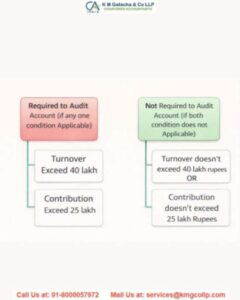
Under the LLP Act, 2008, an audit is required in certain situations. Specifically, Rule 24 of the LLP Rules states that an audit is mandatory if:
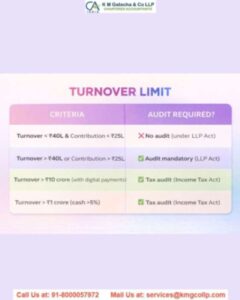
- The LLP’s annual turnover exceeds ₹40 lakh in any financial year, or
- The capital contribution exceeds ₹25 lakh at any time during the financial year.
These conditions make it essential to appoint a qualified Chartered Accountant (CA) to examine and verify the LLP’s accounts.
Important Update (Effective from April 1, 2025)
The regulatory framework for LLP audits was updated in 2025. The thresholds for turnover and capital contribution remain unchanged. However, authorities have increased scrutiny and will closely monitor LLPs that fail to file Form 11 (Annual Return) or Form 8 (Statement of Accounts and Solvency) on time. Non-compliance can trigger stricter audits and penalties.
Income Tax Audit for LLP
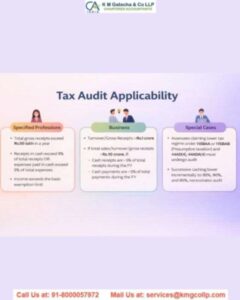
In addition to the audit under the LLP Act, an LLP may also be subject to an Income Tax audit under the Income Tax Act, 1961, if any of the following conditions are met:
- The LLP’s gross turnover exceeds ₹1 crore in a financial year (for businesses).
- The LLP’s gross receipts exceed ₹50 lakh in a financial year (for professionals).
- The LLP opts for a presumptive taxation scheme under Section 44AD or 44ADA and declares profits below the prescribed limit.
This ensures that both statutory compliance and tax obligations are properly addressed.
New Income Tax Compliance Update (2025)
For LLPs, a tax audit is mandatory under the Income Tax Act if:
- For businesses, the turnover reaches or exceeds ₹3 crore, provided that cash payments do not exceed 5% of total turnover.
- For professionals, the gross receipts are ₹75 lakh or more, with cash transactions considered in the calculation.
If the LLP primarily conducts transactions digitally and stays within these limits, a tax audit is not required.
Audit Not Mandatory: Voluntary Audit
If the LLP does not exceed the specified thresholds, an audit is not compulsory. However, the LLP can opt for a voluntary audit if all partners agree. Voluntary audits are often conducted to:
- Enhance credibility and transparency.
- Strengthen internal governance.
- Meet requirements of third parties.
- Facilitate due diligence during mergers and acquisitions.
Forms and Filing Requirements for Audited LLPs
Once the audit is completed, the LLP must comply with filing requirements:
- Form 8 (Statement of Accounts and Solvency)
- Must be filed annually with the Registrar of Companies (RoC).
- Requires signatures of all designated partners and the auditor.
- Form 11 (Annual Return)
- Provides a summary of the LLP’s management structure and partner details.
Timeline for Filing
| Form | Filing Deadline |
| Form 8 | 30th October every year |
| Form 11 | 30th May every year |
Failure to meet these deadlines attracts penalties of ₹100 per day of default, with no upper limit, emphasizing the importance of timely compliance.
Penalty for Non-Compliance
LLPs that fail to meet audit and filing requirements can face significant penalties:
- A fine ranging from ₹25,000 to ₹5 lakh may be imposed under the LLP Act.
- Individual designated partners may also be penalized, with the amount depending on the nature and severity of the default.
- In extreme cases, if Form 8 or Form 11 is not filed for two consecutive years, the RoC can strike off the LLP, effectively terminating its registration.
- Entrepreneurs often overlook filing these forms for multiple years, which can lead to the LLP being removed from official records.
To avoid these consequences, it is crucial to understand LLP audit applicability and strictly adhere to compliance requirements. Maintaining proper filings ensures that the LLP remains active and legally recognized.
Benefits of Conducting an LLP Audit
Performing an audit provides several advantages for an LLP:
- Enhances credibility: Investors, lenders, and vendors are more likely to trust an LLP that complies with legal requirements and maintains transparency in financial reporting.
- Improves internal control: Helps the LLP monitor its financial health effectively.
- Identifies errors early: Detects accounting mistakes before they escalate into bigger problems.
- Supports strategic planning: Assists in preparing for future funding, mergers, or partnerships by providing accurate financial insights.
Conclusion
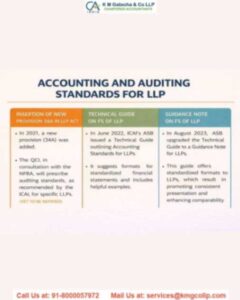
In today’s business environment, transparency, digital compliance, and careful scrutiny of financial records are essential. While not all LLPs are required to undergo an audit, those that meet certain turnover or capital thresholds must appoint a Chartered Accountant to perform the audit. Following the audit and compliance process not only prevents penalties but also strengthens the LLP’s credibility and supports long-term growth.
Disclaimer: The content on this website is for informational purposes only and does not constitute legal, financial, or professional advice. Please consult qualified experts before acting on any information. K M GATECHA & CO LLP accepts no liability for errors, omissions, or outcomes from the use of this content. This site is not an advertisement or solicitation.

