

Taxation of Foreign Source Income
Foreign source income refers to earnings that originate from a country outside India. For residents of India, such income is fully taxable, while for non-residents, it is generally not taxable in India. If the same income is taxed both in India and in the foreign country, a Foreign Tax Credit (FTC) can be claimed to avoid double taxation. This article explains key concepts including the residence rule, source rule, residential status, taxability of income based on residency, and the computation of foreign tax credit.
Rules for Taxation of Income
Globally, taxation of income is generally based on two principles:
- Source Rule
- Residence Rule
Source Rule
- Under the source rule, income is taxed in the country where it is earned, regardless of where the person earning it resides.
- It focuses on the origin of the income, i.e., whether the income arises from resources, operations, or persons in that country.
- The residential status of the individual is not considered.
- Example: If you are an Indian resident and earn income in the United Kingdom (UK), the UK will levy tax on that income based on the source rule.
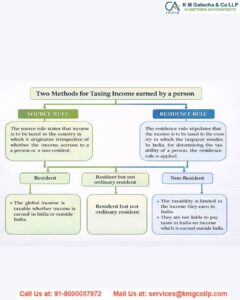
Residence Rule
- According to the residence rule, a country taxes individuals based on their residency, not where the income is earned.
- A tax resident of a country is liable to pay tax on global income, whether earned domestically or abroad.
- India follows the residence rule: if you are an Indian resident, your worldwide income is taxable in India, regardless of where it is generated.
What is Foreign Source Income?
Foreign source income refers to income earned by an individual, such as dividends, interest, royalties, or fees for technical services, from sources located outside India.
For income to qualify as earned outside India:
- The ultimate beneficiary must carry out the activity outside India. For example, you may provide services while in India or abroad, but the services must be utilized by a recipient for activities conducted outside India.
Additionally:
- Even if the income is earned outside India, it should initially be received outside India. You may later remit the income to India without affecting its foreign source status.
- If the income is received directly in India, it will be considered taxable in India.
The taxability of foreign source income also varies based on the residential status of the individual.
Residential Status in India
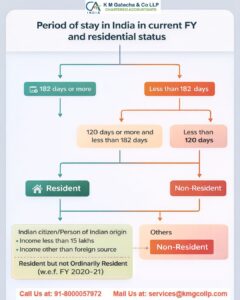
The residential status of an individual in India is determined under Section 6 of the Income Tax Act, 1961.
An individual can fall under one of the following three categories:
- Resident and Ordinarily Resident (ROR)
- Resident but Not Ordinarily Resident (RNOR)
- Non-Resident (NR)
The taxability of income in India depends on the individual’s residential status.

Conditions for Determining Residential Status
Generally, an individual is considered an Ordinarily Resident (ROR) in India if they satisfy any one of the following conditions:
- The individual has stayed in India for 182 days or more during the relevant financial year, or
- The individual has stayed in India for 365 days or more in the preceding four years and 60 days or more in the relevant financial year.
Additional Conditions for Ordinarily Resident Status
To be classified as a Resident and Ordinarily Resident (ROR) in India, an individual must satisfy both of the following additional conditions along with at least one of the basic conditions:
- The individual has been a resident of India for at least 2 years out of the 10 immediately preceding years.
- The individual has stayed in India for 730 days or more during the 7 years immediately preceding the relevant financial year.
If these conditions are met, the individual is considered an ordinary tax resident of India, meaning their global income is fully taxable in India.
There are also other factors that may be considered while determining residential status.
Tax Implications Based on Residential Status
1. Ordinary Residents (ROR):
- Their global income is taxable in India, irrespective of where it is earned.
- Even if the foreign country has already levied tax on the income, it will still be taxable in India (though foreign tax credit may be claimed to avoid double taxation).
2. Resident but Not Ordinarily Resident (RNOR) / Non-Residents (NR):
- Only income that is accrued, arises, or received in India is taxable.
- Income earned in a foreign country by a non-resident, which is not received in India, is generally not taxable in India.
Elimination of Double Taxation and Foreign Tax Credit
You might wonder if foreign source income will be taxed both in India and abroad. The answer is no. To prevent such double taxation, countries have entered into agreements called Double Tax Avoidance Agreements (DTAA), which ensure that a taxpayer does not pay tax on the same income in more than one country.
Foreign Tax Credit (FTC) is available for income that is taxed in a foreign country as well as in India. It is governed by Sections 90 and 91 of the Income Tax Act, 1961. These provisions allow you to claim a credit for taxes paid abroad if the same income is taxable in India under domestic tax laws.
Key Points to Claim Foreign Tax Credit
- Take advantage of DTAAs signed between India and other countries to reduce tax liability.
- Obtain a Tax Residency Certificate (TRC) to claim benefits under the relevant DTAA.
- File Form 67 along with supporting documents to claim the foreign tax credit in India.
By following these steps, you can ensure that your foreign income is not taxed twice and make the most of available tax relief.


