Key Documents Needed for Company Incorporation in India
Company incorporation in India is primarily regulated under the Companies Act, 2013, which outlines the legal structure for establishing, managing, and winding up companies.
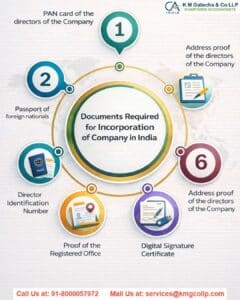
To successfully incorporate a company, one must meet all prescribed statutory and compliance obligations. The process is overseen by the Ministry of Corporate Affairs (MCA) and requires submission of specific documents to confirm the company’s legal identity, ownership, and objectives.
This article presents a clear overview of the crucial documents required for forming a company in India.
I. Director Identification Number (DIN) and Digital Signature Certificate (DSC)
A vital first step in the incorporation process is securing a Director Identification Number (DIN) and a Digital Signature Certificate (DSC) for each director. The DIN, as specified under Section 153 of the Companies Act, 2013, is a unique number assigned to individuals intending to become company directors. To obtain a DIN through Form DIR-3, the following documents must be submitted:
Identity proof (such as Aadhar Card, PAN Card, or Passport for foreign nationals)
Address proof (recent bank statement or utility bill not older than two months)
Passport-sized photographs
The DSC is essential for signing incorporation documents electronically on the MCA portal. It must be procured from authorized Certifying Authorities approved by the Controller of Certifying Authorities (CCA) in India.
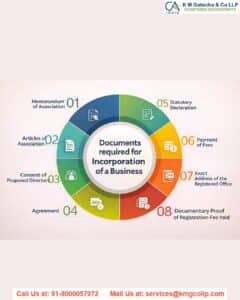
II. Name Reservation via RUN (Reserve Unique Name) Application
Before proceeding with company incorporation, reserving a suitable company name is an essential step. The Ministry of Corporate Affairs (MCA) offers the RUN (Reserve Unique Name) facility to submit applications for name approval.
The selected name must adhere to Rule 8 of the Companies (Incorporation) Rules, 2014, which provides guidelines to ensure the proposed name is not identical or deceptively similar to existing registered entities.
Applicants can file the RUN application through the designated form available on the MCA portal. The form requires:
Two preferred names for the proposed entity
A short summary of the intended business activities to support the name selection
Upon successful approval, the name is held for 20 days for new incorporations. If incorporation is not completed within this time frame, a fresh application must be made. The approved name must be consistently used in all subsequent incorporation documents submitted to the Registrar of Companies (RoC).
III. Memorandum of Association (MoA) and Articles of Association (AoA)
The Memorandum of Association (MoA) and Articles of Association (AoA) are fundamental documents essential for establishing a company in India. These documents define the company’s core purpose, legal structure, and internal functioning.

Memorandum of Association (MoA):
The MoA lays down the company’s main objectives and operational boundaries. It includes six specific clauses: Name, Registered Office, Object, Liability, Capital, and Subscription Clauses.
This document serves as the company’s legal charter and must only state objectives that are clear and lawful. As per Section 4 of the Companies Act, 2013, all initial subscribers must sign the MoA in the presence of a witness.
Articles of Association (AoA):
The AoA specifies the company’s internal management framework, including the responsibilities of directors, governance rules, and shareholder rights.
It must comply with the Companies Act, 2013, and be signed by the company’s subscribers. Both the MoA and AoA are to be submitted electronically using the SPICe+ (Simplified Proforma for Incorporating a Company Electronically Plus) form on the MCA portal.
Properly drafting and submitting these documents is vital, as they represent the foundational structure required for the legal formation and smooth operation of the company.
IV. Declarations by Directors and Promoters (INC-9 and DIR-2)
Among the essential documents for company incorporation in India is a statutory declaration from the proposed directors and promoters, affirming adherence to the legal provisions under the Companies Act, 2013. These declarations are furnished through Forms INC-9 and DIR-2.
Form INC-9:
This declaration is submitted by the initial directors and subscribers to the Memorandum of Association. It certifies that they are not associated with any fraudulent or unlawful activity and confirms the company’s compliance with incorporation norms under the Companies Act, 2013. The form is submitted electronically and must be digitally signed using the applicant’s Digital Signature Certificate (DSC).
Form DIR-2:
This form serves as a consent declaration from individuals agreeing to serve as directors of the new company. It includes their personal details, identity proof, and address proof.
Both INC-9 and DIR-2 are compulsory documents in the incorporation process, verifying that the proposed directors and subscribers are legally qualified for their respective roles.

V. Registered Office Address Proof
A critical requirement during the company incorporation process is the submission of valid proof of the proposed registered office address.
According to Section 12 of the Companies Act, 2013, every company must establish its registered office within 30 days from the date of incorporation. This is the official address for receiving legal notices and government correspondence. Supporting documents must be provided to authenticate this address.
Documents accepted as proof include:
Ownership Document: If the property is owned, submission of the property deed or sale agreement is necessary.
No Objection Certificate (NOC): For rented premises, an NOC from the property owner must be provided, along with a valid rental agreement.
Utility Bill: A recent utility bill (such as electricity, water, or property tax) dated within the last two months must be submitted as occupancy proof.
This address, once verified, becomes the company’s official communication location with the Registrar of Companies (RoC) and other statutory bodies.
VI. PAN and TAN Applications
As part of the mandatory documentation for incorporating a company in India, obtaining a Permanent Account Number (PAN) and a Tax Deduction and Collection Account Number (TAN) is essential.
PAN:
The Permanent Account Number is issued by the Income Tax Department and is required for all tax-related transactions of the company. Upon successful incorporation, the PAN is automatically allotted through the SPICe+ application submitted via the Ministry of Corporate Affairs (MCA) portal. The physical PAN card is issued afterward. PAN details must be used in all financial and taxation matters. Non-compliance with PAN requirements can attract penalties.
TAN:
The Tax Deduction and Collection Account Number is necessary for companies that are obligated to deduct tax at source (TDS) for payments such as salaries, contracts, or professional fees. Like PAN, TAN is also applied for through the SPICe+ form at the time of incorporation. Companies engaging in transactions that involve TDS must have a valid TAN.
Both PAN and TAN are critical tax identifiers and are required for a company to function within the bounds of Indian tax law. Their proper application is a vital step in the overall incorporation process.
VII. SPICe+ (Simplified Proforma for Incorporating a Company Electronically Plus) Form
The SPICe+ form, launched by the Ministry of Corporate Affairs, is an integrated e-form that streamlines the company incorporation process by offering multiple services through a single interface. It is a central component among the documents required for company formation in India.
This all-in-one application facilitates:
Company incorporation
Allotment of Director Identification Number (DIN)
Issuance of PAN and TAN
Optional Goods and Services Tax (GST) registration
ESIC and EPFO registration
Opening of the company’s bank account
The SPICe+ form is divided into two parts:
Part A is used for reserving the company name,
Part B covers the remaining incorporation-related services, including registrations and document submissions.
All necessary documents, such as the MoA, AoA, address proof, and identity proofs of the directors, must be uploaded as part of this submission. Once the SPICe+ form is verified and approved, the Registrar of Companies (RoC) issues the Certificate of Incorporation (CoI), which marks the legal formation of the company.
The SPICe+ form simplifies the entire incorporation procedure, reducing manual work and ensuring compliance with statutory requirements through a consolidated filing process.
VIII. Certificate of Incorporation (CoI)
After all the required documents for company formation in India are duly submitted, reviewed, and approved, the Registrar of Companies (RoC) issues the Certificate of Incorporation (CoI).
This certificate marks the final stage of the incorporation process and legally establishes the existence of the company.
The Certificate of Incorporation includes key information such as:
The Corporate Identity Number (CIN)
Date of incorporation
Company name
Registered office address
Digital signature of the Registrar of Companies
The CoI stands as official confirmation that the company has been registered in accordance with the Companies Act, 2013. It grants the company legal status and the authority to begin operations, exercise corporate rights, and conduct business activities.
Maintaining the CoI is crucial, as it forms a permanent part of the company’s statutory records. Any inaccuracies or false declarations during the incorporation process can lead to penalties or cancellation of the certificate by the relevant authorities.
With the CoI issued, the company is now recognized as a separate legal entity, authorized to engage in commercial activities and enter into binding agreements under Indian law. We can help with company incorporation services!
Conclusion
To sum up, forming a company in India involves a structured and regulated procedure governed by the Companies Act, 2013. Each document required during this process plays a vital role in establishing the company’s legal foundation, ensuring operational integrity and regulatory compliance.
Any failure to comply or submit accurate documents may lead to legal consequences. Therefore, following the incorporation process diligently and lawfully is essential for establishing a successful and compliant business entity in India.
Disclaimer: The content on this website is for informational purposes only and does not constitute legal, financial, or professional advice. Please consult qualified experts before acting on any information. K M GATECHA & CO LLP accepts no liability for errors, omissions, or outcomes from the use of this content. This site is not an advertisement or solicitation.