Understanding TDS on Consultancy Charges
When someone pays a consultant or professional for providing services, a portion of the payment may be deducted as Tax Deducted at Source (TDS). This deduction is made under Section 194J of the Income Tax Act, 1961.
In simple terms, the person making the payment deducts a certain percentage as tax before paying the consultant and deposits it with the government.
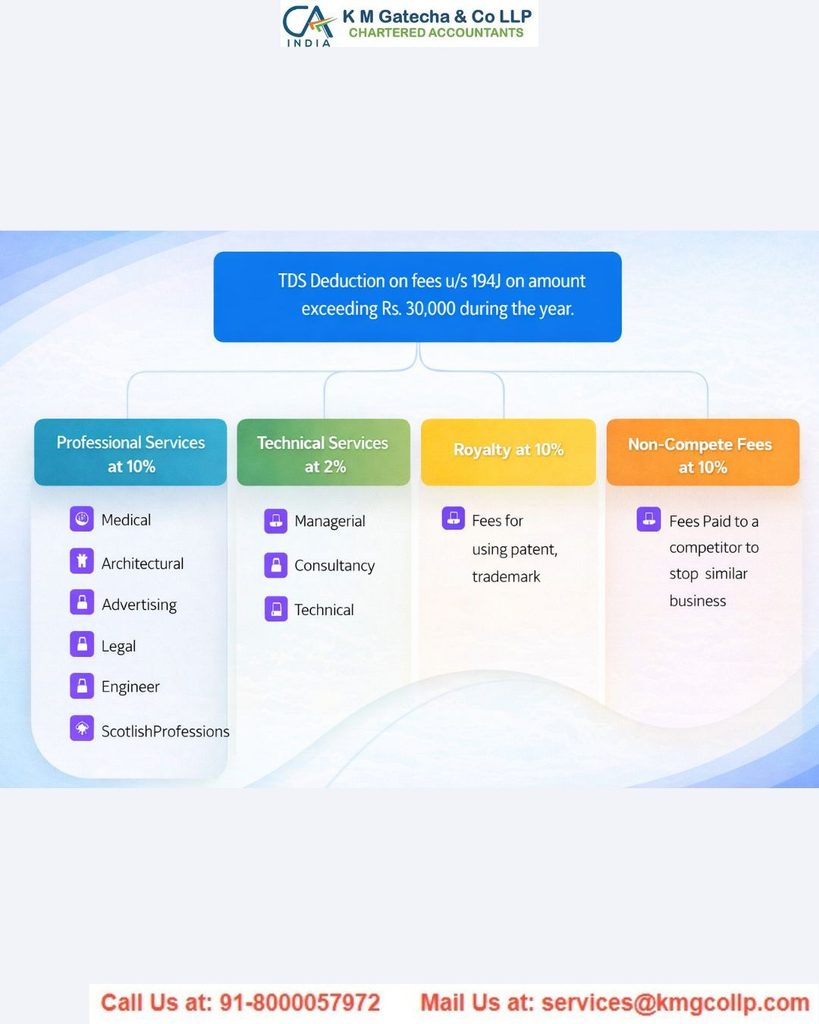
Applicability of TDS on Consultancy Charges under Section 194J
Under Section 194J of the Income Tax Act, TDS must be deducted when certain payments are made to a resident person for professional or technical services.
In general, any person (other than an individual or HUF not covered under tax audit provisions) making such payments is required to deduct TDS at the prescribed rate.
TDS under Section 194J applies to the following types of payments:
- Fees for professional services (such as services provided by doctors, lawyers, consultants, engineers, architects, etc.)
- Fees for technical services
- Royalty payments
- Payments made under Section 28(va) for agreements not to share technical knowledge, patents, copyrights, licences, franchises, or similar rights with others
- Fees, commission, or remuneration paid to a company director
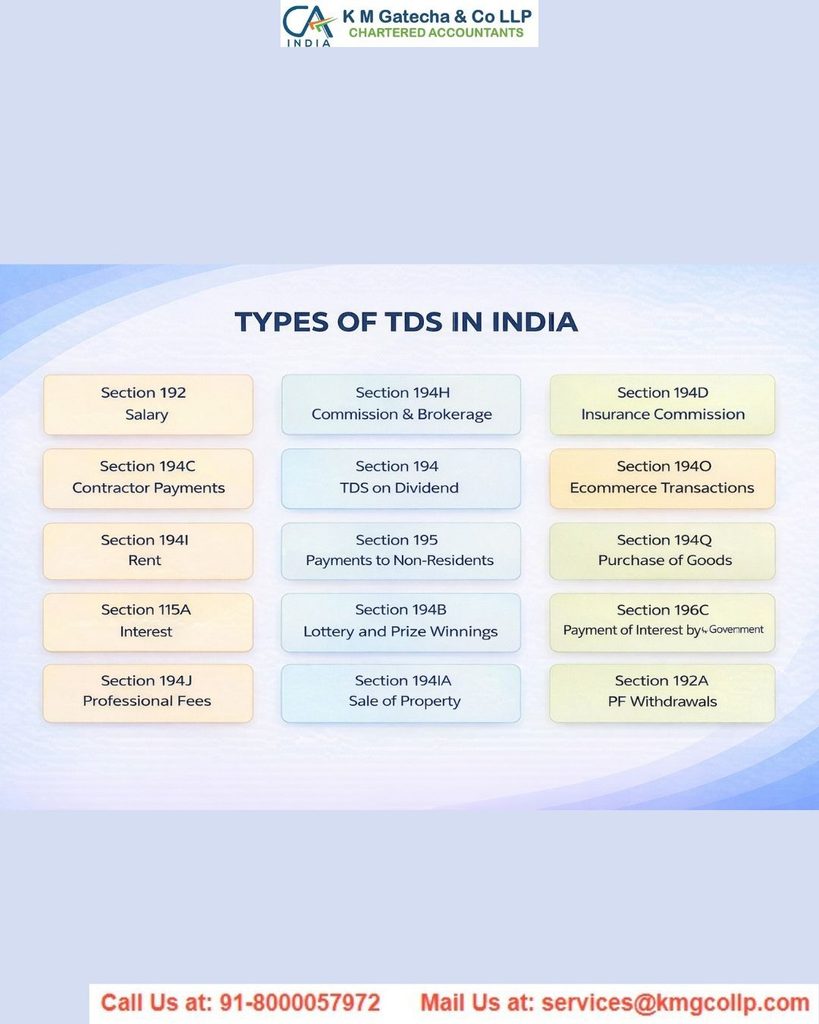
Important: These payments are subject to TDS under Section 194J only if they are not treated as salary. If the payment is considered salary and TDS is required under Section 192, then Section 194J will not apply.
What Are “Professional Services” Under Section 194J?
For the purpose of TDS under Section 194J of the Income Tax Act, 1961, “professional services” include services provided by qualified professionals in specific fields. These include:
- Legal services
- Medical services
- Engineering services
- Architectural consultancy
- Accountancy services
- Technical consultancy
- Interior decoration
- Advertising services
- Any other service notified by the government
If payment is made for any of the above services, TDS may be applicable under Section 194J.
TDS Rate on Consultancy Charges Under Section 194J
The TDS rates for payments covered under Section 194J are as follows:
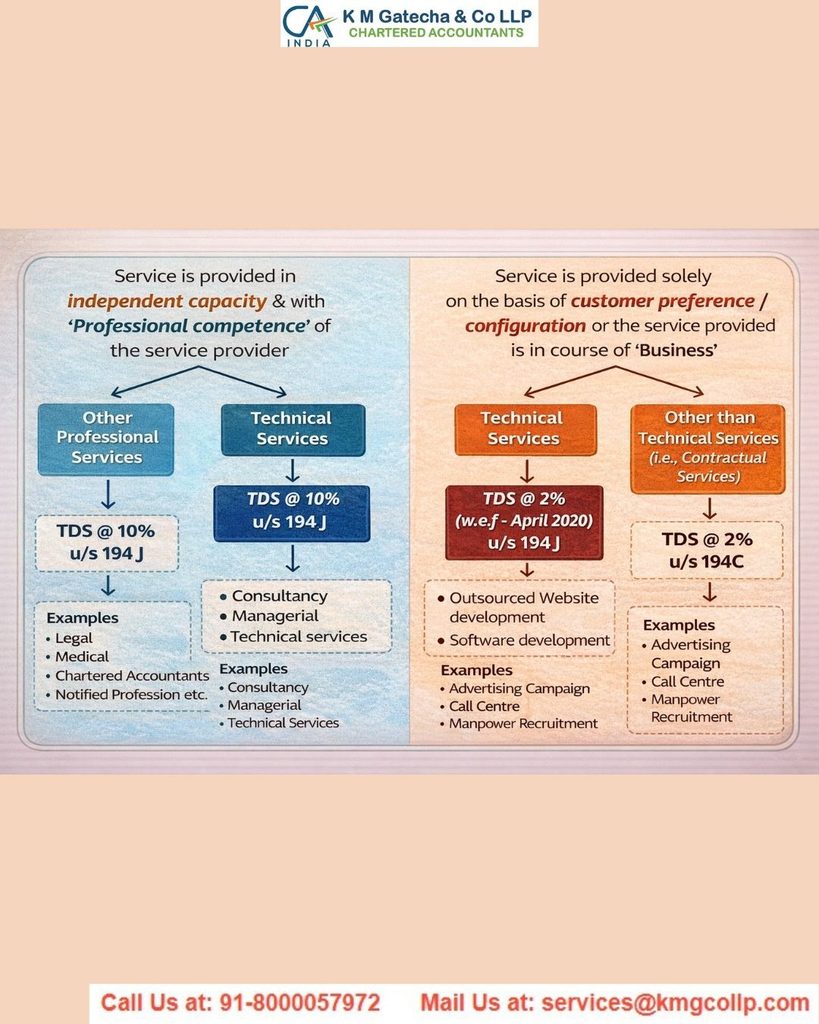
- 10% on fees for professional or technical services.
- 2% in case of payments related to call centre business operations.
- 2% on royalty paid for the sale, distribution, or exhibition of films.
No surcharge or Health and Education Cess (HEC) is added to the above TDS rates.
When Should TDS Be Deducted on Consultancy Charges?
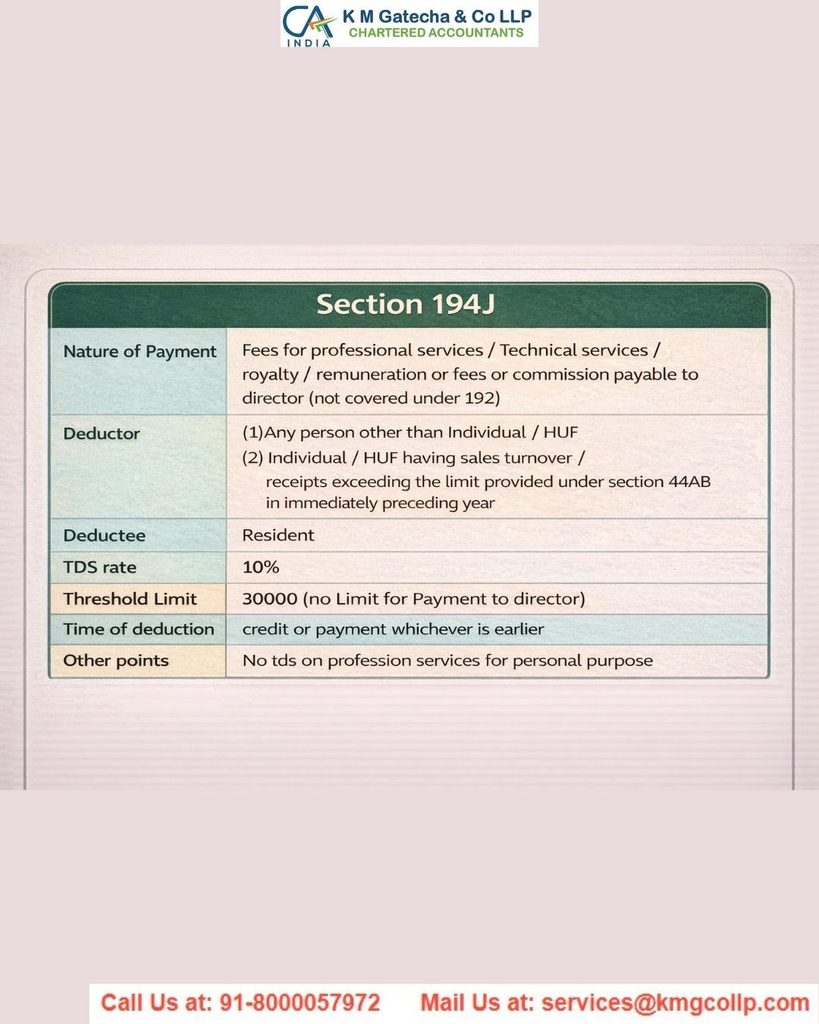
Under Section 194J of the Income Tax Act, 1961, TDS on consultancy charges must be deducted at the earlier of the following two events:
- When the amount is credited to the consultant’s account in the books of the payer, or
- When the payment is actually made to the consultant (whether in cash, cheque, draft, or any other mode).
In simple terms, TDS must be deducted either at the time of booking the expense or at the time of making the payment — whichever happens first.
Deemed Credit – Special Rule
Sometimes, instead of crediting the amount directly to the consultant’s account, the payer may transfer it to a “Suspense Account” or any other temporary account in their books.
In such cases, the law treats this as if the amount has been credited to the consultant’s account. Therefore, TDS must still be deducted at that stage, even if the consultant has not actually received the payment yet.
Threshold Limit for TDS on Consultancy Charges (Section 194J)
TDS under Section 194J is deducted only if the total payment made during the financial year exceeds a certain limit.
The threshold limit is ₹30,000 for each of the following:
- Professional services
- Technical services
- Royalty payments
- Payments covered under Section 28(va)
This means if the total amount paid to a person for any of the above services during the year exceeds ₹30,000, TDS must be deducted.
Once the payment crosses this limit, TDS will be deducted at the applicable rate of 2% or 10%, depending on the type of service, as specified under Section 194J.
Exemptions from TDS on Consultancy Charges (Section 194J)
In some cases, TDS under Section 194J does not apply. Here are the main exemptions explained in simple words:
1. Individuals and HUFs
Section 194J generally does not apply to individuals and Hindu Undivided Families (HUFs).
However, it will apply if their total turnover in the previous financial year exceeded:
- ₹1 crore in case of business, or
- ₹50 lakh in case of profession.
So, if an individual or HUF crosses these limits in the previous year, they must deduct TDS on consultancy payments in the current year.
2. Payments for Personal Use
If an individual or HUF makes a payment for professional or technical services purely for personal purposes (not related to business or profession), then TDS is not required.
3. Old Payments
If any payment was credited or paid before 1 July 1995, TDS under this section does not apply.
4. Amount Does Not Exceed ₹30,000
No TDS is required if the total amount paid or credited during the financial year does not exceed ₹30,000 for:
- Professional services
- Technical services
- Royalty
- Non-compete fees under Section 28(va)
If the total payment crosses ₹30,000, then TDS must be deducted at the applicable rate.
Clarifications by CBDT on TDS Under Section 194J
The Central Board of Direct Taxes (CBDT) has issued some important clarifications about TDS on consultancy and professional fees:
1. TDS on Invoice Value and GST
- TDS should be deducted on the total invoice amount.
- However, if GST is shown separately in the invoice, then TDS is deducted only on the amount excluding GST.
- If GST is not shown separately, then TDS must be deducted on the entire invoice amount, including GST.
2. Commission for Procuring Orders
If a person provides services to procure orders and those services include technical or professional work, then the payment may be treated as professional/technical fees and will be subject to TDS under Section 194J.
3. Payments by Insurance Companies to Hospitals
When a third-party administrator (TPA) makes payment to a hospital on behalf of an insurance company for medical claims, such payments are subject to TDS under Section 194J.
4. Payments Made by Non-Residents
If a non-resident pays professional fees (such as fees to a CA, advocate, solicitor, or lawyer) through normal banking channels, TDS under Section 194J is not applicable, provided the non-resident does not have:
- A Permanent Establishment (PE) in India,
- A Business Connection in India, or
- An Agent in India.
5. Technical Services Under Maintenance Contracts
If technical services are provided as part of a maintenance contract, then the payment for such services will be subject to TDS under Section 194J.
Landmark Judgements on Section 194J of the Income Tax Act, 1961
In Gujarat Sickle Cell Anemia Control Society v. Deputy Commissioner of Income-tax (2022), the assessee conducted laboratory tests such as DTT and HPLC. The Income Tax Appellate Tribunal (ITAT) held that these activities qualify as professional services. Therefore, payments made for such services are liable for TDS under Section 194J.
In Commissioner of Income-tax v. Mewar Hospital (P.) Ltd. (2022), the Rajasthan High Court ruled that when a hospital engages doctors on a retainership basis, the payments made to them for their professional services are subject to TDS under Section 194J.
Illustrations
Illustration 1
XYZ Ltd. availed legal services from ABC Advocates and Solicitors for ₹50,000. What will be the rate of TDS, and how much TDS should be deducted?
Solution:
Legal services are treated as professional services under Section 194J. Since the payment of ₹50,000 exceeds the threshold limit of ₹30,000, TDS will be applicable.
Therefore, TDS will be deducted at 10%, and the amount of TDS will be ₹5,000.
Illustration 2
Mr. X availed medical services from Fortis Hospital for ₹20,000. At what rate will TDS be deducted?
Solution:
Medical services fall under professional services as per Section 194J. However, the threshold limit for deduction of TDS is ₹30,000. Since the payment of ₹20,000 does not exceed this limit, no TDS will be deducted under Section 194J.
For the complete text of Section 194J, you may refer to the relevant provisions of the Income Tax Act.
Conclusion
To sum up, TDS on consultancy charges must be deducted under Section 194J of the Income Tax Act, 1961 when payments are made to residents for professional or technical services. The applicable TDS rate is 2% or 10%, depending on the nature of the service provided.
Disclaimer: The content on this website is for informational purposes only and does not constitute legal, financial, or professional advice. Please consult qualified experts before acting on any information. K M GATECHA & CO LLP accepts no liability for errors, omissions, or outcomes from the use of this content. This site is not an advertisement or solicitation.