India’s corrugated box industry plays a key role in packaging for sectors like e-commerce, pharma, FMCG, and electronics. Over 20,000 MSMEs operate in this segment, and GST on corrugated boxes directly affects their working capital and overall profitability.
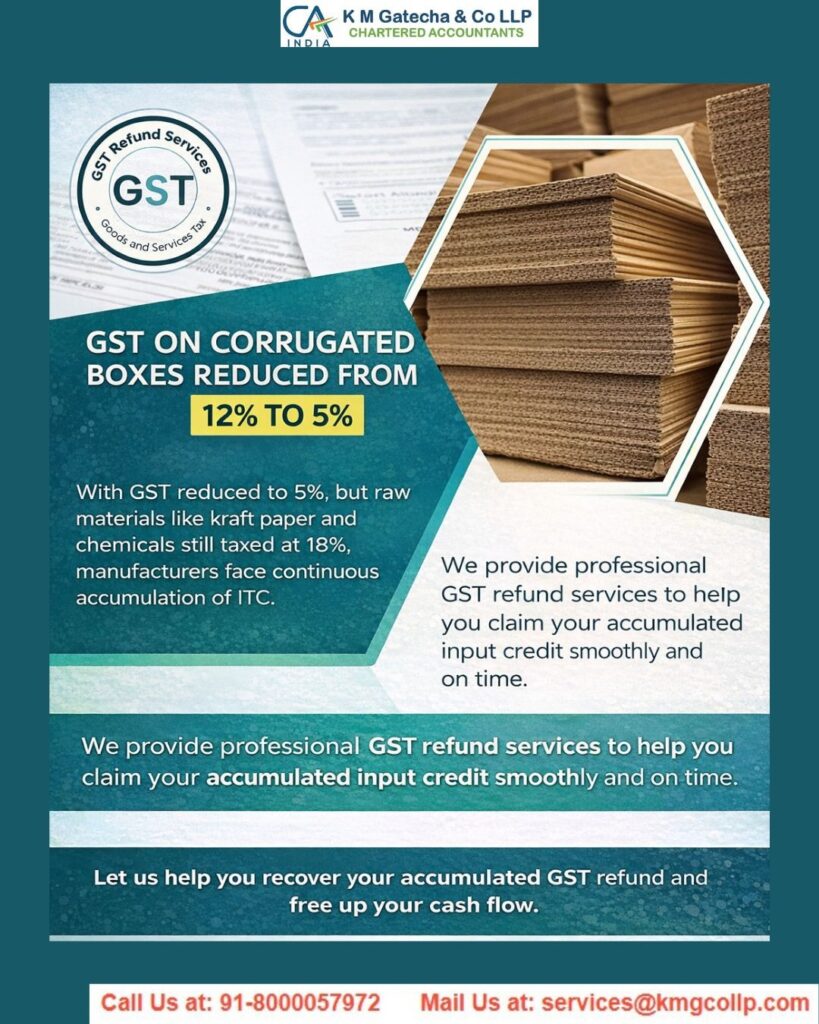
Despite strong growth, many manufacturers face working capital issues due to the Inverted Duty Structure (IDS) under GST. Raw materials such as kraft paper and adhesives attract 18% GST, while the final product—corrugated boxes—is taxed at only 5%. This mismatch leads to accumulation of unused Input Tax Credit (ITC), which blocks funds and negatively impacts business cash flow.
If you are a corrugated box manufacturer in India, this guide will help you understand:
- Why a GST refund is important for your business
- GST rates and HSN codes for corrugated boxes
- When you can claim a GST refund
- Step-by-step process to apply for a refund
- Common mistakes you should avoid
- Ways to get faster refund approval

Why is GST Refund Important for Corrugated Box Manufacturers?
GST refund is very important for corrugated box manufacturers because it helps them manage their money better and keep their business running smoothly.
In this industry, there is a difference in GST rates. Finished corrugated boxes are taxed at 5%, while raw materials like kraft paper, adhesives, and corrugated rolls are taxed at 18%. Because of this, businesses keep getting extra Input Tax Credit (ITC) that they cannot fully use.
This unused ITC blocks their money, which affects cash flow. As a result, they may face problems in buying raw materials or managing daily expenses.
Industry groups like the Eastern India Corrugated Box Manufacturers Association have also said that this issue is creating financial pressure on many small businesses. That’s why claiming GST refunds on time is very important.
Types of GST Refund Available
Under Section 54 of the CGST Act, a registered taxpayer can claim a GST refund in the following situations:
- Refund of accumulated ITC (Inverted Duty Structure) – When input tax is higher than output tax
- Refund on zero-rated supplies (Exports) – For goods or services exported outside India
- Refund of excess balance in electronic cash ledger – When extra tax has been paid
- Refund of wrong tax payment – When CGST/SGST is paid instead of IGST or vice versa
GST on Corrugated Boxes in India – Current Rates (2026)
Here are the latest GST rates for corrugated box products and related materials:
| Product | HSN Code | GST Rate |
| Corrugated Box (Finished) | 48191010 | 5% |
| Printed Corrugated Box | 48191010 | 5% |
| Non-Corrugated Carton | 48192010 | 18% |
| Corrugated Sheets / Board | 48081000 | 18% |
| Kraft Paper / Duplex Paper | 48041900 | 18% |
| Corrugated Roll (2 Ply) | 48081000 | 18% |
| Adhesives / Starch | 3505 / 3506 | 18% |
There is a clear difference in tax rates—most raw materials are taxed at 18%, while finished corrugated boxes are taxed at only 5%. This gap creates an opportunity for manufacturers to claim a refund under the Inverted Duty Structure (IDS).
Update (GST 2.0 – Effective from 22 September 2026):
Corrugated boxes under HSN 48191010 continue to be taxed at 5% (2.5% CGST + 2.5% SGST). However, only specific HSN codes like 481910 and 481920 fall under this lower rate. Other related corrugated product categories still attract 18% GST.
When is GST Refund Applicable?
For corrugated box manufacturers, GST refund can usually be claimed in the following situations:
1. Inverted Duty Structure (IDS)
This happens when the tax paid on raw materials is higher than the tax on the final product.
In this industry, inputs like kraft paper, duplex board, adhesives, and inks are taxed at 18%, while finished corrugated boxes are taxed at only 5%. Because of this, extra Input Tax Credit (ITC) keeps building up.
You can claim a refund for this unused ITC.
Eligible inputs include:
- Kraft paper and duplex board
- Adhesives and starch
- Corrugated rolls and sheets
- Inks and packaging materials
Important: ITC on machinery (capital goods) and services is not allowed for IDS refund.
This refund can be claimed under Section 54 of the CGST Act and Rule 89(5).
2. Export of Corrugated Boxes
Exports are treated as zero-rated supply under GST, which means you can claim a refund.
There are two ways to export:
- With payment of tax: You can claim a refund of IGST paid through the shipping bill
- Without payment of tax (under LUT): You can claim a refund of accumulated ITC
For exporters, up to 90% of the refund is processed within 7 working days, subject to proper documents and compliance.
Documentation Required
Before applying for a GST refund, make sure you have the following documents ready:
- Match your GSTR-1 and GSTR-3B returns properly
- Check your ITC details with GSTR-2A and GSTR-2B
- Keep HSN-wise details of your purchases and sales
- For exports, keep export invoices and shipping bills
- LUT copy (if exporting without paying tax)
- Maintain a purchase register with proper classification:
- Input goods
- Input services
- Capital goods
- CA certificate is required if the refund amount is more than ₹2 lakhs
- Make sure your bank account is verified on the GST portal
Important:
If there is any mismatch in GSTR-1, GSTR-3B, or shipping bill details, your application may get a deficiency memo (RFD-03) and the refund process can be delayed.
Time Limit for Filing Refund
You must apply for a GST refund within 2 years from the relevant date, such as:
- Due date of filing GSTR-3B, or
- Date of export mentioned in the shipping bill
(The exact date depends on the type of refund.)
Common Reasons for Refund Delay or Rejection
Most refund issues happen due to mistakes in data or calculation, not because you are ineligible.
- Missing the time limit: Filing after 2 years will lead to rejection
- ITC mismatch: ITC in GSTR-3B should match with GSTR-2B
- GSTR mismatch: Differences between GSTR-1 and GSTR-3B can delay the refund
- HSN code errors: Wrong or mismatched HSN codes may create issues
- Wrong ITC claimed: Including ITC on capital goods, services, or blocked credits can lead to rejection
- Errors in export details: Mismatch in shipping bill, invoice value, or LUT can cause delays
- Wrong calculation: Incorrect refund calculation as per rules can put your claim on hold
For corrugated box manufacturers, checking these points carefully can help avoid delays and ensure faster refunds.
Your Complete GST Refund Partner
Why Corrugated Box Manufacturers Should Avoid Filing Refunds on Their Own
Why filing on your own can be risky:
- High scrutiny: Refund claims in this industry are checked carefully. Even small calculation mistakes can create problems
- High ITC buildup: Raw materials like kraft paper, adhesives, and rolls are taxed at 18%, which leads to large unused ITC
- Risk of deficiency memo (RFD-03): Errors like wrong HSN codes, return mismatch, or wrong ITC can result in rejection notices
- Cash flow issues: When your ITC is stuck, it affects payments to suppliers, salaries, and business growth
Why Choose a Professional for GST Refund?
- Find all eligible refunds: Proper checking of GST returns and records to ensure you don’t miss any refund
- Accurate calculation: Correct refund calculation as per GST rules to avoid errors
- Complete filing support: Handling the full process, including forms, submission, and follow-ups
- Proper documentation: Preparing all required documents correctly for smooth approval
- Handling notices: Managing department queries to avoid delays
Refund of Stuck Balance in Electronic Credit Ledger
In this industry, businesses invest heavily in machines like corrugating machines, printing machines, and other equipment. They also use many services to run operations.
However, ITC on these capital goods and services is usually not allowed under the inverted duty structure, which leads to a large amount getting stuck in the Electronic Credit Ledger.
With proper planning, this ITC can be better managed.
- Analyze your ITC position
- Plan proper use and adjustment of credits
- Structure transactions for better tax efficiency
- Ensure correct classification while filing refund
This helps in improving ITC usage, maintaining compliance, and getting faster refunds.
How to Claim GST Refund for Corrugated Box Manufacturers – Simple Process
Step 1: Initial Review
Before applying for a refund, it is important to check your GST records properly.
- Review GST returns to find any errors
- Identify ineligible ITC
- Match ITC with GSTR-2B
- Find all possible refund opportunities
This step ensures your data is correct before filing the refund.
Step 2: Claim Preparation
After filing GSTR-3B, the refund process starts. This step includes:
- Preparing purchase and sales records in the required format
- Classifying purchases into:
- Input goods
- Input services
- Capital goods
- Using correct HSN codes for all purchases and sales
- Matching GST data in books with GST returns
- Reconciling purchase data with GSTR-2B
- Calculating refund amount as per rules
- Double-checking calculations to avoid mistakes
- Preparing required statements, declarations, and certificates
Step 3: Filing & Follow-up
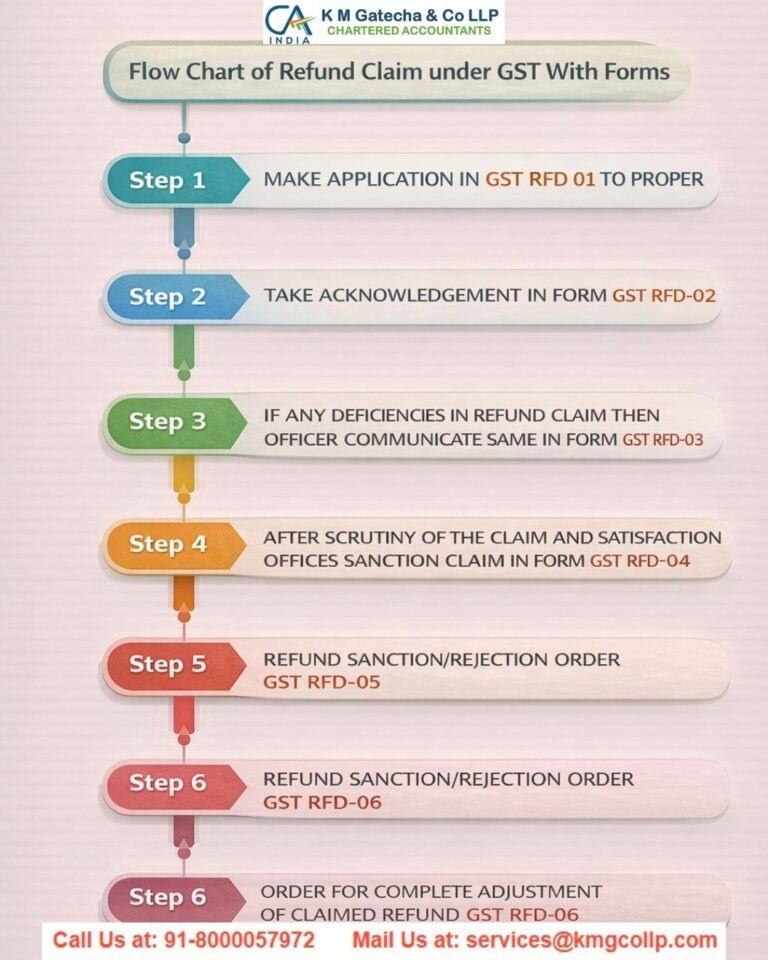
- File refund application (RFD-01) on the GST portal with all documents
- Respond quickly to any questions from the department
- Regularly follow up to avoid delays
Step 4: Refund Credit
- Track the refund status until the money is credited to your bank account
- If a deficiency memo (RFD-03) is received, respond properly to avoid further delays
Following these steps carefully helps in faster and smoother GST refund processing.
Disclaimer: The content on this website is for informational purposes only and does not constitute legal, financial, or professional advice. Please consult qualified experts before acting on any information. K M GATECHA & CO LLP accepts no liability for errors, omissions, or outcomes from the use of this content. This site is not an advertisement or solicitation.