

Crypto Taxation & ITR Reporting Guide for India
Cryptocurrencies, NFTs, and similar digital assets are now classified as Virtual Digital Assets (VDAs) under Section 2(47A) of the Income Tax Act, 1961. From 1st April 2022 (AY 2023-24 onwards), special taxation rules apply to profits earned from these assets.
1. Tax on Profits from Virtual Digital Assets (VDAs)
Tax Rate
- Income from transfer of VDAs is taxed at a flat 30% under Section 115BBH.
- Health & Education Cess: 4% on tax amount.
- Surcharge: Applicable as per total income (if applicable).
- No slab benefits: The rate applies irrespective of your total income.
Example:
- Purchase Bitcoin at ₹3,00,000
- Sell Bitcoin at ₹4,50,000
- Profit = ₹1,50,000
- Tax = 30% of ₹1,50,000 = ₹45,000
- Cess @ 4% = ₹1,800
- Total Tax = ₹46,800
If sold at a loss, say ₹2,50,000 (loss of ₹50,000), the loss cannot be set off against other income or carried forward.

2. Deductions & Allowances
Allowed Deduction
- Cost of acquisition (purchase price) of the crypto/virtual asset only.
Not Allowed
- No deduction for:
- Transaction fees, mining costs, electricity charges, consultancy fees
- Cost of improvement of the asset
- Any exemptions or deductions under capital gains provisions (like 54F, 54EC)
- Loss rules:
- Loss from one crypto cannot be set off against another crypto.
- Loss cannot be set off against salary, business income, or other capital gains.
- No carry-forward of crypto losses to future years.
3. Applicability
The rules apply to all VDAs, which include:
- Cryptocurrencies (Bitcoin, Ethereum, etc.)
- NFTs (Non-Fungible Tokens)
- Other digital tokens recognized as VDAs by the Income Tax Department
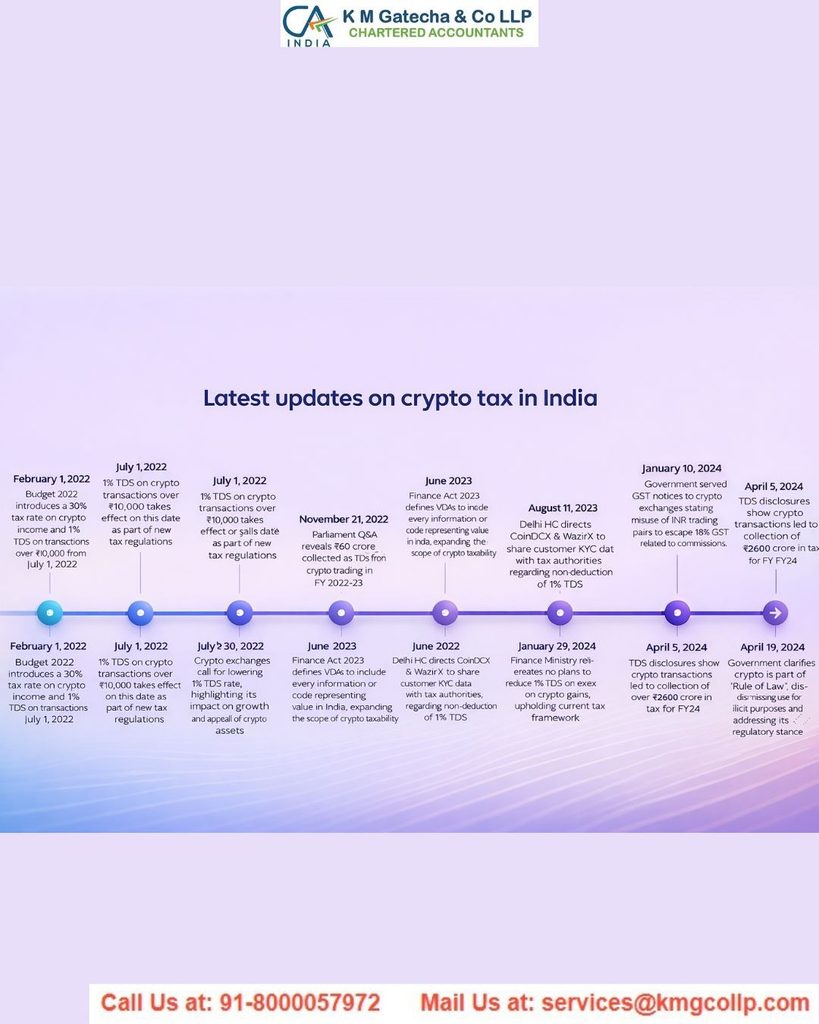
4. Reporting in Income Tax Return (ITR)
Where to Report
- Profits/losses from crypto/VDAs must be reported under “Income from Other Sources” in the ITR.
- Maintain proper records of:
- Date of acquisition
- Date of transfer
- Purchase price
- Sale price
- Profit or loss
TDS on Crypto Transactions
- TDS is not applicable directly on crypto transactions as of now.
- Tax liability arises at the time of computation of profits on transfer.
5. Key Points to Remember
- Flat 30% tax rate applies regardless of income level.
- Only cost of acquisition is deductible; all other expenses are non-deductible.
- Crypto losses cannot reduce your taxable income.
- Keep complete transaction records for accurate ITR reporting.
- Failing to report crypto income can lead to penalties and interest under Income Tax laws.
This taxation framework is strict but simple to apply: compute your profit (or loss), apply the 30% rate, add 4% cess, and report in your ITR under “Income from Other Sources.”

Crypto Taxation & ITR Reporting in India – Updated Guide
Cryptocurrencies, NFTs, and similar assets are classified as Virtual Digital Assets (VDAs) under Section 2(47A) of the Income Tax Act, 1961. Special taxation rules for VDAs apply from 1st April 2022 (AY 2023-24 onwards).
1. Tax on Gains from VDAs
- Flat Tax Rate: 30% on profits from transfer of VDAs
- Cess & Surcharge: 4% Health & Education Cess + applicable surcharge
- No Slab Benefit: The rate is independent of total income
Key Rules:
- Only cost of acquisition is deductible.
- No deduction for transaction fees, mining, electricity, consultancy, or reinvestment.
- Crypto losses cannot be:
- Set off against other income (salary, business, capital gains, etc.)
- Carried forward to future years
Example:
- Buy Bitcoin @ ₹1,00,000
- Sell Bitcoin @ ₹1,50,000
- Profit = ₹50,000
- Tax = 30% of ₹50,000 = ₹15,000 (plus cess & surcharge)
Note: Losses are ignored even for occasional investors.
2. Mandatory ITR Reporting
- Gains from VDAs must be reported in Schedule VDA of ITR.
- Applies to both individuals and businesses.
- Gains cannot be clubbed with normal income slabs.
3. TDS on Crypto Transactions (Section 194S)
- 1% TDS on transfer of VDAs if the aggregate transaction value exceeds ₹10,000 in a year.
- For specified persons (individuals with income < ₹50 lakh and no business income), threshold is ₹50,000.
- TDS applies on payment made in:
- Cash
- Kind
- Crypto-to-crypto trades
- Crypto exchanges usually deduct TDS on behalf of traders.
4. Crypto Received as Gift (Section 56(2)(x))
- If you receive crypto as a gift, it is taxable under Income from Other Sources at market value.
- Exemptions apply for gifts from relatives, on marriage, or other specified exemptions.
5. GST Implications for Businesses/Exchanges
- Crypto exchanges must charge 18% GST on transaction fees or commissions.
- GST is not levied on the transfer of crypto itself for investors.
- Only the services provided by the exchange are subject to GST.
6. Summary – Key Takeaways
| Topic | Key Rule |
| Tax Rate | 30% flat on VDA gains + 4% cess + surcharge |
| Deductions | Only cost of acquisition |
| Losses | Cannot be set off or carried forward |
| ITR Reporting | Mandatory in Schedule VDA |
| TDS | 1% if transaction > ₹10k/₹50k for specified persons |
| Gift of Crypto | Taxable under Income from Other Sources |
| GST | 18% on exchange fees; crypto transfer itself not taxed |
This framework ensures all crypto transactions are fully compliant with Indian taxation laws, including capital gains, TDS, gifts, and GST obligations.
Crypto Income Reporting in ITR – India
Cryptocurrencies, NFTs, and similar assets (Virtual Digital Assets – VDAs) are taxed under Section 115BBH. Proper reporting in Income Tax Returns (ITR) is mandatory to comply with Indian tax laws.
1. Reporting for Individuals / Investors
- ITR Form: ITR-2 or ITR-3
- Schedule: Report crypto gains/losses under Schedule VDA
- Tax Rate: 30% flat on profits (plus 4% health & education cess and surcharge)
- Note: Profits are not merged with normal slab income
Details required for reporting each crypto transaction:
- Date of acquisition
- Date of transfer/sale
- Cost of acquisition (COA)
- Sale consideration
- Profit/Income calculated
2. Reporting for Traders / Business Income
- If crypto trading is frequent and considered a business activity, it should be reported under:
- ITR-3 (Income from Business & Profession – PGBP)
- Taxation: Still taxed at 30% under Section 115BBH, separate from normal business income slabs
3. Line-wise Transaction Reporting (Correct Method)
Many taxpayers report cumulative gains/losses, which can understate taxable gain.
Correct method: Each transaction must be reported line by line to calculate accurate profit/loss.
Example:
| Crypto | Date of Purchase | Date of Sale | Sale Consideration | COA | Gain/Loss |
| Crypto A | 22-01-2025 | 21-03-2025 | ₹11,000 | ₹10,000 | ₹1,000 |
| Crypto A | 23-12-2024 | 23-01-2024 | ₹8,550 | ₹9,000 | -₹450 |
| Crypto B | 23-12-2024 | 23-12-2024 | ₹105,000 | ₹100,000 | ₹5,000 |
| Crypto C | 25-07-2024 | 23-12-2024 | ₹13,440 | ₹12,000 | ₹1,440 |
Total Taxable Gain: ₹7,440 (not ₹6,600 if cumulatively reported incorrectly)
Key Point: Line-by-line reporting ensures accurate calculation of taxable income under VDAs.
4. Reporting for NRIs
- Same tax rules apply for VDAs purchased in India or through Indian exchanges.
- DTAA Relief: Double Taxation Avoidance Agreement (DTAA) benefits may not apply for crypto taxation.
- Reporting must still be done in Schedule VDA of ITR.
5. Important Notes for ITR Reporting
- Mandatory Line-wise Reporting: Each crypto transaction must be detailed individually.
- No Set-off: Losses cannot be adjusted against other income or carried forward.
- TDS Compliance: If TDS under Section 194S is applicable, it must be shown in ITR.
- Separate Tax Payment: Pay 30% tax + cess on crypto profits; do not club with salary or other income.
- Documentation: Maintain records of purchase date, sale date, COA, sale value, and profit/loss for each crypto transaction.
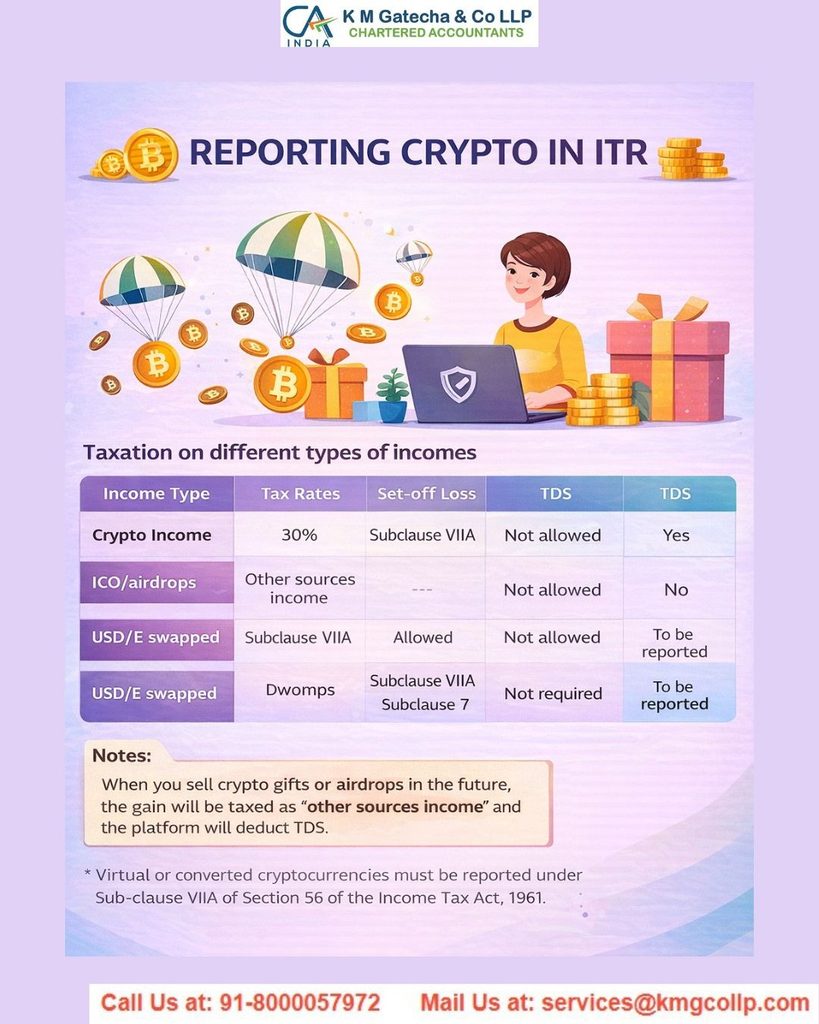
Crypto Taxation & ITR Reporting in India – Overview by Type
| Type of Crypto Income | Tax Rate | Where to Report in ITR | Loss Offsetting | TDS Deducted |
| Crypto Trading (Spot Trading) | 30% flat under Sec 115BBH | Schedule VDA | Not allowed | Yes |
| Crypto Futures (INR-Margined) | Taxed as Business Income | Business Income (ITR-3) | Allowed | No |
| Crypto Futures (USDT-Margined) | 30% flat | Schedule VDA | Not allowed | Yes |
| Gifts / Airdrops | Taxable only if cumulative > ₹50,000/year | Income from Other Sources | Allowed | No |
| P2P Transactions | 30% flat | Schedule VDA | Not allowed | Buyer deducts TDS |
| HODL / Holding Crypto (not sold) | Not taxable until sold | Not reported | Not applicable | No |
Key Points on Crypto Taxation & ITR Reporting
- Flat 30% Tax on Profits:
- Section 115BBH imposes a flat 30% tax on crypto profits.
- No deduction is allowed except the cost of acquisition (purchase price).
- Losses cannot be set-off against other income or carried forward.
- TDS Compliance (Section 194S):
- 1% TDS is applicable on transfer of VDAs if transaction exceeds threshold.
- Exchanges/platforms typically deduct TDS on behalf of investors.
- Gifts & Airdrops:
- Taxed under Income from Other Sources if cumulative value > ₹50,000/year.
- Gains from selling gifts/airdrops are taxed at 30%, and TDS is deducted by the platform.
- Futures & Derivatives:
- INR-Margined Futures: Taxed as Business Income with normal slab rate.
- USDT-Margined Futures: Taxed at 30% flat under Section 115BBH.
- Losses from futures may or may not be offset depending on the type.
- Holding (HODL):
- No tax is applicable on unsold crypto.
- Reporting is only required upon transfer/sale.
- Penalties for Non-Compliance:
- Non-disclosure of crypto assets can result in penalties, scrutiny, or prosecution under Black Money Act / Benami Law (especially for foreign or undisclosed assets).
- Wrong reporting can lead to demand notices from Income Tax authorities.
Compliance Checklist for Crypto in India
- Maintain records of all crypto trades, wallets, and exchange statements.
- Ensure TDS (1%) is correctly deducted and reflected in Form 26AS / AIS.
- Report all crypto income, even if held abroad (for resident taxpayers).
- Disclose gifts, airdrops, and mining rewards as taxable income.
- File ITR-2 / ITR-3 with Schedule VDA properly filled.
- Report each transaction line-wise to calculate accurate taxable profits.
Common Mistakes to Avoid When Filing ITRs
- Not E-Verifying the Return
- Mistake: Submitting the ITR but not e-verifying it within 30 days.
- Impact: The return is considered invalid.
- Tip: Always e-verify via OTP, Aadhaar, net banking, or DSC to complete the filing process.
- Ignoring AIS & TIS Mismatch
- Mistake: Not reconciling your ITR with the Annual Information Statement (AIS) and Taxpayer Information Summary (TIS).
- Impact: Discrepancies may trigger notices or scrutiny from the Income Tax Department.
- Tip: Cross-check TDS, TCS, interest income, and other details before submitting.
- Skipping Capital Gains Reporting
- Mistake: Failing to report gains from shares, mutual funds, crypto, or property, even if reinvested or exempt.
- Impact: Leads to notices, penalties, or interest on underreported income.
- Tip: Maintain detailed transaction records and include all capital gains in the ITR.
- Not Filing When Mandatory
- Mistake: Assuming filing is optional when income is below taxable limit.
- Impact: Non-compliance if you have foreign assets, TDS deductions, or high-value transactions.
- Tip: Check mandatory filing conditions carefully to avoid penalties.
- Omitting Bank Account Details
- Mistake: Not including all active bank accounts in the ITR.
- Impact: Refunds may be delayed or rejected.
- Tip: Include all active accounts; skip only dormant accounts.
- Not Comparing Old vs New Tax Regime
- Mistake: Filing without evaluating which tax regime saves more tax.
- Impact: You may end up paying higher taxes unnecessarily.
- Tip: Use online calculators or consult a tax professional to choose the optimal regime.
- Unvalidated Bank Account for Refund
- Mistake: Bank account isn’t validated on the Income Tax portal.
- Impact: Refund may get delayed, rejected, or returned.
- Tip: Ensure your bank account is verified before filing.
Pro Tip: Maintaining proper documentation (Form 16, Form 26AS, investment proofs, and bank statements) and cross-checking every entry before submission can help you avoid most of these mistakes.
Disclaimer: The content on this website is for informational purposes only and does not constitute legal, financial, or professional advice. Please consult qualified experts before acting on any information. K M GATECHA & CO LLP accepts no liability for errors, omissions, or outcomes from the use of this content. This site is not an advertisement or solicitation.


