LLP Audit Applicability: Importance and Requirements
Limited Liability Partnerships (LLPs) in India are a popular business structure due to their operational flexibility and the benefit of limited liability. As per the LLP Act, 2008, every LLP must undergo an annual audit to ensure compliance and maintain transparency. Knowing the importance of audits, when audit provisions apply, and the essential steps involved in conducting an LLP audit is vital for meeting legal obligations and building trust with stakeholders. This article provides a detailed overview of LLP audit requirements, highlighting both legal and procedural aspects.

LLP Audit – A Brief Overview
An LLP (Limited Liability Partnership) audit involves examining and validating financial records, statements, and adherence to relevant laws and regulations. Although not all LLPs are required to be audited, specific conditions such as higher annual turnover or substantial capital contributions make audits compulsory. The purpose of the audit is to ensure transparency, accuracy, and statutory compliance while protecting the interests of all stakeholders. It includes evaluating financial statements, checking transaction records, and verifying that the LLP is following the provisions of the LLP agreement and legal requirements.
Why is LLP Audit Important?
LLP audits play a crucial role for several reasons:
- They help confirm the accuracy and dependability of the financial statements.
- They show that the LLP is complying with all relevant laws and regulations.
- They improve the credibility of the LLP, building trust among investors, lenders, and business associates.
- They help detect financial discrepancies and weaknesses in internal controls.
- They offer insights into areas that may need improvement, supporting business development and long-term stability.
- They boost stakeholder confidence in the LLP’s financial position and overall operations.
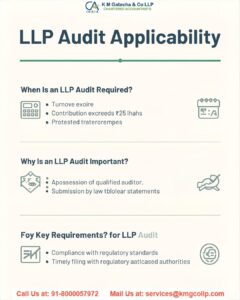
When is an LLP Audit Applicable?
The need for an LLP audit depends on its annual turnover and capital contribution. As per Rule 24 of the LLP Rules, 2009, an audit becomes compulsory in the following situations:
- If the LLP’s annual turnover is more than ₹40 lakhs, it must undergo an audit to maintain transparency and compliance.
- If the total capital contribution of the LLP exceeds ₹25 lakhs, an audit is required.
- LLPs engaged in professional services must carry out an annual audit, irrespective of their turnover or capital contribution.
Audit & Books of Accounts Requirements for LLP
Under Section 34 of the LLP Act, 2008, and Rule 24 of the LLP Rules, 2009, Limited Liability Partnerships (LLPs) must maintain proper financial records and comply with audit requirements. These regulations ensure transparency, accountability, and smooth financial operations.

1. Maintenance of Books of Account
Every LLP must:
- Maintain proper books of account for each financial year.
- Records should be kept on either a cash basis or accrual basis, following the double-entry system of accounting.
- These books must accurately reflect the financial position and transactions of the LLP.
- The records must be maintained and preserved at the registered office of the LLP for the prescribed period.
2. Statement of Account and Solvency (LLP Form 8)
- Every LLP is required to prepare and file a Statement of Account and Solvency using Form 8.
- This must be filed with the Registrar within 30 days from the end of six months of the financial year.
- The form must be signed by the designated partners and reflect the financial position and solvency status of the LLP for that financial year.
3. Appointment of Auditor
- Designated partners are responsible for appointing an auditor to ensure audit compliance.
- For the first financial year: The auditor must be appointed before the end of the first year.
- For subsequent financial years:
- The auditor should be appointed at least 30 days before the end of the financial year.
- If designated partners fail to appoint one, any partner may appoint the auditor.
✅ Summary
| Requirement | Details |
| Books of Account | Must be maintained on cash or accrual basis using double-entry system at registered office. |
| Statement of Account & Solvency | File Form 8 within 30 days from the end of six months of the financial year. |
| Auditor Appointment (First Year) | Before the end of the first financial year. |
| Auditor Appointment (Subsequent Years) | At least 30 days before the end of the financial year. |
Procedure to Conduct an LLP Audit
The audit process for a Limited Liability Partnership (LLP) generally follows the steps below:
1. Appointment of Auditor
- Appoint a qualified Chartered Accountant (CA) as the auditor.
- Ensure the auditor is independent, reliable, and capable of providing an unbiased evaluation of the LLP’s financial records.
2. Pre-Audit Preparation
- Gather and organize all financial documents such as ledgers, invoices, bank statements, and other necessary records.
- Coordinate with the auditor to ensure a smooth and efficient audit process.
3. Audit Planning
- The auditor prepares an audit plan based on the LLP’s size, nature of business, and financial operations.
- This includes assessing internal controls, identifying areas of financial risk, and determining the audit scope.
4. Conducting the Audit
- The auditor reviews financial transactions, account books, and supporting documents.
- They ensure compliance with accounting standards, tax regulations, and statutory requirements.
5. Verification and Sampling
- The auditor cross-checks financial data using sampling techniques and verifies records with supporting evidence to confirm accuracy.
6. Reporting
- After completing the audit, the auditor prepares:
- Audit Report
- Financial Statements
- Notes to Accounts
- Audit Report
- These documents summarize the financial position and audit findings of the LLP.
7. Filing of Audit Report
- The audited financial statements and the auditor’s report must be submitted to the Registrar of Companies (RoC) within the prescribed deadline to ensure statutory compliance.
Penalties for Non-Compliance with LLP Audit
Failure to comply with LLP audit requirements can lead to penalties as follows:
| Offender | Penalty Amount |
| LLP | ₹25,000 to ₹5,00,000 |
| Each Designated Partner | ₹10,000 to ₹1,00,000 |
These penalties emphasize the importance of timely audits and adherence to legal obligations.

Conclusion
An LLP audit is essential for ensuring financial transparency, regulatory compliance, and building stakeholder trust. By understanding the importance, applicability, and steps of the audit process, LLPs can fulfill their legal responsibilities and foster sustainable business growth.
Maintaining accurate books of accounts, being aware of audit provisions, and appointing auditors on time not only prevents penalties but also enhances the credibility and reliability of the business.
Disclaimer: The content on this website is for informational purposes only and does not constitute legal, financial, or professional advice. Please consult qualified experts before acting on any information. K M GATECHA & CO LLP accepts no liability for errors, omissions, or outcomes from the use of this content. This site is not an advertisement or solicitation.