Non-Resident Indians (NRIs) have a wide array of investment opportunities in India. From investing in the equity markets—either directly through stocks or via mutual funds—to placing funds in NRE or NRO fixed deposits, purchasing real estate like flats, plots, or commercial spaces, or even investing in gold and government-backed schemes—the options are plenty.
Among these, earning rental income from residential or commercial properties remains a popular choice. It not only provides a steady income stream in the form of rent but also offers long-term capital appreciation. Additionally, when the property is eventually sold, NRIs can benefit from indexation on the purchase cost, which helps in lowering the overall capital gains tax liability.
In this article, the focus is on understanding how rental income is taxed for NRIs, what complexities are involved, and how one can legally reduce the tax burden by utilizing available deductions and exemptions.
If you’re an NRI earning income by letting out a property in India, it’s important to know that this income is taxable under Indian law. However, what many may not realize is that the Income Tax Act offers various deductions and rebates under the head “Income from House Property.”
The term “House Property” under tax laws doesn’t only mean a physical house. It includes a wide range of assets like a residential flat, a shop, an office, or any other building along with any adjoining land, such as a parking space. The law does not distinguish between residential and commercial property—both fall under the same category for tax purposes.
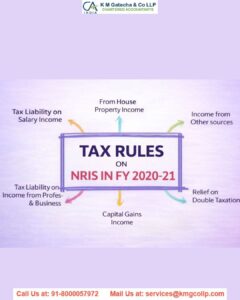
From a tax perspective, the legal owner is the person who holds ownership rights independently and not as a representative of someone else. This legal ownership determines who is liable to pay tax on the rental income received from the property.
Step-by-Step Guide to Calculating Income from House Property
Understanding how to calculate income from house property is essential for accurate tax reporting. Here’s a clear, step-by-step breakdown:
1. Determine the Gross Annual Value (GAV):
If the property is self-occupied, its GAV is considered zero.
For a rented property, GAV is the higher of actual rent received or expected rent.
If a property remains vacant and cannot be classified as self-occupied, it is treated as deemed let-out, and the GAV is the expected annual rent for the entire year. (More on deemed let-out is explained later.)
2. Subtract Property Tax Paid:
Any property tax paid to local authorities during the year can be deducted from the GAV. Make sure to retain the receipt for documentation purposes.
3. Calculate Net Annual Value (NAV):
Net Annual Value = Gross Annual Value – Property Tax Paid
4. Apply Standard Deduction @ 30%:
Under Section 24 of the Income Tax Act, a flat 30% deduction is allowed on the NAV, regardless of actual expenses incurred.
This means that even if you spend more or less on maintenance, painting, or repairs, you’re allowed a fixed deduction of 30%—no more, no less.
5. Deduct Interest on Home Loan:
Also under Section 24, you can claim a deduction for interest payable on borrowed capital used for acquiring, constructing, repairing, or renovating the property.
For self-occupied property:
The maximum deduction allowed is ₹30,000, which increases to ₹2,00,000 if the loan was taken for purchase or construction.
For rented properties:
The entire interest amount is eligible for deduction—no upper limit.
6. Compute the Income from House Property:
After subtracting both the standard deduction and the home loan interest, the result is your taxable income under the head ‘Income from House Property’, which is taxed according to your applicable income tax slab.
7. Adjust for Loss from House Property:
In the case of self-occupied property, where GAV is nil, claiming a home loan interest deduction leads to a negative income, i.e., a loss from house property. This loss can be set off against income from other heads such as salary or business.
Note:
If a property is let out, its GAV must be the higher of actual rent or expected rent. Deliberate under-reporting (e.g., quoting a lower municipal or fair rental value) may result in scrutiny, and the expected rent could be deemed as actual rent for taxation purposes.

Additional Considerations and Available Tax Benefits:
Tax Benefit on Principal Repayment:
Repayment of the principal amount of a home loan qualifies for tax deduction under Section 80C, with a maximum limit of ₹1,50,000. However, certain conditions must be fulfilled to avail of this benefit, such as completion of construction and possession of the property.
Additional Deduction for First-Time Home Buyers – Section 80EE:
Section 80EE of the Income Tax Act offers an exclusive deduction of up to ₹50,000 on home loan interest for individuals purchasing their first residential property. This benefit is applicable if the buyer holds only one house property on the date the loan is sanctioned.
Deemed Rental Income for Owning More Than Two Residential Properties
According to the Finance Act, 2019, an individual taxpayer can treat up to two residential properties as self-occupied for tax purposes. If you own more than two houses and they are lying vacant, the third and additional properties will be treated as “deemed to be let out.” This means the tax department will assume you’re earning rental income from them, even if they are unoccupied.
In such cases, the notional rent or fair market rental value of the excess properties must be calculated and included in your total income. You’re allowed to claim standard deductions (such as 30% under Section 24) on this deemed income, similar to an actually rented-out property.

To clarify further, here are a few scenarios:
One house given on rent: Pay tax on the actual rental income (Let-out property).
One house kept vacant: No tax applicable (Self-occupied property).
Two houses both rented: Pay tax on rental income from both.
Three houses all vacant: Two will be considered self-occupied (no tax), and the third will be treated as deemed let out. You must pay tax on the fair rental value of the third.
This concept often catches Non-Resident Indians (NRIs) off guard. For instance, if someone owns four residential units in a prime Mumbai locality, only two can be treated as self-occupied. The other two are treated as deemed rented, and rental income based on prevailing market rates is added to the total income. If the fair rental value is estimated at ₹20 lakhs per annum, the individual may enter a higher tax slab and must file a return and pay applicable taxes.
Conclusion: Lack of awareness about deemed rental income can result in heavy tax liabilities. Proper tax planning and timely advice are essential to avoid unpleasant surprises.
Disclaimer: The content on this website is for informational purposes only and does not constitute legal, financial, or professional advice. Please consult qualified experts before acting on any information. K M GATECHA & CO LLP accepts no liability for errors, omissions, or outcomes from the use of this content. This site is not an advertisement or solicitation.