You are currently viewing Simple Guide to Family Trust and Private Trust Registration in India

Simple Guide to Family Trust and Private Trust Registration in India

Family trusts in India are useful for managing and protecting family wealth. They help in planning for the future, transferring assets to the next generation, and improving tax planning. Many families use trusts to keep their finances secure and stable.

However, setting up and managing a family trust requires proper understanding of legal rules, tax laws, and compliance requirements.

This guide will help you understand how to register and manage a family trust in India, along with important rules and examples from real cases, including the Buckeye Trust case.

Simple Guide to Family Trust and Private Trust Registration in India

What is a Family Trust?

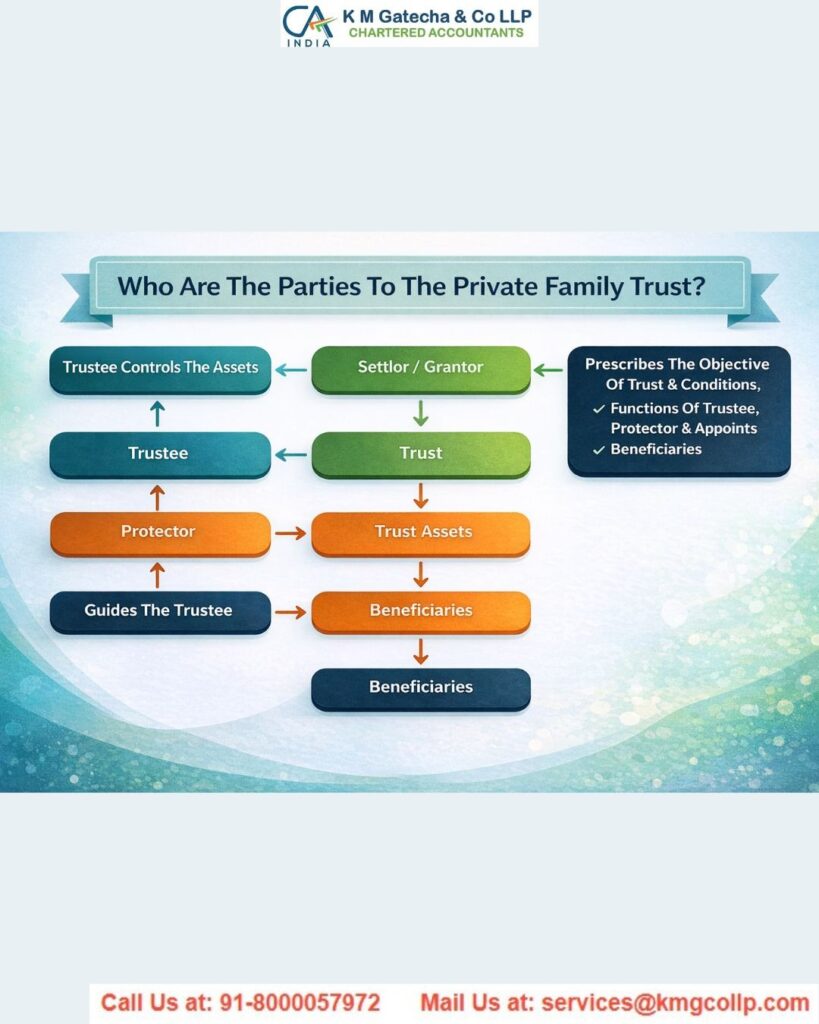
A family trust is a legal setup where one person (trustee) manages assets for the benefit of family members (beneficiaries).

It is mainly used to:

  • Protect family wealth: Keep assets safe from legal issues or claims
  • Plan future transfer: Easily pass wealth to the next generation
  • Provide financial support: Help family members with regular income
  • Save tax: Manage taxes in a better way

Types of Family Trusts

  • Specific Trust: Names of beneficiaries and their shares are clearly defined
  • Discretionary Trust: Trustee decides how to distribute income or assets
  • Hybrid Trust: A mix of both specific and discretionary trust

Note: The type of trust you choose depends on your family needs, assets, and long-term goals.

Step-by-Step Guide to Registering a Family Trust in India

Setting up a family trust needs proper planning and correct legal steps. Here’s a simple guide:

1. Decide the Purpose of the Trust

  • Clearly define why you want to create the trust (wealth protection, future planning, or financial security)
  • Decide which family members will benefit from it

2. Prepare the Trust Deed

  • Create a legal document with all details, such as:
    • Names of settlor, trustees, and beneficiaries
    • Details of assets being transferred
    • Duties and powers of trustees
    • How income or assets will be shared

3. Choose Trustees

  • Select trustworthy and capable people as trustees
  • They should always work in the best interest of the beneficiaries

4. Register the Trust

  • If the trust includes property (land/building), registration is compulsory
  • If it includes only movable assets, registration is optional but recommended

5. Apply for PAN

  • Get a PAN card for the trust for tax purposes

6. Open a Bank Account

  • Open a separate bank account in the name of the trust for all transactions
Simple Guide to Family Trust and Private Trust Registration in India

Taxation of Family Trusts in India

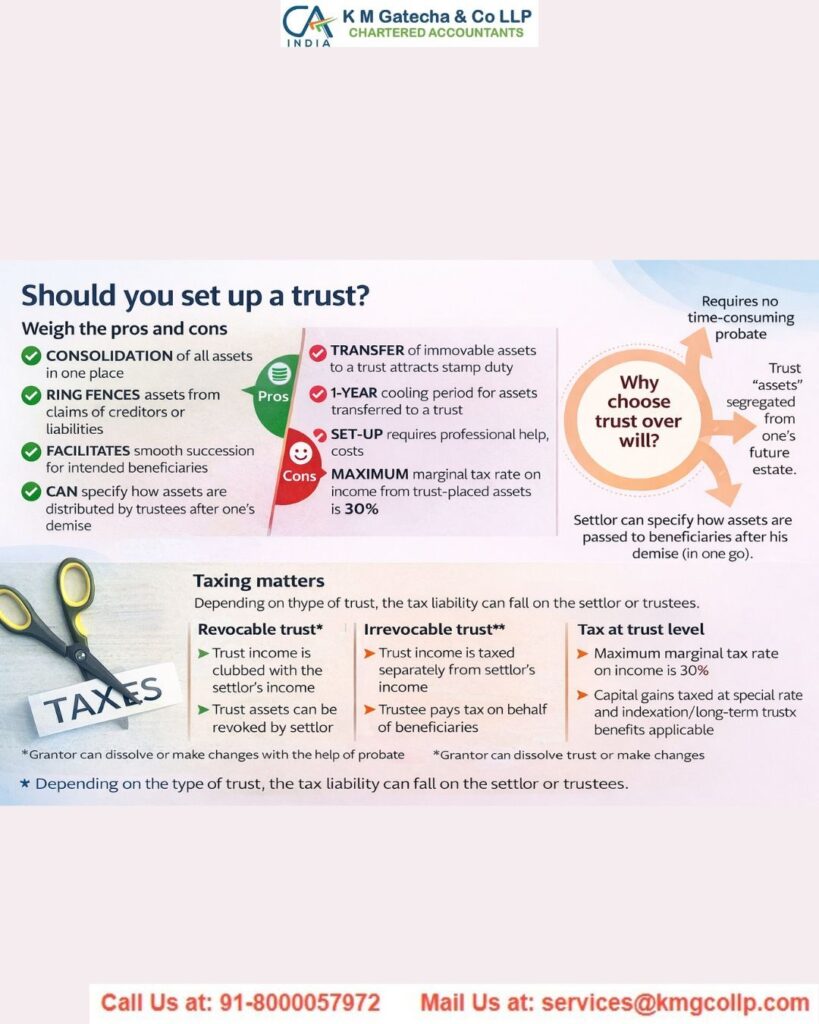
Tax rules for a family trust depend on the type of trust.

1. Specific Trust

  • Income is taxed in the hands of the beneficiaries
  • Tax is charged as per their individual tax slab

2. Discretionary Trust

  • Income is taxed at the highest tax rate (Maximum Marginal Rate)
  • Beneficiaries pay tax only when they receive the income

3. Gift Tax (Section 56(2)(x))

  • If assets are given to the trust for close relatives, no gift tax is charged
  • If non-relatives are included, tax may be applicable

Important:
Clearly mentioning beneficiaries in the trust deed helps avoid tax problems later.

Compliance Requirements for Family Trusts

Following proper rules is important to run a family trust smoothly.

1. Registration Requirements

  • Trusts with property (land/building) must be registered
  • Trusts with movable assets can be registered (recommended for safety)

2. PAN and Bank Account

  • Get a PAN card for tax filing
  • Maintain a separate bank account for all trust transactions

3. Accounting and Audit

  • Keep proper records of all income and expenses
  • If income crosses the limit, audit is required every year

4. Income Tax Filing

  • File yearly tax returns using ITR-7
  • Make sure details are correct and filed on time

Private Discretionary Trusts in India

1. What is a Private Discretionary Trust?

A private discretionary trust is a setup where trustees decide how, when, and to whom the trust income or assets will be given among the beneficiaries.

2. Key Features

  • Flexible: Trustees can distribute income based on needs
  • No fixed share: Beneficiaries do not have fixed portions
  • Trustee control: Trustees take major decisions
  • Responsibility: Trustees must act honestly and in the best interest of the trust

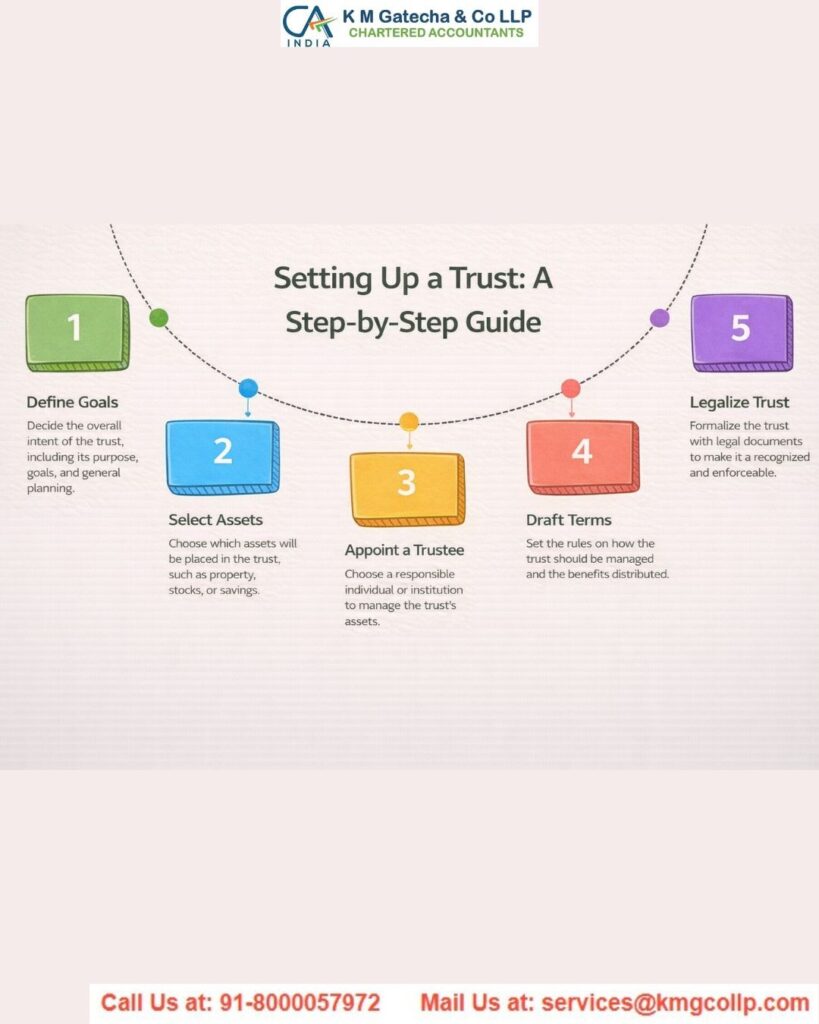
3. Steps to Set Up a Private Discretionary Trust

Step 1: Decide the Purpose

  • Define goals like wealth protection, tax planning, or future planning

Step 2: Prepare the Trust Deed

  • Mention trustee powers, rules for distribution, and beneficiary details

Step 3: Appoint Trustees

  • Choose reliable and knowledgeable people

Step 4: Register the Trust

  • Follow rules under the Registration Act, 1908

Step 5: Get PAN & Bank Account

  • Apply for PAN and open a bank account for the trust

Step 6: Follow Compliance Rules

  • Maintain records and complete yearly filings

4. Taxation

  • Income is taxed at the highest tax rate (Maximum Marginal Rate)
  • Proper classification of assets helps avoid tax issues

5. Compliance Requirements

  • Maintain clear and proper records
  • Conduct yearly audits (if required)
  • File tax returns on time

6. Important Tips

  • Take help from professionals for better management
  • Keep updated with tax rules
  • Maintain proper documentation to avoid problems
Simple Guide to Family Trust and Private Trust Registration in India

Key Lessons from the Buckeye Trust Case

Case Overview

  • The Buckeye Trust was created with assets worth ₹669.27 crores
  • Settlor: Anand Nadathur
  • Trustee: Vervain Management Private Limited
  • Main issue: The trust had discretionary powers and included non-family members as beneficiaries
  • Tax department treated the asset transfer as taxable under Section 56(2)(x)

What Happened (Simple Timeline)

  • Trust Formation: Assets were transferred to the trust
  • Initial Filing: No taxable income was reported
  • Review by Tax Authority: The case was rechecked and marked as incorrect
  • Tax Department View: Since beneficiaries were not clearly defined and included non-relatives, the transfer was treated as taxable
  • Final Decision: The tribunal agreed with the tax department and confirmed that tax would apply

Key Takeaways

  • Clearly define beneficiaries: If beneficiaries are not clearly mentioned, it can lead to tax problems
  • Avoid including non-relatives: Adding non-family members can remove tax benefits
  • Proper asset transfer: All assets should be clearly recorded and explained
  • Regular audits: Periodic checks help avoid future tax issues
  • Take expert help: Involve legal and tax professionals while setting up the trust
  • Stay updated with tax laws: Trustees should keep track of changing tax rules
Simple Guide to Family Trust and Private Trust Registration in India

Final Thoughts

Family and private discretionary trusts are useful for managing wealth, saving tax, and planning for the future.

To make them work well, it is important to have clear documents, follow legal rules, and take professional guidance. This helps in securing family wealth and passing it smoothly to future generations.

Disclaimer: The content on this website is for informational purposes only and does not constitute legal, financial, or professional advice. Please consult qualified experts before acting on any information. K M GATECHA & CO LLP accepts no liability for errors, omissions, or outcomes from the use of this content. This site is not an advertisement or solicitation.

Need Help?

FREQUENTLY ASKED QUESTIONS

“Family trust” is a common term used to describe a private trust created specifically for the benefit of the settlor’s family members — spouse, children, parents, or other relatives. Legally, both are governed by the same statute: the Indian Trusts Act, 1882. The distinction is purely in the purpose and beneficiaries, not in the legal structure. All family trusts are private trusts, but a private trust may also be created for non-family purposes such as business succession or employee benefit.

No. Unlike a company or an LLP, a private or family trust is not a separate legal entity under Indian law. The trust property is held by the trustee(s) in a fiduciary capacity. However, for income tax purposes, a private trust is treated as a separate assessable entity with its own PAN and files its own income tax return. This distinction — not a legal person but a separate tax entity — is important when dealing with banks, regulators, and government authorities.

Yes. A single individual can be the settlor of a family trust. They can also act as one of the trustees (though not the sole trustee if they are also the sole beneficiary). Many family trusts are created by a single patriarch or matriarch for the benefit of their children and grandchildren. The trust deed just needs to be properly executed and, for immovable property, registered.

The Indian Trusts Act does not prescribe a minimum number of trustees. A single trustee is legally sufficient. However, best practice strongly recommends appointing at least two trustees — this ensures continuity if one trustee passes away or becomes incapacitated, avoids the need for court intervention, and provides a check-and-balance in trust management decisions.

Yes, an NRI can create a private trust in India to hold Indian assets. However, NRIs must additionally comply with FEMA (Foreign Exchange Management Act) regulations when transferring property into the trust, particularly for immovable property. If any of the trustees or beneficiaries are foreign nationals or foreign residents, additional RBI compliance and reporting obligations under FEMA may apply. Legal and FEMA-specific advice is essential before creating such a trust.

A private trust deed for immovable property must be registered at the office of the Sub-Registrar of Assurances (SRO) having jurisdiction over the area where the trust property is located. If the trust holds properties in multiple states, registration is done in the state where the primary or first-mentioned property is situated. For movable-property-only trusts, registration is not legally mandatory but is advisable for legal clarity and enforceability.

Step 1 — Draft the trust deed with the help of a lawyer on appropriate non-judicial stamp paper of the value applicable in your state. Step 2 — Pay the applicable stamp duty as per your state’s Stamp Act. Step 3 — All executing parties (settlor, accepting trustee(s), and two witnesses) appear in person before the Sub-Registrar. Step 4 — Submit the deed along with identity proofs, address proofs, property documents, and passport photographs of all parties. Step 5 — Pay the registration fee. Step 6 — The registered deed is returned with the endorsement, registration number, and official seal — usually within 1 to 3 working days.

Yes, in most states a properly executed Power of Attorney (POA) can authorize a representative to present and execute the trust deed on behalf of an absent party at the Sub-Registrar’s Office. However, the POA itself must be properly stamped and notarized (and in some cases registered), and the Sub-Registrar has discretion to require personal appearance in certain circumstances. Check with your local SRO before relying on a POA.

Stamp duty is a state subject and varies significantly across states. Some states (like Maharashtra) levy stamp duty as a percentage of the market value of the property being settled into the trust — which can be substantial. Other states charge a nominal fixed amount for family settlements. The nature of the trust (family settlement vs. commercial) and the type of property also affect the rate. Always check the current stamp duty schedule for your specific state before drafting the deed to avoid underpayment, which can invalidate the document.

The following documents are generally required: the original trust deed executed on stamp paper; self-attested copies of PAN card, Aadhaar card or passport of the settlor, all trustees, and two witnesses; recent passport-sized photographs of all parties; original title deed or ownership documents of the property being settled into the trust; a demand draft or receipt for payment of registration fees; and in some states, a valuation certificate or ready reckoner value of the property. Requirements can vary slightly by state, so verify with your local SRO in advance.

Notarization is not a statutory requirement under the Registration Act, 1908 for registering a trust deed — registration itself is the formal legal process. However, some practitioners recommend notarization of supporting affidavits or declarations that accompany the trust deed. Notarization does not substitute for registration where registration is required by law.

After registration, you should: (1) Apply for a PAN for the trust by filing Form 49A with the Income Tax Department, citing the registered trust deed as proof; (2) Open a dedicated bank account in the name of the trust; (3) Transfer the trust property formally into the trust’s name (for shares — execute a share transfer form; for immovable property — execute a separate conveyance deed if required); (4) Obtain GST registration if the trust will carry on any business activity; and (5) Set up an accounting system to maintain proper books and records for the trust.

After the trust deed is registered, the trustee(s) can apply for a PAN for the trust by submitting Form 49A to the Income Tax Department or authorized PAN service providers (NSDL/UTI). The application requires: the registered trust deed as proof of existence; identity and address proof of the trustee(s); and the trust’s address for correspondence. The PAN is typically issued within 7 to 15 working days. The PAN is essential for opening bank accounts, filing tax returns, and making investments in the trust’s name.

For immovable property — a separate registered gift deed or conveyance deed transferring ownership from the settlor to the trustee(s) on behalf of the trust is required. The trust deed alone does not transfer title to property. For shares — a share transfer form (SH-4) must be executed and the company’s register of members updated. For bank FDs or savings — the accounts are closed and re-opened in the trust’s name. For mutual funds — units must be redeemed and re-purchased in the trust’s name, as direct transfer of mutual fund units is not permitted.

No. Once a trust deed is registered, there is no periodic renewal or re-registration required for the trust itself. The registration is permanent. However, if the trust deed is subsequently amended (e.g., to add trustees, change beneficiaries, or modify powers), and the amendment relates to immovable property, the amendment deed must also be registered. Annual income tax return filing and other ongoing statutory compliances must be maintained each year.

Yes — this is one of the most common and beneficial uses of a family trust in India. Parents (as settlors) can transfer assets into the trust with the trustees holding and managing them until the children reach a specified age (e.g., 21 or 25 years). The trust deed can specify that distributions are made for the children’s education, health, and welfare in the interim. This avoids the legal complications of minors directly holding property and ensures proper management by responsible trustees.

Yes. A husband and wife can jointly create a family trust as co-settlors, each contributing their individual assets to the trust corpus. This is common in joint estate planning, where both spouses want to ensure their combined wealth passes to their children in a structured manner. The trust deed should clearly identify each settlor’s contributed assets and address what happens to the trust in the event of divorce or death of one settlor.

This requires careful legal consideration. HUF property belongs to all coparceners collectively and cannot be transferred into a private trust by the Karta alone without the consent of all coparceners. If all coparceners agree, the HUF can be partitioned first and then each coparcener’s individual share transferred into the trust. Unauthorized transfer of HUF property into a trust can be challenged and set aside. Always obtain a legal opinion before including HUF property.

Yes. A family trust can hold shares in a private limited company, partnership interest, or other business assets. In fact, using a family trust to hold promoter shares in a family business is a well-established succession planning strategy in India. It ensures business continuity, prevents fragmentation of shareholding due to inheritance, and allows professional trustees to manage business interests even when individual family members may not be equipped to do so. Compliance with the Companies Act (share transfer, shareholder agreements) must be maintained.

A Protector is an independent third party — often a trusted advisor, retired judge, or senior professional — appointed in complex family trusts to oversee the trustees and protect the interests of beneficiaries. The Protector typically has the power to remove and replace trustees, veto major decisions, and ensure the trust purpose is being followed. While the concept of a Protector is not specifically defined in the Indian Trusts Act, 1882, it is legally permissible to include such provisions in the trust deed, and Indian courts have generally respected such arrangements.

The most common mistakes include: using inadequate or incorrect stamp paper value (leading to impoundment of the deed); failing to register when registration is legally required for immovable property trusts; leaving beneficiaries vaguely described (making the trust legally uncertain); not separately transferring each asset into the trust after registration (assuming the deed alone transfers ownership); not obtaining a separate PAN for the trust; failing to maintain separate books of accounts; and drafting overly restrictive trust deeds that don’t give trustees adequate flexibility to manage assets over the long term.

Yes. Under the Stamp Acts, a document that is insufficiently stamped is inadmissible as evidence and can be impounded by any authority before whom it is produced. If underpayment is discovered, the deficient stamp duty along with a significant penalty (up to ten times the deficient amount in some states) must be paid before the document can be used. This is why it is essential to accurately assess and pay the correct stamp duty at the time of execution.

It is highly risky. Generic online templates may not comply with your state’s specific stamp duty requirements, may not account for your family’s unique asset profile and succession needs, may contain outdated legal provisions, and almost certainly will not include optimized tax planning structures. Given that a trust deed is a long-term, irrevocable legal document with significant financial and family consequences, professional legal drafting is not a cost but an investment.

Minor clerical errors (typographical mistakes, wrong dates, misspelled names) can sometimes be corrected by executing a supplementary deed of rectification, which itself may need to be registered. Substantive errors (wrong property description, incorrect beneficiary details) are more serious and may require filing a court application for rectification or, in extreme cases, creating a fresh trust. This underscores the importance of careful proofreading before the deed is signed and registered.

Yes. A private trust is a separate taxable entity under the Income Tax Act, 1961, and must file an annual income tax return using its own PAN. The return is filed in the name of the representative assessee (trustee). The applicable ITR form depends on the nature of income earned by the trust. Filing is mandatory regardless of whether any tax is payable, as long as the trust has income or assets above the basic threshold.

A private trust can claim deductions available to individuals or HUFs depending on the type of trust and income. Standard deductions applicable to income from house property, business income deductions, and capital gains exemptions (such as under Section 54 for reinvestment in residential property) may be available. However, deductions under Section 80C and similar personal investment deductions are generally not available to a trust. The specific deductions available depend on the trust’s structure and must be evaluated with a tax professional.

For a specific (determinate) trust, income is taxed directly in the hands of each beneficiary at their individual slab rates — the trust itself pays no additional tax on distributions. For a discretionary trust, the trustee pays tax at the maximum marginal rate (30%) on undistributed income; once distributed to beneficiaries, it is generally not taxed again in their hands to avoid double taxation. Corpus distributions (not income) are generally not taxable in the beneficiary’s hands.

GST applies only if the trust carries on any taxable supply of goods or services, such as renting commercial property, carrying on a business, or providing services. A family trust that merely holds residential property or financial investments and distributes income to family members generally does not require GST registration. However, if the trust is used as a vehicle for any business activity — even indirectly — GST registration and compliance obligations must be evaluated.

Table of Contents