

Company Striking Off – Close an Inactive Company Easily
An inactive or defunct company can be closed quickly by filing an application in Form STK-2 with the Registrar of Companies (ROC) for striking off its name from the register. We assist companies in completing the entire striking-off process in a smooth and 100% online manner.
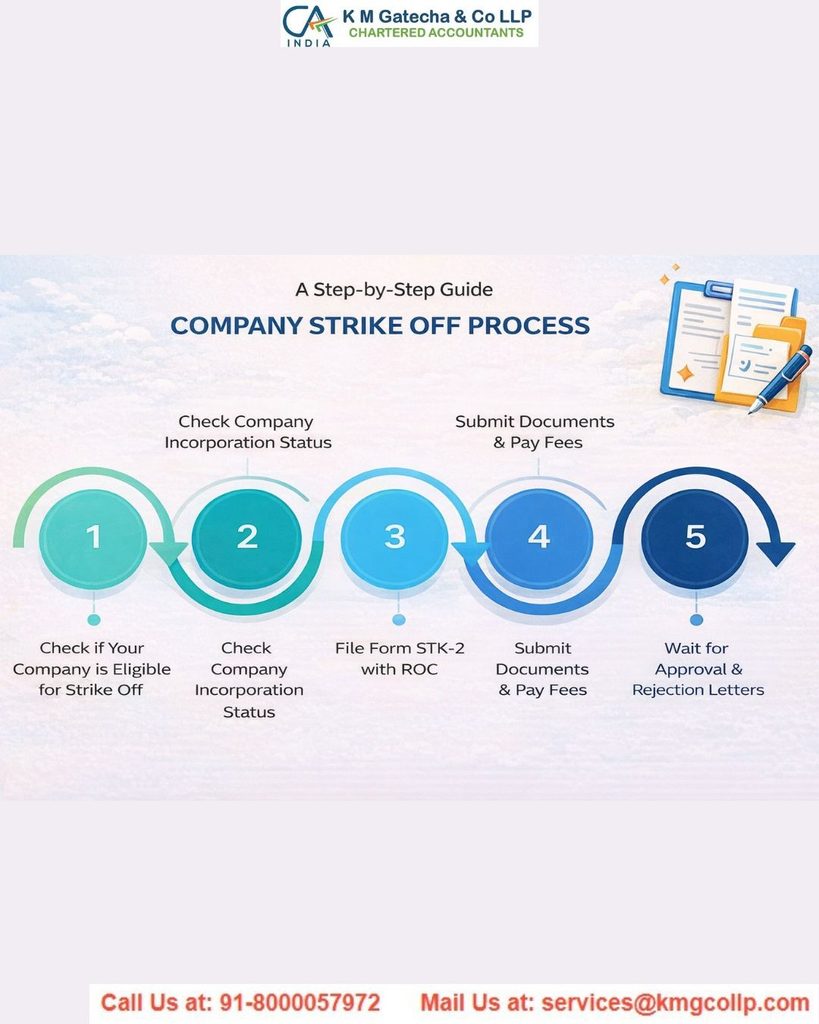
Striking-Off a Private Limited Company
A company is incorporated through a prescribed legal procedure under the Companies Act, 2013. Similarly, a Private Limited Company or One Person Company (OPC) can be closed only by following the procedures laid down under the Act.
Striking off a company means that the name of the company, which was entered in the Register of Companies at the time of incorporation, is removed by the ROC due to prolonged inactivity or failure to commence business operations.
Unlike winding up, striking off is a simpler closure mechanism for companies that:
- Have not commenced business, or
- Have been inactive for a significant period, and
- Have no outstanding liabilities.
A key advantage is that, unlike a company that has been wound up, a struck-off company may be restored by following the prescribed legal procedure if its financial position improves or valid grounds for restoration exist.
Can a Company Get Struck-Off Voluntarily?
Yes, but subject to specific conditions.
Under the Companies Act, 2013, the power to strike off a company ultimately rests with the Registrar of Companies (ROC). The ROC may initiate the process on its own, or a company may apply voluntarily for striking off—provided it meets the eligibility criteria.
For voluntary striking off:
- The company must file Form STK-2 with the ROC.
- It must demonstrate inactivity for the period prescribed under Section 248 of the Companies Act, 2013.
- The company should have no outstanding liabilities and must comply with prescribed procedural requirements.
Important: If the ROC has already issued a notice for strike-off on its own motion, the company cannot subsequently file Form STK-2.
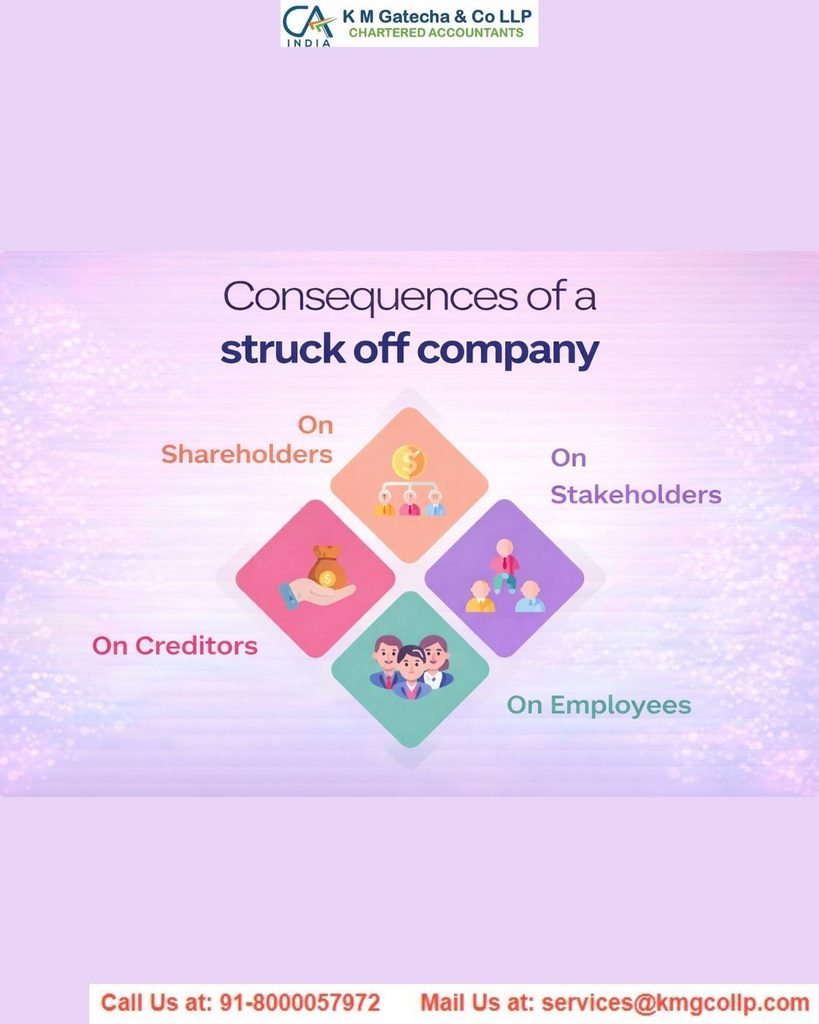
Difference Between Striking Off and Winding Up
Under the Companies Act, 2013, striking off and winding up are two distinct methods for closing a company.
Striking Off
Striking off is a simpler and faster closure process, generally used for inactive or dormant companies.
- The company’s name is removed from the Register of Companies maintained by the ROC.
- It can be initiated voluntarily by the company or by the ROC if it believes the company is not carrying on business.
- It is cost-effective and involves fewer legal formalities.
- Suitable for companies with no liabilities and minimal operations.
Winding Up
Winding up is a more formal and complex process involving liquidation of assets and settlement of liabilities.
- Assets are realized and distributed among creditors and shareholders.
- It may be initiated voluntarily by members or creditors.
- It may also be ordered by the National Company Law Tribunal (NCLT) in cases of default or statutory non-compliance.
- It involves greater regulatory scrutiny and legal compliance.
Key Distinction
- Striking Off → Administrative removal of a dormant company’s name from records.
- Winding Up → Legal liquidation process involving asset distribution and closure of financial obligations.
Striking off is quicker and less expensive, while winding up is comprehensive and mandatory when liabilities need to be settled formally.
Legal Provisions in the Companies Act, 2013 for Company Closure
Under the Companies Act, 2013, Section 248 of the Companies Act, 2013 empowers the Registrar of Companies (ROC) to strike off the name of a company under specified circumstances. The ROC may exercise this power either suo moto or upon an application made by the company.
A Private Limited Company may be struck off if any one of the following conditions is satisfied:
Conditions for Striking-Off
| Section | Legal Provision |
| 248(1)(a) | The company has failed to commence its business operations within one year of incorporation. |
| 248(1)(c) | The company has not carried on any business for two immediately preceding financial years and has not applied for dormant status under Section 455 of the Companies Act, 2013. |
| 248(1)(d) | The subscribers to the Memorandum of Association (MOA) have not paid the subscription amount within 180 days from incorporation. |
| 248(1)(e) | The company is not carrying on any business activity as revealed through physical verification of its registered office by the ROC. |
Minimum Requirements to Strike-Off a Private Limited Company
Before filing Form STK-2, the following conditions must be fulfilled:
- Identify the applicable clause under Section 248 due to which the company is inactive or defunct.
- Obtain consent from at least 75% of shareholders (either through written consent or special resolution).
- Ensure all government dues and liabilities are fully paid.
- Close the company’s bank account and obtain the bank closure certificate/statement.
- Ensure the company has no assets or liabilities before filing STK-2.
- File a Statement of Accounts (Nil assets and liabilities) certified by a Chartered Accountant.
- Confirm that no litigation or tax proceedings are pending.
- Ensure the DIN and DSC of all directors are active.
Benefits of Striking-Off a Company
1. No Ongoing Compliance Burden
Even inactive companies must file annual returns and financial statements. Striking off eliminates ongoing compliance requirements.
2. Avoidance of Penalties
Non-compliance attracts heavy penalties. Striking off prevents accumulation of fines for an inactive business.
3. Better Utilisation of Resources
Instead of maintaining a non-performing company, promoters can close it and redirect resources to more productive ventures.
4. Option to Restore Operations
Striking off is not always permanent. A company can apply for restoration within three years from the date of strike-off by appealing against the ROC’s order before the appropriate authority.
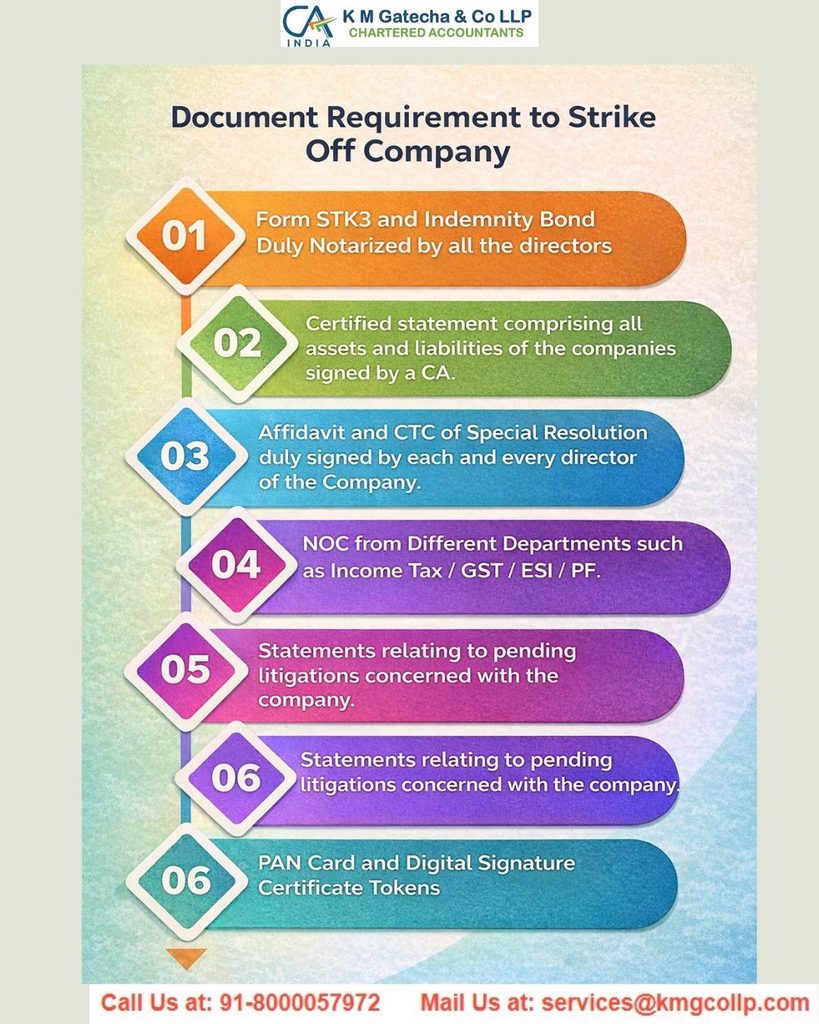
Documents Required for Company Closure (Striking-Off)
Below is the list of documents required for filing Form STK-2 for striking off a Private Limited Company under the Companies Act, 2013:
| S. No. | Document |
| 1 | Indemnity Bond signed by all directors (Form STK-3) |
| 2 | Affidavit signed by all directors (Form STK-4) |
| 3 | Consent from at least 75% of shareholders or certified copy of Special Resolution filed in Form MGT-14 |
| 4 | Board Resolution authorising a Director/MD/Manager/Company Secretary to sign STK-2 using DSC |
| 5 | Statement of Accounts showing Nil assets and liabilities (Form STK-8) |
| 6 | Bank account closure statement and bank closure letter |
Important Note:
- The Indemnity Bond (STK-3) must be executed on a non-judicial stamp paper of ₹100.
- The Affidavit (STK-4) must be executed on stamp paper of ₹50–₹100 (as applicable).
- Both documents must be duly notarised.
- Stamp duty and notary charges vary from state to state.
Process of Striking-Off a Private Limited Company
Step 1: Documentation
Ensure all required documents are collected and updated before initiating the application. Missing or outdated documentation can delay the process.
Step 2: Obtain Shareholders’ Consent
At least 75% of shareholders must approve the closure either:
- By written consent, or
- By passing a Special Resolution in a general meeting.
A copy of the consent or resolution must be attached with the STK-2 application.
Step 3: Surrender Registrations and Licences
Before applying for strike-off, the company must surrender its registrations and licences.
- GST registration must be surrendered before filing STK-2.
- Registrations such as EPF, ESI, PAN, TAN, and IEC are generally surrendered after the company is struck off.
Step 4: Close Bank Account & Prepare Financial Statement
- Close the company’s current bank account.
- Obtain the bank closure certificate and final statement.
- Prepare financial statements showing Nil assets and liabilities, not older than 3 months from the date of filing.
- The statement must be certified by a practising Chartered Accountant (CA).
Step 5: Affidavit & Indemnity Bond
All directors must:
- Sign an Indemnity Bond accepting responsibility for future liabilities (if any).
- Sign an Affidavit declaring the company has been inactive for the past two financial years or since incorporation (as applicable).
Step 6: Board Resolution
Conduct a Board Meeting to authorise a director (or authorised person) to sign and submit the STK-2 application using a Digital Signature Certificate (DSC).
Step 7: Filing of Form STK-2
- File Form STK-2 online with the Registrar of Companies (ROC).
- Attach all required documents.
- The prescribed government fee for STK-2 is ₹10,000.
- The form must be certified by a practising CA, CS, or CMA before submission.
Step 8: Strike-Off by the ROC
Upon receiving the application:
- The ROC examines the documents.
- If satisfied, the ROC issues a public notice of proposed strike-off in the Official Gazette through Form STK-7.
- The notice remains open for 30 days for objections.
- If no objections are received, the company is struck off, and its status on the MCA portal changes to “Struck Off.”
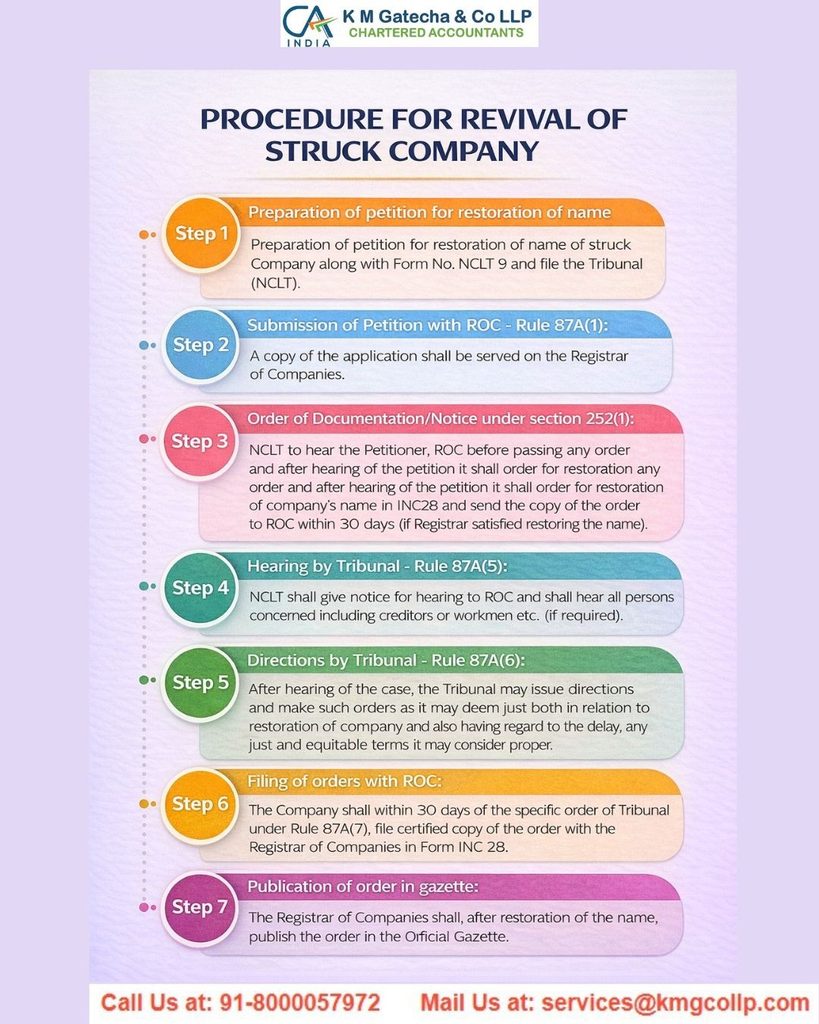
How Can We Help?
Voluntarily striking off your company is often the most practical solution when it has remained inactive or defunct for a prolonged period. It helps you avoid ongoing compliance costs and penalties while preserving the option to restore the company in the future if business prospects improve.
While the concept may seem simple, the actual process involves detailed legal procedures under the Companies Act, 2013. From eligibility verification to document drafting and regulatory approvals, striking off requires strict compliance—making professional assistance highly advisable.
Our Striking-Off Services Include:
- ✔ Checking eligibility under Section 248 of the Companies Act
- ✔ Drafting and preparing all required documents (STK-2, STK-3, STK-4, financial statements, resolutions, etc.)
- ✔ Filing Form STK-2 with the Registrar of Companies (ROC)
- ✔ Coordinating certification by practising professionals (CA/CS/CMA)
- ✔ Tracking application status until final strike-off approval
- ✔ End-to-end online support and compliance guidance
Our team of experienced legal and compliance professionals ensures a smooth, error-free, and timely closure of your Private Limited Company.
If you’re planning to close your inactive company, connect with our startup advisors today and complete the strike-off process efficiently and at minimal cost.
Disclaimer: The content on this website is for informational purposes only and does not constitute legal, financial, or professional advice. Please consult qualified experts before acting on any information. K M GATECHA & CO LLP accepts no liability for errors, omissions, or outcomes from the use of this content. This site is not an advertisement or solicitation.

