


What is Advance Tax & How to Calculate and Pay It?
Advance tax is paid in instalments before the end of the financial year rather than as a single lump-sum payment at year-end. Understanding how advance tax works—its calculation, due dates, and eligibility—is essential for individuals, freelancers, and businesses to stay compliant with income tax laws in India.
Every citizen of India is required to pay income tax if their earnings fall within the tax brackets prescribed by the Government of India. Tax revenue plays a crucial role in funding public services, infrastructure development, healthcare, education, and other welfare initiatives that support the country’s economic growth.
India follows a structured tax system based on income tax slabs, under which taxpayers are obligated to pay taxes according to their income level. This guide will help you understand what advance tax is, who needs to pay it, how to calculate it, and how to make payments on time to avoid penalties.
Key Takeaways
- Advance tax helps taxpayers avoid a large lump-sum payment at the end of the financial year
- Salaried individuals must pay advance tax if they earn additional income from rent, interest, or capital gains not fully covered under TDS
- Freelancers and businesses need to pay advance tax if their total tax liability exceeds ₹10,000 in a financial year
- Advance tax payments are made in four instalments during the year
- Missing due dates may result in interest penalties under Sections 234B and 234C of the Income-tax Act
- Timely payment of advance tax supports better financial planning and tax compliance
What Is Advance Tax in Income Tax?
Advance tax is the amount of income tax paid in advance during the financial year based on estimated income, instead of paying the entire tax amount at the time of filing the income tax return. It is commonly known as the “pay-as-you-earn” tax system.
Under this system, taxpayers estimate their income for the year and pay taxes in instalments according to the due dates prescribed by the Income Tax Department. Advance tax must be paid in the same financial year in which the income is earned.
This method helps both taxpayers and the government by ensuring regular tax payments and reducing the burden of large payments at the end of the year.
Who Needs to Pay Advance Tax?
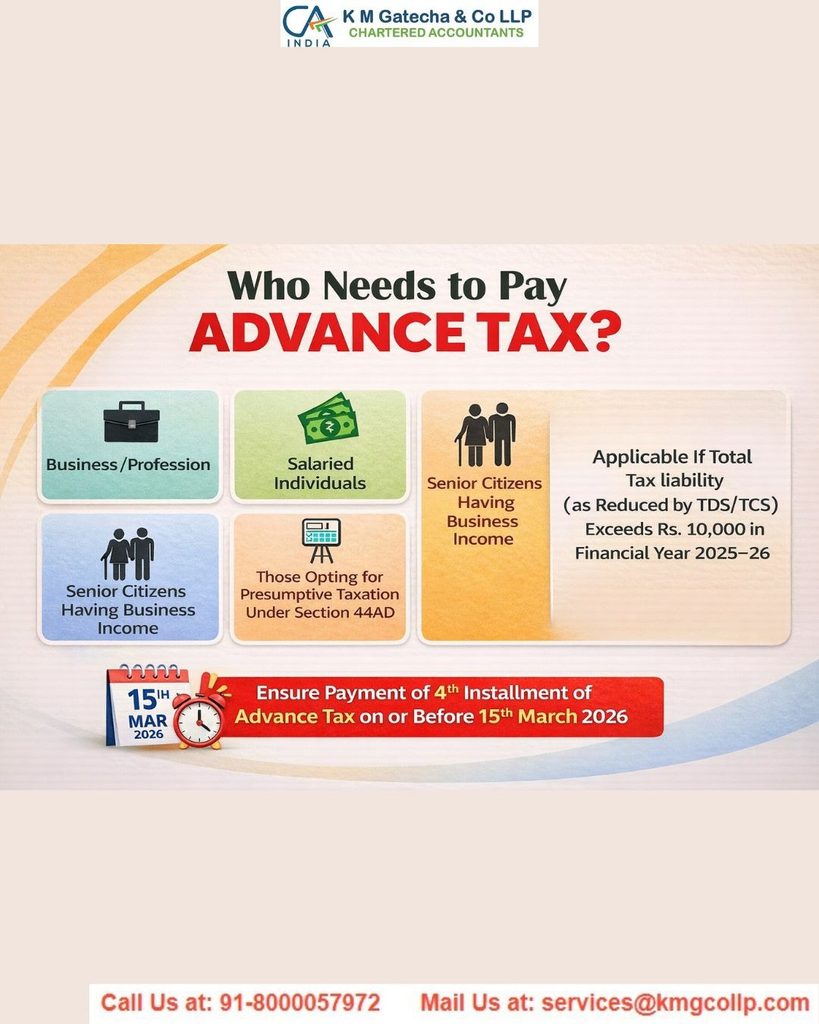
Advance tax is mandatory for taxpayers whose estimated tax liability is ₹10,000 or more in a financial year, as specified under Section 208 of the Income-tax Act, 1961. This requirement applies to individuals, professionals, businesses, and certain non-residents earning income in India.
Below are the primary categories of taxpayers required to pay advance tax.
Individuals, Professionals, and Self-Employed Persons
Taxpayers who earn income from sources other than salary—such as professional services, consultancy, or business activities—must pay advance tax if their tax liability exceeds ₹10,000 in a financial year.
Non-Resident Individuals and Foreign Companies
Non-resident individuals and foreign companies earning income in India are also required to comply with advance tax provisions if their tax liability exceeds the specified threshold.
Income from Multiple Sources
Advance tax applies to taxpayers earning income from various sources, including:
- Capital gains from shares or property
- Interest earned on fixed deposits
- Rental income from property
- Business or professional income
- Dividend or investment income
If the total tax liability from these sources exceeds ₹10,000, advance tax payment becomes mandatory.
Advance Tax for Salaried Individuals, Freelancers, and Businesses
Salaried Individuals
Salaried individuals are generally not required to pay advance tax if their employer deducts sufficient TDS from their salary. However, they must pay advance tax if they earn additional income not covered by TDS, such as:
- Rental income
- Interest income
- Capital gains
- Freelance or consulting income
Freelancers and Businesses
Freelancers, consultants, and business owners are typically responsible for paying advance tax because their income is not automatically subject to TDS.
If their total tax liability exceeds ₹10,000 in a financial year, they must estimate their income and pay advance tax in instalments to avoid interest penalties.
Advance Tax for Senior Citizens and Presumptive Income
Senior citizens aged 60 years or above who do not earn income from a business or profession are generally exempt from paying advance tax.
However, taxpayers opting for the presumptive taxation scheme—such as small businesses under Section 44AD or professionals under Section 44ADA—are required to pay 100% of their advance tax liability in a single instalment on or before March 15 of the financial year.
Why is Advance Tax Important?
Advance tax plays a vital role in maintaining financial discipline for both taxpayers and the government.
Benefits for the Government
Advance tax ensures a steady flow of revenue throughout the financial year. This consistent income helps the government:
- Fund public infrastructure projects
- Provide healthcare and education services
- Support social welfare programs
- Maintain economic stability
Benefits for Taxpayers
Paying advance tax offers several practical advantages.
Reduces Financial Burden
Paying tax in instalments prevents the stress of making a large payment at the end of the financial year.
Avoids Interest and Penalties
Timely payment helps avoid interest charges under Sections 234B and 234C of the Income-tax Act.
Improves Financial Planning
Regular tax payments help individuals and businesses manage their cash flow more effectively.
Ensures Compliance
Advance tax payments keep taxpayers compliant with income tax laws and reduce the risk of receiving notices from the Income Tax Department.
How to Pay Advance Tax Online and Offline
Paying advance tax is a straightforward process, and taxpayers can choose between online and offline payment methods. The Income Tax Department of India provides a secure digital platform that makes advance tax payments convenient and fast.
Steps to Pay Advance Tax Online
Follow these steps to pay advance tax online:
- Visit the official Income Tax e-filing portal.
- Log in using your PAN credentials.
- Select e-Pay Tax and choose Advance Tax (100) as the payment type.
- Enter the required details such as assessment year and payment amount.
- Choose your preferred payment method (net banking, debit card, or UPI).
- Confirm the payment and download the receipt for your records.
Paying online is the most popular option because it is quick, secure, and allows instant confirmation of payment.
Steps to Pay Advance Tax Offline
Taxpayers who prefer traditional methods can pay advance tax offline by visiting an authorized bank branch.
Here is how the offline process works:
- Obtain Challan No. ITNS 280 from the bank.
- Fill in details such as PAN, assessment year, and tax amount.
- Submit the form along with the payment (cash or cheque).
- Collect the stamped challan receipt as proof of payment.
It is important to keep this receipt safely, as it will be required when filing your income tax return.
Which Forms Are Required for Advance Tax?
The primary form required for paying advance tax is:
Challan No. ITNS 280
Challan No. ITNS 280 is the official form used to deposit advance tax with the Income Tax Department. Before submitting the form, taxpayers must ensure that all details are entered accurately.
Pre-Requisites of Challan No. ITNS 280
1. PAN Details
You must carefully enter the correct Permanent Account Number (PAN). Incorrect PAN details may result in the tax being credited to another taxpayer’s account.
2. Assessment Year
Select the correct assessment year for which the advance tax is being paid. Since advance tax is paid in the same financial year in which income is earned, choosing the correct year is essential.
3. Type of Payment
Taxpayers must select the appropriate payment category:
- Advance Tax – When paying tax during the current financial year based on estimated income
- Self-Assessment Tax – When paying tax after the financial year ends
After completing the payment, you will receive a Challan Identification Number (CIN). This number serves as proof of payment and must be used while filing your income tax return.
What Is the Interest on Late Payment of Advance Tax?
Failing to pay advance tax on time can result in interest charges under the Income Tax Act. These penalties are calculated based on the delay and the amount of unpaid tax.
Interest Under Section 234B
Under Section 234B, taxpayers must pay at least 90% of their total tax liability through advance tax or TDS by March 31 of the financial year.
If this requirement is not met:
- Interest is charged at 1% per month
- It is calculated on the unpaid tax amount
- The interest applies until the tax is fully paid
This penalty ensures taxpayers make timely payments and do not postpone their tax obligations.
Interest Under Section 234C
Section 234C applies when advance tax instalments are not paid according to the prescribed schedule.
Here is how the interest is calculated:
- Less than 15% paid by June 15 – 1% interest per month for 3 months
- Less than 45% paid by September 15 – 1% interest per month for 3 months
- Less than 75% paid by December 15 – 1% interest per month for 3 months
- Less than 100% paid by March 15 – 1% interest per month for 1 month
These penalties can significantly increase your overall tax liability, making timely payments essential.
Common Mistakes to Avoid While Paying Advance Tax
Avoiding simple mistakes can save you from penalties and unnecessary complications.
Some common errors include:
- Underestimating total annual income
- Missing instalment due dates
- Entering incorrect PAN or assessment year
- Ignoring additional income such as interest or rental income
- Not revising estimates during the financial year
- Forgetting to claim eligible deductions
Regularly reviewing your income and tax liability helps ensure accurate advance tax payments.
How to Pay Advance Tax Online
Just like regular tax payments, advance tax can also be paid using a challan through authorized banks or online from the comfort of your home. The online method is the most convenient and widely used, as it allows taxpayers to make payments quickly without visiting a bank branch.
Here is a simple step-by-step guide to help you understand how to pay advance tax online without any hassles.
Step-by-Step Process to Pay Advance Tax Online
Follow these steps to complete your advance tax payment online:
- Visit the official Income Tax e-filing portal.
- Log in using your PAN credentials.
- Select the “e-Pay Tax” option from the dashboard.
- Choose Challan 280 for advance tax payment.
- Fill in the required details such as:
- PAN number
- Assessment year
- Type of payment (Advance Tax)
- Address and contact details
- Select your preferred payment mode, such as:
- Net banking
- Debit card
- UPI
- NEFT/RTGS
- Confirm the payment and complete the transaction.
- Save or download the payment receipt for future reference.
Once the payment is successful, a Challan Identification Number (CIN) will be generated. This number acts as proof of payment and is required while filing your income tax return.
Documents Required for Advance Tax Payment
Before making an advance tax payment, ensure that you have the following documents and information ready:
- PAN Card
- Estimated income details for the financial year
- Advance tax calculation or tax liability details
- Bank account or net banking credentials
- Challan 280 form details
- Contact information such as email address and phone number
Having these details prepared in advance helps avoid errors and ensures a smooth payment process.
Advance Tax Challan 280 Explained
Challan 280 is the designated form used for paying advance tax, self-assessment tax, and regular income tax. It plays a crucial role in ensuring that the payment is correctly recorded in the Income Tax Department’s system.
Key Details Included in Challan 280
Challan 280 typically contains the following fields:
- Permanent Account Number (PAN)
- Assessment Year
- Type of payment (Advance Tax or Self-Assessment Tax)
- Tax amount to be paid
- Bank details
- Address and contact information
Filling this form accurately is essential to ensure that your payment is credited to the correct taxpayer account.
Interest on Late Payment of Advance Tax
Failing to pay advance tax on time can result in interest penalties under the Income Tax Act.
Interest Under Section 234B
Under Section 234B, interest is charged if a taxpayer fails to pay at least 90% of the total tax liability by the end of the financial year.
Key points:
- Interest rate: 1% per month or part of a month
- Applied on the unpaid tax amount
- Continues until the tax is fully paid
Interest Under Section 234C
Section 234C applies when advance tax instalments are not paid according to the prescribed schedule.
Interest is charged when:
- Instalments are delayed
- Payments are lower than the required percentage
- Due dates are missed
The interest rate is 1% per month, calculated based on the shortfall in each instalment.
Exemptions and Refunds in Advance Tax
Not all taxpayers are required to pay advance tax. Certain exemptions apply based on the amount of tax liability and income type.
Who Is Exempt from Paying Advance Tax?
You are generally exempt from paying advance tax if:
- Your total tax liability is less than ₹10,000 in a financial year
- You are a senior citizen (60 years or above) without business or professional income
- Your income is fully covered under Tax Deducted at Source (TDS)
Refund of Excess Advance Tax
If you pay more advance tax than required, the excess amount can be claimed as a refund while filing your income tax return.
Important points:
- Refunds are processed after return filing
- Interest on refunds is provided under Section 244A (subject to conditions)
- The refund amount is credited directly to your bank account
Benefits of Paying Advance Tax
Paying advance tax offers several financial and compliance advantages for taxpayers.
Here are the key benefits:
- Reduces the burden of paying a large tax amount at the end of the financial year
- Helps avoid interest penalties for late payment
- Improves financial planning and cash flow management
- Ensures timely compliance with tax laws
- Reduces stress during the tax filing season
- Supports continuous government funding for public services and infrastructure
Advance Tax Due Dates
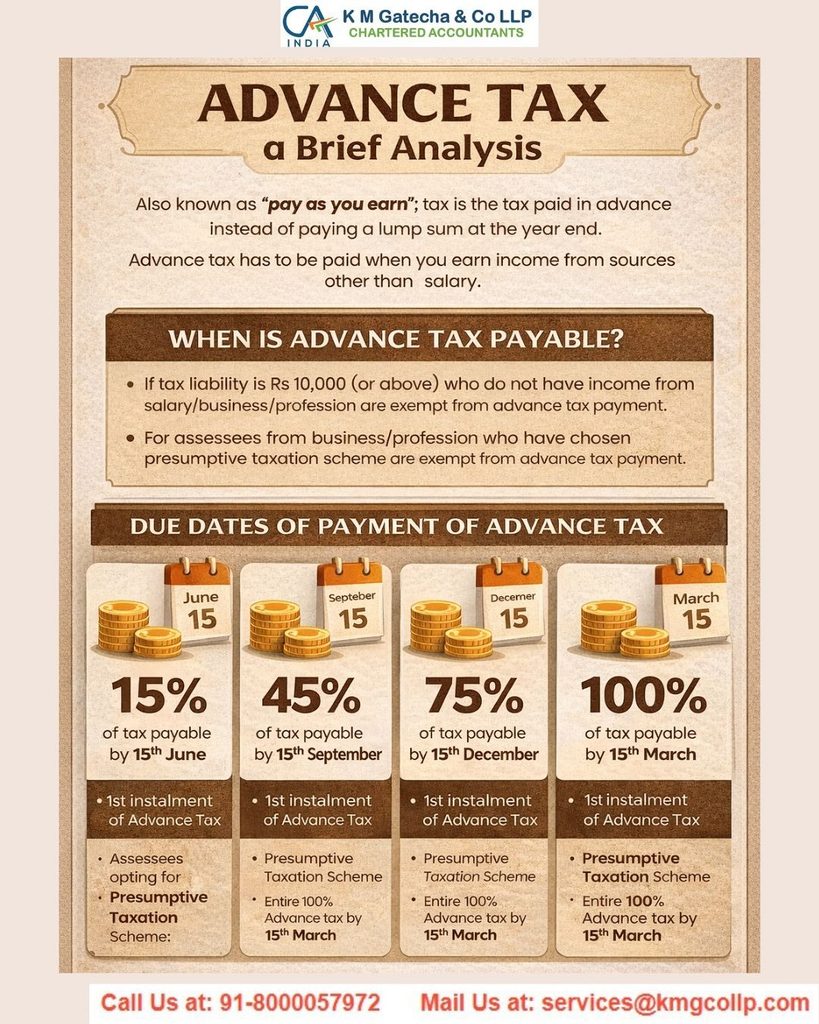
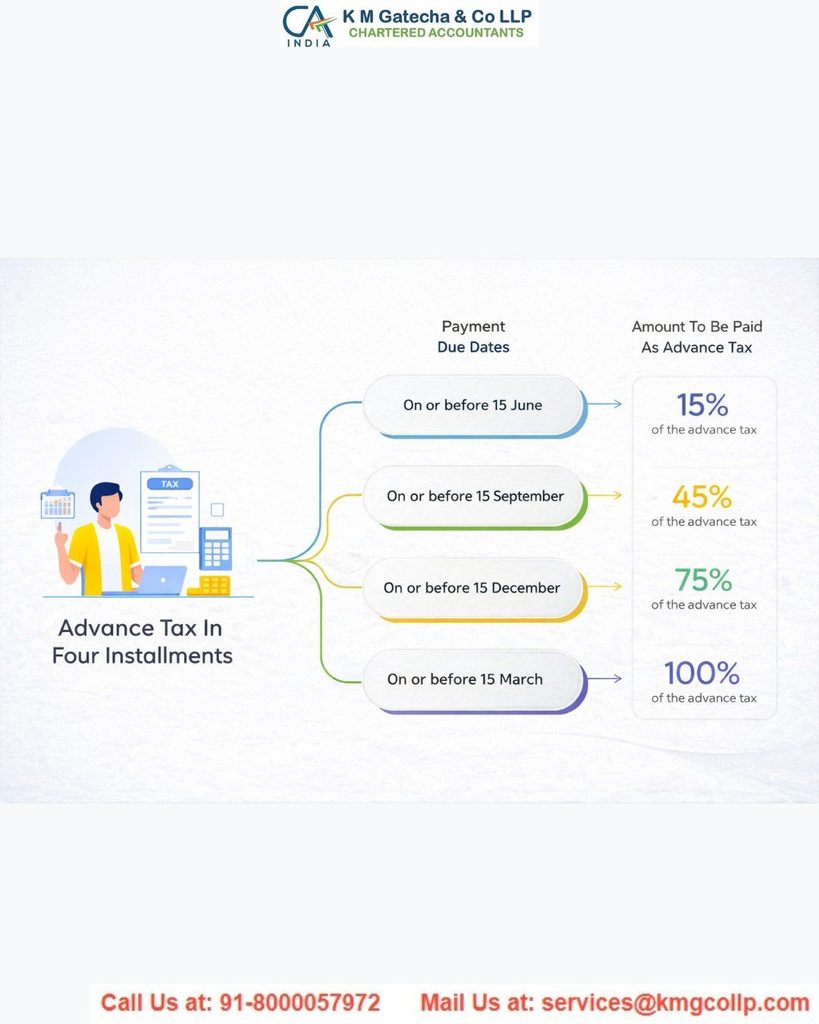
Advance tax payments are made in four instalments during the financial year. Each instalment represents a percentage of the total tax liability.
Advance Tax Payment Schedule
On or before June 15
Pay 15% of the total advance tax liability
On or before September 15
Pay 45% of the total advance tax liability (cumulative)
On or before December 15
Pay 75% of the total advance tax liability (cumulative)
On or before March 15
Pay 100% of the total advance tax liability (cumulative)
Meeting these deadlines helps taxpayers avoid penalties and maintain compliance with tax regulations.
Final Thoughts
Advance tax is an essential part of India’s taxation system that promotes timely tax payments and better financial discipline. By understanding how to calculate, pay, and schedule advance tax instalments, taxpayers can avoid penalties, manage their finances efficiently, and stay compliant with tax regulations.
Planning ahead and making payments on time not only reduces last-minute financial pressure but also ensures a smooth and hassle-free tax filing experience.
Disclaimer: The content on this website is for informational purposes only and does not constitute legal, financial, or professional advice. Please consult qualified experts before acting on any information. K M GATECHA & CO LLP accepts no liability for errors, omissions, or outcomes from the use of this content. This site is not an advertisement or solicitation.


