


Section 115BAA, introduced with effect from FY 2019-20, allows domestic companies to opt for a lower tax rate. Under this provision, companies can pay tax at 22%, along with a surcharge of 10% and health & education cess of 4%, which results in an effective tax rate of 25.17%. Announced on September 20, 2019, this measure was a part of the government’s tax reforms aimed at easing the burden on businesses in India. Additionally, the Minimum Alternate Tax (MAT) rate was lowered from 18.5% to 15%.
The objective of Section 115BAA was not only to cut tax rates but also to create a more business-friendly environment, encourage fresh investments, and support overall economic growth.

Key Points on Section 115BAA of the Income Tax Act, 1961
- Normally, companies in India are taxed at a flat rate of 30%.
- Section 115BAA gives eligible domestic companies the option to adopt a concessional tax rate.
- Companies choosing this option are liable to pay tax at 22% plus a 10% surcharge and 4% cess.
- This brings the effective rate to 25.17% from FY 2019-20 (AY 2020-21) onwards, subject to specified conditions.
- Earlier, all domestic companies had to pay tax at the 30% flat rate.
- MAT has also been revised down from 18.5% to 15%.

Section 115BAA – Main Features
Below are the important features of Section 115BAA:
| Feature | Details |
| Applicability | The concessional tax option is available only to domestic companies that distribute their taxable income as dividends within India. |
| Reduced Tax Rate | Eligible companies can pay tax at 22% plus a surcharge of 10% and cess of 4%, resulting in an effective rate of 25.17%. |
| Exemption from MAT | Companies choosing Section 115BAA are not liable to pay Minimum Alternate Tax. Any previously accumulated MAT credit cannot be used once this option is selected. |
| Irrevocable Choice | After opting for the concessional tax under Section 115BAA, a company cannot withdraw unless it becomes disqualified under the provisions. |
| Deadline for Option | The option must be exercised by the due date of filing ITR, i.e., 31st October of the relevant assessment year. |
| No Extra Depreciation | Manufacturing companies normally eligible for additional depreciation cannot claim it if they opt for Section 115BAA. |
Eligibility Criteria under Section 115BAA
Domestic companies can opt to pay income tax at 22% (plus surcharge and cess) if they follow the conditions laid out in the Income Tax Act. The detailed conditions are as follows:
1. No Claim of Exemptions or Incentives
The company must compute total income without availing deductions or incentives, such as:
- Deduction under Section 10AA for Special Economic Zone (SEZ) units.
- Additional depreciation under Section 32 and investment allowance under Section 32AD for new plant and machinery in notified backward areas of Andhra Pradesh, Bihar, Telangana, and West Bengal.
- Deduction under Section 33AB for tea, coffee, or rubber manufacturing businesses.
- Deduction under Section 33ABA for deposits in a site restoration fund by companies engaged in petroleum or natural gas production.
- Deduction under Section 35 for scientific research or contributions to universities, research associations, National Laboratories, or IITs.
- Deduction under Section 35AD for capital expenditure by specified businesses.
- Deduction under Section 35CCC for agricultural extension projects and under Section 35CCD for skill development projects.
- Deductions under Chapter VI-A (Sections 80IA, 80IAB, 80IAC, 80IB, etc.), except those allowed under Section 80JJAA and Section 80M.
2. Restriction on Set-off and Depreciation
- Losses or unabsorbed depreciation linked to the above deductions cannot be set off against current or future income.
- An amalgamated company cannot claim the carried-forward losses or unabsorbed depreciation of an amalgamating company if such amounts relate to the restricted deductions.
- Normal depreciation is permitted, but additional or accelerated depreciation cannot be claimed.
- Once opted, these disallowed losses are considered permanently absorbed and cannot be carried forward in later years.
3. Filing of Option and Timelines
- The company must opt for Section 115BAA on or before the due date of filing its income tax return, generally 30th September of the relevant assessment year.
- Once exercised, the option is irrevocable and cannot be withdrawn in future years.
- The option must be submitted in Form 10-IC, notified by the CBDT, and filed electronically using either a digital signature or an electronic verification code (EVC).
4. Applicability of Section 115BAA
- There is no restriction on turnover for availing this option.
- Both new and existing domestic companies can choose Section 115BAA at any stage.

Section 115BAA – Tax Rates
Tax Structure for Companies Opting Section 115BAA
The taxation framework under Section 115BAA is outlined below:
| Particulars | Rate | Details |
| Base Tax | 22% | Flat rate applicable on total income, regardless of turnover. However, income subject to special rates (e.g., long-term capital gains) will continue to be taxed at those special rates. |
| Surcharge | 10% | Levied on the base tax uniformly, irrespective of income level. |
| Cess | 4% | Health and Education Cess, charged on the total of base tax plus surcharge. |
👉 When combined, the effective tax rate under Section 115BAA comes to 25.168%.
Different Tax Rates for Domestic Companies (AY 2025-26)
| Condition for Domestic Companies | Tax Rate (Excl. cess) |
| Turnover or gross receipts of the previous year not exceeding ₹400 crores | 25% |
| Domestic manufacturing companies opting for Section 115BA | 25% |
| Domestic companies choosing Section 115BAA | 22% |
| Companies taxed under Section 115BAB | 15% |
| Other domestic companies (general rate) | 30% |
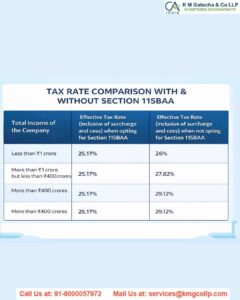
Comparison – Normal Tax Rates vs Section 115BAA
| Total Income | Effective Tax Rate under Section 115BAA (incl. surcharge & cess) | Effective Tax Rate without Section 115BAA (incl. surcharge & cess) |
| Up to ₹1 Crore | 25.17% | 26% |
| Above ₹1 Crore but ≤ ₹10 Crore | 25.17% | 27.82% |
| Above ₹10 Crore | 25.17% | 29.12% |
For companies under Section 115BAA, surcharge is fixed at 10%, irrespective of income.- For companies under normal provisions, surcharge varies: 7% if income exceeds ₹1 crore but ≤ ₹10 crore, and 12% if income exceeds ₹10 crore.
- In both cases, the calculated tax and surcharge are further increased by 4% Health and Education Cess.
When Should a Company Opt for Section 115BAA?
Although Section 115BAA provides the advantage of a lower tax rate, the timing of choosing it must be carefully planned. Key points to consider are:
1. Deadline for Filing Returns
To avail the concessional tax rate of 25.17%, the option must be exercised before the due date of filing the income tax return, which is generally 30th September of the relevant assessment year.
2. Strategic and Irrevocable Choice
Once a company chooses Section 115BAA, the decision is permanent and cannot be reversed. Therefore, the choice should align with the company’s long-term financial and business strategy.
3. Impact of Losses and Depreciation
Losses or unabsorbed depreciation related to specific deductions cannot be set off under this section. Companies must weigh the benefit of a reduced tax rate against the potential tax savings from using these deductions in the existing tax regime.
4. Current and Future Profitability
- If profits are stable or expected to grow in future, shifting to the lower tax rate is generally advantageous.
- However, if the company foresees significant benefits from available deductions in the coming years, continuing with the normal tax structure may be more beneficial.
MAT Credits and Set-off under Section 115BAA
Utilisation of MAT Credits
Domestic companies choosing Section 115BAA are not permitted to use MAT credits for taxes paid during the tax holiday period. Once this option is exercised, companies cannot reduce their tax liability under Section 115BAA by adjusting against MAT credits.
Set-off of Brought Forward Losses and Unabsorbed Depreciation
- Companies opting for Section 115BAA cannot set off brought forward losses or unabsorbed depreciation that relate to additional depreciation.
- From the assessment year in which this option is exercised, and for future years, such set-offs are disallowed.
- Since additional depreciation itself is not claimable under this section, any unabsorbed portion from earlier years also becomes ineligible for adjustment.
Can a Company Opt Out of Section 115BAA?
- A domestic company may choose not to adopt the concessional tax rate immediately and can opt for it after the expiry of its tax holiday, incentives, or exemptions.
- However, once the option is exercised under Section 115BAA, it becomes irrevocable. The company cannot withdraw from this regime in subsequent years.


