

When it comes to lawful tax planning, the Hindu Undivided Family (HUF) remains one of the most effective yet underutilised options. Established under Hindu law, a HUF is treated as a separate tax entity, enabling families to access additional deductions and manage taxes more efficiently. This blog explains what a HUF is, how it is created, and the tax benefits it offers, helping you decide whether it suits your financial strategy.

Understanding Hindu Undivided Family (HUF)
A Hindu Undivided Family (HUF) is a distinct legal entity recognised under Indian law and taxed independently from its members. It can be formed by Hindu, Sikh, Jain, or Buddhist families to collectively manage ancestral assets and income. The head of the HUF, known as the Karta, is generally the senior-most male member, though a senior female member may also act as the Karta.
The HUF consists of coparceners—sons and daughters who acquire a birthright in the family property—along with other members such as the wife and daughter-in-law.
A HUF enjoys the same income tax slabs and deductions as an individual taxpayer. It operates with its own PAN and files income tax returns separately, allowing families to organise finances better and potentially lower their overall tax liability.
Steps to Create an HUF
Forming a Hindu Undivided Family (HUF) is a simple process but involves certain formalities to ensure legal and tax recognition.
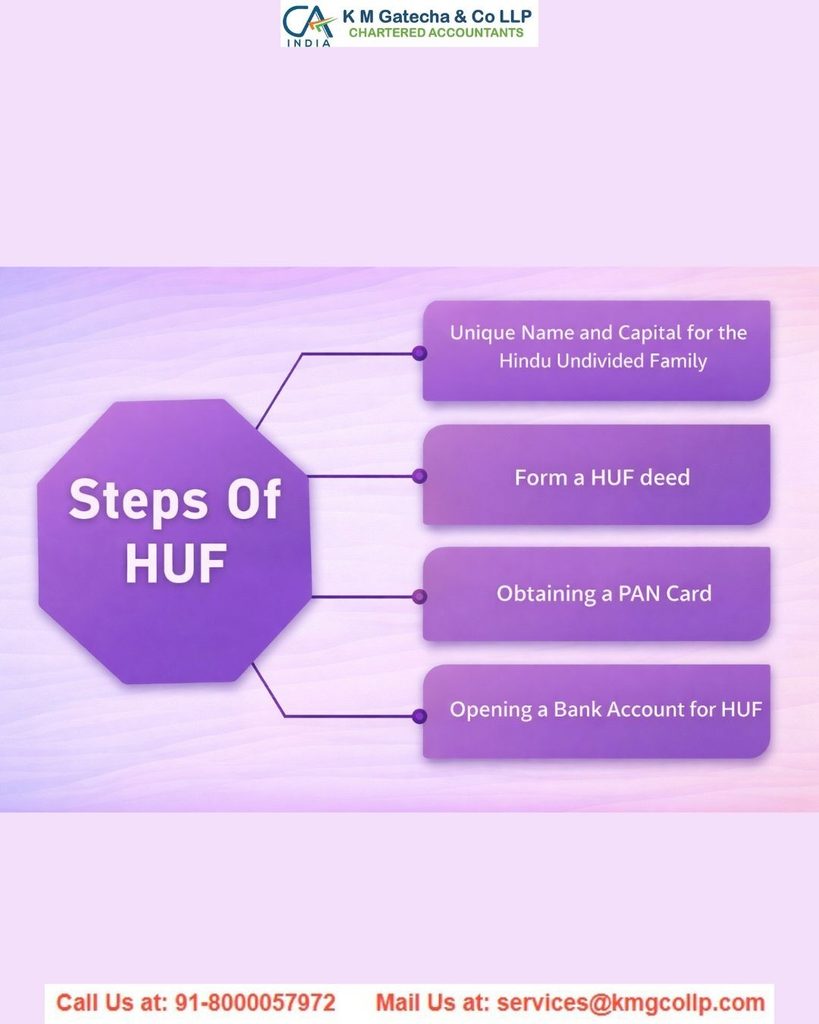
1. Form a Joint Family
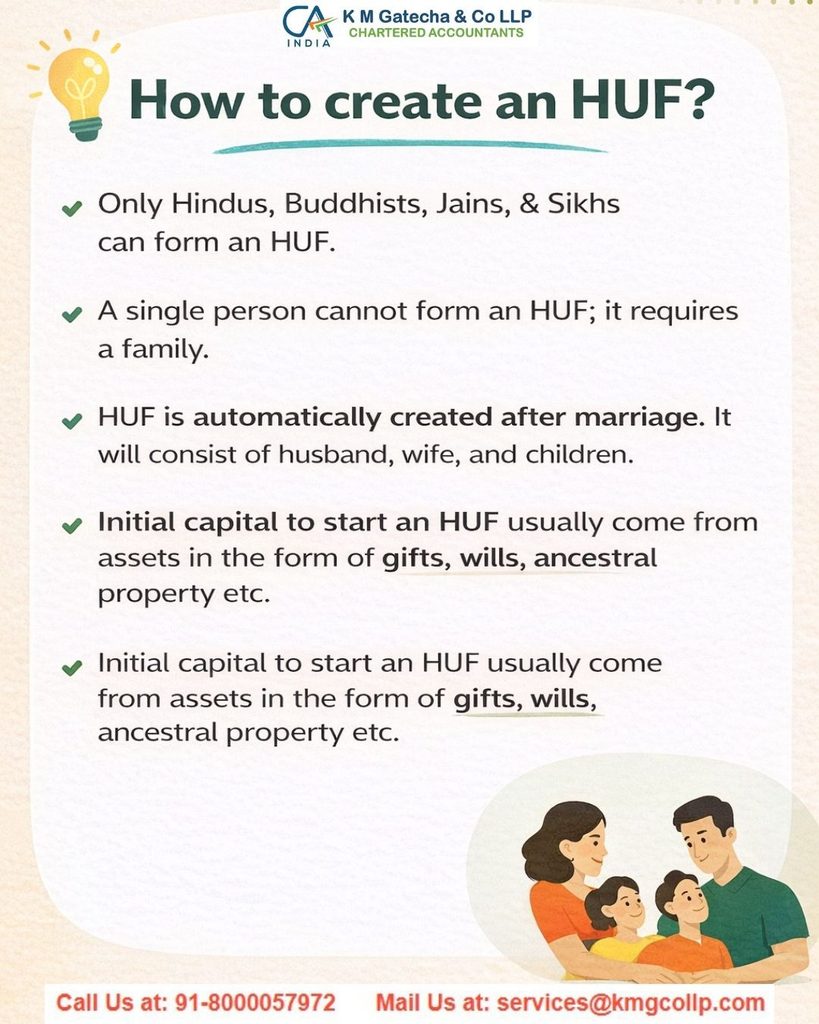
To establish a HUF, there must be at least two members belonging to a Hindu, Sikh, Jain, or Buddhist family—usually a parent and a child. A single individual cannot form a HUF.
2. Appoint the Karta
The eldest family member becomes the Karta and is responsible for managing the affairs of the HUF. The Karta acts as the authorised signatory for all HUF-related transactions.
3. Draft a HUF Deed
A formal HUF deed is prepared, specifying the names of the Karta and coparceners, the date of formation, and the source of the initial capital, such as ancestral assets or gifts.
4. Apply for a PAN Card
To be recognised by the Income Tax Department, the HUF must obtain a separate Permanent Account Number (PAN).
5. Open a Bank Account
A bank account is opened in the name of the HUF and operated by the Karta. All income and expenses of the HUF must be routed through this account.
Features of a Hindu Undivided Family (HUF)
A HUF has several defining characteristics that set it apart from other financial entities.
1. Separate Legal Identity
Under Indian tax laws, a HUF is treated as an independent legal entity capable of owning assets and earning income in its own name.
2. Governed by Hindu Law
HUFs are established under Hindu law and are applicable to Hindu, Sikh, Jain, and Buddhist families.
3. Managed by a Karta
The Karta oversees the HUF’s financial, legal, and administrative matters on behalf of all members.
4. Members and Coparceners
The HUF includes coparceners—sons and daughters with a birthright in family property—along with other members such as the Karta’s spouse.
5. Separate PAN and Tax Filing
A HUF must obtain its own PAN and file income tax returns separately, enabling it to claim deductions and tax benefits independently.
6. Joint Family Assets
All assets and income belonging to a HUF are treated as joint family property and are shared equally among the coparceners.
Investment Options for HUFs
After formation, a HUF can invest and grow its wealth in the same manner as an individual taxpayer. Since the HUF is taxed separately, income generated from these investments is assessed independently, making it a practical tool for effective family financial planning. Common investment options available to a HUF include:
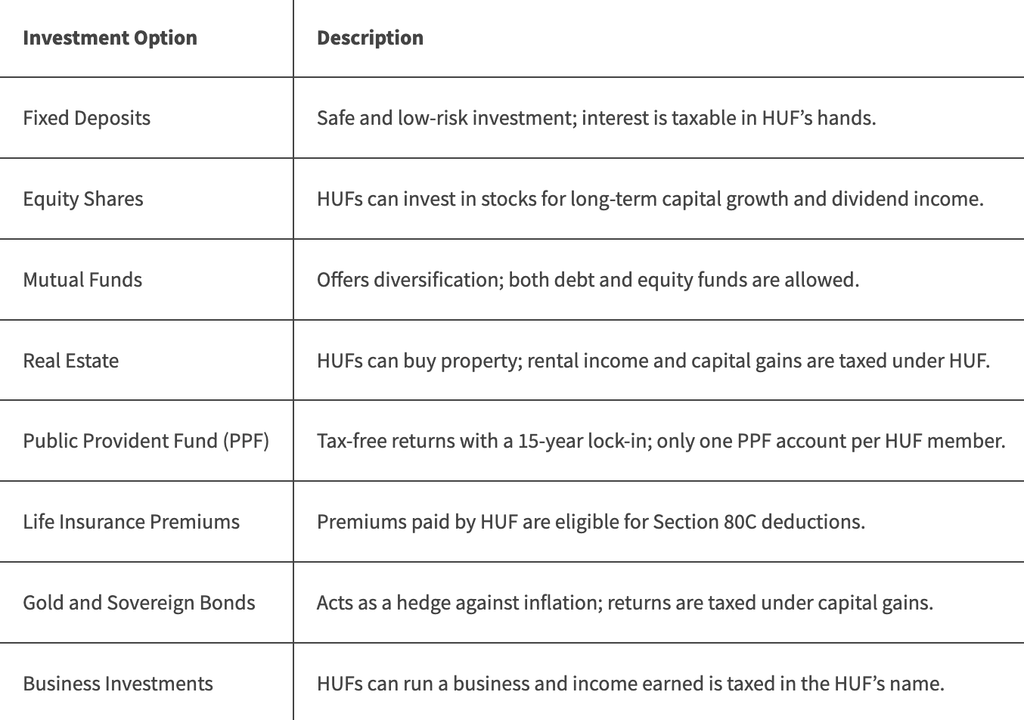
Selecting the right combination of investments allows a Hindu Undivided Family (HUF) to build long-term financial security while fully utilising the tax advantages available under Indian tax laws.
Documents Required for a HUF Account
To formally create and operate a Hindu Undivided Family (HUF) for taxation or investment purposes, certain documents are mandatory. These documents are required for opening a bank account, applying for a PAN card, and ensuring regulatory compliance.
Essential documents include:
- HUF Deed: A formal declaration confirming the formation of the HUF. It specifies the name of the Karta, details of coparceners, and the source of the initial capital, such as ancestral property or gifts.
- PAN Card of the HUF: A separate Permanent Account Number must be obtained for the HUF by submitting Form 49A.
- Identity and Address Proof of the Karta: Documents such as Aadhaar card, passport, or voter ID, along with address proof like utility bills or bank statements.
- Declaration by the Karta: A signed declaration stating the intention to establish and manage the HUF.
Together, these documents establish the HUF as a distinct financial and tax entity under Indian law.
Key Tax Benefits Available to HUFs
A HUF enjoys several tax advantages due to its status as a separate taxpayer:
- The HUF is taxed independently and follows the same income tax slab rates as individuals.
- It can claim deductions under Section 80C up to ₹1.5 lakh for eligible investments.
- Income splitting between the HUF and individual members helps reduce the family’s overall tax burden.
- Rental income from property owned by the HUF is taxed in the hands of the HUF, not individual members.
- Capital gains and business income earned by the HUF are assessed separately.
- The HUF can claim capital gains exemptions under Sections 54, 54F, and 54EC, subject to conditions.
Deductions under Section 80C
HUFs are eligible to claim deductions of up to ₹1.5 lakh per financial year under Section 80C.
Eligible investments include:
- LIC premiums
- Public Provident Fund (PPF)
- Equity Linked Savings Schemes (ELSS)
- National Savings Certificates (NSC)
- Principal repayment of home loans
These deductions reduce taxable income while supporting disciplined, long-term wealth creation.
Deductions under Section 80D
A HUF can also claim deductions for health insurance premiums paid for its members:
- Up to ₹25,000 per year (₹50,000 if covered members are senior citizens)
- Premiums paid for spouses, children, and dependent members qualify
- Preventive health check-ups are allowed within the prescribed limits
Exemption under Section 10(2)
- Any income distributed by the HUF to its members is fully exempt under Section 10(2)
- This exemption applies only to income earned from HUF assets
- It prevents double taxation, as income taxed in the hands of the HUF is not taxed again at the member level
Disclaimer: The content on this website is for informational purposes only and does not constitute legal, financial, or professional advice. Please consult qualified experts before acting on any information. K M GATECHA & CO LLP accepts no liability for errors, omissions, or outcomes from the use of this content. This site is not an advertisement or solicitation.
