HUF Explained: Meaning and Key Benefits
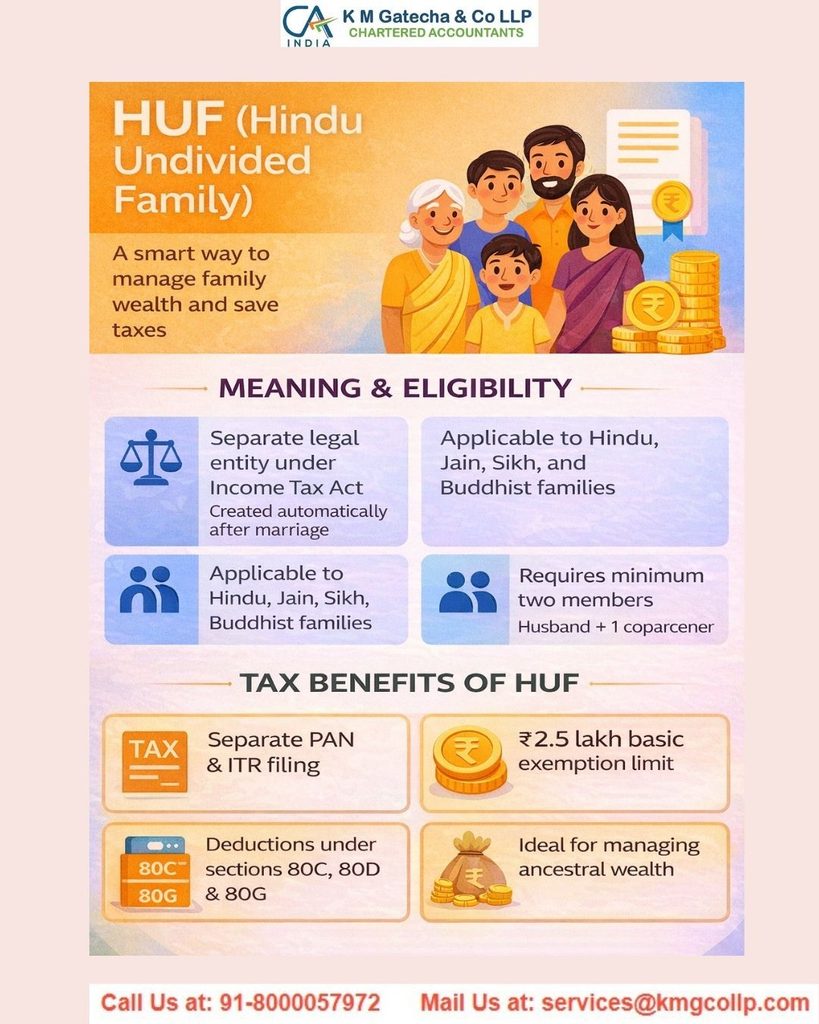
Under Section 2(31) of the Income-tax Act, 1961, a Hindu Undivided Family (HUF) is recognised as a separate tax entity. It is treated as a “person” for tax purposes. A HUF consists of members who are lineal descendants from a common ancestor and can be formed by Hindu, Buddhist, Jain, and Sikh families.
A HUF generally includes:
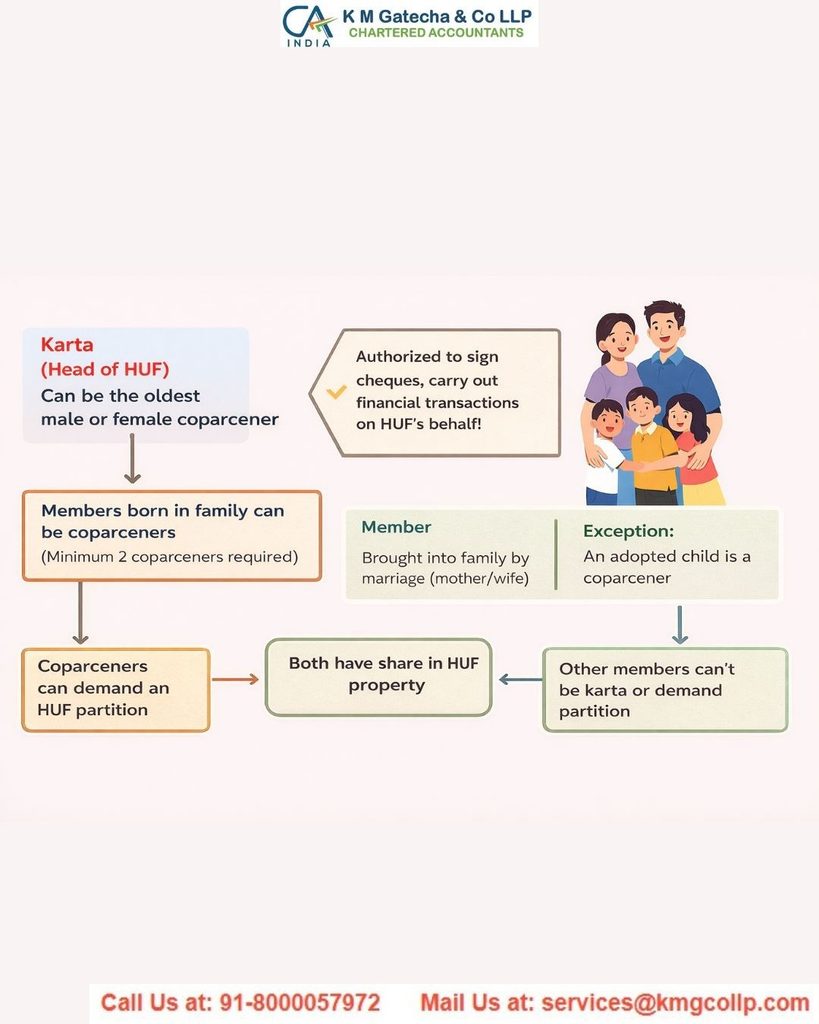
- The head of the family, known as the Karta, who manages the affairs of the HUF.
- Coparceners, who are family members within four generations from the Karta and who acquire rights in the joint family property by birth. They have the right to demand partition and claim their share in the property.
Earlier, only male members were considered coparceners. However, after the 2005 amendment to the Hindu Succession Act, daughters were also granted equal rights as coparceners.
Although individual members have their own Permanent Account Numbers (PAN), the HUF is allotted a separate PAN card. This separate legal identity allows the HUF to carry out financial activities independently, such as making investments and opening a demat account in the name of the HUF.

Benefits of Forming a HUF
Creating a Hindu Undivided Family (HUF) offers several advantages, especially in terms of tax planning and better management of family wealth.
1. Tax Savings
A HUF is taxed at the same income tax slab rates as an individual. Since it is treated as a separate taxable entity, it enjoys a basic tax exemption limit of ₹2.5 lakh, in addition to the exemptions available to individual family members.
This means a family can legally reduce its overall tax burden by distributing income between individuals and the HUF.
Income Not Taxed in the Hands of HUF
The following types of income are not taxed as HUF income:
- Income from property transferred by a member to the HUF without proper consideration (this may be clubbed in the hands of the member).
- Income from a woman’s personal property (stridhan).
- Income from an impartible estate, which is taxed in the hands of the estate holder, not the HUF.
Deductions Available to HUF
A HUF can claim deductions under various sections of the Income Tax Act, such as:
- Section 80C (for investments like life insurance, ELSS, etc.)
- Section 80D (for medical insurance premium)
- Other eligible deductions, similar to those available to individuals
Income earned from ancestral property or family business can be taxed in
the name of the HUF. This helps reduce the taxable income of individual family members.
2. Wealth Management
A HUF provides a structured way to manage family assets jointly. Ancestral properties, businesses, and investments can be held and managed under a single legal entity. This ensures smooth management and continuity of family wealth across generations.
3. Opening a Separate HUF Demat Account
A HUF can open its own demat account, separate from the individual accounts of its members. This allows the HUF to:
- Invest in shares, mutual funds, bonds, ETFs, and other securities
- Apply for IPOs (Initial Public Offerings)
The income earned from investments through the HUF demat account is taxed separately from the personal income of its members.
General Process to Open a HUF Demat Account
- Fill out the required application form.
- Submit necessary documents for verification.
- Complete the account opening formalities, including signature and HUF seal, if applicable.
Once verified, the HUF can start investing and managing its financial assets independently.
How to Create a HUF
Setting up a Hindu Undivided Family (HUF) involves a few simple steps:
1. Draft a HUF Deed
The first step is to create a HUF deed. This document should clearly mention:
- A declaration by the family members stating that a HUF is being formed
- The name of the Karta (head of the HUF)
- The names of all coparceners (members)
- Details of the initial contribution or capital brought into the HUF by members
Although not mandatory under law, a written deed helps establish the existence of the HUF for legal and tax purposes.
2. Apply for a PAN Card
A HUF must have a separate Permanent Account Number (PAN).
You can apply for it by filling out Form 49A online in the name of the HUF.
3. Open a Bank Account
After obtaining the PAN, open a separate bank account in the name of the HUF.
This account will be used for all HUF-related transactions, including receiving income and making investments.

Conclusion
Forming a HUF is an effective way to organise and manage family wealth. It is recognised as a separate legal and taxable entity under Indian law. Through a HUF, families can pool their assets, manage ancestral property efficiently, and benefit from additional tax advantages.
Disclaimer: The content on this website is for informational purposes only and does not constitute legal, financial, or professional advice. Please consult qualified experts before acting on any information. K M GATECHA & CO LLP accepts no liability for errors, omissions, or outcomes from the use of this content. This site is not an advertisement or solicitation.