

GST payments and appeals relate to the timely payment and resolution of a business’s Goods and Services Tax (GST) liabilities. Adhering to GST compliance is essential for businesses, as it ensures proper observance of tax laws and avoids legal complications. Introduced by the Indian government in 2017, the GST regime was designed to bring greater transparency, simplify indirect taxation, and create a uniform tax structure across the country.
As per GST regulations, registered regular taxpayers are required to pay GST by the 20th of each month through the filing of Form GSTR-3B. This return enables taxpayers to report their tax liability and claim eligible Input Tax Credit (ITC). In addition, businesses must file Form GSTR-1 on a monthly basis to declare details of outward supplies or sales. Income tax refunds, if any, can be claimed by filing the Income Tax Return (ITR) in the prescribed format.
Payments to Be Made Under GST
Under the GST regime, taxpayers must understand the different types of tax payments applicable to their transactions to ensure proper compliance. The major GST payments are explained below:
- Integrated Goods and Services Tax (IGST):
IGST is levied by the Central Government on the supply of goods and services between two or more states or Union Territories. It applies to inter-state transactions and imports. - Central Goods and Services Tax (CGST):
CGST is charged by the Central Government on intra-state supplies of goods and services. It has replaced several earlier central indirect taxes and applies when the transaction takes place within the same state. - State Goods and Services Tax (SGST):
SGST is imposed by the State Government on intra-state supplies of goods and services. It is collected on transactions where goods or services are supplied and consumed within the same state.
Calculating GST Payments and Appeals
To begin with, it is essential to identify the correct HSN (Harmonised System of Nomenclature) for goods or SAC (Services Accounting Code) for services. These codes help determine the applicable GST rate for a particular product or service.
GST on services is levied under five tax slabs: 0%, 5%, 12%, 18%, and 28%. Once the appropriate HSN or SAC code is identified, the correct GST rate can be applied accordingly.
Below is a step-by-step approach to calculating GST payments and understanding the amount involved in appeals:
- Adjust Input Tax Credit (ITC):
To calculate the total GST payable, the Input Tax Credit (ITC) must be deducted from the outward GST liability. ITC represents the GST paid on purchases or expenses, which can be set off against the tax payable on sales. Subtracting ITC from the total tax liability gives the net GST payable to the government. - Adjust TDS and TCS:
Next, determine the net tax position by adjusting Tax Deducted at Source (TDS) and Tax Collected at Source (TCS). TDS is the tax deducted by the recipient while making payments to the business, whereas TCS is the tax collected by the seller at the time of receipt. By offsetting TDS against TCS, the final payable or refundable amount can be calculated. - Add Interest and Late Fees (if applicable):
As a final step, any interest or late fees arising due to delayed payment or non-compliance must be added to the calculated amount. These charges are imposed as per GST regulations and increase the total liability. Timely compliance with GST provisions helps businesses avoid such additional costs.
By following these steps, businesses can accurately determine their GST payments and assess the amount involved while filing appeals.
Who Needs to Make GST Payments?
All GST-registered dealers are required to pay GST if they have any tax liability. Timely payment of GST is crucial to remain compliant and to avoid interest, penalties, or legal consequences.
Registered dealers must also meet their tax obligations under the Reverse Charge Mechanism (RCM). Under RCM, the responsibility to pay GST shifts from the supplier to the recipient of goods or services. It is essential for registered taxpayers to understand when RCM applies and ensure that the applicable tax is paid directly to the government.
E-commerce operators, aggregators, and online marketplace merchants have an additional responsibility under GST in the form of Tax Collection at Source (TCS). These entities are required to collect GST on specified transactions carried out through their platforms. The tax is collected from the buyer at the time of payment and later deposited with the government. Proper compliance with TCS provisions is mandatory for e-commerce businesses.
In certain transactions, dealers are also required to deduct Tax Deducted at Source (TDS). TDS applies to specific payments such as rent, professional fees, contractual payments, or commissions. The dealer must deduct the prescribed amount at the time of payment and remit it to the government within the specified deadline. Adhering to TDS provisions ensures smooth compliance with GST laws.
Options for Making GST Payments and Appeals
GST-registered dealers can use their eligible Input Tax Credit (ITC) to pay their GST liability. ITC helps businesses reduce their tax burden by adjusting the GST paid on purchases against the GST payable on outward supplies. However, it is important to note that ITC cannot be used to pay interest, penalties, or late fees. Such amounts must be paid in cash, strictly as per GST regulations. Proper utilization of ITC in line with the prescribed rules is essential to avoid disputes or reversals.
GST payments can be made through the cash ledger using both online and offline modes. In all cases, a GST payment challan must be generated on the GST portal before making the payment. That said, if the tax amount payable exceeds ₹10,000, taxpayers are mandatorily required to make the payment online. This rule supports secure and efficient digital transactions and aligns with the government’s objective of enhancing transparency and simplifying the GST compliance process.
When Can You File an Appeal Under GST?
A GST-registered taxpayer has the right to file an appeal if they are aggrieved by any decision, order, or action taken by a GST officer. The appeal mechanism under GST acts as a legal safeguard, allowing taxpayers to challenge incorrect demands or unjustified orders passed by tax authorities.
Situations Where a GST Appeal Can Be Filed
A taxpayer may file an appeal in the following cases:
- Disputed Tax Demand
When the taxpayer disagrees with the tax liability assessed or determined by the GST officer. - Interest or Penalty Orders
If interest or penalties are imposed due to late filing, incorrect ITC claims, or alleged non-compliance. - Cancellation of GST Registration
If GST registration is cancelled and the taxpayer believes the cancellation is unlawful or unjustified. - Rejection of Refund Claim
When a GST refund application is rejected fully or partially despite being valid. - Assessment Orders
Appeals can be filed against scrutiny assessments, summary assessments, or best judgment assessments. - Delay in Passing an Order
If the adjudicating authority fails to pass an order within the prescribed time limit, an appeal may be considered.
Time Limit for Filing a GST Appeal
As per Section 107 of the CGST Act, an appeal must be filed within three months (90 days) from the date of communication of the order.
If the taxpayer shows sufficient cause for delay, the Appellate Authority may allow a condonation period of up to one additional month.

Steps Involved in Filing an Appeal Under GST
The GST appeal process is clearly laid down in law and is carried out online through the GST portal.
Step-by-Step GST Appeal Procedure
- Filing Form GST APL-01
The appeal is filed electronically using Form GST APL-01, along with all relevant supporting documents. - Payment of Mandatory Pre-Deposit
- 100% of the admitted tax amount must be paid.
- An additional 10% of the disputed tax amount (subject to a maximum of ₹25 crore) must be deposited as a pre-condition for filing the appeal.
- Uploading Supporting Documents
Documents such as the order under appeal, reply to the show cause notice, and evidentiary records must be uploaded. - Acknowledgement of Appeal (Form GST APL-02)
Upon successful submission, the system generates an acknowledgement along with a unique appeal number in Form GST APL-02. - Hearing by the Appellate Authority
The Appellate Authority may grant a personal hearing and seek additional documents or clarifications if required. - Passing of Final Order (Form GST APL-03)
The appellate decision is communicated through Form GST APL-03, which may confirm, modify, or set aside the original order.
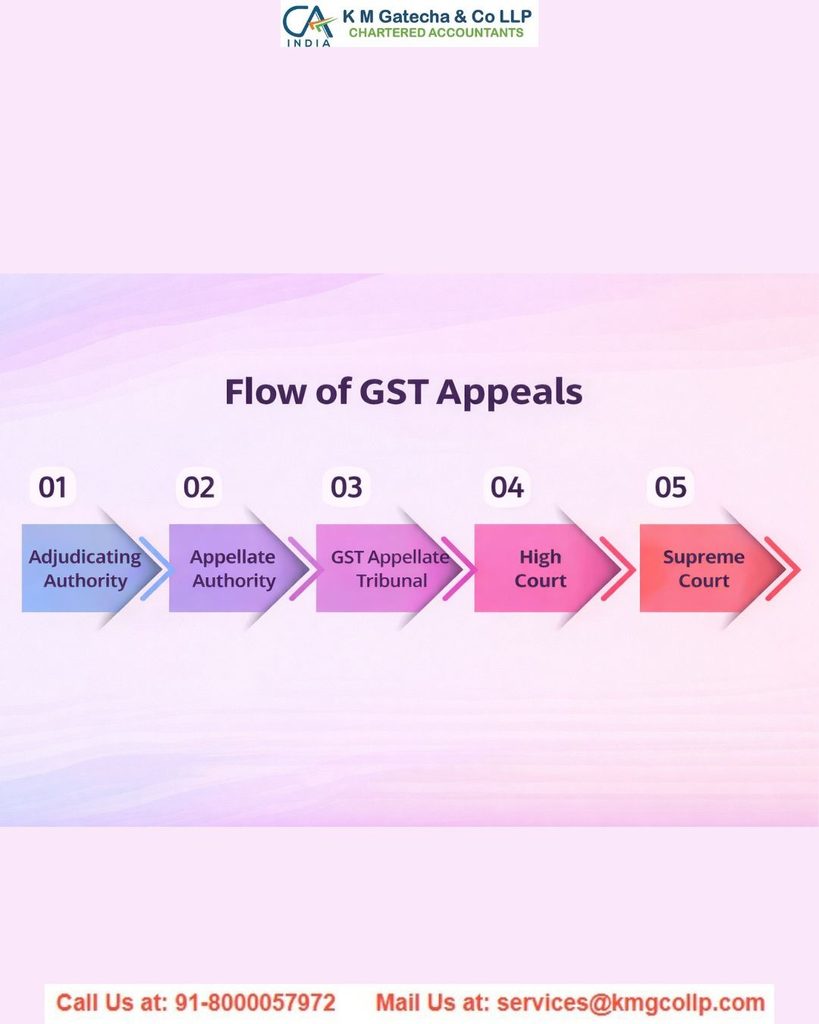
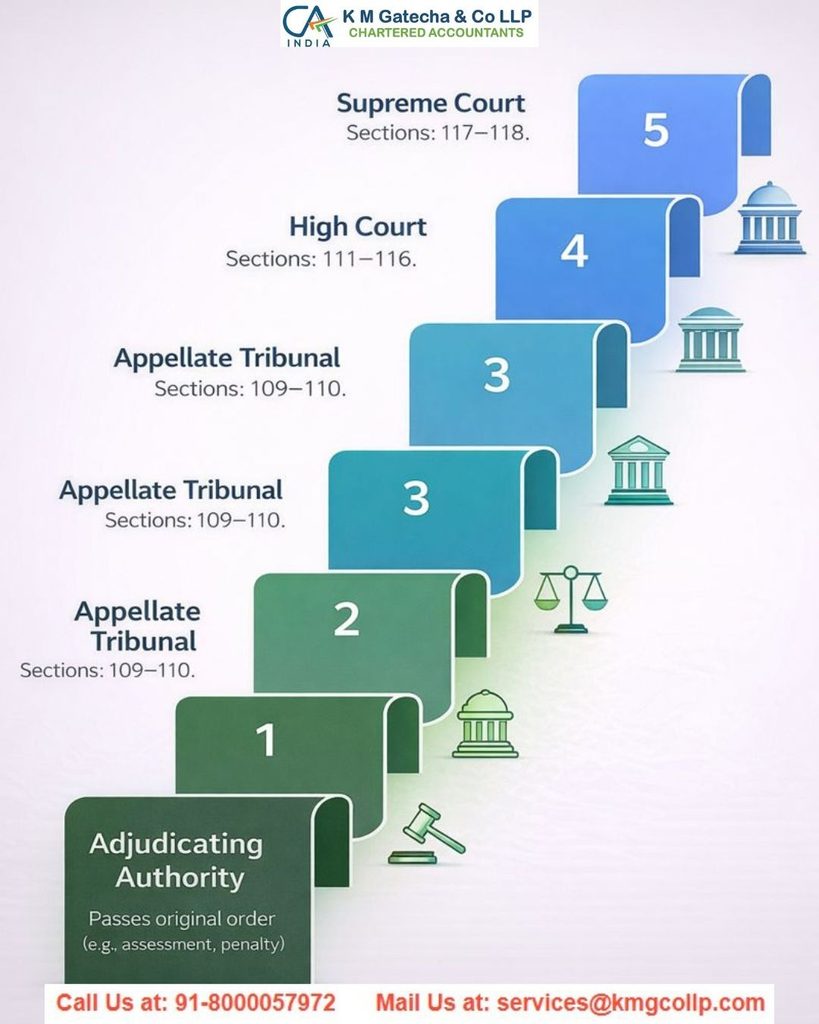
Hierarchy of Appeals Under GST
- First Appeal: Appellate Authority – Section 107
- Second Appeal: GST Appellate Tribunal (GSTAT) – Section 112
- Further Appeals:
- High Court (for substantial questions of law)
- Supreme Court of India (final appellate authority)
What Is a GST Refund?
A GST refund refers to the amount that a registered taxpayer can claim back when they have paid excess GST beyond their actual tax liability. This situation may arise due to excess tax payment, accumulation of input tax credit, or other eligible circumstances under GST law.
To claim a refund, the taxpayer must submit a refund application on the GST portal, furnishing all required details. This includes the refund amount, relevant supporting documents, and any additional information prescribed under the GST rules.
Once the application is filed, the tax authorities examine and verify the claim. If the refund is found to be valid and in compliance with GST provisions, the amount is approved and credited to the taxpayer. The entire process is designed to ensure accuracy, transparency, and adherence to GST refund regulations.
When Can You Claim a GST Refund?
A GST refund can be claimed in several situations where excess tax has been paid or credit has accumulated. Common scenarios include:
- Excess Tax Payment: When GST is paid in excess due to calculation errors, wrong tax rates, or incorrect reporting.
- Accumulated Input Tax Credit (ITC): When ITC builds up because of the supply of exempt, nil-rated, or zero-rated goods or services.
- Exports and Deemed Exports: Exporters, including those making deemed exports, can claim refunds of GST paid on goods or services supplied for export, subject to prescribed conditions.
- Refunds to Embassies and UN Organizations: Refunds of GST paid on purchases made by embassies or organizations associated with the United Nations, as permitted under GST law.
- Refunds to Foreign Tourists: Eligible foreign visitors may claim GST refunds on goods purchased during their stay in India, as per applicable rules.
- Refunds After Certifications or Clearances: Where refunds become available upon completion of specific certifications, approvals, or statutory clearances.
GST Payment for Different Taxpayers
The Goods and Services Tax (GST) is a major tax reform designed to simplify and unify the indirect tax system. Under the GST framework, taxpayers are required to make timely tax payments based on their business activities, turnover, and applicable tax liability. This section provides an overview of GST payment procedures applicable to different categories of taxpayers.
GST Payment for Regular Businesses
Regular businesses registered under GST must pay tax on their taxable supplies after adjusting eligible Input Tax Credit (ITC). The GST payment process generally involves the following steps:
- Compute Tax Liability
Calculate the total GST payable by deducting eligible Input Tax Credit from the output tax liability for the relevant tax period. - Generate GST Challan
Log in to the GST portal and generate a challan by entering the required details, including the amount of tax payable. - Select Payment Mode
Choose a suitable payment option such as internet banking, NEFT, RTGS, or authorized GST payment service providers. - Make the Payment
Complete the payment using the selected mode and confirm the transaction on the portal. - Record the Payment
After successful payment, update the transaction details in your accounting records for compliance and audit purposes.
GST Payment for Composition Scheme Taxpayers
Taxpayers registered under the GST Composition Scheme—generally small businesses—are allowed to pay GST at a fixed rate based on their turnover, instead of the regular GST rates. This simplified scheme reduces compliance burden and streamlines tax payments.
The GST payment process for composition scheme taxpayers involves the following steps:
- Determine Applicable Turnover
Calculate the turnover of the previous financial year or the current financial year, as applicable under the scheme. - Compute Tax Liability
Apply the prescribed composition tax rate to the turnover to arrive at the total GST payable. - Generate GST Challan
Log in to the GST portal and generate a challan by entering the calculated tax liability details. - Select Payment Mode
Choose a suitable payment method such as internet banking, NEFT, RTGS, or other authorized payment options. - Complete Payment and Record Transaction
Make the payment and ensure the transaction details are properly recorded in your books of accounts for future reference and compliance.
GST Payment and Compliance for Input Service Distributors (ISD)
An Input Service Distributor (ISD) is a registered office of a business that receives invoices for input services and distributes the eligible Input Tax Credit (ITC) to its branches or units having the same PAN. The ISD mechanism ensures proper and lawful allocation of credit across multiple locations.
Process for Distributing Input Tax Credit as an ISD
- Check ISD Eligibility
Ensure that the entity is registered as an ISD under GST and receives invoices for input services on behalf of multiple branches or units. - Identify Eligible Input Services
Only credit related to input services (not goods or capital goods) can be distributed by an ISD. - Distribute Input Tax Credit
Allocate ITC to recipient units based on their proportionate turnover or actual usage, in accordance with GST rules. - Issue ISD Invoice or Credit Note
Distribute the credit by issuing an ISD invoice or ISD credit note to the respective branches through the GST system. - File ISD Return (GSTR-6)
Submit Form GSTR-6 monthly, detailing the ITC received and distributed to each unit. This enables the recipient units to claim the credit. - Maintain Proper Records
Keep accurate documentation of invoices received, ITC distribution, and returns filed to ensure audit readiness and compliance.
Important Note on GST Payments by ISD
- ISDs do not pay GST through challans for ITC distribution.
- Their primary responsibility is distribution of eligible ITC, not payment of tax liability.
- Any ineligible credit must be reversed as per GST provisions.
Choosing the Right Mode for Making GST Payments
Making timely Goods and Services Tax (GST) payments is crucial for all taxpayers to ensure compliance and avoid penalties. With multiple payment options available, selecting the mode that best suits your needs is important.
When deciding on a payment method, consider factors such as:
- Digital familiarity – Are you comfortable using online banking or payment portals?
- Transaction security – Ensure the method chosen is safe and traceable.
- Convenience – Some modes may be quicker or easier depending on your setup.
- Transaction charges – Certain modes may incur additional fees.
Whether paying via net banking, NEFT, RTGS, or through the GST portal, the key is to ensure that payments are made accurately and on time. Being informed about payment options and updates to the GST payment process allows businesses to navigate compliance efficiently.
General Rules for Filing GST Appeals
GST appeals provide taxpayers a legal mechanism to contest decisions made by tax authorities. Understanding the general rules ensures a smooth and effective appeal process.
Key Steps for Filing a GST Appeal
- Identify the Appellate Authority
Determine the correct authority to approach. Appeals are generally filed with the Appellate Authority for Advance Ruling (AAAR) at the state or national level, depending on the nature of your case. - Review the Decision
Carefully examine the GST order or decision. Identify the grounds of disagreement and gather all supporting documents and evidence to substantiate your case. - Adhere to Timelines
Filing deadlines are critical. Generally, an appeal must be submitted within 30 days from the date of communication of the order. Missing deadlines can result in dismissal. - Prepare a Clear Appeal Statement
Draft a concise statement outlining:- The facts of the case
- Disputed issues
- Grounds for disagreement
- Relief sought
- Ensure the appeal is structured logically and all relevant details are included.
- Submit Supporting Documents
Attach invoices, contracts, correspondence, or any other relevant records that support your appeal. Properly organise and reference documents to make it easy for the authority to review. - Seek Professional Assistance (if needed)
Complex cases may benefit from guidance by GST consultants or legal experts. Their expertise can strengthen your appeal and ensure compliance with procedural requirements. - Follow Prescribed Format and Pay Fees
Verify the specific format required for filing the appeal and ensure any applicable fees are paid. Adhering to the official format helps avoid procedural rejection. - Track Appeal Status
After submission, monitor the progress of your appeal. Attend hearings or provide additional information if requested by the authority. Timely cooperation ensures smooth processing.
Final Note
Filing GST appeals requires attention to detail, adherence to deadlines, and proper documentation. Following these general rules ensures that your appeal is considered fairly, allowing you to challenge incorrect tax decisions effectively. A well-prepared appeal can significantly improve your chances of a favorable outcome and uphold fairness in taxation matters.
Disclaimer: The content on this website is for informational purposes only and does not constitute legal, financial, or professional advice. Please consult qualified experts before acting on any information. K M GATECHA & CO LLP accepts no liability for errors, omissions, or outcomes from the use of this content. This site is not an advertisement or solicitation.

