Understanding TDS on Sale of Property in India by NRIs
Non-Resident Indians (NRIs), Persons of Indian Origin (PIOs), and Overseas Citizens of India (OCIs) frequently invest in real estate across India. When such properties are sold, certain tax obligations arise — one of the key being Tax Deducted at Source (TDS). This section explains the TDS implications for NRIs who sell property in India.

TDS on Property Transactions by NRIs
NRIs are permitted to sell residential or commercial property to resident Indians or to another NRI/OCI. However, if the property inherited is agricultural land, it can only be sold to resident Indians. Irrespective of the property category — residential, commercial, or agricultural — the sale of property by an NRI in India attracts TDS under the Income Tax Act, 1961.
At the time of payment, the buyer must deduct a specified portion of the sale consideration as TDS and deposit it with the Government of India. The NRI seller can later claim credit for this deducted tax while filing their income tax return (ITR), where the capital gains are reported. This rule applies uniformly, whether the buyer is a resident Indian or another NRI, PIO, or OCI.
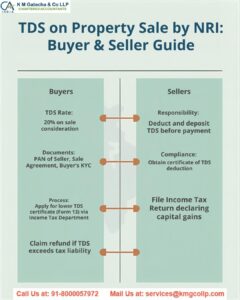
Determining the Applicable TDS Rate
The TDS rate on the sale of property by an NRI depends on several key factors, such as:
- Type of Capital Gain: If the property has been held for more than 24 months, the profit is treated as a Long-Term Capital Gain (LTCG); if held for less, it is classified as a Short-Term Capital Gain (STCG).
- Tax Regime Chosen: The applicable rate varies depending on whether you have opted for the old or new tax regime.
- Income Tax Slab: Your individual income tax slab rate also influences the TDS amount.
- Lower Deduction Certificate (LDC): If you have obtained a Lower Tax Deduction Certificate, TDS will be deducted at the reduced rate specified in the certificate.
Note: For properties inherited by NRIs, the holding period of the previous owner is also counted when determining whether the gain qualifies as LTCG or STCG.

Effective TDS Rates on Long-Term Capital Gains (LTCG) for NRIs in India
The table below outlines the effective TDS rates applicable to NRIs based on their total income levels and the type of capital gains earned from the sale of property in India.
For the best viewing experience, use a desktop or switch your mobile device to landscape mode. Swipe horizontally to view the complete table on mobile.
| Particulars | Total income less than ₹50 lakh | Total income between ₹50 lakh and ₹1 crore | Total income more than ₹1 crore |
| Capital Gain Tax Rate | 12.5% (without indexation) | 12.5% (without indexation) | 12.5% (without indexation) |
| Add: Surcharge | Nil | 10% of the above tax | 15% of the above tax |
| Total Tax Rate | 12.5% | 13.75% | 14.375% |
| Add: Health & Education Cess | 4% of total tax rate | 4% of total tax rate | 4% of total tax rate |
| Effective TDS Rate | 13% | 14.3% | 14.95% |
These rates reflect the effective TDS liability applicable on long-term capital gains arising from the sale of property by NRIs in India.
Effective TDS Rates on Short-Term Capital Gains (STCG) for NRIs in India
The table below provides the effective TDS rates applicable to NRIs based on their total income levels for short-term capital gains arising from the sale of property in India.
For optimal viewing, it’s recommended to use a desktop or switch your mobile device to landscape mode. On mobile, swipe horizontally to view the full table.
| Particulars | Total income less than ₹50 lakh | Total income between ₹50 lakh and ₹1 crore | Total income more than ₹1 crore |
| Capital Gain Tax Rate | 30% | 30% | 30% |
| Add: Surcharge | Nil | 10% of the above tax | 15% of the above tax |
| Total Tax Rate | 30% | 33% | 34.5% |
| Add: Health & Education Cess | 4% of total tax rate | 4% of total tax rate | 4% of total tax rate |
| Effective TDS Rate | 31.2% | 34.32% | 35.88% |
These rates indicate the applicable TDS that must be deducted on short-term capital gains earned by NRIs from property transactions in India.
Reducing TDS Liability with a Lower Deduction Certificate (LDC)
Although your total tax liability does not change, as an NRI, you can minimize your TDS amount by obtaining a Lower Deduction Certificate (LDC) from the Income Tax Department. This allows TDS to be deducted at a reduced rate instead of the standard rate.
Before completing the sale transaction, you can register on the TRACES portal and apply online for an LDC using Form 13, submitting all necessary supporting documents to your Income Tax Assessing Officer (AO) in India. To justify the lower deduction, you must disclose:
- The Long-Term or Short-Term Capital Gain (LTCG/STCG) arising from the property sale, and
- Your estimated total income in India for the current financial year.
Once approved, the AO will issue an LDC valid for a specified period related to the transaction. It is important to verify that your LDC remains valid throughout the sale process.
Alternatively, the buyer may also contact the AO to determine the applicable reduced TDS rate for the seller before making the payment.
However, if neither party obtains an LDC, the buyer must deduct TDS on the entire sale consideration at the maximum applicable rate, assuming the full amount is taxable as capital gain.
Scenario 1: When LDC Is Not Obtained
Amit, an NRI, sold a plot in Mumbai to Rahul, a resident, for ₹1.5 crore in July 2023. The plot was purchased in January 2020. Since Amit held the property for more than 24 months, it qualifies as a long-term capital asset, making it subject to 20% TDS, along with surcharge and cess.
Amit did not apply for a Lower Deduction Certificate (LDC), so Rahul computed TDS on the entire sale consideration of ₹1.5 crore.
TDS Computation:
| Particulars | Amount (₹) |
| A. Sale consideration | 1,50,00,000 |
| B. Tax rate @12.5% on (A) | 18,75,000 |
| C. Surcharge @15% on (B) | 2,81,250 |
| D. Total tax (B + C) | 21,56,250 |
| E. Health & Education cess @4% on (D) | 86,250 |
| F. Total TDS (D + E) | 22,42,500 |
| TDS rate (F/A) | 14.95% |
Hence, Rahul deducted ₹22,42,500 as TDS from the total sale amount.
Scenario 2: When LDC Is Obtained (TDS Deducted at a Lower Rate)
In this case, Amit obtained an LDC from the Assessing Officer (AO) before the sale. Amit purchased the plot in January 2020 for ₹1.2 crore and disclosed this to the AO. The AO determined the indexed cost of acquisition to calculate the capital gains and apply a reduced TDS rate.
Indexed Cost of Acquisition Formula:
Indexed Cost of Acquisition=Cost of Acquisition×CII of Transfer YearCII of Acquisition Year\text{Indexed Cost of Acquisition} = \text{Cost of Acquisition} \times \frac{\text{CII of Transfer Year}}{\text{CII of Acquisition Year}}Indexed Cost of Acquisition=Cost of Acquisition×CII of Acquisition YearCII of Transfer Year
Using the Cost Inflation Index (CII):
- CII for 2020 = 289
- CII for 2023 = 348
₹1.2 crore×348289=₹1.45 crore₹1.2\,\text{crore} \times \frac{348}{289} = ₹1.45\,\text{crore}₹1.2crore×289348=₹1.45crore
Revised TDS Calculation:
| Particulars | Amount (₹) |
| A. Sale consideration | 1,50,00,000 |
| B. Less: Indexed cost of acquisition | 1,20,00,000 |
| C. Capital gain (A – B) | 30,00,000 |
| D. Tax rate @12.5% on (C) | 3,75,000 |
| E. Health & Education cess @4% on (D) | 15,000 |
| F. Total TDS (D + E) | 3,90,000 |
| TDS rate as per LDC (F/A) | 2.6% |
(Refer to the latest Cost Inflation Index as per the Finance Act, 2024 on incometaxindia.gov.in)
Amit shared the LDC with Rahul, who then deducted TDS at 2.6% instead of 14.95%.
Thus, while Amit’s total tax liability remains unchanged, obtaining an LDC helped reduce his upfront TDS from ₹22,42,500 to ₹3,90,000 — saving ₹18,52,500 on the property sale.
Ensuring TDS Compliance as a Seller
Although the buyer is responsible for deducting TDS from the sale proceeds, the seller must also ensure full compliance from their side. This involves:
- Declaring your residential status accurately at the time of the property sale.
- Obtaining the TDS certificate (Form 16A) from the buyer within 15 days of filing the TDS return.
- Reconciling the TDS amount reflected in Form 26AS with the details in Form 16A.
- Claiming the TDS credit shown in Form 26AS while filing your Indian income tax return.
Consequences of Non-Compliance
Failure to comply with TDS regulations can lead to consequences for both the buyer and the seller.
- The buyer may face penalties and interest charges for not deducting or depositing TDS on time.
- The seller could encounter delays in repatriating sale proceeds overseas, as taxes must be settled before funds are transferred.
Additionally, misrepresentation of residency status to avoid TDS deductions can attract legal action. Therefore, sellers should ensure that the buyer properly adheres to TDS requirements.
Impact of Double Taxation Avoidance Agreements (DTAA)
NRIs can benefit from DTAA provisions under agreements between India and their country of residence. However, many nations — including the United States — do not extend DTAA benefits to property sales. Hence, consulting a qualified tax or legal advisor is recommended before proceeding.
Conclusion
For NRIs selling property in India, understanding TDS provisions is essential. Applying for a Lower Deduction Certificate (LDC) can help reduce the immediate tax outflow. While TDS deduction is primarily the buyer’s responsibility, sellers must ensure correct residency declaration, document verification, and compliance throughout the process.
Disclaimer: The content on this website is for informational purposes only and does not constitute legal, financial, or professional advice. Please consult qualified experts before acting on any information. K M GATECHA & CO LLP accepts no liability for errors, omissions, or outcomes from the use of this content. This site is not an advertisement or solicitation.