
Annual Compliance of LLP
A Limited Liability Partnership (LLP) is a separate legal entity registered with the Ministry of Corporate Affairs (MCA). Therefore, designated partners are responsible for maintaining proper books of accounts and filing mandatory annual returns with regulatory authorities each financial year. Timely compliance ensures that the LLP maintains its legal status and avoids heavy penalties.
Unlike Private Limited Companies, LLPs have relatively simpler compliance requirements. LLPs are not required to conduct a statutory audit unless their annual turnover exceeds ₹40 lakh or partner contribution exceeds ₹25 lakh. If these thresholds are not crossed, the LLP can complete its annual filings without undergoing an audit, making the compliance process simpler and more cost-effective.
However, even though compliance requirements are fewer, penalties for non-compliance can be significant. Failure to file required forms on time can lead to daily penalties, legal complications, and possible strike-off of the LLP by regulatory authorities.
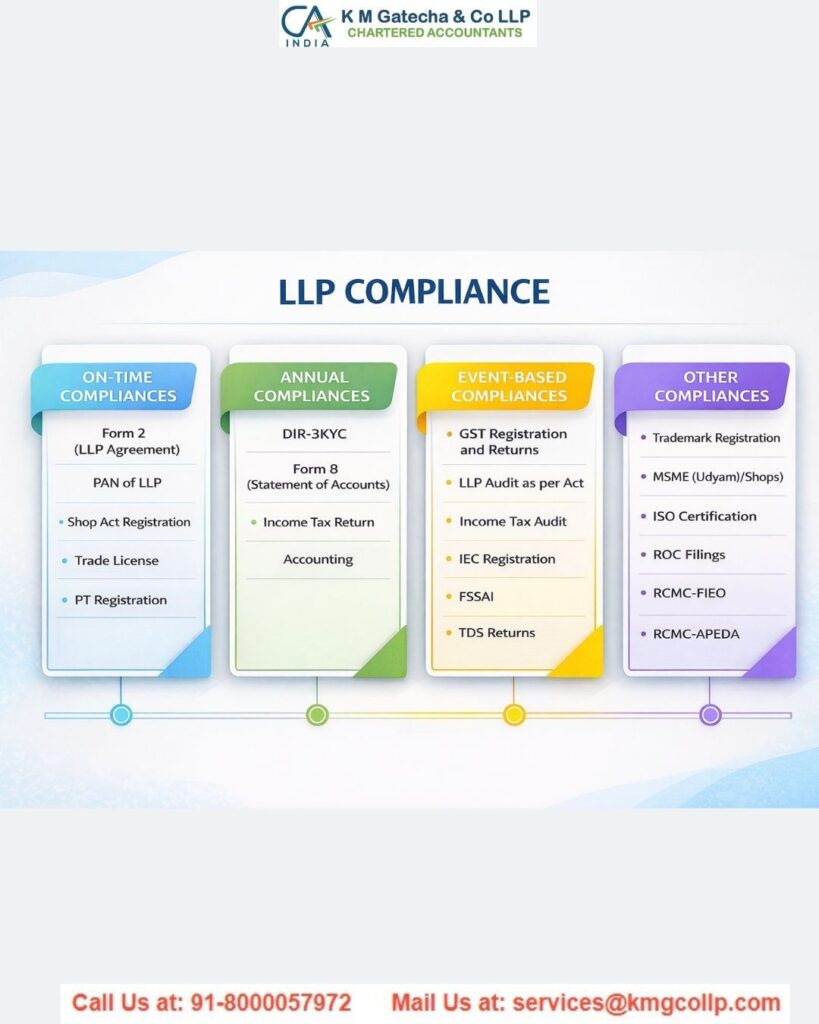
Overview of Annual Compliance of LLP – What Do You Mean by LLP?
A Limited Liability Partnership (LLP) is a separate legal entity incorporated under the Limited Liability Partnership Act, 2008 and regulated by the Ministry of Corporate Affairs (MCA) in India. It combines the benefits of a traditional partnership with the advantages of limited liability protection for partners.
To register an LLP in India, a minimum of two partners is required, and at least one designated partner must be an Indian resident. Partners are responsible for managing the business operations and ensuring compliance with statutory requirements, including maintaining financial records and filing annual returns.
Every LLP must comply with certain mandatory requirements each financial year to maintain its active legal status. These include:
- Maintaining proper books of accounts
- Filing the Statement of Accounts and Solvency (Form 8)
- Filing the Annual Return (Form 11)
- Filing the Income Tax Return (ITR-5)
- Completing partner KYC requirements (DIR-3 KYC, if applicable)
Compared to Private Limited Companies, LLPs have fewer compliance obligations. However, penalties for non-compliance can still be substantial and may accumulate over time if filings are delayed.
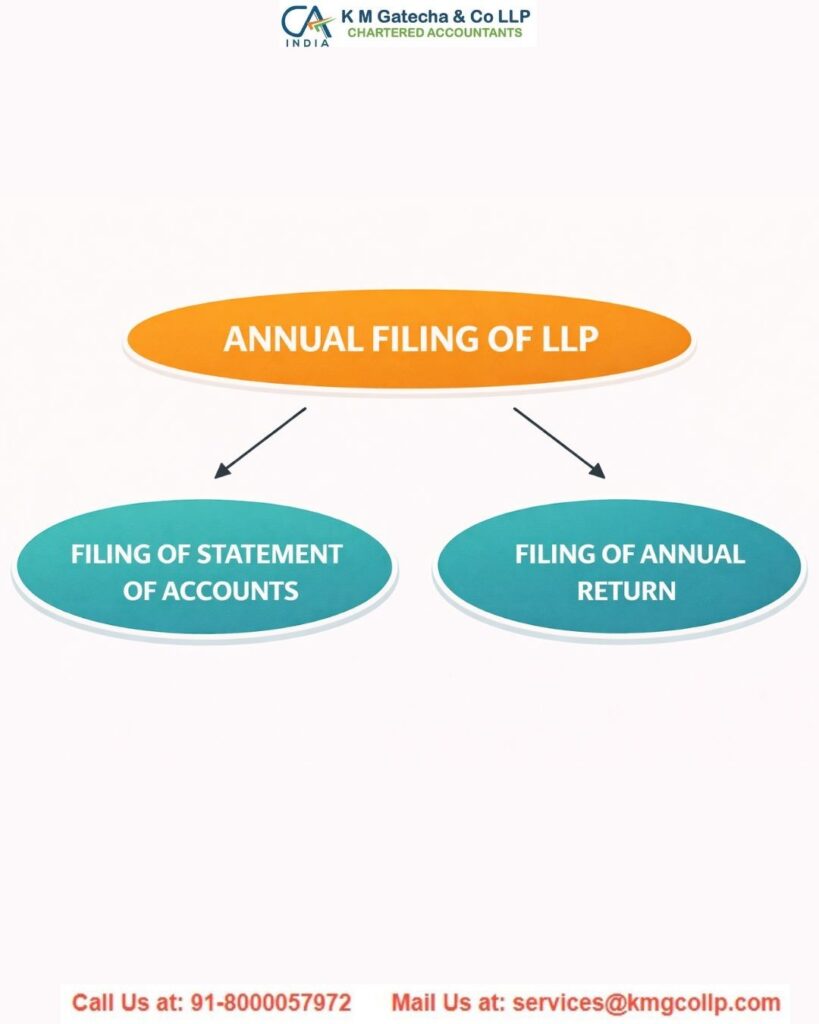
Protection of Limited Liability Partnership (LLP)
A Limited Liability Partnership (LLP) provides a strong legal framework that protects partners while allowing operational flexibility. One of the most important advantages of an LLP is that it is recognized as a separate legal entity, meaning it can own assets, enter contracts, and continue operations independently of its partners. This structure ensures that partners are protected from personal liability arising from business obligations or the actions of other partners.
The concept of limited liability is particularly beneficial for professionals, startups, and small businesses, as it reduces financial risk while maintaining a partnership-style management structure.
Significant Benefits and Powers Enjoyed by LLPs
LLPs enjoy several legal powers and operational advantages that make them a preferred business structure in India. Below are the key benefits and protections provided by an LLP:
Power to Sue and Be Sued
An LLP has the legal authority to initiate legal proceedings or defend itself in court in its own name, just like a company.
Power to Open and Operate Bank Accounts
An LLP can open bank accounts in its registered name to manage business transactions independently of its partners.
Power to Employ Staff
LLPs can recruit employees, consultants, and professionals to support business operations and growth.
Power to Enter Legal Contracts
An LLP can enter into contracts, agreements, and commercial arrangements with clients, vendors, and service providers.
Limited Liability Protection for Partners
In an LLP, one partner is not personally liable for the negligence or misconduct of another partner. Each partner’s liability is limited to their agreed contribution.
Direct Participation in Business Management
Partners have the flexibility to manage business operations directly without the need for a complex corporate governance structure.
Separate Legal Identity
An LLP exists as a separate legal entity distinct from its partners. It can own property, incur liabilities, and continue operations regardless of changes in partnership.
Separate Assets and Accounts
The assets and financial records of an LLP are maintained separately from those of its partners or promoters.
Flexible Partner Structure
An LLP can have an unlimited number of partners after incorporation, allowing for business expansion and investment opportunities.
Continuity of Business
If the number of partners falls below two, the remaining partner is allowed time to appoint a new partner without immediate dissolution of the LLP.
Access to Funding Sources
An LLP can raise funds from partners, banks, and financial institutions such as Non-Banking Financial Companies (NBFCs).
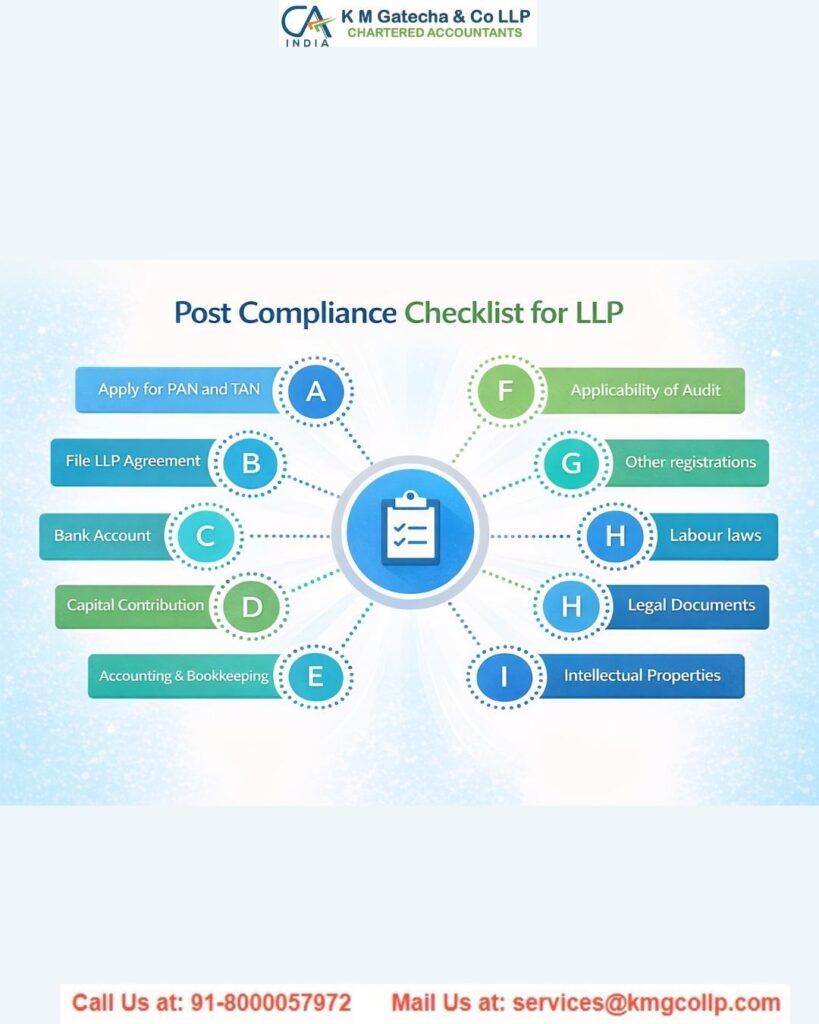
Checklist Details for Filing Annual Compliance of LLP
Every registered LLP must complete annual compliance filings with the Registrar of Companies (RoC) within prescribed timelines. These filings are mandatory even if the LLP has not conducted any business activity during the financial year.
Key compliance requirements include:
- Annual Return must be filed with the Registrar of Companies (RoC)
- Filing must be completed using the prescribed LLP Form 11 format
- The filing must be completed within 60 days from the end of the financial year
- The due date for Annual Return filing is May 30 each year
- Compliance is mandatory even if:
- The LLP has no business activity
- The LLP has been inactive during the year
- The LLP does not have a bank account
- The LLP has minimal transactions
Maintaining regular compliance helps prevent penalties and ensures that the LLP remains legally active.
Documents Needed for Annual Filing of Compliance for LLP
To complete annual compliance filings smoothly, LLPs must maintain accurate and updated documentation. Below is a comprehensive list of documents required for annual compliance.
Basic LLP Documents
- PAN Card and Certificate of Incorporation (COI) of the LLP
- LLP Agreement, including any supplementary or amended agreements
- LLP Identification Number (LLPIN) verification details
- Name of the LLP and proof of registration
- Registered Office Address Proof
Financial and Compliance Documents
- Financial Statements of the LLP duly signed by designated partners
- Bank statements for the relevant financial year
- Details of total capital contribution by partners
- Records of business activities and transactions
- Details of penalties or legal notices, if any
- Information on any compounding of offenses, if applicable
Partner and Management Details
- Details of designated partners and partners of the LLP
- Digital Signature Certificate (DSC) of all designated partners
- Identification and contact details of partners
- Details of partners holding positions in other companies or LLPs
Maintaining these documents in an organized manner ensures smooth compliance filings, reduces delays, and helps the LLP remain legally compliant with regulatory authorities.
Timeline for LLP Annual Filing and Compliance
Every Limited Liability Partnership (LLP) must follow a structured timeline to complete annual compliance requirements with the Ministry of Corporate Affairs (MCA) and the Income Tax Department. A clear compliance timeline ensures timely filings, avoids penalties, and maintains the LLP’s active legal status.
LLP Annual Filing
LLPs are required to file mandatory annual returns with the MCA and maintain proper compliance records each financial year. These filings confirm the LLP’s financial position and management structure.
Annual Return Preparation
The annual return is prepared based on financial statements, business transactions, and partner details from the previous financial year. Accurate preparation ensures compliance with statutory requirements.
Annual Return Verification
All information is reviewed and verified based on documents submitted by the LLP. The prepared return is then shared with partners for confirmation and approval before submission.
Finalization and Filing
After receiving approval, the annual return is filed with the Ministry of Corporate Affairs along with all required attachments and supporting documents. Confirmation receipts are generated upon successful submission.
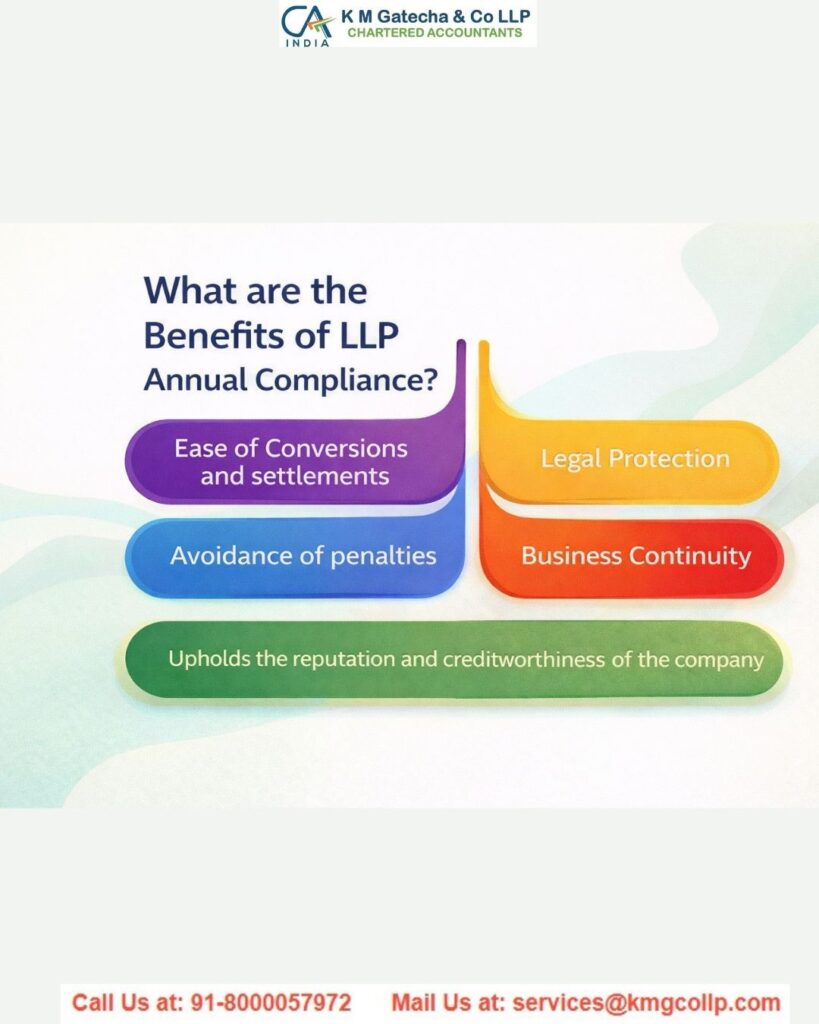
Key Compliance Requirements for LLP Annual Filing
1. Declaration of Accounts and Solvency (Form 8)
All registered LLPs are required to maintain proper books of accounts and submit financial details regarding profits, expenses, assets, and liabilities through Form 8 – Statement of Accounts and Solvency each year.
Important details:
- Form 8 must be signed by designated partners
- The form must be certified by a practicing Chartered Accountant (CA), Company Secretary (CS), or Cost Accountant
- Due date for filing: October 30 each year
- Late filing penalty: ₹100 per day until filing is completed (no maximum limit)
Timely filing of Form 8 ensures that the LLP remains compliant with financial reporting requirements.
2. Filing of Annual Return (Form 11)
Every LLP must submit an annual return using Form 11, which provides a summary of the LLP’s management structure and partner details.
Key details included in Form 11:
- Number of partners and designated partners
- Names and contribution details of partners
- Registered office details
- Changes in partnership structure, if any
Important compliance points:
- Due date for filing: May 30 each year
- Mandatory for all LLPs, regardless of turnover or business activity
- Late filing penalty: ₹100 per day without any maximum limit
Form 11 is a critical compliance document that confirms the legal status and structure of the LLP.
3. Filing and Audit Obligation Under the Income Tax Act
Under the Income Tax Act, LLPs must file income tax returns and conduct audits based on financial thresholds.
Audit requirement applies if:
- Annual turnover exceeds ₹40 lakh, or
- Total partner contribution exceeds ₹25 lakh
Important deadlines:
- Tax Audit Report: Due by September 30
- Income Tax Return (ITR-5):
- July 31 (for non-audit cases)
- October 31 (for audit cases)
Failure to comply with tax filing requirements may result in penalties, interest charges, and legal consequences.
Privileges of LLP Compared to a Private Limited Company
A Limited Liability Partnership offers several operational and compliance advantages compared to a Private Limited Company. These benefits make LLPs an attractive option for professionals, startups, and small businesses.
No Requirement to Maintain Extensive Statutory Registers
LLPs are not required to maintain detailed statutory registers and minute books like companies, reducing administrative burden.
No Mandatory Annual General Meeting (AGM)
Unlike companies, LLPs are not required to conduct Annual General Meetings because there are no shareholders in an LLP structure.
No Mandatory Board Meetings
There is no requirement for formal board meetings in an LLP. Instead, partners manage operations directly and may hold meetings as needed.
Unlimited Number of Partners
An LLP can have any number of partners, allowing flexibility for expansion and investment.
Simplified Compliance Structure
Overall compliance requirements for LLPs are simpler and less time-consuming compared to those for Private Limited Companies.
Understanding Form 11 – Detailed Overview
Form 11 is the mandatory annual return that every LLP must file with the Ministry of Corporate Affairs each year. This filing is required regardless of whether the LLP has conducted business operations during the financial year.
Purpose of Form 11:
Form 11 provides a summary of the LLP’s organizational structure, partner details, and compliance status.
Information required in Form 11 includes:
- Name and registered address of the LLP
- Details of partners and designated partners
- Total capital contribution by partners
- Changes in partnership during the financial year
- Details of penalties imposed or offenses compounded, if any
The form can be filed electronically through the MCA portal, which includes a pre-fill feature to simplify data entry.
Documents to Be Submitted Along with Form 11
The following documents may be required when filing Form 11:
- Details of LLPs or companies in which partners or designated partners hold positions as directors or partners
- Information regarding changes in partners or capital contribution
- Supporting documents for compliance disclosures
- Any additional information as optional attachments, if required
Providing accurate and complete documentation ensures smooth processing of the annual return and helps maintain the LLP’s compliance status.
Important Due Dates for LLP Annual Filing for FY 2019–20
Limited Liability Partnerships (LLPs) must comply with specific statutory deadlines for filing annual returns and financial statements. Meeting these deadlines is essential to avoid penalties and maintain the LLP’s active legal status with the Ministry of Corporate Affairs (MCA) and the Income Tax Department.
LLP Form 11 Due Date for Annual Return Filing
The due date for filing LLP Form 11, which is the annual return of an LLP, for the financial year 2019–20 was:
30 May 2020
Form 11 provides details about the LLP’s partners, management structure, and contribution information. Filing this form on time ensures that the LLP remains compliant with MCA regulations.
Due Date for Income Tax Return (ITR) Filing for LLP
The due date for filing income tax returns depends on whether the LLP is required to undergo a tax audit under the Income Tax Act.
Key Due Dates for FY 2019–20:
- 31 July 2020 – For LLPs not requiring a tax audit
- 30 September 2020 – For LLPs requiring a tax audit
Timely filing of income tax returns helps avoid penalties, interest charges, and legal complications with tax authorities.
LLP Form 8 Due Date – Statement of Accounts and Solvency
The due date for filing LLP Form 8, which contains the Statement of Accounts and Solvency, for the financial year 2019–20 was:
30 October 2020
Form 8 includes financial information such as income, expenses, assets, liabilities, and solvency status of the LLP. This form must be signed by designated partners and certified by a practicing Chartered Accountant, Company Secretary, or Cost Accountant.
Late Fees for Filing LLP Form 8 and Form 11
If there is a delay in filing Form 8 or Form 11, a late fee is applicable under the LLP Act.
Penalty Details:
- Late fee: ₹100 per day
- Applicability: Charged separately for each form
- Duration: From the due date until the actual filing date
- Maximum limit: No maximum cap on penalty amount
Therefore, it is highly recommended for LLPs to complete annual filings within the prescribed timelines to avoid significant financial penalties and ensure continuous compliance.
Disclaimer: The content on this website is for informational purposes only and does not constitute legal, financial, or professional advice. Please consult qualified experts before acting on any information. K M GATECHA & CO LLP accepts no liability for errors, omissions, or outcomes from the use of this content. This site is not an advertisement or solicitation.