
Consultants in Ahmedabad who want to start a professional business with one or more partners can consider forming a Limited Liability Partnership (LLP). An LLP provides a separate legal identity to the business and gives partners limited liability, subject to applicable laws.
For consultants, an LLP can be useful because it combines features of a partnership with the benefits of limited liability. It can also provide a structured way to manage ownership, responsibilities, profits, and business operations.
However, registration is only the first step. After incorporation, the LLP must also follow regular legal, tax, and financial compliance requirements.
What Is an LLP?
A Limited Liability Partnership is a business structure in which two or more partners operate a business together. The LLP has a separate legal identity from its partners.
This means the LLP can enter into contracts, own assets, open a bank account, and conduct business in its own name.
Partners generally have limited liability for the obligations of the LLP, subject to the provisions of the LLP Act and their own actions.
For consultants, this structure can work well for businesses such as management consulting, financial consulting, technology consulting, marketing services, design consulting, engineering services, and other professional services, subject to applicable professional rules.
Why Consultants May Choose an LLP
An LLP can offer several practical benefits:
- Limited liability: Partners generally have limited liability for LLP obligations.
- Separate legal identity: The LLP is legally separate from its partners.
- Flexible management: Partners can decide their roles and responsibilities through the LLP Agreement.
- Suitable for partnerships: It allows two or more professionals to operate under one business structure.
- Continued existence: The LLP can generally continue even when there is a change in partners.
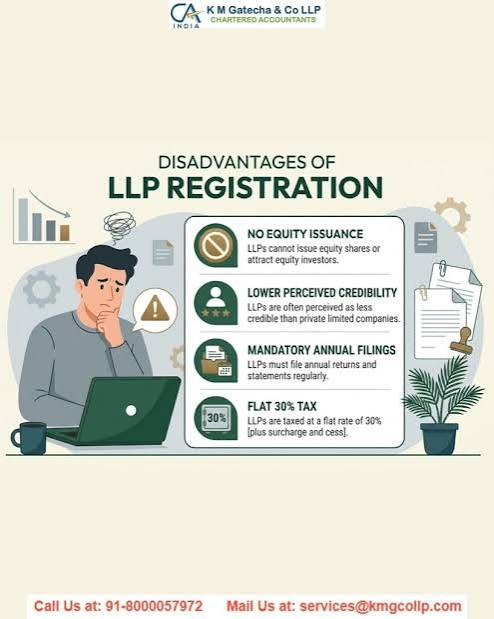
- Lower compliance burden: Compared with a company, an LLP generally has fewer ongoing corporate compliance requirements.
The suitability of an LLP depends on the consultant’s business plans, number of partners, funding requirements, and other factors.
Basic Requirements for LLP Registration
Before starting the registration process, consultants should make sure they meet the basic requirements.
An LLP generally requires at least two partners. At least two designated partners are also required, with at least one designated partner being resident in India as per the applicable requirements.
The LLP also needs a registered office address in India. The partners must provide the required identity, address, and other documents for incorporation.
The proposed name should also follow the applicable naming rules and should not conflict with existing names or trademarks.
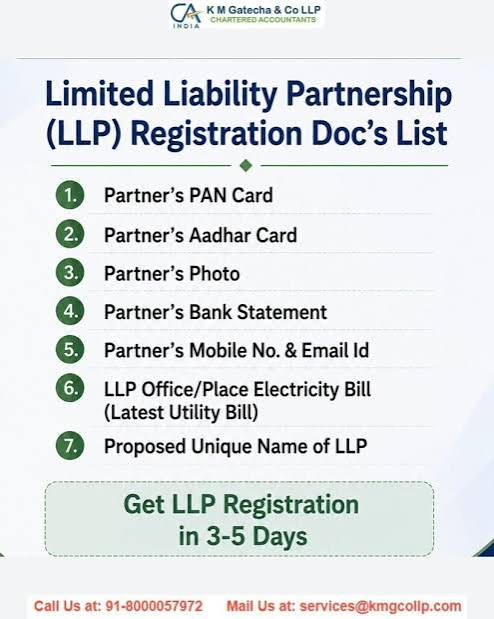
Documents Required for LLP Registration
The exact documents can vary depending on the partners and registered office. Common documents include:
- PAN and identity proof of partners
- Address proof of partners
- Passport-size photographs
- Proof of registered office
- Utility bill or other accepted address proof
- Consent and details of designated partners
- Digital signatures where required
- Documents related to the LLP Agreement
If the registered office is rented, additional documents such as a rent agreement or owner consent may be required.
Providing clear and valid documents can help reduce delays during the registration process.
LLP Registration Process
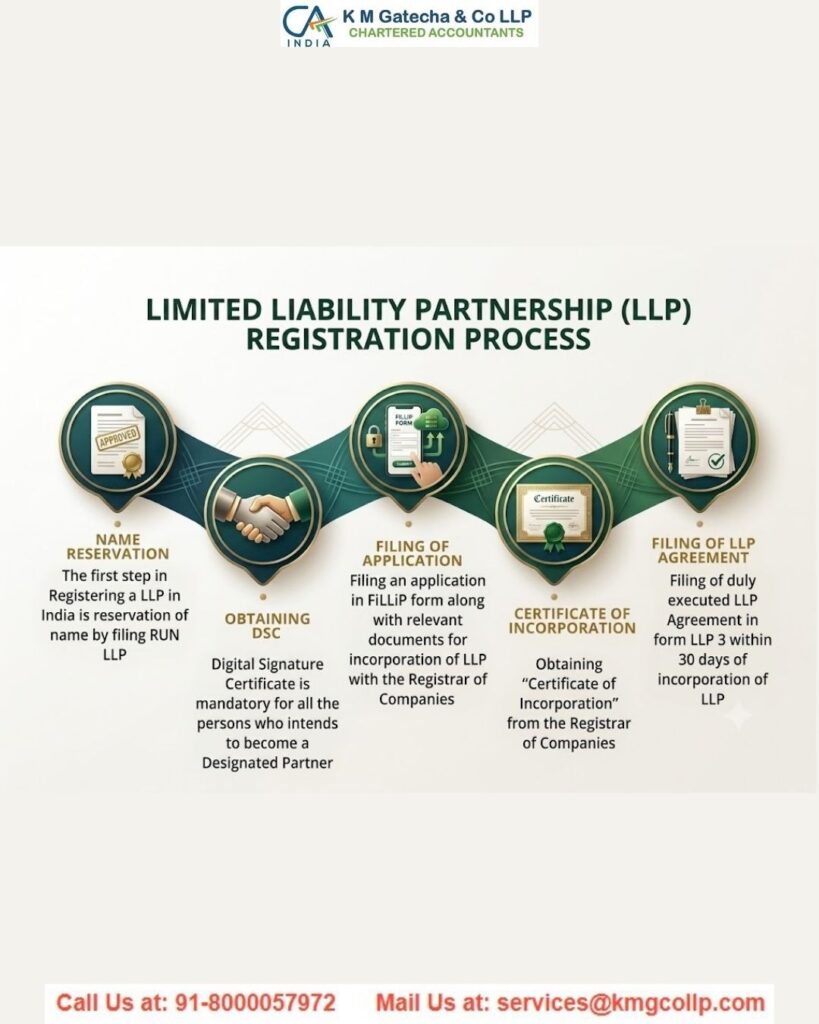
The LLP incorporation process is completed through the Ministry of Corporate Affairs (MCA) system.
The general process includes:
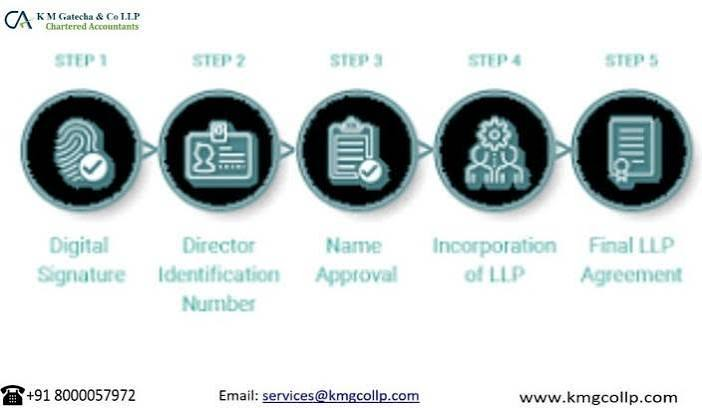
1. Obtain Digital Signatures
Designated partners need digital signatures for signing and submitting electronic forms.
2. Apply for Name Approval
A suitable name is selected and submitted according to the applicable MCA rules.
3. Submit Incorporation Application
The required incorporation details and documents are submitted through the prescribed MCA forms.
4. Receive Certificate of Incorporation
Once the application is approved, the LLP receives its Certificate of Incorporation and LLP identification details.
5. Prepare the LLP Agreement
The partners should prepare an LLP Agreement covering important matters such as capital contribution, profit sharing, partner responsibilities, decision-making, admission or retirement of partners, and dispute resolution.
6. File the LLP Agreement
The required details of the LLP Agreement need to be filed with the MCA within the applicable time limit.
The agreement should be prepared carefully because it forms the basis for how the partners will manage the LLP.
Compliance After LLP Incorporation
Registration does not end the compliance responsibilities of an LLP. Partners need to complete regular filings and maintain proper records.
LLP Agreement
The initial LLP Agreement and relevant changes should be properly documented and filed within the applicable time limit.
Form 11 – Annual Return
LLPs generally need to file Form 11 every year. It contains information about the partners and other required details of the LLP.
The usual due date is 30 May following the end of the financial year.
Form 8 – Statement of Account and Solvency
Form 8 contains information about the LLP’s accounts and financial position. It is generally required to be filed by 30 October each year.
Income Tax Return
The LLP also needs to file its income tax return according to the applicable income tax rules. The due date can vary depending on whether audit requirements apply.
Audit
An LLP may need a statutory tax audit when the applicable turnover or contribution thresholds are crossed. The requirement should be checked based on the LLP’s financial position and current rules.
Why Timely Compliance Matters
LLP compliance should not be ignored after registration. Delayed filings can result in additional fees and may create problems when the LLP needs to apply for registrations, enter into contracts, obtain finance, or provide documents for business transactions.
Keeping accounts updated and maintaining a compliance calendar can help partners track important deadlines.
It is also useful to keep copies of incorporation documents, agreements, financial statements, tax returns, MCA filings, invoices, bank records, and other important documents in an organized manner.
LLP Registration for Consultants in Ahmedabad
The main LLP incorporation process is carried out through the central MCA system, so consultants in Ahmedabad generally follow the same incorporation process as applicants in other parts of India.
However, certain state-level requirements may apply. For example, stamp duty on the LLP Agreement is governed by the applicable state rules. Consultants registering their LLP in Ahmedabad should therefore consider the requirements applicable in Gujarat.
The registered office address also determines the relevant ROC jurisdiction.
LLP vs Private Limited Company for Consultants
Both LLPs and private limited companies can be suitable for professional businesses, but they work differently.
An LLP may be more suitable for consultants who want a partnership-based structure, flexible management, and relatively simpler ongoing compliance.
A private limited company may be more suitable for businesses that plan to raise equity investment, create formal employee stock option plans, or build a structure designed for larger-scale expansion.
The right choice depends on the consultant’s business model, number of founders, funding plans, ownership structure, and long-term goals.
Conclusion
LLP registration can be a practical business structure for consultants in Ahmedabad who want to work with partners while maintaining a separate legal identity and limited liability.
However, consultants should look beyond registration and understand their ongoing compliance responsibilities. Proper documentation, timely MCA filings, tax compliance, accounting records, and a well-drafted LLP Agreement can help create a strong foundation for the business.
Before choosing an LLP, consultants should evaluate their business activities, partnership structure, funding plans, and future goals to determine whether the structure is suitable for them.
Disclaimer: The content on this website is for informational purposes only and does not constitute legal, financial, or professional advice. Please consult qualified experts before acting on any information. K M GATECHA & CO LLP accepts no liability for errors, omissions, or outcomes from the use of this content. This site is not an advertisement or solicitation.