

Business Valuation Services: A Complete Guide to Methods, Process, and Why It Matters
Knowing exactly what a company is worth has become a core part of running a business well, not just something investors ask for. Whether a company is preparing to raise capital, sell a stake, merge with another firm, resolve a dispute among shareholders, or simply wants a clear-eyed view of its financial health, a proper valuation gives owners and decision-makers a factual basis for the choices ahead.
What Is Business Valuation?
Business valuation is the exercise of working out the economic worth of a company, its shares, or its underlying assets at a given point in time. In simple terms, it functions like a financial health check for the business — it looks at earnings, assets, liabilities, cash flow, market position, and future potential to arrive at a defensible figure. That figure then supports decisions ranging from selling the business, bringing in an investor, settling a family or shareholder dispute, or reporting financial results in line with accounting standards.
Why Businesses Need a Valuation
A valuation is rarely done for its own sake — it usually serves a specific purpose. Common situations that call for a professional valuation include:
- Mergers, acquisitions, and sale of a business — to agree on a fair price for the whole company or a stake within it
- Fundraising and investment — investors and lenders want an independent view of what they’re buying into or lending against
- Startup and equity valuation — early-stage companies rely on valuation to negotiate fair equity with investors and attract funding
- Succession and exit planning — owners transferring a business to family members, partners, or a new buyer need a benchmark value
- Estate and gift transfers, and family settlements — including divorce or shareholder disputes, where a business interest must be divided fairly
- Financial reporting — under applicable accounting standards, companies must periodically state the fair value of certain assets and investments
- ESOP and share-based compensation — issuing employee stock options requires a defensible valuation of the underlying shares
- Regulatory and compliance filings — transactions involving foreign investment, transfer pricing, or corporate restructuring often need a valuation report for regulators
- Litigation and expert testimony — courts and tribunals may require an independent valuation opinion in commercial disputes
- Purchase price allocation and impairment testing — used after an acquisition to assign value to acquired assets and goodwill, and to test whether that value still holds up over time
Valuation isn’t reserved for large corporates alone — it is equally relevant for startups negotiating with investors, family-run businesses planning a generational handover, and SMEs seeking bank finance.
The Main Approaches to Valuing a Business
Professional valuers generally rely on three broad approaches, each suited to different kinds of businesses and purposes. A skilled valuer often uses more than one approach and cross-checks the results before finalising a figure.
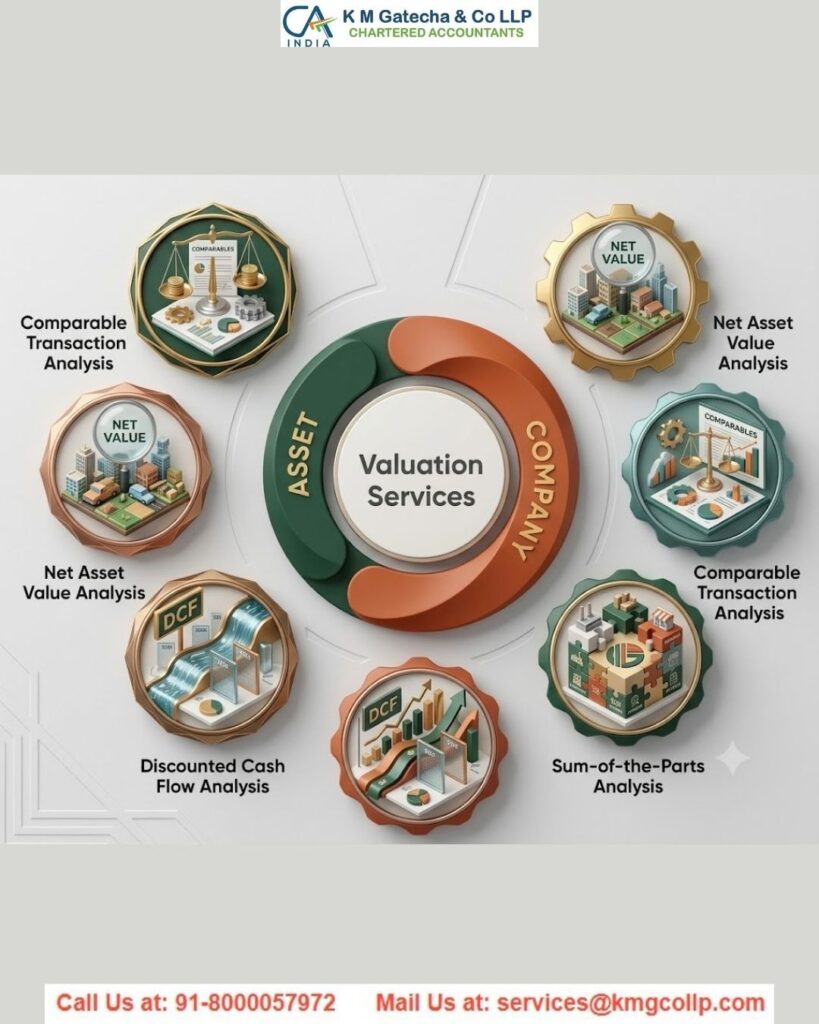
1. Asset-Based Approach
This approach values a business by looking at what it owns minus what it owes. It suits companies with a large base of tangible assets — real estate, machinery, inventory — such as manufacturing or asset-heavy businesses. It includes:
- Book Value Method — values the business based on the figures already recorded in the balance sheet for assets and liabilities.
- Liquidation Value Method — estimates what would be left over if all assets were sold off and every liability paid, typically used for businesses in financial distress or winding up.
- Cost to Duplicate Method — estimates what it would cost to recreate the company’s assets and operations from scratch, often applied to businesses with specialised or proprietary assets such as patented technology.
2. Income Approach (Earning Value)
This approach treats the business as being worth whatever wealth it can generate for its owners in the future. It’s best suited to companies with steady, predictable cash flows. Common methods include:
- Discounted Cash Flow (DCF) Method — projects the company’s future cash flows and discounts them back to today’s value using a rate that reflects the time value of money and the risk involved.
- Capitalisation of Earnings Method — normalises past earnings (adjusting for one-off items) and divides them by a capitalisation rate to arrive at value; suited to companies with stable, predictable earnings.
- Excess Earnings Method — separates the value attributable to tangible assets from the value attributable to intangibles such as patents or trademarks, useful where intangible assets form a significant part of the company’s worth.
3. Market Approach
This approach compares the subject business to similar businesses that have recently been bought, sold, or listed, working on the basic principle that similar assets should command similar prices. It includes:
- Guideline Public Company Method — compares the company’s financial metrics against similar listed companies.
- Guideline Transactions Method — looks at the sale prices of comparable private companies in recent deals.
- Mergers & Acquisitions Method — bases the valuation on prices actually paid in past M&A transactions within the same industry.
4. Industry-Specific and Other Methods
Certain sectors use their own valuation shorthand — for example, valuing a hotel on a price-per-room basis, or a telecom company on a price-per-subscriber basis — because these metrics better reflect how value is actually created in that industry. Beyond the three broad approaches above, valuers may also apply methods such as return-on-investment-based valuation, going-concern valuation, comparable-multiples analysis, or book-value-based approaches, choosing whichever combination best fits the purpose, size, and industry of the business being valued.
What Influences a Company’s Valuation
The final value placed on a business depends on a combination of factors, including:
- Historical and projected financial performance
- Growth prospects and future earnings potential
- The industry environment and prevailing market conditions
- The strength of the asset base, both tangible and intangible (including brand value)
- Quality of management and business operations
- The regulatory environment applicable to the business or transaction
A thorough valuation exercise typically involves reviewing financial statements and performance metrics, applying the appropriate valuation methods, analysing market and industry trends, assessing operational and growth potential, and preparing a detailed report with findings, supporting rationale, and recommendations. Good valuation work also flags risks and opportunities that could affect the number, and supports the client through negotiation once the report is ready.

Who Is Legally Authorised to Conduct a Business Valuation in India
Not every valuation needs to be carried out by a specially registered professional, but for many statutory and regulatory purposes in India, it does. Under Section 247 of the Companies Act, 2013, and the related Companies (Registered Valuers and Valuation) Rules, valuations required for specified purposes must be carried out by a Registered Valuer — a professional accredited and regulated by the Insolvency and Bankruptcy Board of India (IBBI). This framework, in force since 2019, means that before hiring a valuer for a regulatory filing, M&A transaction, insolvency matter, or similar statutory purpose, it’s worth confirming that the valuer holds a valid IBBI registration and certificate of practice. For valuations that fall outside strict regulatory requirements, experienced Chartered Accountants and valuation professionals are also well placed to deliver credible, defensible reports.
Business Valuation and Corporate Restructuring
Valuation work often goes hand in hand with corporate restructuring, since companies frequently need to know their worth before reorganising how they are owned, financed, or operated. Restructuring generally falls into two categories:
- Financial restructuring — changes to a company’s equity pattern, shareholding, debt repayment schedule, or cross-holdings, usually undertaken to improve sustainability and profitability, particularly during difficult economic conditions.
- Organisational restructuring — changes to the internal structure of the company, such as flattening management hierarchy, redesigning roles, or adjusting reporting lines, generally aimed at reducing costs or managing debt.
Typical restructuring objectives include sharpening focus on core assets while divesting non-core ones, simplifying complex multi-layered corporate structures, entering joint ventures, planning cross-border mergers or acquisitions, preparing the organisation to raise funds, reducing exposure to tax or reputational risk, and expanding into new geographic markets. A good restructuring advisor will review all the applicable regulatory areas — exchange control, income tax, indirect taxes, stamp duty, competition law, company law, accounting standards, and securities law — before recommending and implementing a course of action.
What to Look for in a Valuation Partner
Because valuation reports carry real financial and legal weight, the credibility of the firm preparing them matters. When evaluating a valuation partner, consider:
- Relevant expertise and qualifications — ideally a team combining Chartered Accountants with IBBI-Registered Valuers
- Experience across methodologies and industries — a firm that understands which method fits which situation, rather than applying a one-size-fits-all model
- Regulatory awareness — familiarity with the standards a report needs to comply with (accounting standards, RBI/FEMA norms, SEBI requirements, or IBC provisions, depending on the purpose)
- A collaborative process — one that takes time to understand the specific business, its value drivers, and risk factors, rather than working off a template
- Track record of defensible reports — valuations that hold up to scrutiny from auditors, investors, tax authorities, or courts
Disclaimer: The content on this website is for informational purposes only and does not constitute legal, financial, or professional advice. Please consult qualified experts before acting on any information. K M GATECHA & CO LLP accepts no liability for errors, omissions, or outcomes from the use of this content. This site is not an advertisement or solicitation.


