
Form 145 (Income Tax 2025): Purpose, Who Needs It & How It Replaces Form 15CA
What is Form 145?
Form 145 is a compulsory form that needs to be submitted before making any payment outside India. It helps the Income Tax Department track foreign remittances and ensures that the correct tax is deducted, if applicable.
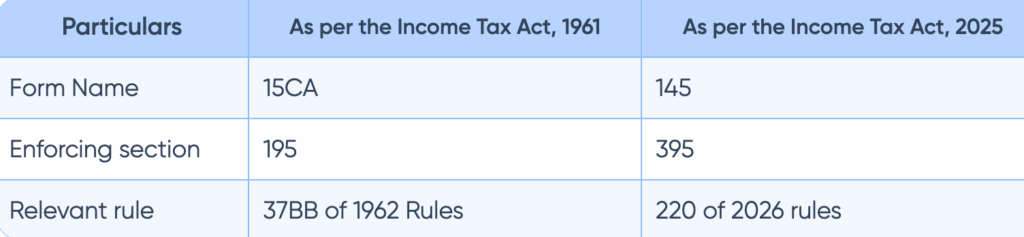
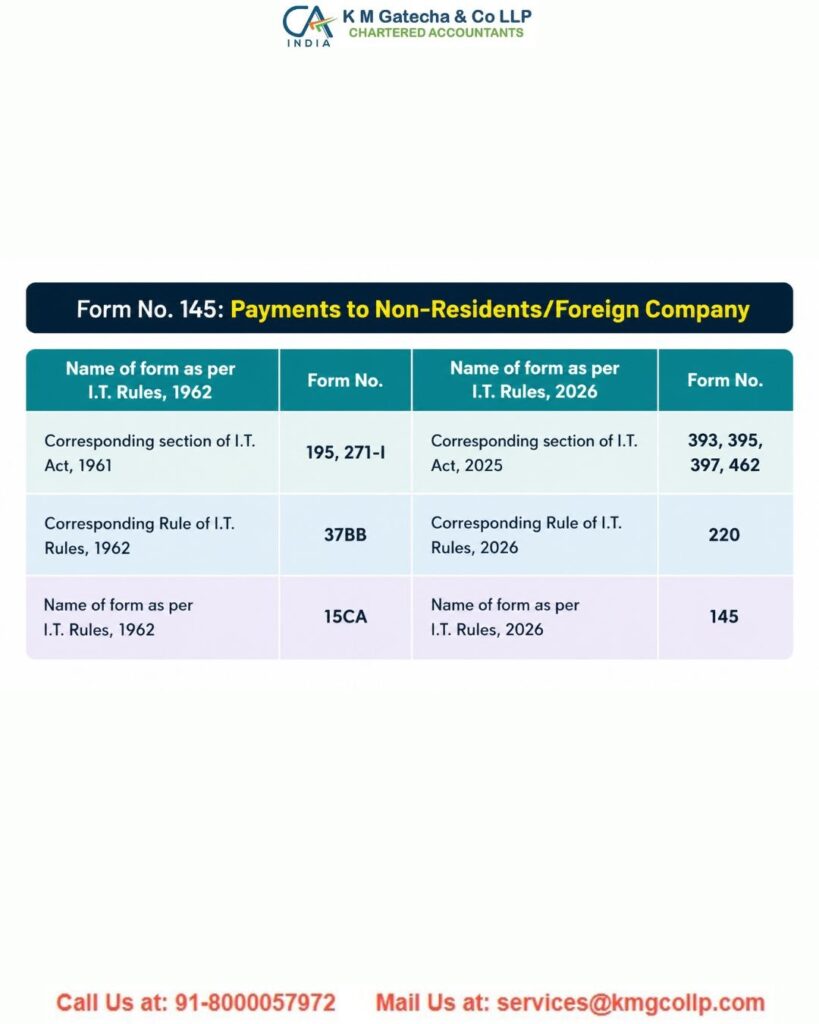
This form is governed by Sections 393, 395, 397, and 462 of the Income Tax Act, 2025, along with Rule 220 of the Income Tax Rules, 2026.
The table below shows the difference between the old provisions (under the 1961 Act) and the new provisions (under the 2025 Act), including the relevant forms, sections, and rules.
What was Form 15CA?
Form 15CA was a declaration required under Section 195(6) of the Income Tax Act, 1961, along with Rule 37BB of the Income Tax Rules, 1962. It had to be filed before making any payment to a non-resident or a foreign company. This form helped the tax authorities keep track of foreign remittances and ensure proper tax compliance.
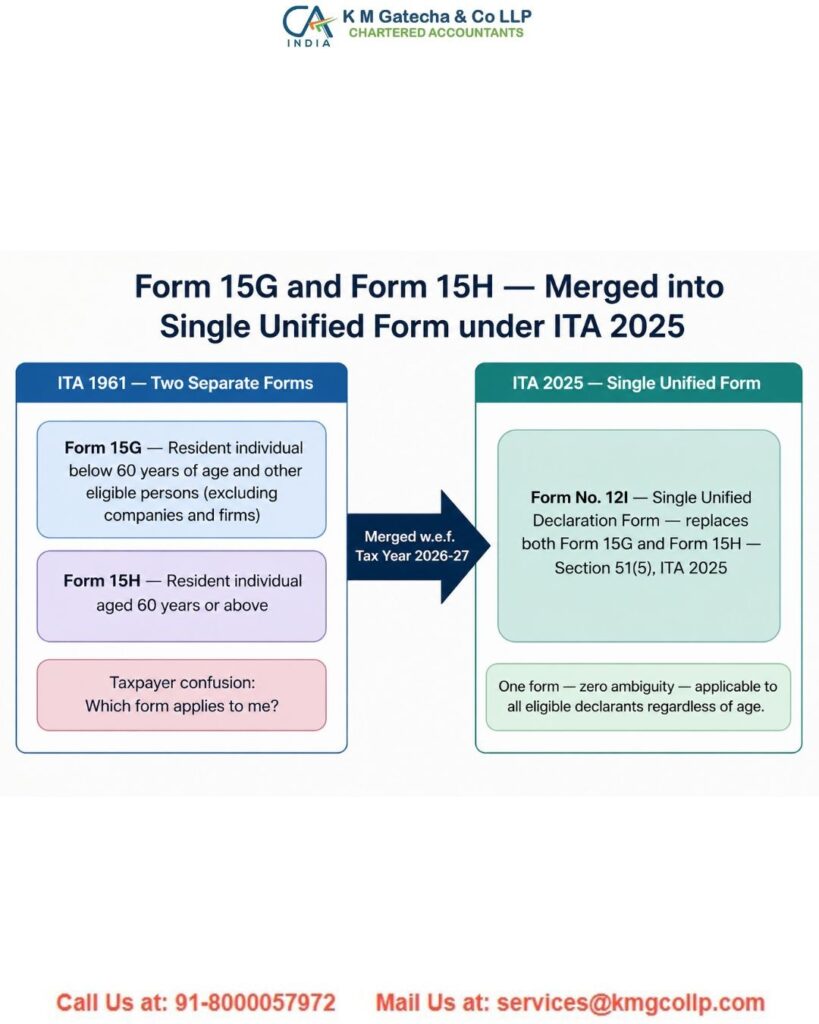
It applies to:
- Indian companies paying fees, royalties, interest, or dividends to foreign entities
- Individuals in India sending money abroad for services, professional fees, or investments
- Businesses making payments to overseas consultants, software providers, or licensors
- Banks and financial institutions making remittances on behalf of their clients
- Any taxpayer, authorised signatory, or representative assessee responsible for reporting foreign payments
Each remittance requires a separate Form 145. A single form cannot be used for multiple transactions, so every payment made outside India must be reported individually.
Cases Where Form 145 Is Not Required
Form 145 does not need to be filed in certain situations where the payment is exempt under the Income Tax Act, 2025.
If an individual sends money abroad and the amount is not taxable under the Act and does not require prior approval from RBI, then Form 145 is not needed.
Transactions carried out by IFSC units under Section 147 of the Income Tax Act, 2025 are also exempt from this requirement.
Additionally, some specified transactions are not required to file Form 145, as long as they are not chargeable to tax under the Income Tax Act, 2025.
Breakdown of the Four Parts of Form 145
Form 145 is divided into four sections based on the type and value of the remittance:
- Part A – For taxable payments up to ₹5 lakh
- Part B – For taxable payments above ₹5 lakh where a certificate from the Assessing Officer is obtained
- Part C – For taxable payments above ₹5 lakh where a CA certificate (Form 146) is obtained
- Part D – For payments that are not taxable
Each part applies depending on the amount being sent and the applicable tax requirements.
Detailed Explanation of Parts A, B, and C of Form 145
Part A – Taxable Remittances up to ₹5 Lakh
Part A is used when the payment is taxable under the Income Tax Act, 2025 and the total amount sent to a particular recipient during the financial year does not exceed ₹5 lakh.
Details required in Part A include:
- Information of the remitter (name, PAN, address, contact details)
- Information of the recipient (name, address, TIN of their country)
- Remittance details such as amount, country, bank details, and BSR code
- Nature of payment (selected from specified remittance categories)
- TDS details like rate, amount, and date of deduction
- RBI purpose code
- Declaration and signature of the remitter
Part B – Taxable Remittances Above ₹5 Lakh (With AO Certificate)
Part B applies when the payment is taxable and the total remittance exceeds ₹5 lakh in a financial year, and a lower or nil TDS certificate has been obtained from the Assessing Officer under Section 395 of the Income Tax Act, 2025.
In addition to all details required in Part A, Part B also includes:
- Details of the certificate or order received from the Assessing Officer
- Applicable section and TDS rate as per the certificate
Part C – Taxable Remittances Above ₹5 Lakh (With CA Certificate – Form 146)
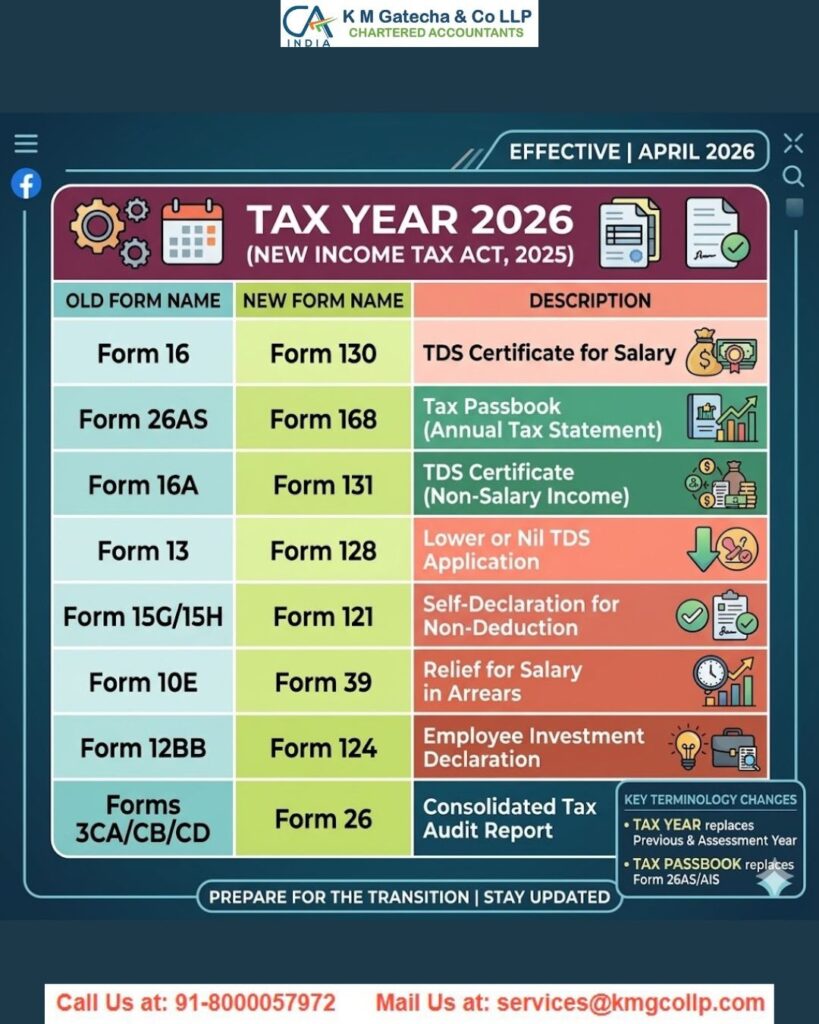
Part C is commonly used for higher-value business transactions. It applies when the payment is taxable, exceeds ₹5 lakh, and a Chartered Accountant certificate (Form 146, replacing Form 15CB) is obtained instead of an Assessing Officer’s certificate.
Along with details from Part A, Part C requires:
- Details of the Chartered Accountant issuing Form 146
- Acknowledgement number of the filed Form 146
- UDIN (Unique Document Identification Number) of the CA certificate
- Taxability as per the Income Tax Act (without considering DTAA)
- Taxability under the applicable DTAA, including relevant article and treaty rate
- Tax Residency Certificate (TRC) details if DTAA benefit is claimed
- Details of Form 41 (application for lower TDS), if applicable
Each part ensures proper reporting based on the value of remittance and the type of certification obtained.
Part D – Non-Taxable Remittances
Part D is used when the payment made outside India is not taxable under the Income Tax Act, 2025. This includes cases like payments for imports of goods, certain capital transactions, or any remittance that is specifically exempt.
Details required in Part D:
- Basic details of the sender (remitter) and receiver (remittee)
- Information about the remittance (amount, purpose, etc.)
- Declaration stating that the payment is not taxable
- Confirmation by the remitter regarding non-taxability
Documents and Information Needed for Form 145
To fill Form 145, you will need the following details:
- PAN of the remitter (person making the payment)
- TAN of the remitter
- Name, address, and Tax Identification Number (TIN) of the foreign recipient
- Country of residence of the recipient and Tax Residency Certificate (TRC), if claiming DTAA benefit
- Remittance amount, currency, and purpose code
- Nature of payment (selected from the list provided in the form)
- BSR code of the bank branch used for the transaction
- ITDREIN (Income Tax Department Reporting Entity Identification Number)
- TDS details such as rate, amount deducted, and date
Additional details (if applicable):
- For Part B: Details of the Assessing Officer’s certificate under Section 395
- For Part C: Acknowledgement number and UDIN of Form 146 issued by a Chartered Accountant
These details help ensure accurate reporting of foreign payments and proper tax compliance.
For Part A, Part B & Part D (No CA Certificate Required)
- Log in to the Income Tax portal using your ID and password
- Go to e-File → Income Tax Forms → File Income Tax Forms
- Select “Forms as per Income Tax Act 2025”
- Choose Form 145
- Select Online mode, choose the Tax Year, and click Continue
- Click “Let’s Get Started” and select the applicable part (A, B, or D)
- Fill in all required details:
- Your details (remitter)
- Receiver details (remittee with TIN)
- Remittance details (amount, country, etc.)
- Nature of payment and TDS details
- Check all details on the preview page
- Click Proceed to e-Verify and verify using DSC or EVC
- Submit the form and download the acknowledgement
- Share the filed form and acknowledgement with your bank before making the payment
For Part C (CA Certificate / Form 146 Required)
- First, add your Chartered Accountant (CA):
- Go to My Account → Authorised Partners → My Chartered Accountants → Add CA
- Enter CA details and select Form 146
- Your CA will log in and file Form 146 (certificate for tax details)
- The CA verifies it using DSC
- Log in again and select Form 145 → Part C
- Enter the acknowledgement number of Form 146 (details will auto-fill)
- Complete the remaining details
- Review, verify, and submit the form
- Download the acknowledgement and give it to your bank
What is Form 146 and How is it Connected to Form 145?
Form 146 is a certificate issued by a Chartered Accountant under the Income Tax Act, 2025. It has replaced the earlier Form 15CB. This certificate is prepared and verified by a CA registered on the Income Tax e-filing portal.
Form 146 confirms the following details:
- Nature and purpose of the payment made outside India
- Whether the payment is taxable under the Income Tax Act, 2025
- Taxability under the applicable DTAA (if any)
- Applicable TDS rate and the amount to be deducted
- Details of the Tax Residency Certificate (TRC) of the recipient
- UDIN (Unique Document Identification Number) for verification
Form 146 is required only in Part C of Form 145. It is used when the remittance is taxable, exceeds ₹5 lakh, and no certificate has been obtained from the Assessing Officer.
Disclaimer: The content on this website is for informational purposes only and does not constitute legal, financial, or professional advice. Please consult qualified experts before acting on any information. K M GATECHA & CO LLP accepts no liability for errors, omissions, or outcomes from the use of this content. This site is not an advertisement or solicitation.