

ITR Filing 2026: Do NRIs Need to File Schedule FA for Foreign Assets?
Who Needs to Report Foreign Assets in Schedule FA?
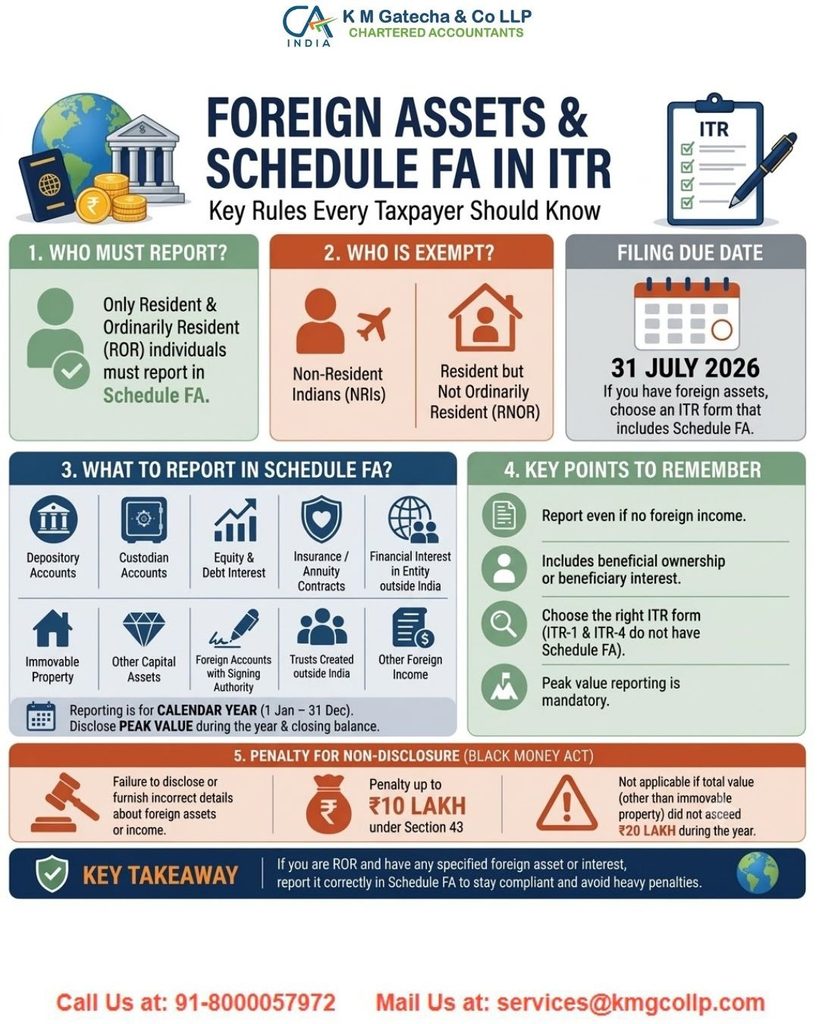
Resident and Ordinarily Resident (ROR) individuals generally need to report their specified foreign assets in Schedule FA of their Income Tax Return (ITR).
The requirement mainly depends on your residential status for the relevant financial year. Non-Resident Indians (NRIs) and Resident but Not Ordinarily Resident (RNOR) individuals generally do not have to report their foreign assets in Schedule FA.
Therefore, it is important to correctly determine your residential status before filing your ITR.
What About NRIs?
NRIs generally do not have to disclose their overseas assets in Schedule FA when they qualify as non-residents for Indian income-tax purposes.
For NRIs, Indian taxation generally focuses on income that is received in India or income that accrues or arises in India, subject to the applicable tax rules.
However, residential status can change from one financial year to another. If a taxpayer changes from NRI or RNOR status to Resident and Ordinarily Resident (ROR) status, the foreign asset reporting requirements can also change.
Therefore, taxpayers should check their residential status every year before filing their ITR.
What About RNOR Taxpayers?
A person who is Resident but Not Ordinarily Resident (RNOR) generally does not have the same foreign asset reporting requirement under Schedule FA as an ROR taxpayer.
However, the exact tax treatment can depend on the taxpayer’s residential status, type of foreign asset, and source of income.
This is why determining residential status correctly is an important step in ITR filing.
What Needs to Be Reported in Schedule FA?
Schedule FA covers different types of foreign assets, accounts, financial interests, and income.
The main categories include:
- Table A1: Foreign depository accounts
- Table A2: Foreign custodial accounts
- Table A3: Foreign equity and debt interests
- Table A4: Foreign cash value insurance or annuity contracts
- Table B: Financial interest in an entity located outside India
- Table C: Immovable property located outside India
- Table D: Other capital assets located outside India
- Table E: Foreign accounts where the taxpayer has signing authority
- Table F: Foreign trusts where the taxpayer is a trustee, beneficiary, or settlor
- Table G: Other foreign-source income not covered in the above categories
The taxpayer must provide the details required for the relevant category while filing the ITR.
Schedule FA Can Apply Even if You Earn No Foreign Income
One important point is that Schedule FA is mainly a disclosure requirement.
You may need to report a foreign asset even if:
- The asset did not generate any income.
- You did not receive any money from the asset.
- The income from the asset is not taxable in India in a particular situation.
- The asset has a low or no current income.
Therefore, foreign income and foreign asset reporting should not be treated as the same thing.
If you are required to report the foreign asset, the asset may need to be disclosed even when it has not generated income.
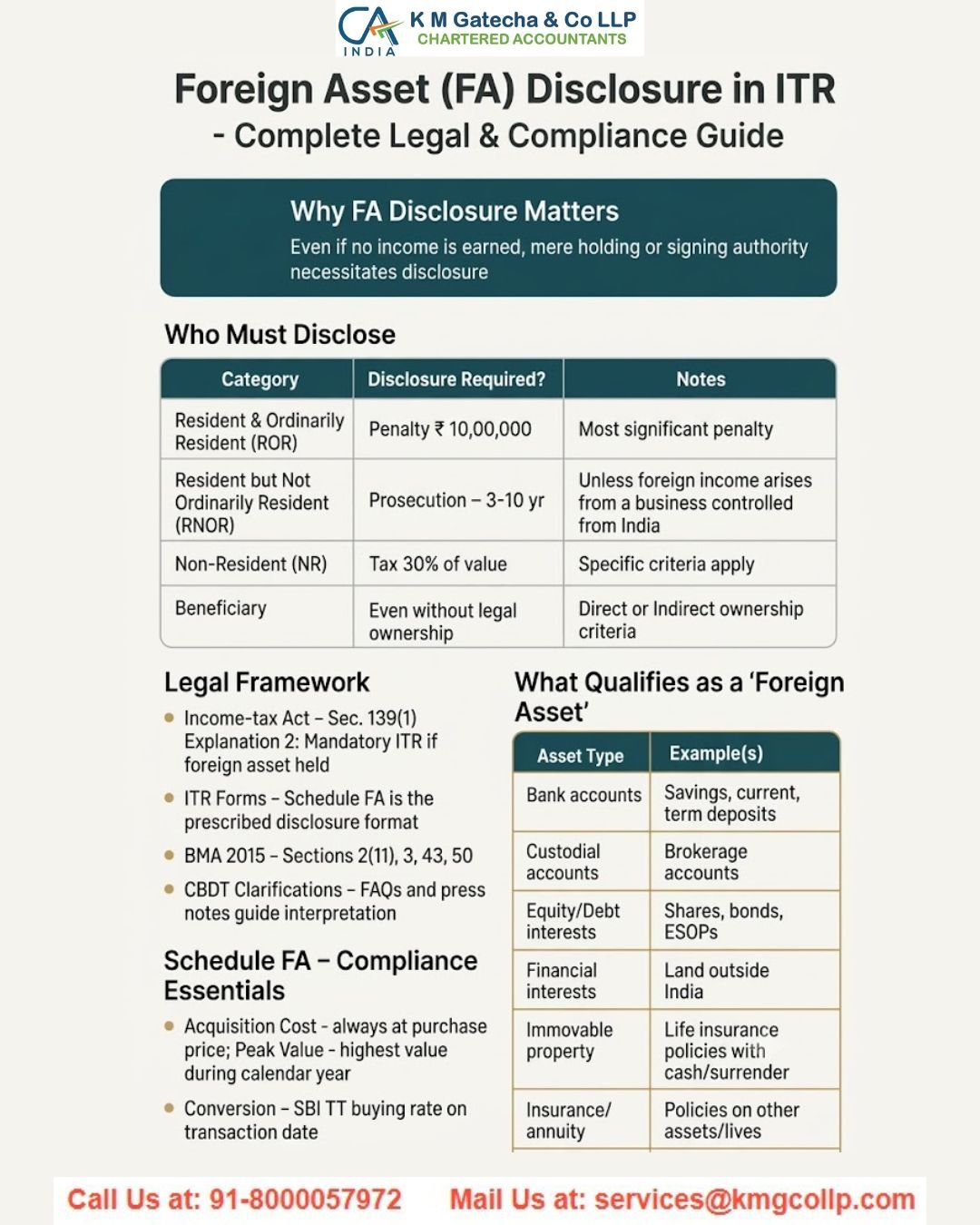
Foreign Assets Must Be Reported Even Without Legal Ownership
Schedule FA reporting is not always limited to assets that are legally registered in your own name.
The reporting requirement can also cover certain situations where you are:
- A beneficial owner
- A beneficiary
- A person having a financial interest in the foreign asset or account
For example, an overseas asset may legally be held by another person, but you may still have to report it if you provided the money for the asset or have a present or future benefit from it.
What Is a Beneficial Owner?
A beneficial owner generally refers to a person who has provided consideration, directly or indirectly, for an asset and holds an interest in the asset for their own benefit or for the benefit of another person.
What Is a Beneficiary?
A beneficiary is generally a person who receives or may receive a present or future benefit from an asset, even when someone else provided the consideration for that asset.
Because of these rules, taxpayers should not assume that an asset is outside Schedule FA simply because it is not legally registered in their own name.
Choose the Correct ITR Form
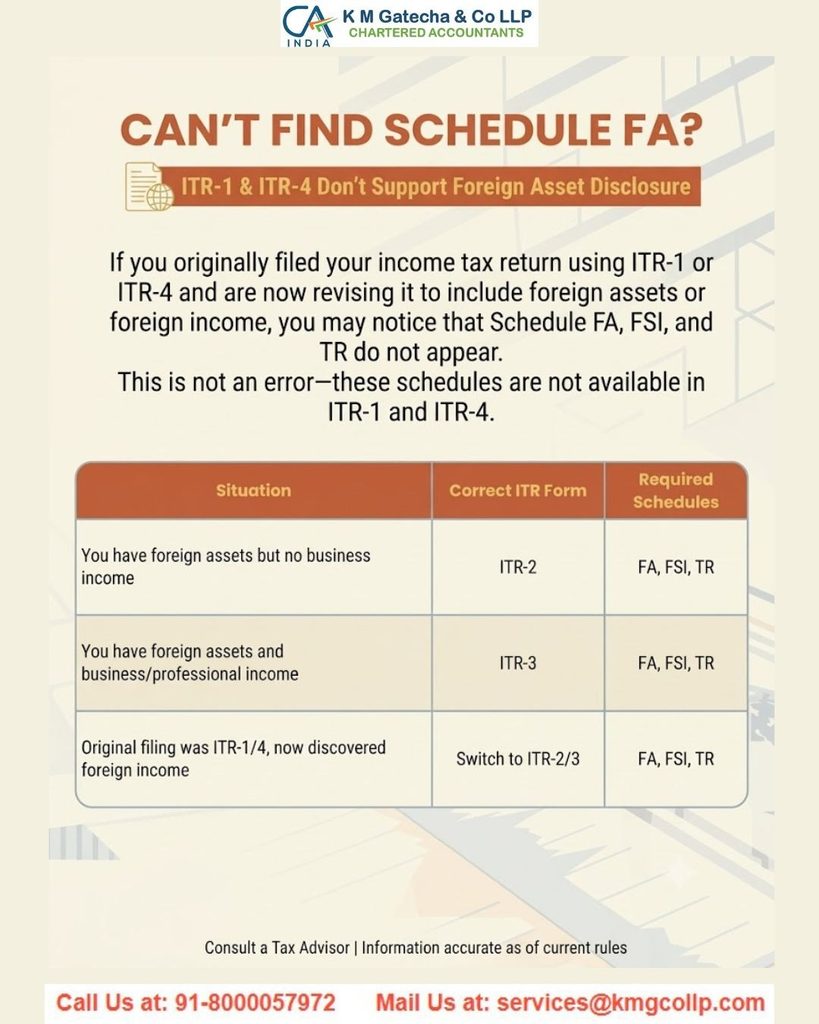
Taxpayers who have reportable foreign assets or foreign income should also make sure they select the correct ITR form.
Some simpler ITR forms do not contain Schedule FA. Therefore, a taxpayer who otherwise qualifies for a simpler return may need to use another applicable ITR form if foreign asset reporting is required.
Choosing the wrong ITR form can create a compliance issue and may result in important foreign asset details being left out.
Before filing the return, check whether the selected ITR form contains the schedules required for your sources of income and foreign assets.
Schedule FA Uses a Different Reporting Period
Another important point is the reporting period used for Schedule FA.
Schedule FA generally follows the calendar year, which runs from January 1 to December 31, rather than the financial year used for many other parts of the ITR.
Because of this difference, taxpayers with foreign assets should keep their overseas account and investment records for the relevant calendar year.
This is especially important for:
- Foreign bank accounts
- Overseas brokerage accounts
- Foreign shares
- Foreign investment accounts
- Foreign properties
- Other overseas financial interests
Keeping complete records can make Schedule FA reporting easier and help avoid missing important information.
Peak Value Must Also Be Reported
For certain foreign accounts and investments, Schedule FA requires details of the peak value during the relevant reporting period, along with other required values such as the closing balance.
This is important because the highest balance during the year may be different from the balance at the end of the year.
For example, if money was deposited into a foreign account and later withdrawn before the end of the reporting period, looking only at the closing balance may not give the required information.
Therefore, taxpayers should review their complete foreign account and investment statements instead of checking only the year-end balance.
Penalties for Not Reporting Foreign Assets
Foreign asset reporting is an important tax compliance requirement.
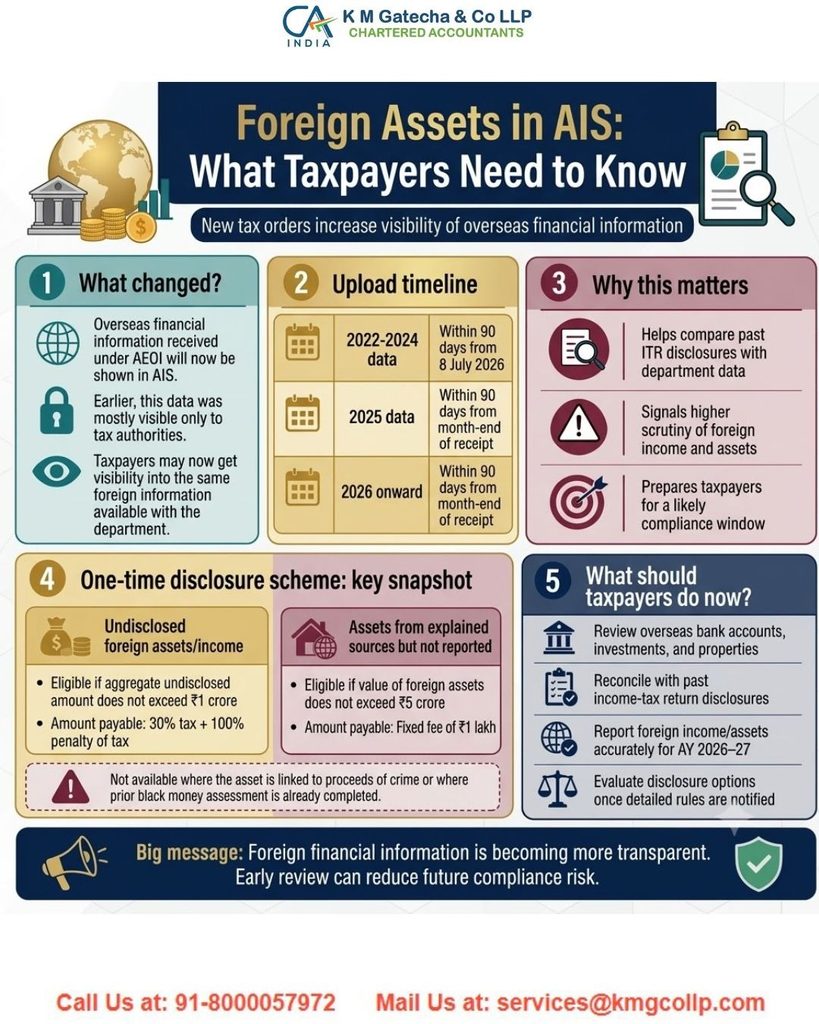
Failure to disclose a reportable foreign asset or providing incorrect information can lead to penalties and, in certain cases, prosecution under the applicable provisions of the Black Money (Undisclosed Foreign Income and Assets) and Imposition of Tax Act, 2015.
The law provides penalties for failing to provide required information or for giving incorrect details about certain foreign assets or financial interests.
The exact consequences can depend on the nature of the asset, the taxpayer’s circumstances, and the applicable provisions.
There are also specific exceptions and thresholds under the law for certain assets and situations. Therefore, taxpayers should check the current rules before filing or correcting their return.
Key Points to Remember
If you have foreign assets, keep these points in mind:
- First, determine your residential status for the relevant financial year.
- ROR taxpayers generally need to report specified foreign assets in Schedule FA.
- NRIs and RNOR taxpayers generally do not have the same Schedule FA reporting requirement.
- Foreign assets may need to be reported even when they do not generate income.
- Beneficial ownership and beneficiary interests can also create reporting requirements.
- Schedule FA generally uses the calendar year for reporting.
- Peak values may need to be reported for certain foreign accounts and investments.
- Select an ITR form that contains the required foreign asset schedules.
- Keep foreign bank, investment, property, and other relevant records ready.
- Incorrect or incomplete disclosure can lead to tax and legal consequences.
Conclusion
Schedule FA is an important part of ITR filing for taxpayers who are required to disclose foreign assets and financial interests.
The first step is to determine whether you are an ROR, RNOR, or non-resident for the relevant financial year. If you are an ROR and have reportable foreign assets, you should carefully provide the required information in Schedule FA.
You should also check whether you have any beneficial ownership, beneficiary interest, signing authority, or foreign income that needs to be reported.
Accurate information, proper records, and the correct ITR form can help ensure that your foreign asset disclosures are complete and compliant with the applicable tax rules.
Disclaimer: The content on this website is for informational purposes only and does not constitute legal, financial, or professional advice. Please consult qualified experts before acting on any information. K M GATECHA & CO LLP accepts no liability for errors, omissions, or outcomes from the use of this content. This site is not an advertisement or solicitation.

