

Selling a residential house can result in a significant profit, especially when the property has been owned for many years. This profit may be treated as a capital gain and can be taxable under the income tax rules.
However, taxpayers who sell a qualifying residential house and reinvest the eligible long-term capital gain in another residential house in India may claim relief under Section 82 of the Income Tax Act, 2025. The section sets out specific conditions, time limits, and rules that must be followed to claim the benefit.
In simple terms, Section 82 allows eligible taxpayers to reinvest the capital gain in another residential house instead of paying tax on the qualifying amount, subject to the conditions provided under the law.
What Is Section 82?
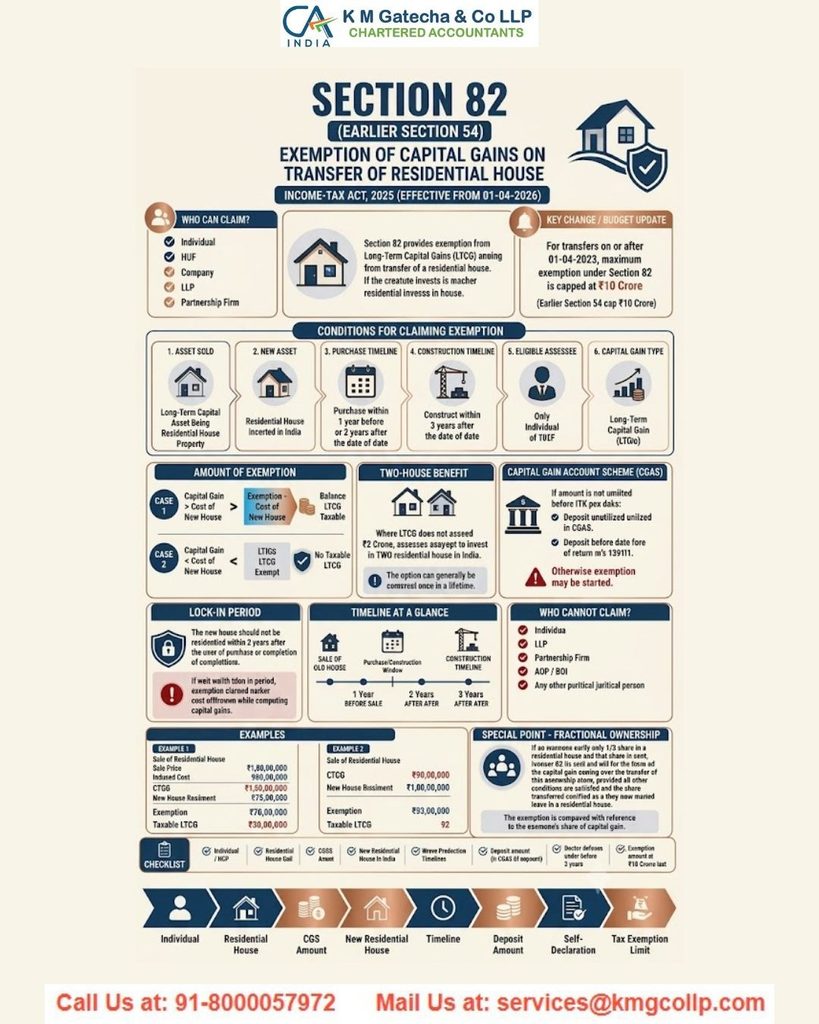
Section 82 deals with the profit from the sale of property used for residence. It applies when an individual or HUF earns long-term capital gains from the transfer of a qualifying residential house.
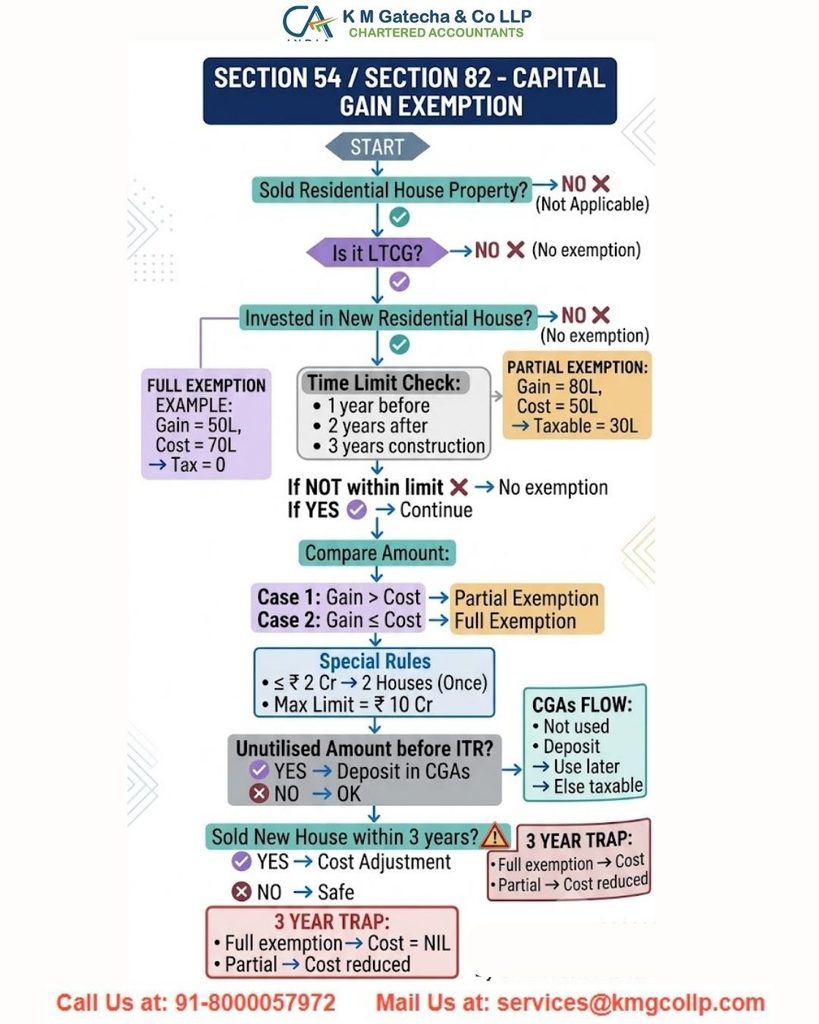
To claim the benefit, the taxpayer must purchase or construct another residential house in India within the prescribed period.
The new house can generally be:
-
- Purchased within one year before the sale of the original house.
-
- Purchased within two years after the sale.
-
- Constructed within three years after the date of transfer.
The exemption is not automatic. The taxpayer must meet the conditions of Section 82 and correctly report the transaction while filing the income tax return.
Who Can Claim the Section 82 Benefit?
The provision specifically covers:
-
- Individuals
-
- Hindu Undivided Families (HUFs)
The original property must be a residential house or building with land attached to it, and the income from that property should fall under the head “Income from house property.” The capital gain must also qualify as a long-term capital gain.
Therefore, simply selling any type of property does not automatically qualify for the Section 82 benefit.
What Is the Time Limit for Reinvestment?
The timing of the purchase or construction is important.
Buying a New House
If the taxpayer purchases another residential house, the purchase can be made:
-
- Up to one year before the transfer of the original house, or
-
- Within two years after the transfer.
Constructing a New House
If the taxpayer chooses to construct a residential house, the construction must be completed within three years from the date of transfer of the original property.
Taxpayers should keep documents showing the dates of purchase, payments, construction, and other related transactions.
What If the Capital Gain Has Not Been Used?
A taxpayer may not always be able to purchase or construct the new house before filing the income tax return.
In such a situation, the unused capital gain can be deposited under the Capital Gains Account Scheme (CGAS) within the prescribed deadline. The deposited amount can then be used for purchasing or constructing the new residential house according to the applicable rules.
The taxpayer should also keep the deposit proof and provide the required details while filing the return.
What Happens If the Full Amount Is Not Reinvested?
The amount of relief depends on the amount of capital gain and the cost of the new residential house.
If the capital gain is higher than the eligible cost of the new house, the excess amount can remain taxable.
If the cost of the new house is equal to or higher than the eligible capital gain, the qualifying gain may not be charged to tax, provided all the conditions of Section 82 are satisfied.
For example, if a taxpayer earns a long-term capital gain and invests the eligible amount in another residential house within the required period, the taxpayer may claim relief on the qualifying gain.
What Happens If the New House Is Sold Within Three Years?
Section 82 also contains rules for situations where the newly purchased or constructed house is transferred within three years.
The cost of the new house is adjusted for calculating capital gains on its later sale. This means that claiming the Section 82 benefit can affect the calculation of capital gains if the new property is sold within the specified period.
Therefore, taxpayers should consider these rules before selling the newly acquired property.
Can the Benefit Be Used for Two Houses?
Section 82 provides an option in certain cases where the capital gain does not exceed the specified threshold. An eligible taxpayer may choose to purchase or construct two residential houses in India instead of one.
However, this is a special option and can be exercised only once. A taxpayer who has already used this option cannot use it again for another tax year.
Is There a Limit on the Amount Considered?
Yes. Section 82 contains limits on the amount that can be considered for the exemption.
If the cost of the new residential house is above the specified limit, the amount above that limit is not considered while calculating the benefit. Similarly, where the capital gain from the original property exceeds the specified limit, the excess is not considered for the purpose of the provision.
Taxpayers with large capital gains should therefore check these limits carefully before planning the reinvestment.
Documents to Keep
Proper documentation is important when claiming the benefit. Taxpayers should keep documents such as:
-
- Sale deed of the original property
-
- Purchase deed of the new house
-
- Construction-related documents, where applicable
-
- Payment records and bank statements
-
- Capital gains calculation
-
- CGAS deposit proof, if applicable
-
- Income tax return and supporting details
These documents can help establish that the requirements of Section 82 were followed.
Key Points to Remember
Section 82 can provide capital gains tax relief when an eligible taxpayer sells a qualifying residential house and reinvests the eligible gain in another residential house in India.
The main points are:
-
- The provision applies to individuals and HUFs.
-
- The original property must meet the requirements of the section.
-
- The gain must be a long-term capital gain.
-
- A new house can generally be purchased within one year before or two years after the sale.
-
- Construction must be completed within three years.
-
- Unused capital gains may need to be deposited under CGAS.
-
- A two-house option is available in certain cases.
-
- The two-house option can be used only once.
-
- Specific limits apply to the amount considered for the benefit.
-
- Proper documentation should be maintained.

Conclusion
Section 82 of the Income Tax Act, 2025 provides an important route for eligible taxpayers to claim relief on long-term capital gains arising from the sale of a residential house.
The benefit mainly depends on timely reinvestment in another residential house in India and compliance with the conditions of the section. Taxpayers should pay close attention to the purchase or construction deadlines, CGAS requirements, applicable limits, and documentation.
Before claiming the exemption, it is important to calculate the capital gain correctly and check whether the particular property and transaction meet all the conditions under Section 82.
Disclaimer: The content on this website is for informational purposes only and does not constitute legal, financial, or professional advice. Please consult qualified experts before acting on any information. K M GATECHA & CO LLP accepts no liability for errors, omissions, or outcomes from the use of this content. This site is not an advertisement or solicitation.


