
Anyone selling land in India is required to pay tax on the profit earned from the sale of the asset. However, there are several legal provisions and investment options available that can help reduce or save capital gains tax on land sales. This guide explains the taxation rules, calculation methods, and exemptions available under the Income Tax Act.
Income Tax Act 2025 Update
The Income Tax Act, 2025 has replaced the terms “Previous Year” and “Assessment Year” with “Tax Year.” For example, income earned during 2025–26 will now be referred to as Tax Year 2025–26. However, terms like FY and AY are still commonly used for easier understanding.
The new Act has also simplified the structure of the law by reducing and renumbering various sections and schedules.
Short-Term and Long-Term Capital Gains on Land
Capital gains on land are classified based on the holding period.
- If land is sold within 24 months of purchase, the profit is treated as Short-Term Capital Gain (STCG).
- If the land is held for more than 24 months before sale, the profit is considered Long-Term Capital Gain (LTCG).
Difference Between STCG and LTCG on Land Sale
| Basis | Short-Term Capital Gain | Long-Term Capital Gain |
| Meaning | Profit from sale of short-term assets | Profit from sale of long-term assets |
| Holding Period | Up to 24 months for land/property | More than 24 months |
| Tax Treatment | Taxed as per slab rates or Section 111A where applicable | Taxed at 12.5% or 20% depending on asset type |
| Risk | Lower due to shorter holding period | Higher because of long holding duration |
| Returns | Generally lower | Usually higher over time |
How to Calculate Capital Gains on Land Sale
Key Components Used in Calculation
| Term | Meaning |
| Cost of Acquisition | Original purchase cost along with related expenses |
| Cost of Improvement | Amount spent on renovation or improvement |
| Sale Price | Total amount received from the buyer after deductions |
Capital Gains Tax Rates
| Tax Type | Applicable Rate |
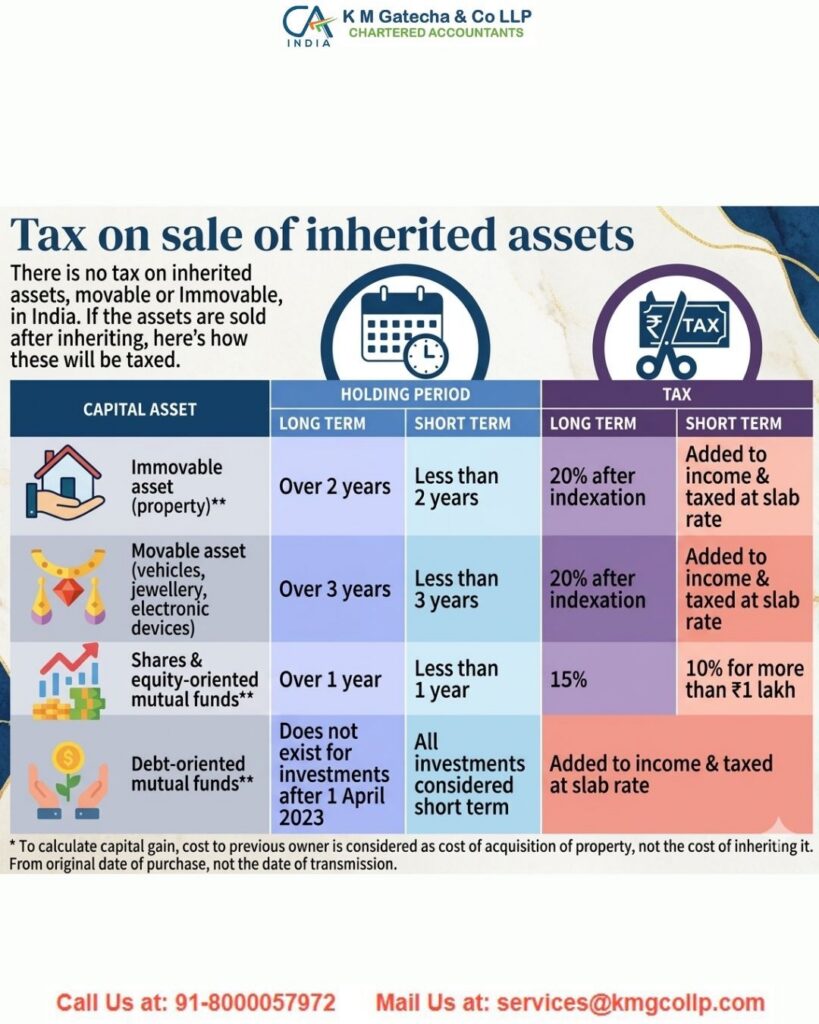
| Long-Term Capital Gain on listed equity/equity mutual funds | 12.5% above ₹1.25 lakh |
| Other Long-Term Capital Gains | 20% |
| Short-Term Capital Gain without STT | Taxed as per slab rates |
| Short-Term Capital Gain with STT | 20% |
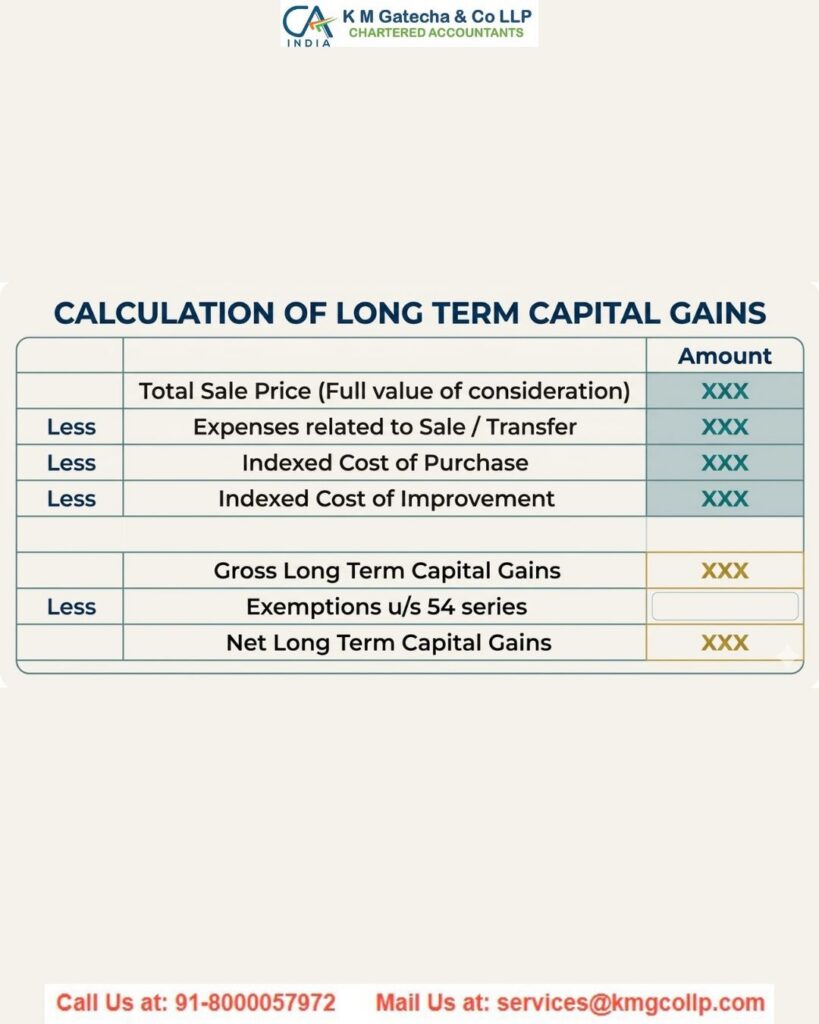
Example of Long-Term Capital Gain Calculation
| Particulars | Amount |
| Sale Price | ₹10,00,000 |
| Less: Indexed Cost of Acquisition | ₹7,09,090 |
| Less: Improvement/Sale Expenses | XX |
| Less: Exemption under Sections 54F/54EC etc. | XX |
| Long-Term Capital Gain | XXX |
The final long-term capital gain is taxed according to the applicable provisions of the Income Tax Act.
How to Save Capital Gains Tax on Sale of Land
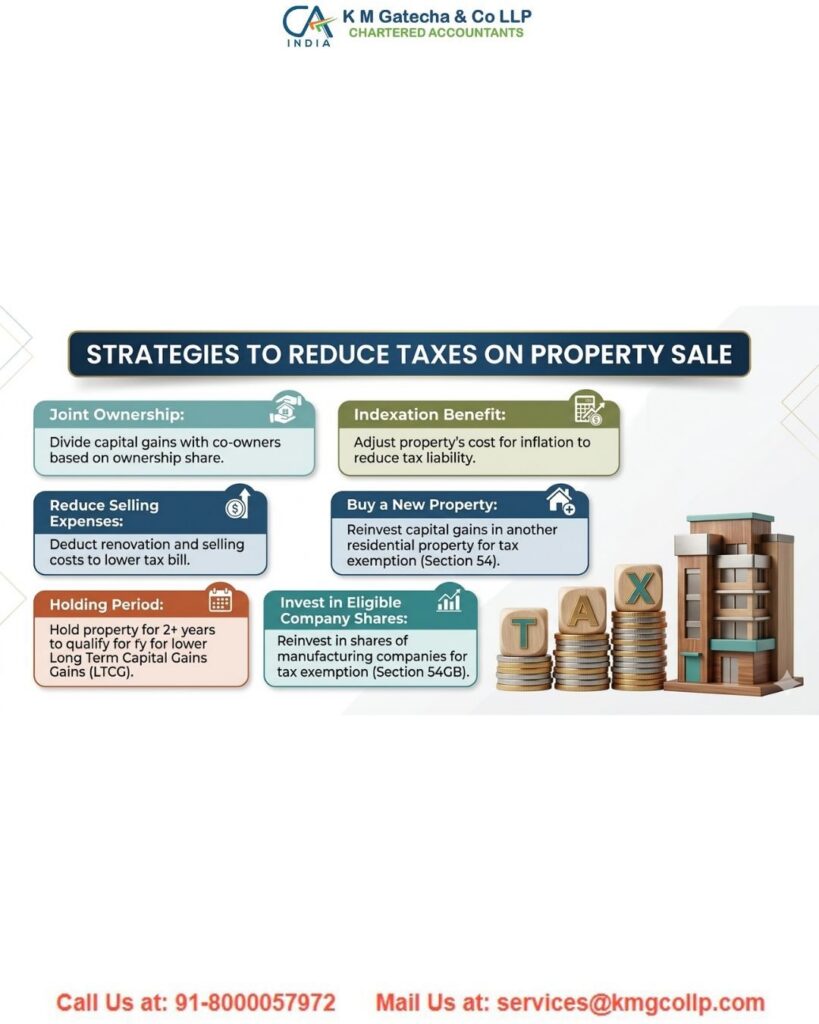
If the land is sold after 24 months, the gain becomes long-term capital gain, and certain exemptions can be claimed.
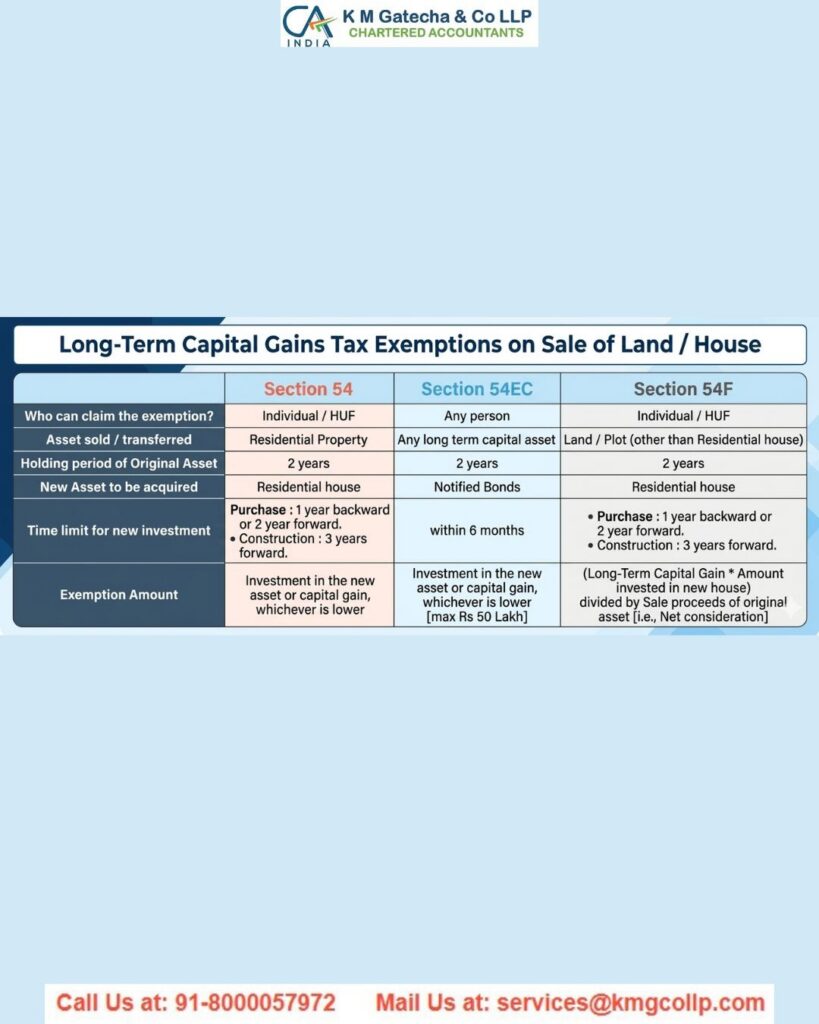
1. Invest in Residential Property Under Section 54F
You can save tax by investing the sale proceeds into a residential house property.
Conditions for claiming exemption under Section 54F:
- Only individuals and HUFs are eligible.
- The new residential property must be located in India.
- Purchase should be made within:
- 1 year before the sale, or
- 2 years after the sale.
- Construction should be completed within 3 years from the date of sale.
- The new property must be held for at least 3 years.
- The taxpayer should not own more than one residential property other than the new one on the date of transfer.
If the entire sale consideration is invested, full exemption can be claimed. Partial investment results in proportionate exemption.
2. Invest in 54EC Capital Gain Bonds
Another option is to invest long-term capital gains in specified bonds under Section 54EC.
Eligible bonds include:
- REC
- NHAI
- PFC
- IRFC
Important conditions:
- Investment must be made within 6 months from the sale date.
- Maximum investment allowed is ₹50 lakh in one financial year.
- Only capital gains amount needs to be invested, not the full sale consideration.
- No need to deposit funds in a Capital Gains Account Scheme for this exemption.
Sections Available for Capital Gain Exemptions
| Section | Purpose |
| Section 54F | Purchase/construction of residential house |
| Section 54EC | Investment in notified bonds |
| Section 54B | Reinvestment in agricultural land |
| Section 54D | Reinvestment after compulsory acquisition |
| Section 54G | Shifting industry from urban to rural area |
| Section 54GA | Shifting industry to SEZ |
Capital Gains Account Scheme (CGAS)
The Capital Gains Account Scheme helps taxpayers save tax when they are unable to immediately reinvest capital gains before the ITR filing deadline.
Under CGAS:
- Capital gains can be deposited in a designated bank account.
- The deposited amount can later be used for property purchase or construction.
- Exemption can still be claimed while filing the income tax return.
- Unused funds after the prescribed period become taxable.
Alternative Tax Saving Option Beyond CGAS
If you do not plan to purchase another property, you can invest in 54EC bonds such as REC, NHAI, PFC, or IRFC bonds.
Key points:
- Bonds have a 5-year lock-in period.
- Investment must be made within 6 months from the sale date.
- Maximum limit is ₹50 lakh annually.
- Interest earned on these bonds is taxable.
CGAS vs 54EC Bonds
| Feature | CGAS | 54EC Bonds |
| Eligible Asset | Residential property | Land/building |
| Applicable Section | 54 & 54F | 54EC |
| Investment Type | Bank deposit account | Specified bonds |
| Maximum Limit | No limit | ₹50 lakh |
| Time Limit | Before ITR due date | Within 6 months |
| Lock-in Period | 2–3 years | 5 years |
| Returns | No returns | Fixed taxable interest |
| Liquidity | Flexible for property investment | Locked investment |
Choose CGAS if:
You plan to buy or construct a property and need time to complete the process.
Choose 54EC Bonds if:
You prefer a low-risk investment option and do not intend to reinvest in property.
Disclaimer: The content on this website is for informational purposes only and does not constitute legal, financial, or professional advice. Please consult qualified experts before acting on any information. K M GATECHA & CO LLP accepts no liability for errors, omissions, or outcomes from the use of this content. This site is not an advertisement or solicitation.