In today’s global economy, many individuals earn income from multiple countries due to increasing international mobility and liberal economic policies. This often raises questions regarding the taxation of foreign income in different jurisdictions.
In India, the taxation of an individual depends mainly on their residential status and the source of income. Generally, residents are taxed on their worldwide income, whereas non-residents are taxed only on income earned in India. According to Section 5 of the Income Tax Act, 1961, a resident individual earning income from Indian or foreign sources must disclose income under all heads such as salary, house property, business or profession, capital gains, and other sources, and pay taxes accordingly. This article explains the taxation of foreign source income, reporting requirements, and related tax implications.

Important Update for Taxpayers Holding Foreign Income or Assets
The Income Tax Department has started sending NUDGE campaign notifications through SMS and email to taxpayers who may have failed to disclose foreign income or foreign assets.
If you receive such a communication, there is no need to panic, as it is only a request for clarification. Taxpayers can still rectify omissions or errors by filing a Revised or Belated Income Tax Return before 31st December 2025.
Rules Governing Taxation of Income
Globally, income taxation is generally based on two principles:
Source Rule
Under the source rule, income is taxed in the country where it is earned. The taxation depends on the origin of the income and whether it is generated through resources or activities within that country.
For example, if an Indian resident earns income in the UK, the income may be taxed in the UK under the source rule.
Residence Rule
According to the residence rule, a person’s country of residence taxes the individual on income earned worldwide, irrespective of where the income arises.
For instance, if an Indian resident earns income in the UK, India may also tax that income because the individual is a resident of India.
What is Foreign Source Income?
Foreign source income refers to income such as dividends, royalties, interest, and fees for technical services received from outside India. For income to qualify as foreign income, the related activities must generally be carried out outside India.
Services may be rendered from India, but the recipient should use those services outside India. Further, the initial receipt of such income should occur outside India. If the amount is directly received in India, it may become taxable in India.
The tax treatment of foreign source income depends largely on the taxpayer’s residential status.
What are Foreign Assets?
For Indian tax residents, foreign assets include various financial and non-financial holdings situated outside India, such as:
- Foreign bank accounts
- Financial interests in overseas entities
- Insurance policies with cash value
- Annuity contracts
- Immovable properties abroad
- Custodial accounts
- Foreign equity and debt investments
Residential Status and Tax Liability
Understanding residential status is the first step in determining tax liability on foreign income. Under Indian tax laws, individuals are classified into the following categories:
- Resident and Ordinarily Resident (ROR)
- Resident but Not Ordinarily Resident (RNOR)
- Non-Resident (NR)
This classification determines the extent of taxation applicable to an individual.
How is Residential Status Determined?
Resident and Ordinarily Resident (ROR)
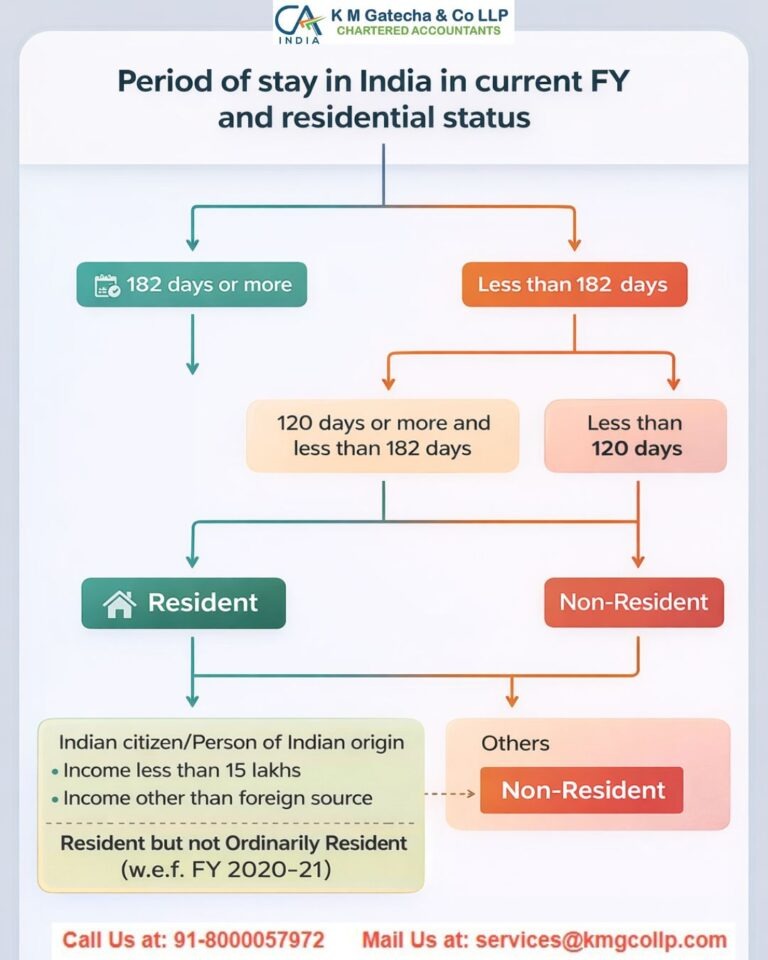
An individual qualifies as a resident if they satisfy either of the following conditions:
- Stay in India for 182 days or more during the financial year, or
- Stay in India for at least 60 days during the relevant financial year and 365 days or more during the preceding four years.
Resident but Not Ordinarily Resident (RNOR)
An individual becomes RNOR if:
- They were non-resident in 9 out of the previous 10 years, or
- Their total stay in India during the preceding 7 years was 729 days or less.
Non-Resident (NR)
An individual who does not satisfy the conditions for residency is treated as a non-resident.
Taxation of Foreign Income Based on Residential Status
ROR (Resident and Ordinarily Resident)
ROR individuals are taxed on their global income, including foreign income earned abroad.
Their foreign income is added to Indian income and taxed according to the applicable slab rates. Relief may be available for taxes paid overseas through Double Taxation Avoidance Agreements (DTAA).
RNOR (Resident but Not Ordinarily Resident)
RNOR individuals are generally not taxed on foreign income if such income is neither received nor accrued in India.
However, income arising from a business controlled or profession set up in India remains taxable.
NR (Non-Resident)
Non-residents are taxed only on income earned, received, or accrued in India.
Certain incomes such as royalties, interest, technical service fees, and capital gains from Indian assets may still be taxable in India.
For all categories, DTAA provisions should also be considered to avoid double taxation.

Taxation of Foreign Income for Residents
Residents, whether ROR or RNOR, may be required to pay taxes on foreign income depending on the nature and source of the income.
If foreign income is received in India, tax becomes payable in the same financial year. If it is not received in India, taxation applies in the year in which it accrues or is realized.
Difference Between ROR and RNOR Taxation
ROR individuals are taxed on their entire worldwide income, whereas RNOR individuals are taxed only on:
- Income received or accrued in India, or
- Income from a business controlled or profession established in India.
This distinction reflects the degree of the individual’s economic connection with India.
Taxation of Foreign Income for Non-Residents
Taxable Income Categories for Non-Residents
Non-residents are taxed differently under Indian law. Income categories such as interest, royalty, fees for technical services, and capital gains may be taxable in India.
Section 195 of the Income Tax Act governs the taxation of payments made to non-residents.
Withholding Tax Provisions
Payments made to non-residents are generally subject to withholding tax, ensuring tax collection by the Indian government on income arising within India.
Disclosure of Foreign Assets
Individuals holding foreign assets are required to disclose such assets in the Foreign Asset (FA) or Foreign Source Income (FSI) schedule while filing their Income Tax Returns, even if:
- The assets were acquired from disclosed income sources, or
- Their total income falls below the taxable threshold.
Failure to disclose foreign assets or foreign income may result in a penalty of ₹10 lakh under the Black Money (Undisclosed Foreign Income and Assets) and Imposition of Tax Act, 2015.
Double Taxation Avoidance Agreements (DTAA)
Many taxpayers wonder whether they need to pay tax twice on the same income in India and the foreign country. India has entered into several DTAA agreements to avoid such double taxation.
These agreements allow taxpayers to claim relief for taxes paid abroad against taxes payable in India.
Foreign tax credit can be claimed under Sections 90 and 91 of the Income Tax Act for income taxed in both India and another country.
Form 67
Taxpayers claiming foreign tax credit while filing their Income Tax Return under Section 139(1) must file Form 67.
This form applies to individuals earning foreign income and paying taxes in another country.
Schedule FA in Income Tax Return
Schedule FA (Foreign Assets) in ITR-2 and ITR-3 requires disclosure of all foreign assets such as:
- Foreign shares
- Overseas mutual funds
- Foreign ESOPs
- Overseas bank accounts
- Foreign investments
These disclosures are mandatory for Resident and Ordinarily Resident individuals and Hindu Undivided Families (HUFs).
Non-disclosure of foreign assets or foreign income can attract a penalty of ₹10 lakh under the anti-black money law.
The due date for filing revised or belated returns remains 31st December for the applicable assessment year.
Disclaimer: The content on this website is for informational purposes only and does not constitute legal, financial, or professional advice. Please consult qualified experts before acting on any information. K M GATECHA & CO LLP accepts no liability for errors, omissions, or outcomes from the use of this content. This site is not an advertisement or solicitation.