
What is a Hindu Undivided Family (HUF)? Features & Tax Benefits
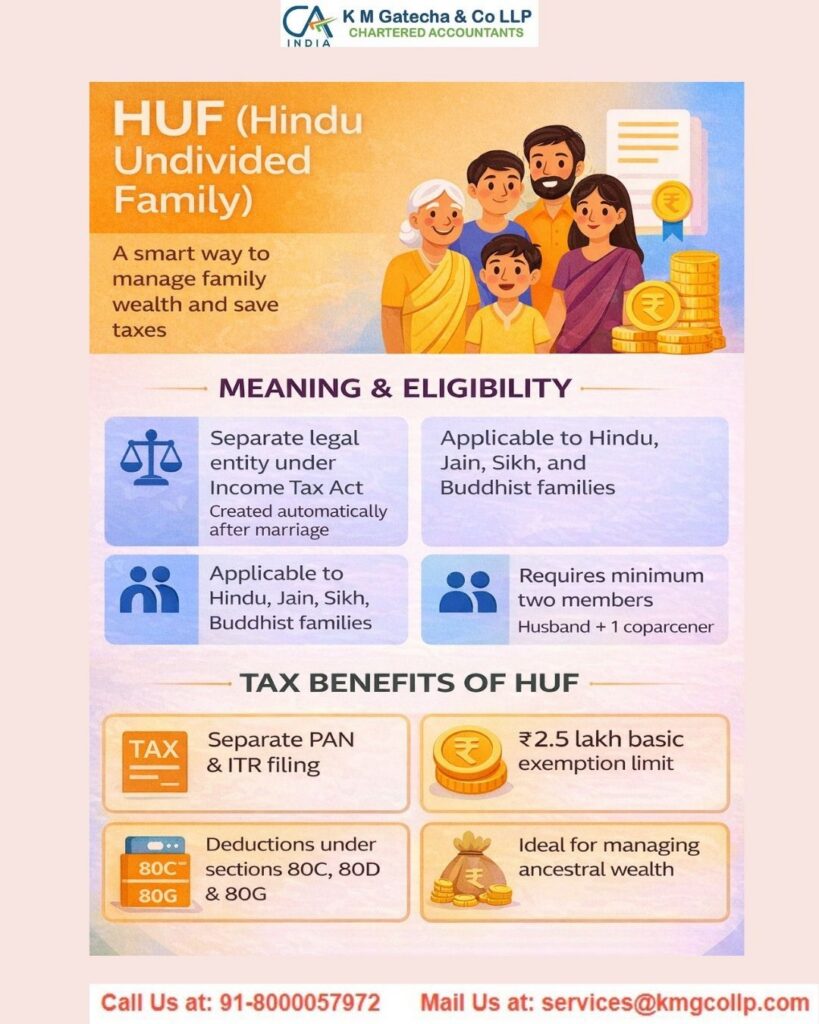
HUF stands for Hindu Undivided Family. It is treated as a separate legal entity under the Income Tax Act and is mainly created to help families manage income and save taxes. According to Hindu law, a HUF consists of individuals descended from a common ancestor, including their wives and unmarried daughters. The HUF is usually managed by the eldest family member, known as the Karta.
Income Tax Act 2025 Update
The Income Tax Act, 2025 has replaced the terms “Previous Year” and “Assessment Year” with “Tax Year.” For example, income earned during 2025-26 will now be referred to as Tax Year 2025-26. However, since taxpayers are more familiar with the terms FY and AY, this guide continues to use them for easier understanding.
The new Act has also simplified and renumbered several sections and schedules.

What is a HUF?
A Hindu Undivided Family is a joint family arrangement recognised as a separate taxable entity. It is generally formed when a family owns ancestral property, receives gifts, or acquires assets using joint family funds. Members of a HUF include descendants of a common ancestor, their spouses, and children.
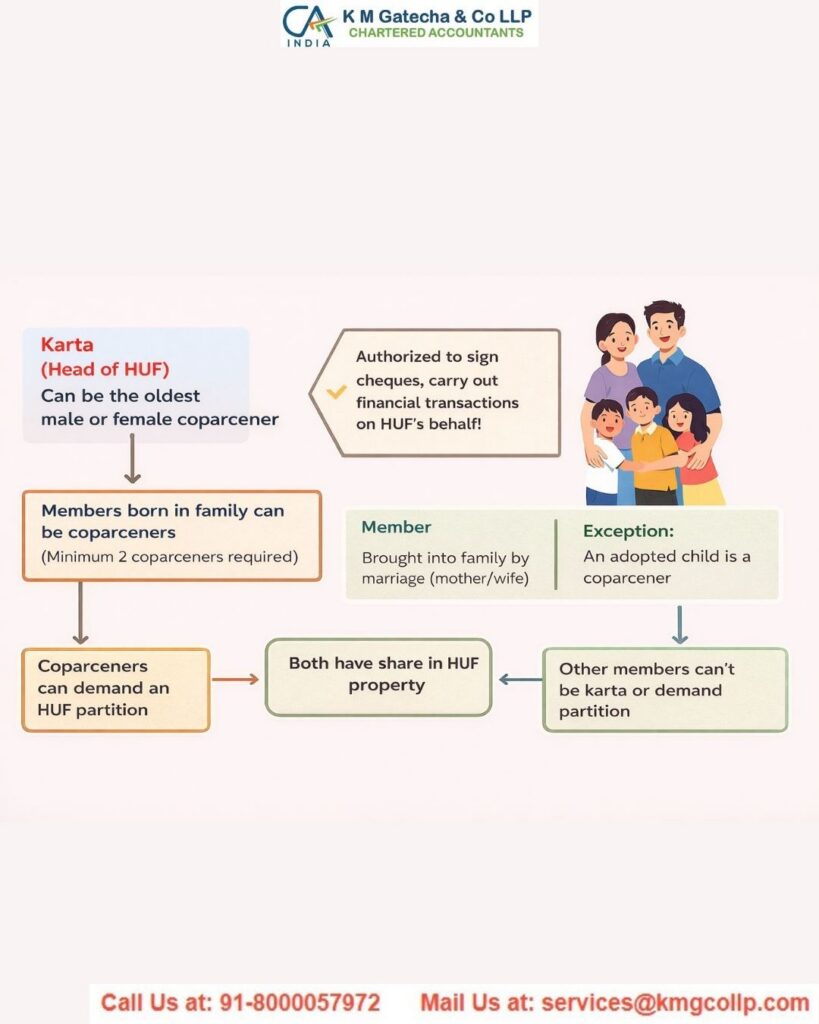
Under Section 2(31) of the Income Tax Act, a HUF is treated as a separate “person” for tax purposes. The head of the HUF is called the Karta, who manages the affairs and finances of the family. Male members are called coparceners, while female members are referred to as members. Today, even daughters can become Karta if they are the eldest member of the family.
Jains, Sikhs, and Buddhists are also eligible to form a HUF, even though they are not governed by Hindu law.
Rules for Forming a HUF
The following conditions must be fulfilled to create a HUF:
- A single person cannot form a HUF; a family is required.
- Marriage automatically creates a HUF.
- A HUF includes descendants of a common ancestor, their wives, and unmarried daughters.
- Hindus, Sikhs, Jains, and Buddhists can form a HUF.
- The HUF must obtain a PAN card and open a separate bank account.
- A formal HUF deed mentioning members and business details should be prepared.
- Members may contribute income or assets to the HUF corpus.
- The HUF can claim tax deductions and exemptions separately.
Tax Benefits of a HUF
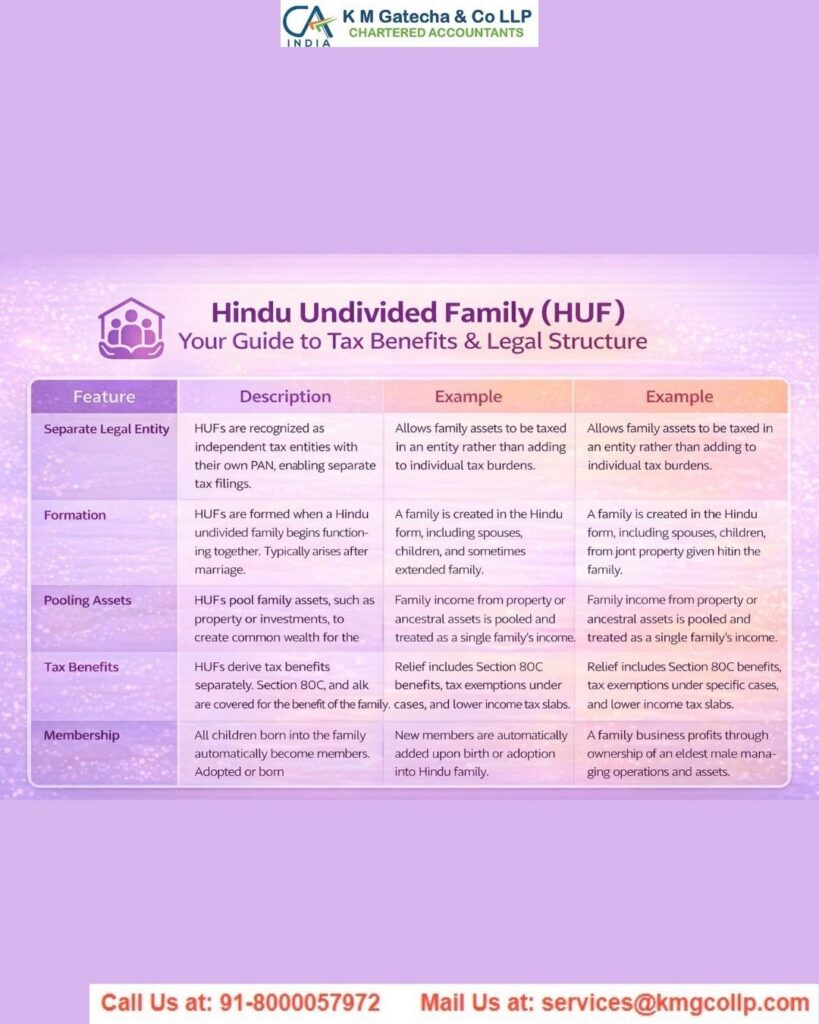
A HUF enjoys separate tax treatment and receives many of the same deductions available to individuals.
Separate Tax Entity
A HUF has its own PAN card and files a separate income tax return. This allows the family to claim an additional basic exemption limit and reduce overall tax liability.
Tax Benefits under Section 80C
A HUF can claim deductions up to Rs.1.5 lakh under Section 80C for investments such as:
- ELSS
- PPF
- Life insurance premiums
- Tax-saving deposits
Health Insurance Deduction
A HUF can claim deduction under Section 80D for health insurance premiums paid for family members, providing an additional tax-saving benefit.
Residential Property Benefits
A HUF can own residential property in its own name. This helps families manage multiple properties and optimize taxation on house property income.
Investment and Business Income
The HUF can earn income from:
- Rental properties
- Business activities
- Investments in shares and mutual funds
- Interest income
Such income is taxed separately in the hands of the HUF.
Computation of HUF Income
The income of a HUF is calculated under different heads of income after excluding exempt income. Some important points include:
- Salary or remuneration earned by a member for personal services is treated as individual income.
- Income generated due to HUF investments may be treated as HUF income.
- Genuine remuneration paid by the HUF to members for services rendered can be claimed as an expense.
The following are not taxed as HUF income:
- Personal income of members
- Income from self-acquired property transferred without consideration
- Income from a woman’s Stridhan
- Income from individual property of a daughter
Additional HUF Tax Advantages
Tax-Free Gifts
Gifts received by a HUF up to Rs.50,000 are tax-free. Certain larger gifts and property transfers may also qualify for exemption if structured properly.
Investment in Tax-Free Instruments
The HUF corpus can be invested in tax-saving and tax-free instruments. Income from these investments is taxed separately in the HUF’s hands.
Example of Tax Saving through HUF
Suppose a family earns income from salary, business, and ancestral property. By transferring rental income and part of the business income to the HUF, the family can divide taxable income across separate entities and reduce their overall tax burden significantly.
Disadvantages of Forming a HUF
Despite the tax benefits, a HUF also has certain limitations:
- All members have equal rights over HUF assets.
- Selling HUF property requires consent from members.
- Family disputes may create complications.
- Dissolving a HUF can be legally difficult.
- The relevance of HUFs has reduced with the rise of nuclear families.
Ways to Reduce Tax Liability through HUF
Rental Income
Rental income from family-owned property can be taxed under the HUF.
Business Income
Family businesses operated under the HUF structure can reduce overall tax liability.
Remuneration to Members
Payments made to the Karta or members for genuine services can be claimed as deductions.
Family Arrangements
Family settlements are generally not treated as transfers and may not attract tax.
Can a HUF Hold Property?
Yes, a HUF can own assets in its own name. Common assets include:
- Ancestral property
- Gifts received by the HUF
- Property purchased using joint family funds
- Assets received through a will
Since the assets belong collectively to the family, their transfer requires approval from all members.
Partition of a HUF
A HUF can be divided through partition:
Total Partition
All assets are distributed among members, and the HUF ceases to exist.
Partial Partition
Only certain members or specific assets are separated while the remaining HUF continues.
Important Points about HUF
- A HUF must file income tax returns separately every year.
- Clubbing provisions may apply if property is transferred to the HUF without consideration.
- Female members can become Karta in the absence of a male member.
- Managing large HUFs can become complicated due to growing family size and disputes.
A Hindu Undivided Family offers several tax-saving opportunities through separate taxation, deductions, and income distribution. However, families should also consider the legal and practical challenges before creating a HUF structure.
Disclaimer: The content on this website is for informational purposes only and does not constitute legal, financial, or professional advice. Please consult qualified experts before acting on any information. K M GATECHA & CO LLP accepts no liability for errors, omissions, or outcomes from the use of this content. This site is not an advertisement or solicitation.