
LLP vs Private Limited Company: Key Differences Explained
Starting a business is not only about having a good idea—it also requires choosing the right business structure that suits your goals, management style, and future plans.
In India, Private Limited Company (Pvt Ltd) and Limited Liability Partnership (LLP) are two popular business structures for startups, small businesses, and growing companies.
Both LLP and Pvt Ltd offer limited liability protection, meaning the personal assets of owners are generally protected from business debts. However, they are different in terms of ownership, management, legal compliance, taxation, and funding opportunities.
Choosing the right structure is important for the long-term success of your business. An LLP is often preferred for flexibility and lower compliance, while a Private Limited Company is commonly chosen by businesses planning to raise investments or expand quickly.
In this guide, we will explain the main differences between LLP and Private Limited Company, including compliance, taxation, ownership, funding, and business operations, to help you choose the right option for your business.
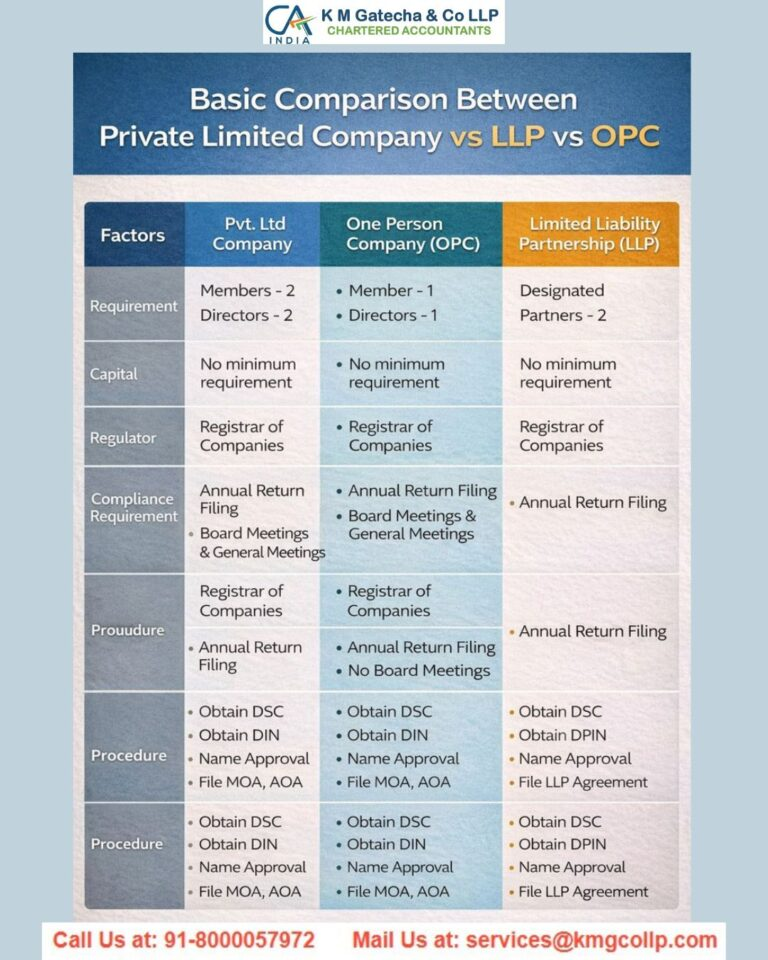
Difference Between Private Limited Company and LLP (Simple Explanation)
| Aspect | Private Limited Company (Pvt Ltd) | Limited Liability Partnership (LLP) |
| Law | Governed by Companies Act, 2013 | Governed by LLP Act, 2008 |
| Best For | Startups and businesses planning to grow, raise funding, or expand | Small businesses, professionals, and service-based firms |
| Ownership & Management | Owned by shareholders and managed by directors | Owned and managed by partners together |
| Members Required | Minimum 2, maximum up to 200 shareholders | Minimum 2 partners, no maximum limit |
| Capital Requirement | No fixed minimum, but basic setup capital is usually required | No minimum capital required |
| Taxation | Company tax applies, and dividends are taxed in shareholders’ hands | Fixed tax rate on profits; no extra tax on profit sharing |
| Funding Options | Can raise funds from investors by issuing shares | Cannot issue shares; funding mainly from partners or loans |
| Ownership Transfer | Shares can be transferred easily | Transfer is more difficult and needs partner approval |
| ESOPs (Employee Benefits) | Can offer ESOPs to employees | ESOPs not allowed |
| Compliance | More rules, audits, meetings, and filings required | Fewer compliance requirements |
| Annual Filing | More detailed annual filings required | Fewer and simpler annual filings |
| Registration Process | Done through company incorporation form | Done through LLP incorporation form |
| Closure Process | More complex process | Simpler process |
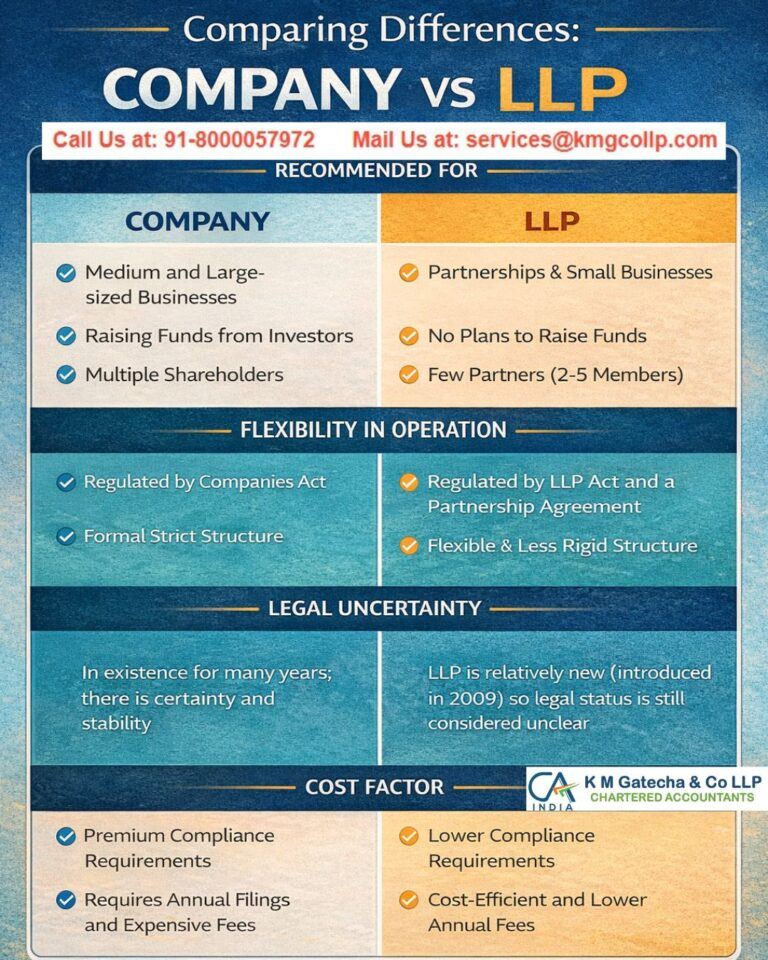
Similarities Between LLP and Private Limited Company
Even though LLPs and Private Limited Companies are different in structure, they share some common features:
Limited Liability Protection:
In both cases, owners’ personal assets are protected. Their liability is limited to the amount they have invested in the business.
Separate Legal Identity:
Both LLPs and Private Limited Companies are treated as separate legal entities, meaning the business is different from its owners.
Government Registration:
Both must be registered under the Ministry of Corporate Affairs to operate legally.
Continuity of Business:
The business continues to exist even if partners or shareholders change.
In simple terms, both structures provide legal protection, formal recognition, and long-term stability. The main difference lies in how they are managed and how they grow.
LLP vs Private Limited Company: Registration Process
Starting a business requires completing some basic legal steps. Both LLP and Private Limited Company have different registration processes. Here is a simple comparison:
| Step | Private Limited Company | LLP |
| 1. Digital Signature | Required for directors and shareholders to sign documents online | Required for all designated partners |
| 2. Name Approval | Apply through SPICe+ form with name options for approval | Apply through LLP name approval form |
| 3. Registration Process | Company is registered through SPICe+ form, and PAN, TAN, and other registrations are also allotted | LLP is registered through LLP form, followed by filing partnership details |
| 4. Bank Account | Mandatory after registration | Mandatory after registration |
| 5. Business Start Declaration | A declaration must be filed before starting business operations | Not required for LLP |
Both LLP and Private Limited Company require online registration and documentation. However, Private Limited Companies have more formal steps and additional compliance, while LLP registration is slightly simpler.
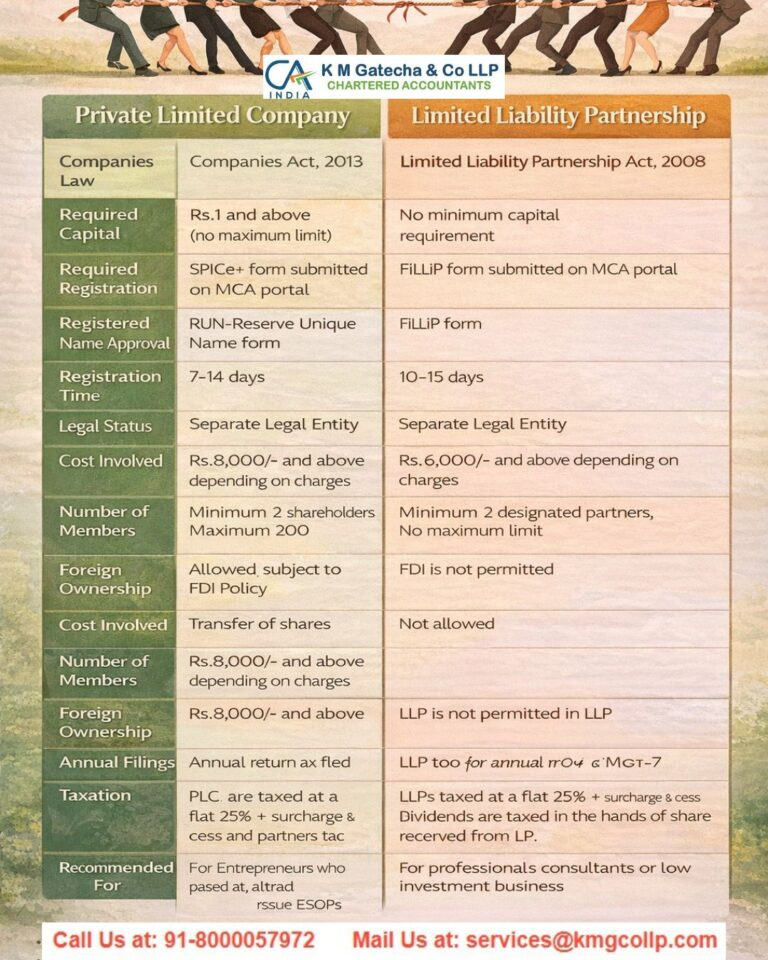
Compliance Rules: Private Limited Company vs LLP
Running a business also means following regular legal rules. Here is a simple comparison of compliance requirements for both structures:
| Requirement | Private Limited Company | LLP |
| Board Meetings | Must hold regular board meetings every year | Not required |
| Annual General Meeting (AGM) | Must conduct AGM every year within a fixed time | Not required |
| Statutory Audit | Mandatory for all companies | Required only if turnover or contribution crosses set limits |
| Annual Filings | Must file financial statements and annual returns every year | Must file annual return and financial details every year |
| Director/Partner Details Update | Must update director KYC annually | Must update partner KYC annually |
Funding & Investment Options: LLP vs Private Limited Company
The way your business is structured affects how easily you can raise money and attract investors. Here is a simple comparison:
| Aspect | Private Limited Company | LLP |
| Equity Funding | Can raise money by issuing shares to investors like venture capitalists and angel investors | Cannot issue shares, so raising external investment is limited |
| Debt Funding | Can easily get loans, debentures, and other funding options | Can also get loans, but options are more limited |
| Foreign Investment | Foreign investment is allowed in most sectors | Foreign investment is allowed in many cases, similar to companies |
Taxation: Private Limited Company vs LLP
Although both LLPs and Private Limited Companies provide limited liability protection, their tax rules are different and can affect overall profits.
| Aspect | Private Limited Company | LLP |
| Tax Rate | Tax is charged at different rates based on income and turnover slabs | Fixed tax rate on total income |
| Surcharge | Additional surcharge applies based on income level | Surcharge applies when income crosses a certain limit |
| Cess | Health and education cess is applicable on tax and surcharge | Same cess applies |
| Overall Tax Impact | Tax rate varies depending on income and company type | Tax rate is generally fixed |
| Dividend Tax | No separate dividend tax, but shareholders are taxed on dividends as per their income slab | Not applicable as LLPs do not issue dividends |
Day-to-Day Operations: Private Limited Company vs LLP
| Aspect | Private Limited Company | LLP |
| Decision Making | Formal approvals and structured voting system | Simple and flexible partner-based decisions |
| Documentation | More detailed records and compliance required | Less documentation and simpler records |
| Business Growth | Easier to scale and attract investors | Growth depends mainly on partners and internal funding |
| Financial Management | Strict reporting and audits required | Flexible financial management with fewer audits |
| Ownership Transfer | Shares can be transferred easily | Ownership transfer needs partner agreement |
| Market Image | Viewed as more professional and investor-friendly | Seen as suitable for small and service-based businesses |
| Expansion | Easier expansion and funding opportunities | Expansion is slower and more internal |
| Assets | Can hold and manage assets easily | Can also own assets but with simpler structure |
How to Choose the Right Structure
Choose Private Limited Company if:
- You plan to raise investment or venture capital
- You want to scale your business quickly
- You need ESOPs for employees
- You may go for IPO or large expansion in future
Choose LLP if:
- You run a small or professional service business
- You prefer simple compliance and flexibility
- Your business is self-funded
- You want easier day-to-day management
Key Points to Remember:
- Private Limited Company = better for growth and funding
- LLP = better for flexibility and low compliance
- Your choice should depend on your long-term business goals
Final Thought:
The right business structure is not just a legal step—it decides how your business will grow, raise funds, and operate in the future.
Disclaimer: The content on this website is for informational purposes only and does not constitute legal, financial, or professional advice. Please consult qualified experts before acting on any information. K M GATECHA & CO LLP accepts no liability for errors, omissions, or outcomes from the use of this content. This site is not an advertisement or solicitation.


