
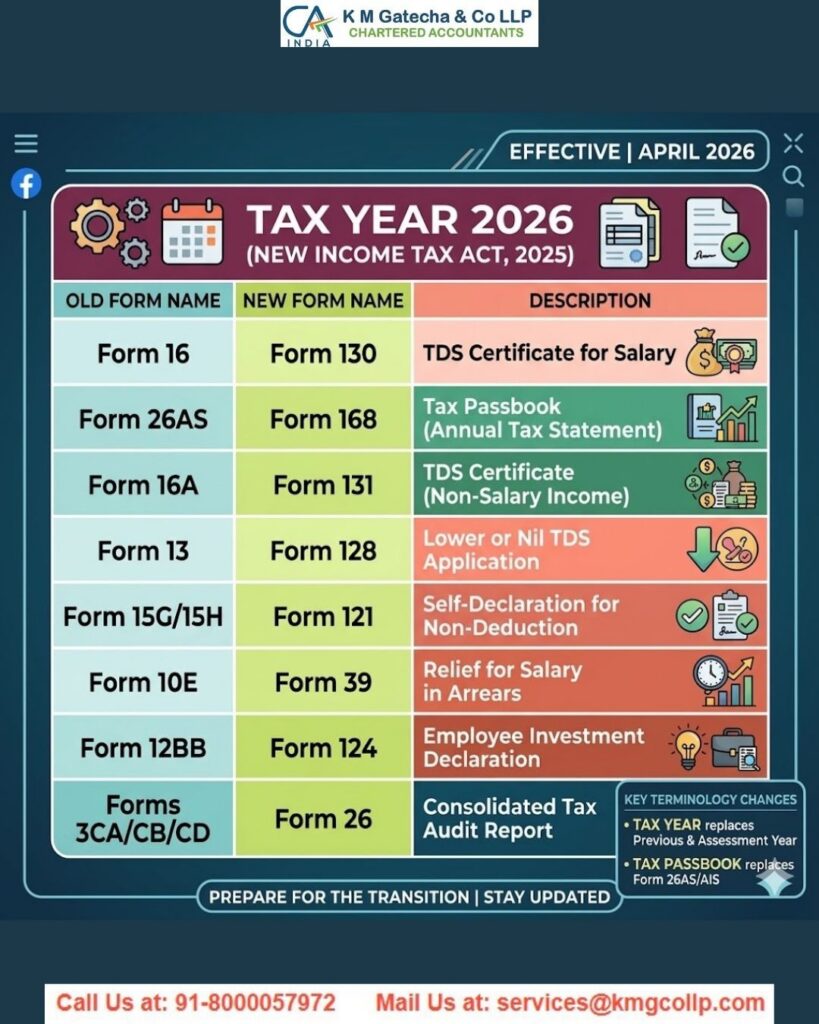
Form 145 is a mandatory declaration form for foreign remittances under the new Income Tax Act, 2025. If you are sending money to a non-resident individual or a foreign company, you must file this form before making the payment.
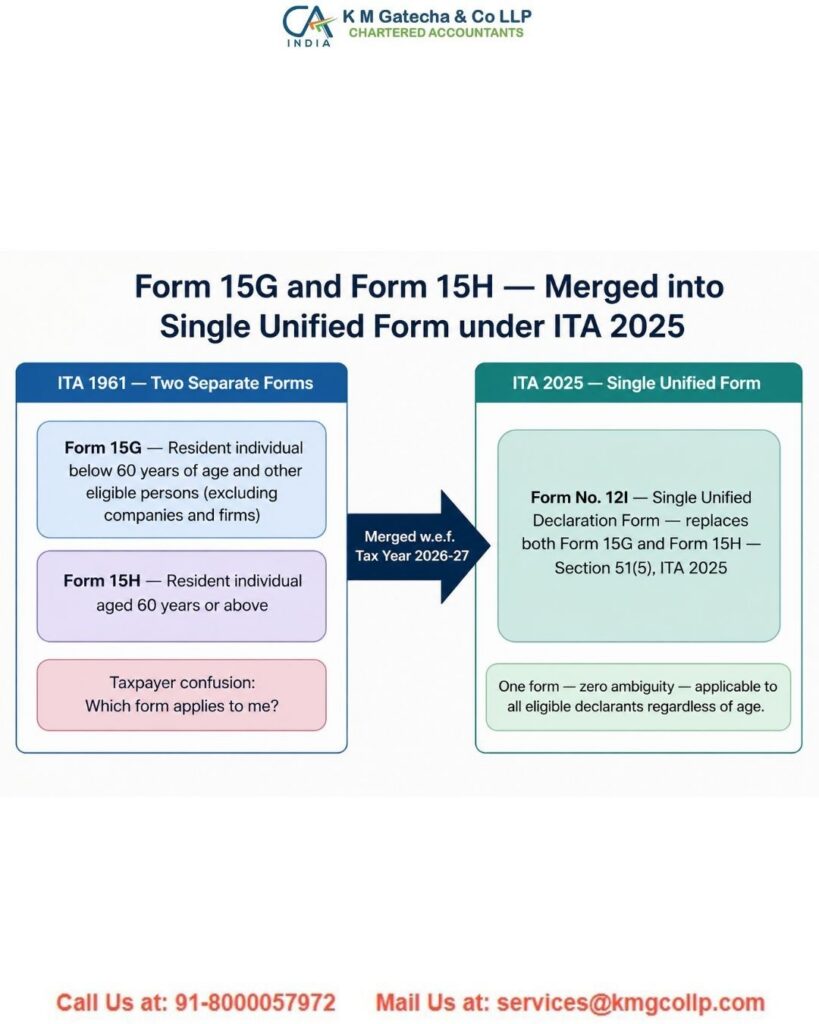
Form 145 replaces the earlier Form 15CA and needs to be filed separately for every foreign remittance transaction. In some cases, you may also need a CA certificate in Form 146 before submitting Form 145.
What is Form 145?
Form 145 is a declaration that must be submitted before making payments to a non-resident or foreign company. It helps the tax department ensure that the correct tax has been deducted or considered on international payments.
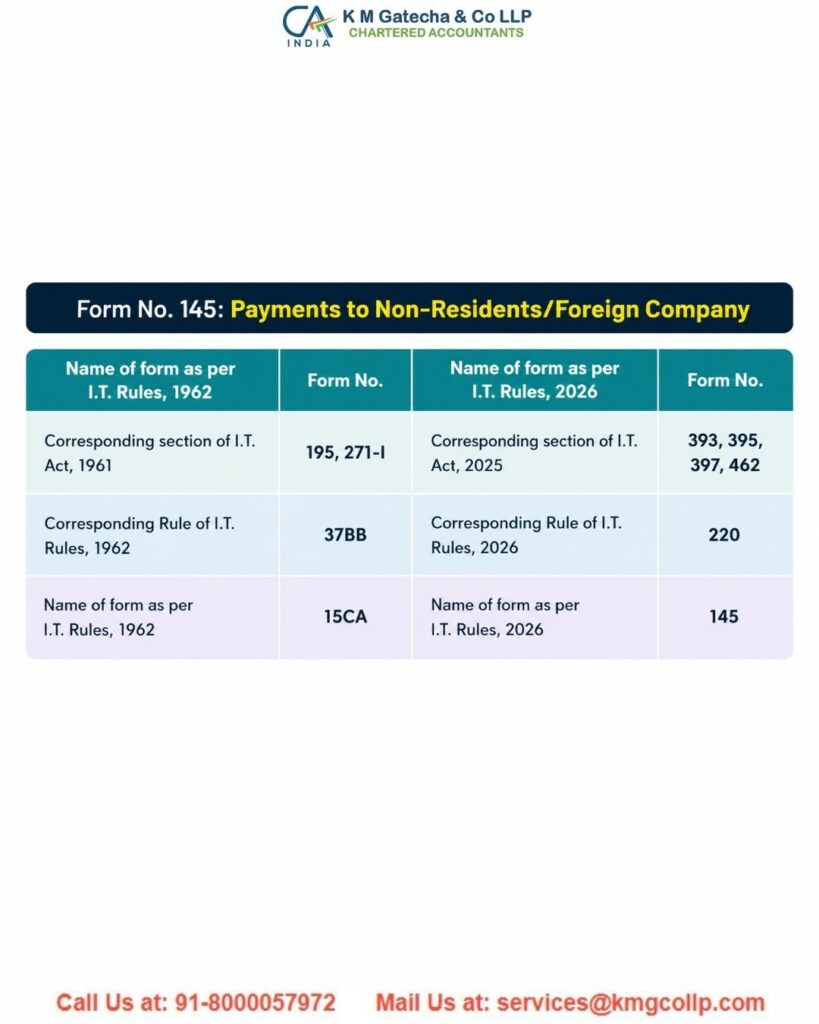
The requirement for Form 145 is governed by the Income Tax Act, 2025, mainly under Sections 393, 395, 397, and 462, along with Rule 220 of the Income Tax Rules, 2026.
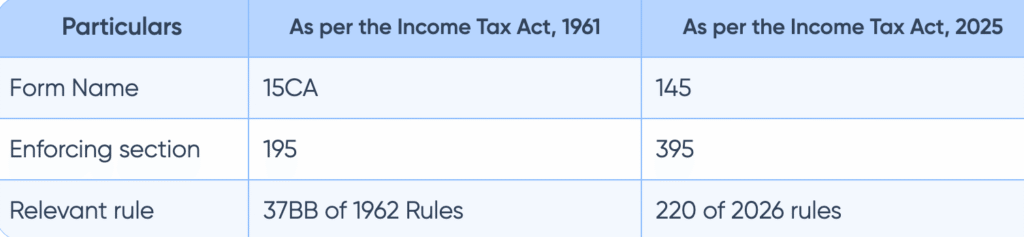
To make it easier to understand, here is a quick comparison between the old and new provisions:
| Particulars | Under Income Tax Act, 1961 | Under Income Tax Act, 2025 |
| Form Name | Form 15CA | Form 145 |
| Section | Section 195 | Section 395 |
| Income Tax Rule | Rule 37BB of Income Tax Rules, 1962 | Rule 220 of Income Tax Rules, 2026 |
Why is Form 145 Important?
Earlier, taxpayers had to file Form 15CA under Section 195(6) of the Income Tax Act, 1961 and Rule 37BB of the Income Tax Rules, 1962 before making payments to a non-resident or foreign company. It worked as a self-declaration form to report foreign payments and ensure proper tax compliance.
Why Was Form 15CA Replaced?
With the introduction of the Income Tax Act, 2025, several tax provisions were updated. As part of these changes, old forms were replaced with new ones to match the updated compliance and reporting system.
As a result, Form 15CA has now been replaced by Form 145 under the new tax regime.
Who Should File Form 145?
Form 145 must be filed by any person making a payment to a non-resident individual or foreign company before sending money outside India, as per Rule 220 of the Income Tax Rules, 2026.
It is generally applicable to:
- Indian companies paying royalty, fees, interest, or dividends to foreign entities
- Individuals sending money abroad for professional services, investments, or business purposes
- Businesses paying foreign consultants, overseas vendors, or software providers
- Banks or financial institutions making remittances for customers
- Any taxpayer or authorised person responsible for reporting foreign payments
When is Form 145 Required?
You need to file Form 145 in the following cases:
- Before making a foreign remittance
- For every transaction separately
- Whether the payment is one-time or recurring
Who Does Not Need to File Form 145?
Form 145 is not required in certain cases, such as:
- Individuals sending money abroad under the Liberalized Remittance Scheme (LRS) where RBI approval is not needed
- Businesses operating in an International Financial Services Center (IFSC)
- Certain RBI-notified transactions that are not taxable in India and are exempt from reporting
Components and Structure of Form 145
Form 145 is divided into four parts, depending on the amount of remittance and whether the payment is taxable in India.
Part A – Taxable Payments Up to ₹5 Lakh
Part A applies when:
- The payment is taxable in India, and
- The total payment to the same recipient during the financial year is up to ₹5 lakh
Details required include:
- Sender’s details (name, PAN, address, contact information)
- Recipient’s details (name, address, foreign tax ID)
- Remittance details (amount, bank details, country)
- Nature of payment
- TDS details (rate, amount, deduction date)
- RBI purpose code
- Declaration by the sender
Part B – Taxable Payments Above ₹5 Lakh (With AO Certificate)
Part B applies when:
- The payment is taxable,
- Total payment exceeds ₹5 lakh, and
- You have obtained a lower or nil TDS certificate from the Assessing Officer (AO)
Along with Part A details, you must also provide:
- Details of the AO certificate
- Approved TDS rate mentioned in the certificate
Part C – Taxable Payments Above ₹5 Lakh (With CA Certificate)
Part C is the most commonly used section for higher-value foreign remittances.
It applies when:
- The payment is taxable,
- The amount exceeds ₹5 lakh, and
- A CA certificate in Form 146 is obtained instead of an AO certificate
Additional details required:
- Chartered Accountant’s details
- Form 146 acknowledgement number
- UDIN of the CA certificate
- Taxability under Indian tax laws
- DTAA benefits and treaty rate (if applicable)
- Tax Residency Certificate (TRC) for claiming treaty benefits
Part D – Non-Taxable Payments
Part D is used when the foreign payment is not taxable in India.
Examples include:
- Import of goods
- Certain capital transactions
- Payments specifically exempt under tax laws
Details required:
- Basic information of sender and recipient
- Remittance details
- A declaration confirming that the payment is not taxable in India
What is Form 146?
Form 146 is a certificate issued by a Chartered Accountant (CA) under the Income Tax Act, 2025. It replaces the earlier Form 15CB and is used before making certain foreign payments to confirm the tax details of the transaction.
What Does Form 146 Confirm?
Before issuing Form 146, a CA checks important details related to the payment, such as:
- The purpose and nature of the foreign payment
- Whether the payment is taxable in India
- Whether any benefit under the Double Taxation Avoidance Agreement (DTAA) is available
- The correct TDS rate and tax amount to be deducted
- Details of the Tax Residency Certificate (TRC) of the foreign recipient
- UDIN (Unique Document Identification Number) for authenticity
When is Form 146 Required?
Form 146 is needed only in specific cases:
- The payment is taxable in India
- The total payment is more than ₹5 lakh
- You are filing Part C of Form 145
- You do not have an Assessing Officer (AO) certificate
Documents and Details Required for Form 145
To file Form 145 correctly, you should keep the following details ready.
1. Remitter (Sender) Details
You need:
- PAN of the person making the payment
- TAN, if applicable
- ITDREIN (Income Tax Department Reporting Entity Identification Number)
- Name and address of the sender
2. Foreign Recipient Details
You need:
- Name and address of the foreign recipient
- Tax Identification Number (TIN) of their country
- Country of residence
- Tax Residency Certificate (TRC) if claiming DTAA benefit
3. Remittance Details
Keep the following information ready:
- Amount being sent and currency type
- Purpose of remittance (RBI purpose code)
- Nature of payment
- BSR code of the bank branch handling the transfer
4. Tax (TDS) Details
You will need:
- Applicable TDS rate
- Amount of tax deducted
- Date of tax deduction
5. Bank Details
Provide details of the Authorized Dealer (AD) bank handling the remittance.
6. Additional Documents (If Required)
For Part B:
- Details of the Assessing Officer (AO) certificate
For Part C:
- Form 146 acknowledgement number
- UDIN issued by the CA
Details Required to File Form 145
While filing Form 145, you need to provide:
- Sender details: PAN, name, address
- Recipient details: Name, country, tax identification number
- Payment details: Amount, currency, and bank details
- Purpose of remittance: As per RBI code
- Tax details: TDS rate and tax deducted
- Supporting documents, if required
How to File Form 145 Online?
You can file Form 145 online through the Income Tax portal or offline using a utility. However, online filing is easier and faster.
Steps to File Form 145 Online
- Log in to the Income Tax e-filing portal using your ID and password.
- Go to:
e-File → Income Tax Forms → File Income Tax Forms - Open the section for forms under the Income Tax Act, 2025.
- Search for and select Form 145.
- Choose Online mode, select the relevant tax year, and continue.
- Click “Let’s Get Started” and choose the applicable part (A, B, C, or D).
- Fill in the required details, such as:
- Sender and recipient information
- Remittance amount, country, and purpose
- Nature of payment
- TDS details
- Review all details carefully in the preview section.
- Click “Proceed to e-Verify” and verify using DSC or EVC.
- Submit the form and download the acknowledgment.
- Share the acknowledgment with your Authorized Dealer (AD) bank before making the payment.
Filing Form 145 Part C (With Form 146)
For higher-value transactions where a CA certificate is required, follow these extra steps:
- Add your CA on the portal:
My Account → Authorised Partners → My Chartered Accountants → Add CA - Enter the CA membership number and assign Form 146.
- The CA will:
- Prepare Form 146
- Verify taxability, DTAA benefits, and TDS rate
- Submit the form using DSC
- Once the CA files Form 146, log in again and open Form 145 – Part C.
- Enter the Form 146 acknowledgement number. Most details will be auto-filled.
- Complete the remaining details, e-verify, and submit the form.
- Download the acknowledgment and share it with your AD bank.
Due Date for Form 145
Form 145 does not have a yearly due date. It must be filed every time you make a foreign remittance.
| Event | Who Needs to Act | Timeline |
| File Form 145 (Part A/B/D) | Taxpayer / Remitter | Before each remittance |
| File Form 145 Part C | Taxpayer | Before remittance above ₹5 lakh |
| File Form 146 | Chartered Accountant | Before filing Part C |
| Withdraw Form 145 | Remitter | Within 7 days of filing |
Penalty for Not Filing Form 145
Filing Form 145 is mandatory. Not filing it may create problems and penalties.
1. Penalty up to ₹1 lakh
Under Section 462, a penalty may apply if:
- Form 145 is not filed, or
- Wrong or incomplete details are submitted
2. Foreign Payment May Get Delayed
Banks usually do not process international payments without a Form 145 acknowledgment.
3. Tax Demand and Interest
If TDS is deducted incorrectly, additional tax and interest may be charged.
4. Penalty for Wrong Information
Even if you file the form, providing incorrect details can attract penalties.
Form 15CA vs Form 145 – Key Differences
| Basis | Form 15CA (Old) | Form 145 (New) |
| Applicable Law | Income Tax Act, 1961 | Income Tax Act, 2025 |
| Main Section | Section 195 | Section 395 |
| Rule | Rule 37BB | Rule 220 |
| CA Certificate | Form 15CB | Form 146 |
| UDIN Requirement | Not Mandatory | Mandatory |
| Recipient TIN | Not Required | Mandatory |
| Filing Period | Up to 31 March 2026 | From 1 April 2026 |
| Filing Method | Online / Offline | Online / Offline |
Disclaimer: The content on this website is for informational purposes only and does not constitute legal, financial, or professional advice. Please consult qualified experts before acting on any information. K M GATECHA & CO LLP accepts no liability for errors, omissions, or outcomes from the use of this content. This site is not an advertisement or solicitation.