
Foreign Company Registration in India: Complete Guide
India is one of the world’s fastest-growing economies, offering a vast consumer market, skilled workforce, and attractive investment opportunities. As a result, many international businesses choose India as their preferred destination for expansion and Foreign Direct Investment (FDI). To establish a business presence in India, foreign entities must comply with the provisions of the Companies Act, 2013, Foreign Exchange Management Act (FEMA), RBI regulations, and the Companies (Registration of Foreign Companies) Rules, 2014.

What is a Foreign Company Under the Companies Act, 2013?
As per Section 2(42) of the Companies Act, 2013, a foreign company refers to a company or body corporate incorporated outside India that:
- Has a place of business in India, either directly or through an agent, physically or electronically, and
- Conducts any business activity in India in any manner.
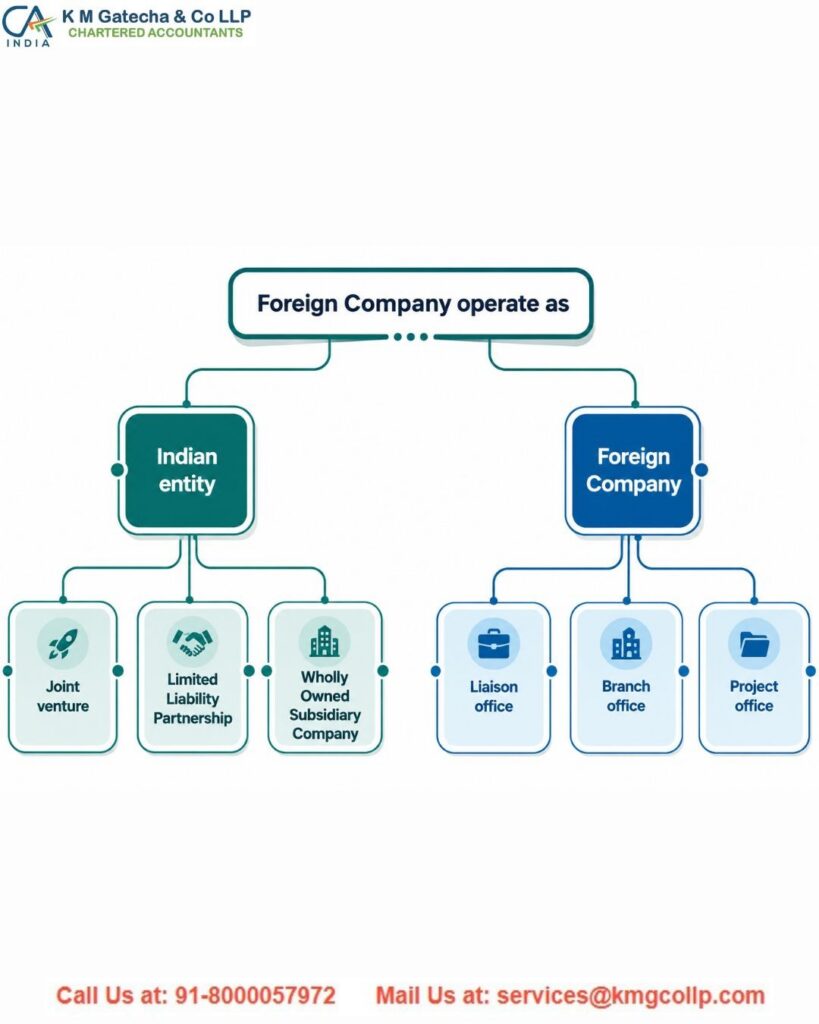
Ways to Establish a Foreign Company in India
Foreign nationals and overseas entities can enter the Indian market through various business structures depending on their objectives and investment plans.
1. Private Limited Company
A Private Limited Company is the most preferred and efficient structure for foreign businesses entering India. In many sectors, up to 100% FDI is allowed through the automatic route.
A foreign company can establish:
Joint Venture Company
Under this structure, a foreign entity partners with an Indian business to operate jointly in India.
Key features:
- Selection of a suitable Indian partner
- Execution of a Memorandum of Understanding (MoU) or Letter of Intent (LOI)
- Formation of a detailed Joint Venture Agreement
- Agreement covers shareholding, management rights, dispute resolution, confidentiality, transfer of shares, and governance matters
Wholly Owned Subsidiary (WOS)
A foreign company can own 100% shares in an Indian company where sectoral regulations permit.
Benefits include:
- Complete ownership and control
- Independent management structure
- Access to Indian markets and customers
- Limited liability protection
Other Business Presence Options for Foreign Companies
Apart from incorporating an Indian company, foreign entities can establish representative offices in India subject to RBI approval.
Liaison Office
A Liaison Office acts as a communication channel between the foreign parent company and Indian businesses.
Permitted activities include:
- Representing the parent company in India
- Promoting exports and imports
- Facilitating technical and financial collaborations
- Coordinating communication between Indian entities and the parent company
Restrictions:
- Cannot undertake commercial activities
- Cannot generate revenue in India
Project Office
A Project Office can be established for executing specific projects awarded by Indian entities.
It is generally permitted when:
- The project is funded through inward remittances from abroad
- Funded by international financial institutions
- Approved by an appropriate government authority
- Supported through loans from Indian banks or financial institutions
Branch Office
A Branch Office allows a foreign company to conduct certain business activities in India.
Permitted activities include:
- Import and export operations
- Consultancy and professional services
- Research activities
- Technical support services
- Software development and IT services
- Acting as buying or selling agents
Restrictions:
- Retail trading is prohibited
- Manufacturing activities cannot be carried out directly in India

Registration Process for a Wholly Owned Subsidiary
The incorporation process generally involves the following steps:
Step 1: Appoint Directors
- Minimum two directors are required.
- At least one director must be a resident of India.
Step 2: Obtain DSC and DIN
All directors must obtain:
- Digital Signature Certificate (DSC)
- Director Identification Number (DIN)
Step 3: Reserve Company Name
Apply for name approval through Part A of the SPICe+ application on the MCA portal.
Step 4: Draft Constitutional Documents
Prepare:
- Memorandum of Association (MOA)
- Articles of Association (AOA)
Step 5: File SPICe+ Incorporation Application
Submit Part B of SPICe+ along with required attachments.
Step 6: Submit Supporting Documents
For Indian Directors:
- PAN Card
- Identity proof
- Address proof
For Foreign Directors:
- Passport
- Address proof such as driving licence, bank statement, or utility bill
- Documents duly notarised and apostilled or consularised
For Registered Office:
- Address proof
- Utility bill
- NOC from owner (if applicable)
Step 7: Certificate of Incorporation
Upon successful verification, the Registrar of Companies (ROC) issues:
- Certificate of Incorporation
- Corporate Identification Number (CIN)
- PAN and TAN
Step 8: Open Bank Account and Complete FDI Compliance
After incorporation:
- Open a company bank account
- Receive foreign investment
- Complete RBI and FEMA reporting requirements
Conditions for Opening a Liaison Office
To establish a Liaison Office, the foreign company generally must:
- Have a profitable track record for the preceding three financial years
- Possess a net worth of at least USD 50,000
- Obtain RBI approval through an Authorised Dealer Category-I Bank
Required documents include:
- Certificate of Incorporation
- MOA and AOA
- Audited financial statements
- Application to RBI
Conditions for Opening a Branch Office
To establish a Branch Office, the foreign company should:
- Be engaged in manufacturing or trading activities
- Have a profit-making track record during the preceding five years
- Maintain a net worth of at least USD 100,000
Approval is obtained through RBI via an Authorised Dealer Bank.
Advantages of Foreign Company Registration in India
- Access to one of the world’s largest consumer markets
- Liberal FDI policy in most sectors
- Availability of skilled workforce
- Cost-effective operations
- Strong startup and technology ecosystem
- Growing infrastructure and digital economy
- Opportunity to establish wholly owned operations

Conclusion
India offers multiple avenues for foreign businesses to establish and expand their presence. Depending on business objectives, foreign investors can choose between a Joint Venture, Wholly Owned Subsidiary, Liaison Office, Project Office, or Branch Office. Among these options, a Private Limited Company, particularly a Wholly Owned Subsidiary, remains the most popular structure due to its flexibility, operational freedom, and ability to attract foreign investment. Proper compliance with the Companies Act, FEMA regulations, and RBI guidelines is essential for a smooth and legally compliant business setup in India.
Disclaimer: The content on this website is for informational purposes only and does not constitute legal, financial, or professional advice. Please consult qualified experts before acting on any information. K M GATECHA & CO LLP accepts no liability for errors, omissions, or outcomes from the use of this content. This site is not an advertisement or solicitation.