
Foreign Company Registration Options in India
India allows foreign businesses to establish their presence through multiple business structures, each offering different ownership rights, compliance obligations, and operational flexibility. Over the years, Foreign Direct Investment (FDI) reforms have made it easier for overseas companies to enter the Indian market by opening more sectors to foreign participation and streamlining approval procedures.
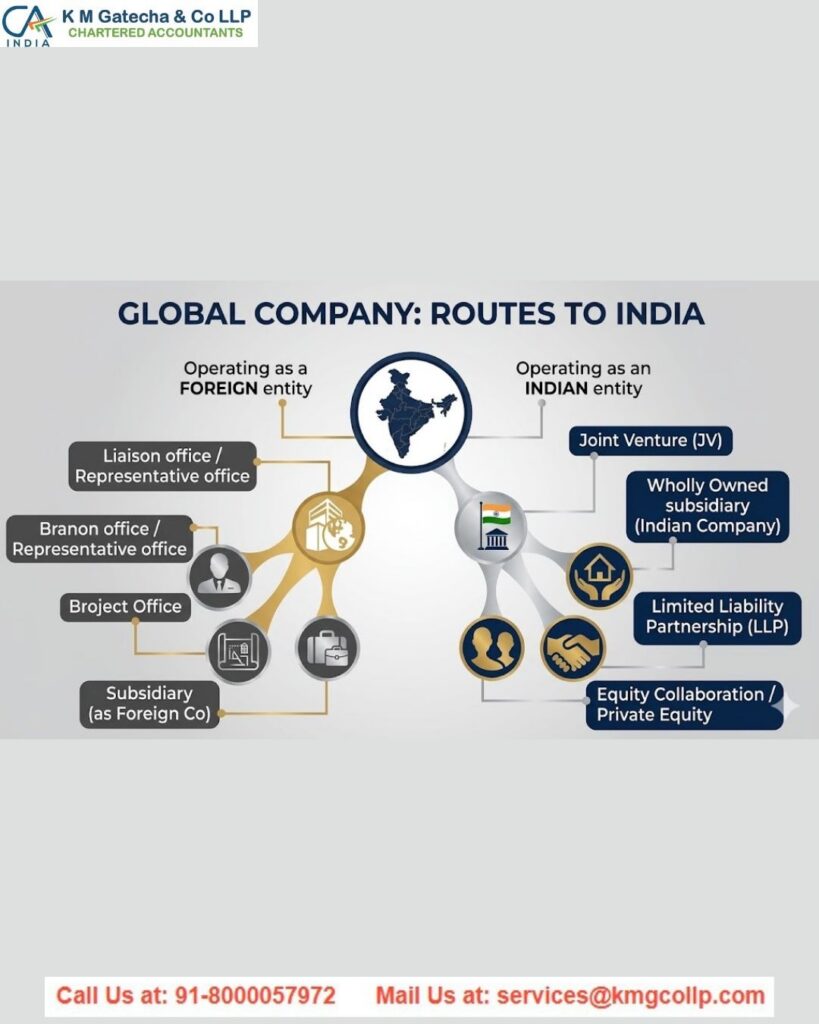
This guide explains the major registration options available to foreign companies in India, including wholly owned subsidiaries, joint ventures, branch offices, liaison offices, project offices, and LLPs.
Key Highlights
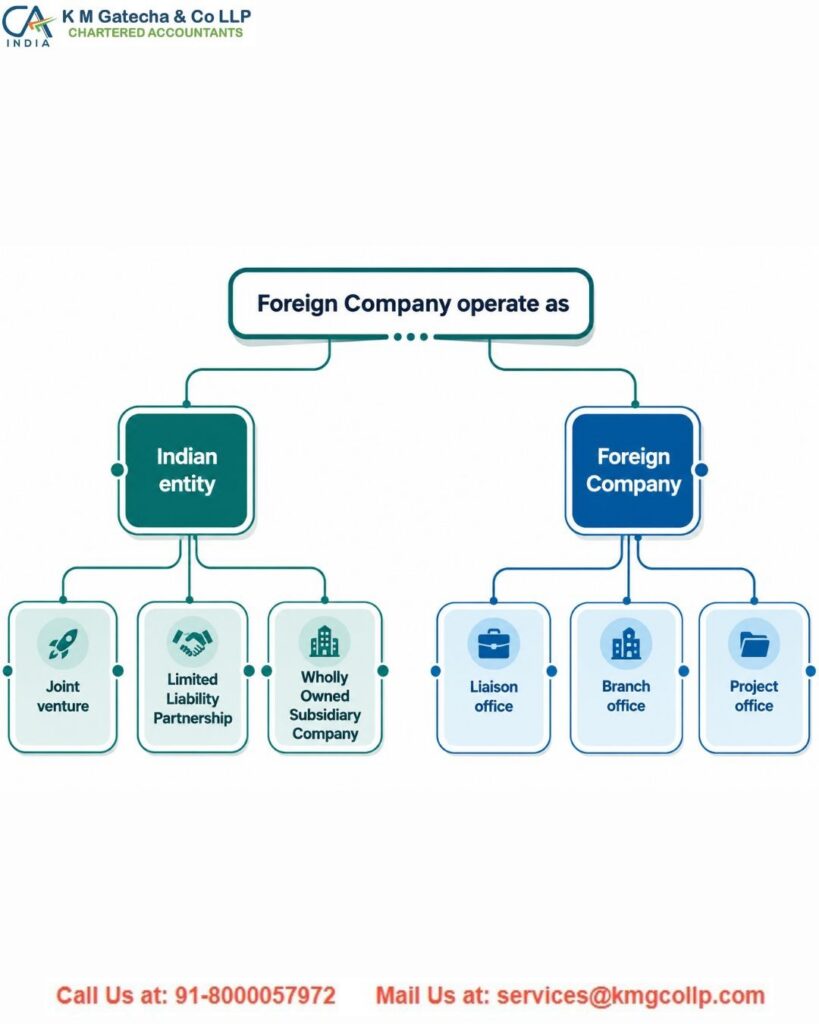
- Foreign companies can enter India through wholly owned subsidiaries, joint ventures, branch offices, liaison offices, project offices, or LLPs.
- Registration with the Registrar of Companies (ROC), PAN, TAN, GST, and RBI/FEMA compliance are essential requirements.
- A wholly owned subsidiary provides complete ownership and operational control.
- Joint ventures enable foreign businesses to partner with Indian entities and share resources and risks.
- Liaison and branch offices are suitable for representation, coordination, and limited business activities.
- LLPs offer lower compliance costs and are suitable for professional and service-oriented businesses.
Entry Routes for Foreign Businesses in India
Foreign investors can choose from several business structures depending on their objectives, investment plans, and operational requirements:
- Wholly Owned Subsidiary (WOS)
- Joint Venture (JV)
- Liaison Office (LO)
- Project Office (PO)
- Branch Office (BO)
- Limited Liability Partnership (LLP)
Each structure has distinct legal and regulatory implications, making it important to select the option that aligns with the company’s expansion strategy.
Basic Registration Requirements
Foreign entities establishing operations in India generally need the following registrations and approvals:
- Registration with the Registrar of Companies (ROC) under the Ministry of Corporate Affairs (MCA).
- Permanent Account Number (PAN) for income tax compliance.
- Tax Deduction and Collection Account Number (TAN) for withholding tax obligations.
- Registration under the Shops and Establishments Act, where applicable.
- Import Export Code (IEC) for businesses involved in international trade.
- GST registration if turnover exceeds the prescribed limits.
- Compliance with RBI regulations, FEMA provisions, and applicable FDI policies.
Additional approvals may be required depending on the industry and nature of activities.
Wholly Owned Subsidiary (WOS)
A wholly owned subsidiary is an Indian company whose shares are entirely owned by a foreign parent company. It offers complete control over management and operations.
Eligibility
- No minimum paid-up or authorized capital requirement.
- Minimum two shareholders.
- Compliance with FDI policy and FEMA regulations.
Permitted Activities
Subject to sector-specific regulations, a WOS can undertake manufacturing, trading, service, and other business activities. In sectors permitting 100% FDI under the automatic route, prior RBI approval is generally not required.
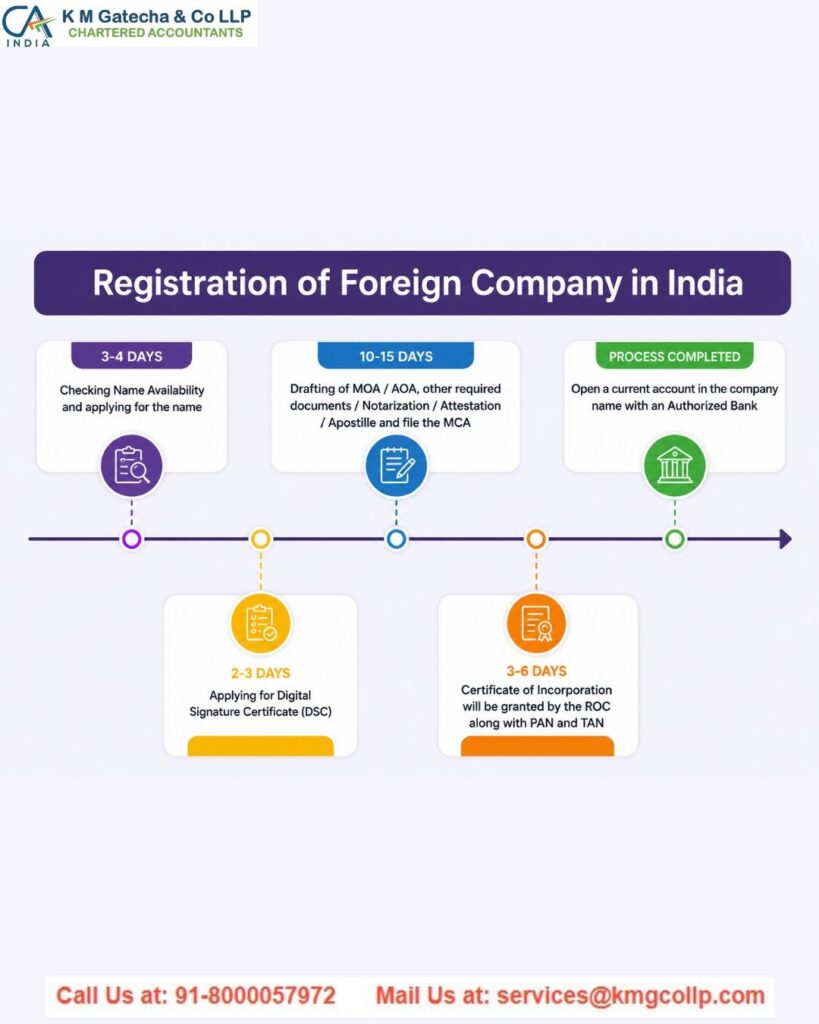
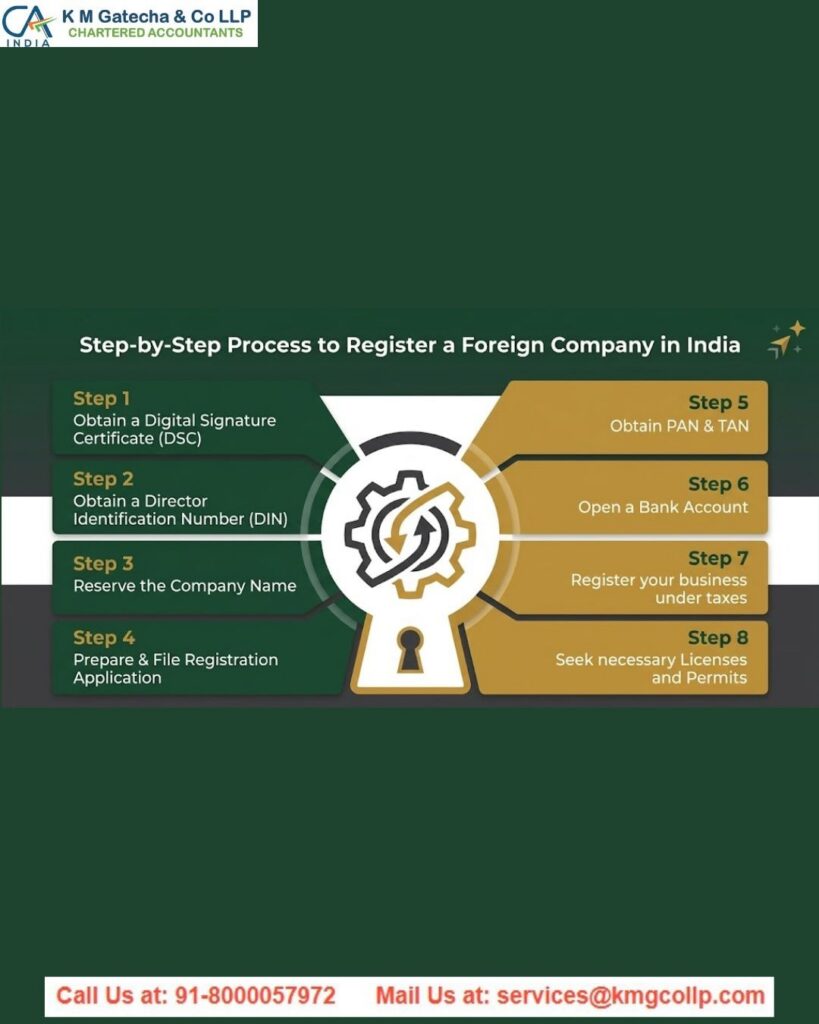
Registration Process
- Select the appropriate company structure.
- Obtain DIN for directors.
- Acquire Digital Signature Certificates (DSC).
- Reserve a company name through MCA.
- Draft MOA and AOA.
- File incorporation documents through SPICe+.
- Pay applicable registration fees.
- Obtain the Certificate of Incorporation.
- Receive PAN and TAN.
- Open a corporate bank account.
- Complete GST and other regulatory registrations, if applicable.
Setup Timeline
Approximately 4–8 weeks.
Advantages
- Complete ownership and decision-making authority.
- Separate legal entity status.
- Easier consolidation of financial statements.
- Improved operational control and scalability.
Disadvantages
- Higher compliance obligations.
- Extensive documentation requirements.
- Parent company may be affected by subsidiary losses.
- Additional tax considerations.
Joint Venture (JV)
A joint venture involves collaboration between a foreign investor and an Indian partner, making it suitable for sectors with FDI restrictions or where local expertise is valuable.
Eligibility
- No minimum capital requirement.
- Joint Venture Agreement or Memorandum of Understanding required.
- Minimum two participants.
- Subject to FEMA and FDI regulations.
Registration Process
- Identify a suitable Indian partner.
- Execute a Joint Venture Agreement.
- Select the business structure (Company, LLP, etc.).
- Obtain necessary approvals.
- Register with relevant authorities.
- Obtain PAN, TAN, and GST registration.
- Open a business bank account.
- Ensure compliance with industry-specific regulations.
Setup Timeline
Approximately 4–8 weeks.
Advantages
- Access to local expertise and networks.
- Shared investment and operational risks.
- Easier market penetration.
Disadvantages
- Potential management conflicts.
- Unequal resource contributions.
- Differences in business culture and expectations.
Liaison Office (LO)
A liaison office acts as a communication and coordination channel between the foreign company and Indian stakeholders. It cannot undertake commercial activities or earn revenue in India.
Eligibility
- Profit-making track record for the previous three years.
- Minimum net worth of USD 50,000.
Permitted Activities
- Representing the parent company.
- Promoting imports and exports.
- Facilitating technical and financial collaborations.
- Acting as a communication channel.
Registration Process
- Apply through an Authorized Dealer Bank.
- Obtain RBI approval.
- Receive a Unique Identification Number (UIN).
- Register with MCA and ROC.
- Obtain PAN and TAN.
- Maintain annual compliance records.
Setup Timeline
Approximately 6–8 weeks.
Advantages
- Cost-effective market entry.
- Limited compliance burden.
- Useful for market research and relationship building.
Disadvantages
- Cannot generate revenue.
- Cannot undertake commercial operations.
- Restricted scope of activities.
Branch Office (BO)
A branch office allows a foreign company to conduct approved business operations in India while remaining an extension of the parent company.
Eligibility
- Minimum net worth of USD 100,000.
- Profitable track record during the previous five financial years.
Permitted Activities
- Import and export of goods.
- Consultancy and professional services.
- Research activities.
- IT and software services.
- Acting as buying or selling agents.
Restricted Activities
- Manufacturing and processing.
- Retail trading.
- Construction and development activities.
Registration Process
- Submit an application through an Authorized Dealer Bank.
- Obtain RBI approval where required.
- Register with ROC.
- Obtain PAN and TAN.
- Open a bank account.
- Complete GST and IEC registrations if applicable.
Setup Timeline
Approximately 6–8 weeks.
Advantages
- Direct presence in India.
- Operates under the parent company’s brand.
- Centralized management control.
Disadvantages
- Higher tax rates compared to subsidiaries.
- Limited to approved business activities.
- Dependence on the parent company for financial support.
Project Office (PO)
A project office is established for executing a specific project in India, usually in sectors such as infrastructure, engineering, or construction.
Eligibility
- Contract awarded by an Indian entity.
- Project funded through inward remittances, multilateral agencies, or approved financing arrangements.
Advantages
- Quick and practical setup for project execution.
- Lower cost compared to establishing a subsidiary.
Disadvantages
- Restricted to project-related activities.
- Must be closed after project completion.
Limited Liability Partnership (LLP)
An LLP combines the benefits of limited liability with operational flexibility and lower compliance requirements.
Key Features
- FDI up to 100% is permitted in many sectors under the automatic route.
- Lower compliance obligations than a private limited company.
- Flexible profit-sharing arrangements.
Advantages
- Cost-effective structure.
- Simplified compliance.
- Suitable for consulting, professional services, and technology firms.
Disadvantages
- Limited fundraising opportunities.
- Less attractive to venture capital and institutional investors.
- Certain sectors have FDI restrictions.
Project Office
A Project Office is an ideal option for foreign companies undertaking specific assignments in India, such as infrastructure, engineering, construction, or turnkey projects. This setup allows foreign entities to execute a particular project in India without establishing a permanent business presence. The office operates only for the duration of the approved project and must comply with FEMA regulations and other applicable laws.
Eligibility Requirements
A foreign company can establish a Project Office in India when:
- It has secured a contract from an Indian entity to execute a project in India.
- The project has obtained all required regulatory approvals.
- The project is financed directly through inward remittances from abroad.
Alternatively, a Project Office may also be established if the project is funded by:
- An Indian company awarding the contract.
- A bilateral or multilateral international financing institution.
- A term loan sanctioned by an Indian bank or financial institution.
Permitted Activities
A Project Office is allowed to:
- Execute the specific project for which it has been established.
- Carry out activities directly related to the implementation and completion of the approved project.
However, it is not permitted to:
- Lend funds to any person or entity in India.
- Undertake activities unrelated to the approved project.
- Transfer funds between different projects without obtaining prior approval from the Reserve Bank of India (RBI).
Registration Process
The process for setting up a Project Office in India generally involves the following steps:
- Prepare the required documentation, including:
- Memorandum and Articles of Association of the parent company.
- Board Resolution or Power of Attorney authorizing the establishment of the Project Office.
- Letter of Intent.
- Copy of the project award or contract.
- Audited financial statements for the previous three years.
- Banker’s reference letter.
- Submit the prescribed application form along with supporting documents to an Authorized Dealer (AD) Category-I Bank.
- The AD Bank forwards the application to the RBI for obtaining a Unique Identification Number (UIN).
- After reviewing the application and ensuring compliance with applicable regulations, the AD Bank issues an approval letter permitting the establishment of the Project Office.
- Within 30 days of setting up the office, the company must file the required details electronically with the RBI.
- Open a bank account with an AD Category-I Bank for conducting project-related financial transactions.
- Complete other mandatory registrations and compliances, including:
- GST registration, where applicable.
- Professional Tax registration.
- Employees’ State Insurance Corporation (ESIC) compliance.
- Provident Fund (PF) compliance, if required.
Setup Timeline
A Project Office can generally be established within approximately four weeks, subject to timely submission of documents and approvals.
Advantages of a Project Office
- Enables foreign companies to execute specific projects in India without incorporating a separate entity.
- Operates under the parent company’s name, strengthening brand visibility and credibility.
- Provides a practical and cost-effective structure for project-based assignments.
- Simplifies the management of temporary business operations in India.
Disadvantages of a Project Office
- Activities are strictly restricted to project execution.
- Lending activities and unrelated business operations are prohibited.
- Transfer of funds between projects requires RBI approval.
- The office must be closed once the project is completed.
Conclusion
India provides foreign businesses with multiple entry routes, each designed to meet different operational objectives and regulatory requirements. While Wholly Owned Subsidiaries and Joint Ventures offer long-term business presence and operational flexibility, Liaison Offices, Branch Offices, and Project Offices serve more specific and restricted purposes.
Selecting the right business structure depends on factors such as investment plans, business objectives, industry regulations, and compliance requirements. With India’s growing economy, favorable investment climate, and expanding market opportunities, foreign companies can successfully establish and expand their operations by choosing the most suitable entry model and ensuring compliance with applicable laws.
How KMG & CO LLP Can Help
KMG & CO LLP provides comprehensive assistance for foreign companies planning to establish a presence in India. Our team offers end-to-end support, including business structure selection, company incorporation, regulatory approvals, FEMA and FDI compliance, tax registrations, accounting, and ongoing compliance management.
Whether you are setting up a Wholly Owned Subsidiary, Joint Venture, Branch Office, Liaison Office, Project Office, or LLP, our professionals help simplify the process and ensure full compliance with Indian regulations. We assist businesses at every stage, from initial registration to long-term tax and regulatory compliance, enabling a smooth and successful expansion into the Indian market.
Disclaimer: The content on this website is for informational purposes only and does not constitute legal, financial, or professional advice. Please consult qualified experts before acting on any information. K M GATECHA & CO LLP accepts no liability for errors, omissions, or outcomes from the use of this content. This site is not an advertisement or solicitation.