
US Tax Return Filing Services for NRIs
Complete IRS, FATCA, FBAR, and PFIC Compliance Solutions
Are you an NRI, Green Card holder, US citizen, or Indian-origin individual with financial interests in both India and the United States? Managing tax obligations across multiple jurisdictions can be challenging, and non-compliance with US tax laws may result in significant penalties. At KMG & CO LLP, we provide specialized US tax filing and cross-border tax advisory services to help individuals meet all IRS reporting requirements accurately and efficiently.
Our team assists with every aspect of US tax compliance, including:
- Preparation and filing of Form 1040
- FBAR (Foreign Bank Account Report) filing
- FATCA compliance through Form 8938
- Reporting ownership in foreign corporations using Form 5471
- PFIC reporting for Indian mutual funds through Form 8621
- Foreign trust and gift reporting under Forms 3520 and 3520-A
- Foreign Tax Credit (FTC) claims and DTAA benefits
- International tax planning and cross-border advisory
With more than 25 years of experience serving NRIs and global Indians, we deliver reliable tax solutions that ensure compliance while optimizing tax efficiency.

Who Must File a US Tax Return?
You may be required to file a US tax return if you are:
- A US citizen, regardless of your country of residence
- A Green Card holder living in India or any other country
- An H-1B, L-1, or other visa holder qualifying as a resident alien under the Substantial Presence Test
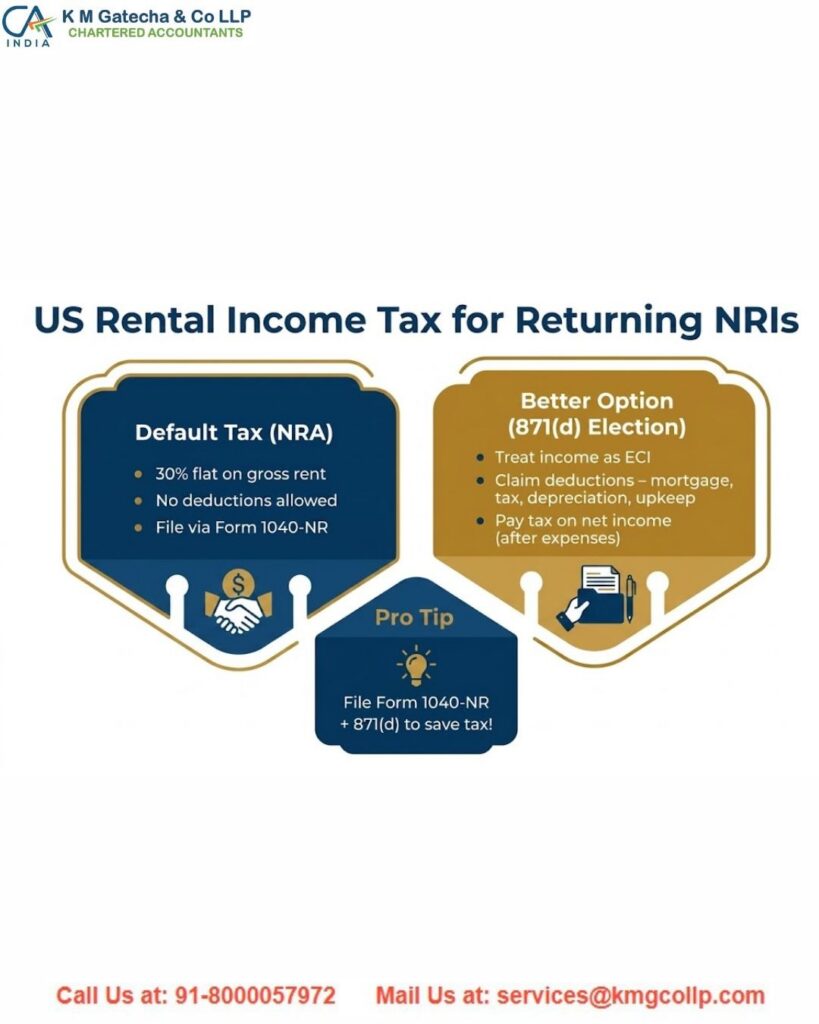
- An individual earning income from US sources such as dividends, capital gains, rental income, or business income
- Holding foreign bank accounts, investments, or ownership interests in Indian entities
Important US Tax Filing Deadlines
- April 15: Standard filing deadline
- June 15: Automatic extension for taxpayers residing outside the United States
- October 15: Extended filing deadline after submitting Form 4868
Filing returns within the prescribed timelines helps avoid penalties, interest, and unnecessary compliance issues.

Key US Tax Forms for NRIs and Global Indians
| Form | Purpose |
| Form 1040 | Individual US income tax return |
| Schedule B | Reporting interest and dividend income |
| Schedule D | Reporting capital gains and losses |
| Schedule E | Reporting rental and passive income |
| Form 8938 | FATCA reporting of foreign financial assets |
| FBAR (FinCEN Form 114) | Reporting foreign financial accounts |
| Form 8621 | PFIC reporting for Indian mutual funds |
| Form 5471 | Reporting foreign corporation ownership |
| Form 3520 / 3520-A | Reporting foreign trusts and gifts |
| Form 8833 | Disclosure of treaty-based positions under DTAA |
| Form 1116 | Claiming Foreign Tax Credit |
| Form 8992 | GILTI reporting for controlled foreign corporations |
Understanding FBAR and FATCA Requirements
US taxpayers with foreign financial accounts, including bank accounts, fixed deposits, demat accounts, or other financial assets, may have additional reporting obligations.
FBAR (FinCEN Form 114)
An FBAR filing is required if the aggregate value of all foreign financial accounts exceeds USD 10,000 at any time during the year. Failure to file may result in substantial penalties.
FATCA (Form 8938)
Form 8938 must be filed when specified foreign financial assets exceed applicable thresholds. Generally, the reporting requirement applies when foreign assets exceed USD 50,000 for single filers or USD 100,000 for joint filers at year-end.
PFIC Reporting for Indian Mutual Funds – Form 8621
Most Indian mutual fund investments, including equity funds, debt funds, hybrid funds, ELSS schemes, and ETFs, are classified by the IRS as Passive Foreign Investment Companies (PFICs).
Failure to report PFIC investments can result in adverse tax consequences and additional interest charges. We assist clients in determining the most suitable reporting method, including:
- Excess Distribution Method
- Mark-to-Market Election
- Qualified Electing Fund (QEF) Election, where available
Penalties for Non-Compliance
Failure to meet US tax reporting requirements can result in significant penalties, including:
- Late Filing Penalty: Up to 5% of unpaid tax per month, subject to prescribed limits
- FBAR Non-Filing Penalty: Up to USD 10,000 per non-willful violation
- FATCA Non-Compliance Penalty: Starting from USD 10,000 and increasing for continued non-compliance
- PFIC Reporting Failures: Additional taxes, interest charges, and increased audit risk
Why Choose us?
- More than 25 years of experience in NRI and international taxation
- Expertise in US-India cross-border tax matters
- Comprehensive IRS, FATCA, FBAR, and PFIC compliance support
- Assistance with DTAA planning and Foreign Tax Credit claims
- Personalized advisory for NRIs, expatriates, and globally mobile professionals
Our goal is to simplify complex international tax requirements while ensuring complete compliance with US tax laws and reporting obligations.
Tax Planning, Foreign Tax Credit (FTC) & DTAA Advisory
Our US tax specialists help NRIs and global taxpayers optimize their tax position while ensuring full compliance with IRS regulations. We assist with:
- Claiming Foreign Tax Credit (Form 1116) to reduce or eliminate double taxation on income taxed in both India and the United States.
- Preparing treaty-based disclosures (Form 8833) under the India–US Double Taxation Avoidance Agreement (DTAA).
- Tax planning and equalization strategies for expatriates and internationally mobile employees.
- Managing dual-status tax returns, residency transitions, and expatriation-related tax matters.
Who We Serve
We provide US tax compliance and advisory services to:
- NRIs residing in the United States, Canada, the United Kingdom, the UAE, Singapore, and Australia.
- US citizens and Green Card holders of Indian origin.
- Entrepreneurs, startup founders, and business owners with cross-border income and investments.
- Returning NRIs planning fund repatriation and tax-efficient relocation.
- H-1B and L-1 visa holders, consultants, and technology professionals.
- Individuals holding US citizenship or permanent residency with financial interests in India.
Amendment of US Tax Returns
Taxpayers who need to correct previously filed US tax returns can do so by filing Form 1040-X (Amended U.S. Individual Income Tax Return). In most cases, amendments must be submitted within three years from the date the original return was filed. Amending a return allows taxpayers to correct income, deductions, credits, filing status, or other reporting errors and maintain compliance with IRS requirements.
Disclaimer: The content on this website is for informational purposes only and does not constitute legal, financial, or professional advice. Please consult qualified experts before acting on any information. K M GATECHA & CO LLP accepts no liability for errors, omissions, or outcomes from the use of this content. This site is not an advertisement or solicitation.