Foreign Company Registration in India
India is one of the world’s fastest-growing economies, offering a vast consumer base and significant business opportunities. With a population exceeding 1.2 billion and a favorable investment environment, the country continues to attract substantial Foreign Direct Investment (FDI). As a result, many overseas businesses are establishing their presence in India each year.
However, foreign entities must comply with the provisions of the Companies Act, 2013, the Companies (Registration of Foreign Companies) Rules, 2014, RBI regulations, and FEMA guidelines before commencing operations in India.

Foreign Company Under the Companies Act, 2013
As per Section 2(42) of the Companies Act, 2013, a foreign company refers to a company or body corporate incorporated outside India that:
- Has a place of business in India, either directly or through an agent, physically or through electronic means; and
- Conducts business activities in India in any manner.
Methods of Registering a Foreign Company in India
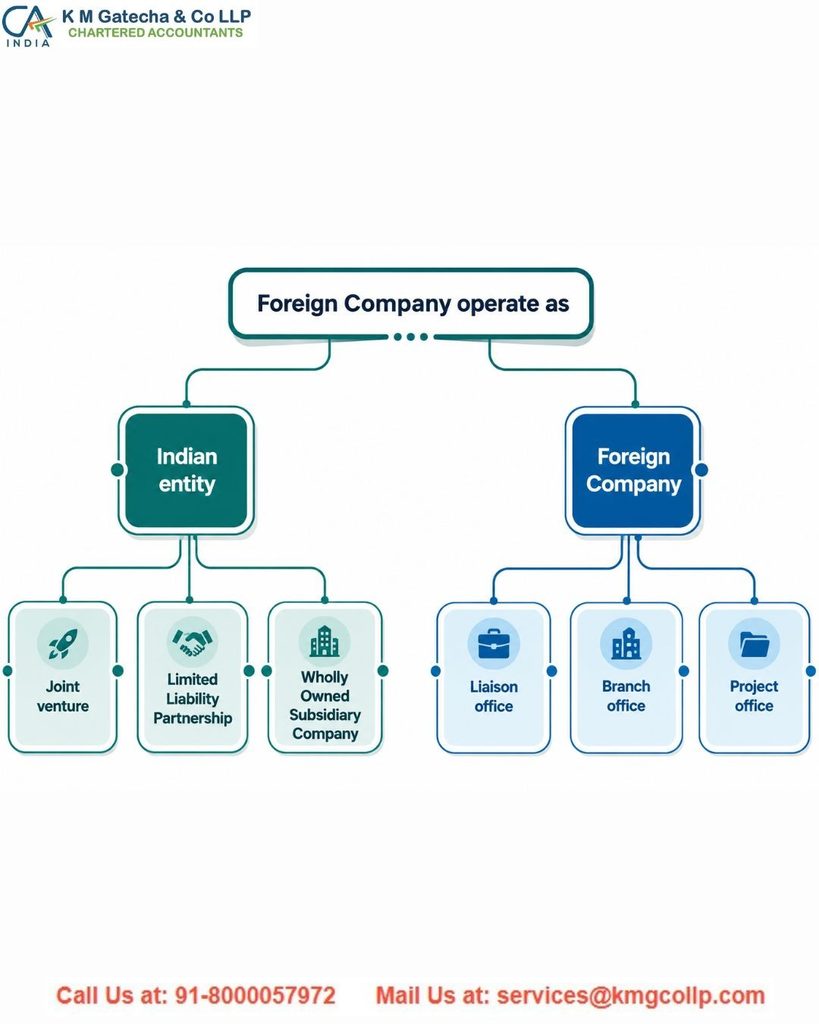
Foreign nationals and overseas entities can establish their presence in India through various business structures. One of the most preferred options is incorporating a Private Limited Company, as it offers a straightforward and efficient route for conducting business. Under the FDI policy, up to 100% foreign investment is permitted in many sectors through the automatic route. A foreign company may establish its Indian presence either as a Joint Venture or a Wholly-Owned Subsidiary.

Joint Venture
Under a joint venture arrangement, a foreign company collaborates with an Indian partner to carry out business operations in India. Generally, the parties enter into a Letter of Intent (LOI) or Memorandum of Understanding (MOU), outlining the foundation of the proposed partnership.
A detailed Joint Venture Agreement is then executed, specifying the rights, obligations, investment terms, and operational framework of both parties. The agreement must comply with applicable Indian laws as well as relevant international regulations.
Wholly-Owned Subsidiary
A foreign company can also establish a wholly-owned subsidiary in India by investing up to 100% foreign capital through the automatic route, subject to sector-specific regulations.
In this structure, the Indian company is entirely owned by the foreign parent entity, allowing complete control over management and operations while functioning as a separate legal entity under Indian law.
Other Forms of Foreign Business Presence in India
Apart from incorporating a company, foreign entities may also establish a Liaison Office, Project Office, or Branch Office in India. These forms generally require approval from the Reserve Bank of India (RBI) or the relevant government authorities.
Liaison Office
A Liaison Office serves as a communication channel between the foreign parent company and Indian stakeholders. It is permitted to undertake only liaison and coordination activities and cannot engage in commercial or revenue-generating operations.
All expenses of the liaison office must be funded through inward remittances from the foreign parent company.
Project Office
Foreign companies awarded specific projects by Indian entities may establish a Project Office in India to execute those projects.
Depending on the nature of the project and applicable regulations, RBI approval may be required before setting up the office.
Branch Office
A Branch Office enables a foreign company to conduct approved business activities in India. To establish a branch office, the foreign company generally needs to demonstrate a proven track record, substantial business operations, and profitability in its home country.
The branch office can undertake activities permitted under RBI regulations while remaining an extension of the foreign parent company.

Joint Venture Registration Process
A Joint Venture (JV) is a business arrangement in which two or more parties collaborate to carry out a commercial activity or achieve a common business objective.
To establish a company in India through a joint venture, a foreign entity or individual must first identify an Indian partner for the proposed business venture.
The registration process generally involves the following steps:
- Selection of a suitable Indian partner for the joint venture.
- Execution of a Letter of Intent (LOI) or Memorandum of Understanding (MOU) between the foreign entity and the Indian partner.
- The LOI or MOU should outline the basic framework and understanding of the proposed collaboration.
- Both parties must negotiate and finalize the terms and conditions of the joint venture agreement.
- The agreement should comply with applicable Indian laws as well as relevant international regulations.
- Key clauses generally include dispute resolution mechanisms, shareholding structure, transfer of shares, confidentiality obligations, board composition, non-compete provisions, governing law, and other operational terms.
Wholly-Owned Subsidiary Registration Process
A foreign company can establish a wholly-owned subsidiary in India by incorporating an Indian company under the Companies Act, 2013.
The registration process includes:
- Appointment of a minimum of two directors, with at least one director being a resident of India.
- Obtaining a Director Identification Number (DIN) and Digital Signature Certificate (DSC) for all directors.
- Drafting the Memorandum of Association (MOA) and Articles of Association (AOA).
- Subscription to the MOA by the shareholders.
- Reservation of the proposed company name through Part A of the SPICe+ application.
- Filing the incorporation application through Part B of the SPICe+ form on the Ministry of Corporate Affairs (MCA) portal.
- Submission of supporting documents, including:
- Registered office address proof.
- PAN card, identity proof, and address proof of Indian directors.
- Passport and address proof of foreign directors, duly certified by the Indian Embassy, Consulate, or other authorized authorities.
- Payment of the prescribed government fees and submission of the incorporation application.
- Verification of documents and application by the Registrar of Companies (ROC).
- Issuance of the Certificate of Incorporation and PAN upon successful verification.
- Opening of a company bank account.
- Completion of FDI compliance requirements after the share capital is subscribed.

Process for Setting Up a Liaison Office
A foreign company can establish a Liaison Office in India after obtaining prior approval from the Reserve Bank of India (RBI).
Eligibility Requirements
- The foreign company should have a profit-making track record during the preceding three financial years in its home country.
- The net worth of the foreign company should be at least USD 50,000.
- If a subsidiary company does not satisfy these conditions, it may submit a Letter of Comfort from its parent company, provided the parent company meets the eligibility criteria.
Registration Process
- Submit the application to the Foreign Exchange Department through an Authorized Dealer Category-I Bank (AD Bank).
- Provide the English version of the Certificate of Incorporation, MOA, AOA, and latest audited financial statements, duly certified by the Indian Embassy or a Notary Public in the country of incorporation.
- Obtain a Unique Identification Number (UIN) from the RBI.
- Apply for a PAN from the Income Tax Department.
- Ensure all operating expenses are funded through inward remittances from the foreign parent company.
Special Approvals
- Foreign insurance companies require approval from the Insurance Regulatory and Development Authority of India (IRDAI).
- Foreign banks require approval from the Department of Banking Regulation (DBR).
Permitted Activities
A Liaison Office can:
- Represent the parent company in India.
- Promote import and export activities.
- Facilitate technical and financial collaborations.
- Coordinate communication between the parent company and Indian businesses.
A Liaison Office cannot undertake any commercial, trading, or income-generating activities in India.
Process for Setting Up a Project Office
A foreign company can establish a Project Office in India to execute a specific project awarded by an Indian entity.
Conditions for Setting Up a Project Office Without RBI Approval
A Project Office can be established without prior RBI approval if:
- The foreign company has secured a contract from an Indian company for executing a project in India.
- The project is financed through inward remittances from abroad.
- The project is funded by a bilateral or multilateral international financing agency.
- The project has received approval from the appropriate regulatory authority.
- The Indian entity awarding the contract has obtained a term loan from an Indian bank or public financial institution for the project.
If these conditions are not met, prior approval from the RBI is required before establishing the Project Office.
Process for Setting Up a Branch Office
A foreign company may establish a Branch Office in India with prior approval from the RBI.
Eligibility Criteria
- The foreign company should be engaged in manufacturing or trading activities.
- It should have a profit-making track record for the previous five financial years.
- The net worth of the company should be at least USD 100,000.
- A subsidiary company that does not meet these requirements may submit a Letter of Comfort from its parent company, provided the parent company satisfies the criteria.
Registration Process
- Submit the application through an Authorized Dealer Category-I Bank to the Foreign Exchange Department.
- File certified copies of the Certificate of Incorporation, MOA, AOA, and latest audited financial statements.
- Obtain a Unique Identification Number (UIN) from the RBI.
- Apply for a PAN from the Income Tax Department.
- Ensure all expenses are funded through inward remittances from the foreign head office.
- Obtain approvals under FEMA, 1999 and any additional approvals from sector-specific regulators such as IRDAI, where applicable.
Permitted Activities
A Branch Office may undertake the following activities:
- Import and export of goods.
- Professional and consultancy services.
- Research activities related to the parent company’s business.
- Promotion of technical and financial collaborations.
- Acting as a buying or selling representative of the parent company.
- Software development and IT-enabled services.
- Providing technical support for products supplied by the parent company.
- Operations related to foreign airline and shipping businesses.
Restricted Activities
A Branch Office is not permitted to:
- Engage in retail trading activities.
- Carry out manufacturing or processing activities in India, either directly or indirectly.
Opportunities for Foreign Companies in India
India continues to offer significant opportunities for foreign investors across various sectors, including e-commerce, manufacturing, technology, and services. The country maintains a liberal FDI framework, allowing up to 100% foreign investment under the automatic route in most sectors, subject to specific regulatory conditions and sectoral restrictions.
Why Register a Foreign Company in India?
India’s Business Environment
India continues to be one of the most attractive destinations for foreign businesses looking to expand internationally. With a rapidly developing economy, expanding consumer market, and strong digital infrastructure, the country offers significant opportunities across various industries.
Several factors contribute to the growing interest in Foreign Company Registration in India:
Large Consumer Market
India is the world’s fifth-largest economy and home to more than 1.4 billion people. This provides businesses with access to one of the largest consumer markets globally.
Strong Economic Growth
India’s economy has consistently recorded robust growth compared to many developed nations. With annual growth projections of around 7%, it remains one of the fastest-growing major economies in the world.
High-Growth Industries
Numerous sectors in India offer substantial business opportunities, including:
Automotive Industry
India is among the world’s largest automotive markets, with increasing demand for electric vehicles and advanced mobility solutions.
Technology Sector
The country has emerged as a global center for software development, artificial intelligence, fintech, and digital innovation.
Service Industry
Information technology, business process outsourcing, consulting, and related services continue to contribute significantly to India’s economy.
Retail and E-commerce
A growing middle class, rising disposable income, and widespread internet adoption are driving rapid growth in retail and online commerce.
Why Foreign Companies Should Register in India
Advantages of Establishing a Business Presence in India
India has become a preferred destination for international companies due to its large market potential, supportive policies, and access to skilled talent. Establishing operations in India offers several strategic, financial, and operational benefits.
Key Benefits of Foreign Company Registration in India
1. Access to a Vast Consumer Base
India’s population exceeds 1.4 billion, supported by a rapidly expanding middle-income segment. Increasing urbanization, higher spending power, and a young demographic create strong demand across multiple industries.
2. Enhanced Business Credibility
Registration under the Companies Act, 2013 provides legal recognition and strengthens business credibility among customers, investors, financial institutions, and regulatory authorities.
3. Favourable FDI Policies
India permits up to 100% Foreign Direct Investment (FDI) in many sectors through the automatic route, reducing regulatory hurdles and simplifying market entry.
4. Skilled Workforce at Competitive Costs
Businesses gain access to a large pool of qualified professionals across technology, finance, healthcare, research, and other sectors. India offers globally competitive talent at comparatively lower costs.
5. Tax and Business Incentives
Eligible startups may benefit from tax exemptions under government schemes. Businesses operating in Special Economic Zones (SEZs) may also receive tax benefits and streamlined approvals.
6. Strategic Geographic Position
India serves as an important gateway to South Asian markets and provides convenient access to markets across Asia, the Middle East, and Africa.
7. Intellectual Property and Legal Protection
Indian laws provide protection for intellectual property rights and establish legal mechanisms for contract enforcement, helping businesses safeguard their commercial interests.
8. Government Support Programs
Initiatives such as Make in India, Digital India, and Production Linked Incentive (PLI) schemes encourage investment in manufacturing, technology, pharmaceuticals, electronics, and other key sectors.
9. Banking and Financial Benefits
Registered foreign businesses can open Indian bank accounts, conduct transactions in Indian Rupees, and comply more efficiently with FEMA and RBI regulations.
10. Double Taxation Relief
India has entered into Double Taxation Avoidance Agreements (DTAAs) with more than 90 countries, helping businesses reduce tax liabilities on cross-border income and dividend earnings.
Businesses That Commonly Benefit from Registration in India
Foreign company registration is particularly suitable for:
- Technology companies establishing development centers or offshore operations.
- Manufacturing businesses seeking benefits under government incentive schemes.
- E-commerce brands targeting Indian consumers.
- Consulting, legal, and financial service providers expanding into South Asia.
- Businesses entering strategic partnerships or joint ventures with Indian companies.
What Is a Foreign Company Under the Companies Act, 2013?
Definition
According to Section 2(42) of the Companies Act, 2013, a foreign company refers to:
“A company or body corporate incorporated outside India which has a place of business in India, either directly or through an agent, physically or electronically, and conducts business activities in India in any manner.”
Key Conditions for Recognition as a Foreign Company
Incorporated Outside India
The entity must be legally incorporated in a country other than India.
Presence in India
The company must maintain a place of business in India, which may be physical, digital, or through an authorized representative.
Conducting Business Activities
The company should engage in business operations within India, including sales, consultancy services, project execution, commercial transactions, or other business-related activities.
Understanding Foreign Company Registration Options in India
India provides multiple entry routes for foreign businesses looking to establish operations in the country. Each structure comes with its own eligibility conditions, operational scope, benefits, and compliance requirements. Selecting the right option depends on the company’s objectives, investment plans, and long-term strategy.
1. Wholly Owned Subsidiary (WOS)
Meaning and Registration Process
A Wholly Owned Subsidiary is an Indian company whose entire shareholding is owned by a foreign parent entity. This structure allows complete ownership and management control over Indian operations.
Registration Steps
- Select and reserve the company name through the Ministry of Corporate Affairs (MCA).
- Obtain Digital Signature Certificates (DSC) and Director Identification Numbers (DIN) for directors.
- Draft the Memorandum of Association (MOA) and Articles of Association (AOA).
- File the incorporation application through the SPICe+ portal.
- Receive the Certificate of Incorporation.
- Obtain PAN and TAN registrations.
Eligibility and FDI Requirements
- Up to 100% Foreign Direct Investment is permitted under the automatic route in many sectors.
- Business activities must comply with FEMA regulations and applicable FDI policies.
Advantages
- Complete ownership and operational control.
- Separate legal identity from the parent company.
- Protection from liabilities of the parent organization.
- Eligible businesses may benefit from schemes such as the Employee Linked Incentive (ELI) Scheme for employment generation.
Limitations
- Extensive documentation requirements.
- Need to appoint a nominee shareholder.
- Ongoing compliance, audit, and filing obligations.
2. Joint Venture (JV)
Overview and Formation Process
A Joint Venture is formed when a foreign company collaborates with an Indian partner to operate a business together. The relationship is governed by a Joint Venture Agreement (JVA).
Formation Steps
- Identify a suitable Indian business partner.
- Negotiate and draft the Joint Venture Agreement.
- Decide on the legal structure, such as a Private Limited Company, LLP, or Partnership.
- Register the entity with the Registrar of Companies.
- Obtain PAN, TAN, GST registration, and other required approvals.
Benefits of Local Partnership
An Indian partner contributes market knowledge, business networks, and regulatory understanding, helping foreign businesses establish themselves more effectively.
Advantages
- Access to local expertise and market insights.
- Easier entry into established customer and distribution networks.
- Shared investment and operational risks.
Limitations
- Potential disputes regarding management and business strategy.
- Unequal resource contributions may create operational challenges.
3. Liaison Office
Purpose and Scope
A Liaison Office serves as a communication and coordination channel between the foreign parent company and Indian stakeholders. It cannot undertake commercial or revenue-generating activities.
Restrictions
- Cannot earn income in India.
- Cannot enter into commercial contracts.
- Cannot engage in trading or manufacturing activities.
Eligibility Criteria
- The parent company must have a profitable track record for at least three years.
- Minimum net worth requirement of USD 50,000.
Registration Procedure
- Submit an application to the RBI through an Authorized Dealer (AD) Bank.
- Provide audited financial statements and supporting corporate documents.
- Obtain a Unique Identification Number (UIN) from RBI.
- Register with the MCA.
Advantages
- Cost-effective method of entering the Indian market.
- Lower compliance burden compared to other structures.
Limitations
- No revenue generation permitted.
- Limited operational functionality.
Sector-Specific Approvals
- Insurance companies require approval from IRDAI.
- Foreign banks require approval from the Department of Banking Regulation (DBR).
4. Branch Office
Overview and Permitted Activities
A Branch Office allows a foreign company to conduct specific business activities in India while operating under the parent company’s identity.
Permitted Activities
- Import and export operations.
- Professional and consultancy services.
- Research activities.
- Technical and financial collaboration support.
- Software development and IT services.
- Technical support for products supplied by the parent company.
Eligibility Requirements
- Profit-making record for the previous five financial years.
- Minimum net worth of USD 100,000.
Registration Process
- Apply to RBI through an Authorized Dealer Bank.
- Submit incorporation documents, board resolutions, and financial statements.
- Register with MCA and obtain PAN and TAN.
Advantages
- Direct operational presence in India.
- Strong brand visibility through the parent company’s identity.
Limitations
- Higher taxation compared to subsidiaries.
- Restrictions on manufacturing and retail trading activities.
Additional Regulatory Approvals
Insurance and banking entities must obtain approvals from their respective regulators in addition to RBI clearance.
5. Project Office
Purpose
A Project Office is established for executing a specific project in India, particularly in sectors such as construction, infrastructure, engineering, and research.
Eligibility Conditions
- A valid contract with an Indian company or organization.
- Funding through inward remittances or approved international financing arrangements.
Advantages
- Quick and efficient setup.
- Suitable for short-term and project-based operations.
- Lower costs compared to establishing a permanent entity.
Limitations
- Activities are restricted to the approved project.
- Operations must cease after project completion.
- Closure and repatriation procedures are mandatory.
6. Limited Liability Partnership (LLP)
Overview
An LLP is increasingly being used by foreign businesses entering India, especially in consulting, technology, and professional service sectors.
Key Features
- Up to 100% FDI permitted in most eligible sectors through the automatic route.
- Reduced compliance requirements compared to a private limited company.
- Flexible profit-sharing arrangements among partners.
Advantages
- Lower compliance and operational costs.
- Simplified management structure.
- Suitable for service-oriented businesses.
Limitations
- Less attractive to venture capital and institutional investors.
- Certain sectors continue to impose FDI restrictions.
- Limited fundraising opportunities through equity investments.
Best Suited For
Professional service firms, consulting companies, and technology businesses that do not intend to raise external equity funding in India.
Comparison of Foreign Company Entry Routes in India
| Entry Route | Eligibility | Permitted Activities | Key Approvals | Advantages | Limitations |
| Wholly Owned Subsidiary | FDI compliance and minimum directors | Manufacturing, trading, services, IT, and more | ROC registration and FDI compliance | Full ownership, separate legal entity, easier profit repatriation | Higher compliance and documentation |
| Joint Venture | Indian partner required | Based on JV agreement | ROC registration and sector approvals | Local expertise and shared risk | Shared control may create conflicts |
| Branch Office | Profit track record and net worth criteria | Consultancy, research, exports, imports, IT services | RBI approval | Direct operations and brand presence | Activity restrictions and higher taxes |
| Liaison Office | Three-year profit history and minimum net worth | Market research, communication, promotion | RBI approval | Cost-effective market entry | No commercial activities allowed |
| Project Office | Valid project contract | Project-specific operations | RBI approval in certain cases | Quick setup and lower cost | Restricted to project duration |
| LLP | FDI permitted in eligible sectors | Consulting, professional services, technology | MCA registration and FEMA compliance | Flexible management and lower compliance | Limited investor appeal |
Disclaimer: The content on this website is for informational purposes only and does not constitute legal, financial, or professional advice. Please consult qualified experts before acting on any information. K M GATECHA & CO LLP accepts no liability for errors, omissions, or outcomes from the use of this content. This site is not an advertisement or solicitation.
Need Help?
Frequently Asked Questions (FAQs)
1. What is a foreign company under Indian law?
A foreign company is a company incorporated outside India that establishes a place of business or conducts business activities in India, either directly or through an agent.
2. Can a foreign company register and operate in India?
Yes, foreign companies can establish operations in India by setting up a subsidiary company, branch office, liaison office, project office, or joint venture, subject to applicable laws and RBI regulations.
3. What are the different ways a foreign company can enter the Indian market?
A foreign company can enter India through a wholly owned subsidiary, joint venture, branch office, liaison office, or project office, depending on its business objectives and regulatory requirements.
4. What documents are required for foreign company registration in India?
Common documents include the certificate of incorporation, memorandum and articles of association, board resolution, identity and address proofs of directors, and proof of the registered office.
5. Is RBI approval required for foreign company registration in India?
Certain business structures, such as branch offices and liaison offices, may require approval from the Reserve Bank of India (RBI), depending on the sector and applicable regulations.
Table of Contents
Toggle