
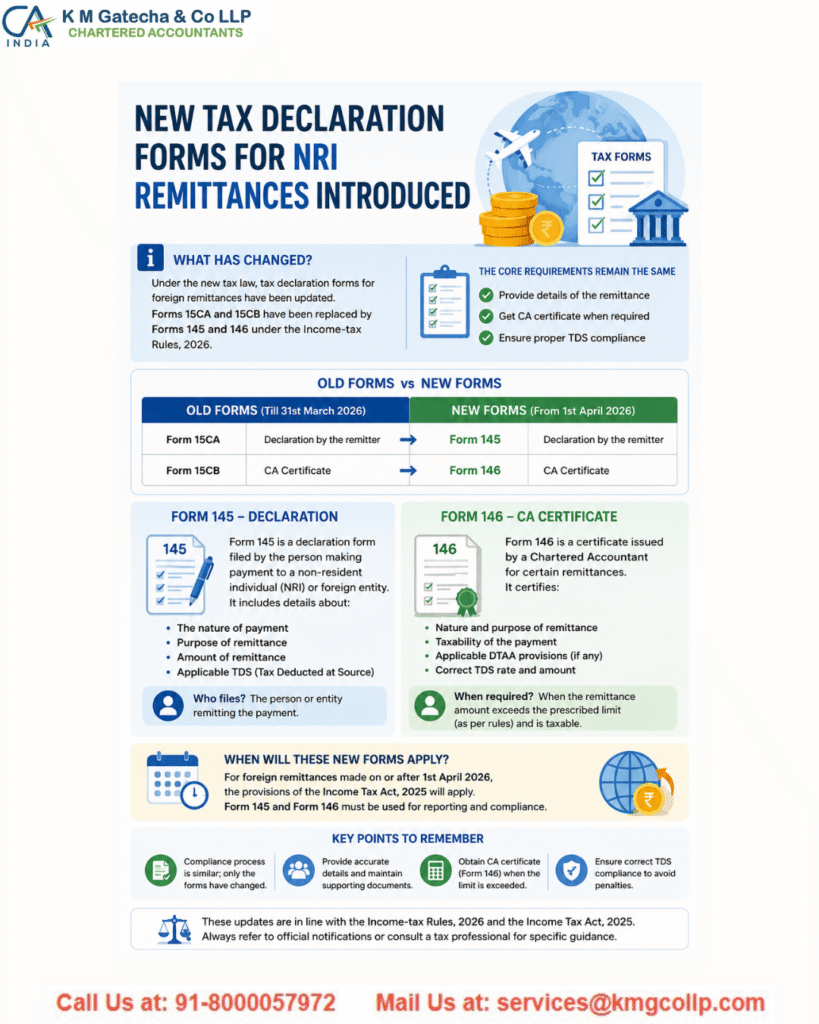
Form 145 is a declaration form filed by the person making payment to a non-resident individual (NRI) or foreign entity. It includes details about the payment, purpose of remittance, and applicable TDS (Tax Deducted at Source).
If you are sending money abroad to an NRI or a non-resident person, the compliance process has changed slightly under the new tax law. However, the basic requirements remain mostly the same.
The main change is that Forms 15CA and 15CB have been replaced by Forms 145 and 146 under the Income-tax Rules, 2026. You still need to provide details of the foreign remittance, obtain a certificate from a Chartered Accountant when the amount exceeds the prescribed limit, and ensure proper TDS compliance.
For foreign remittances made on or after 1st April 2026, the rules under the Income Tax Act, 2025 will apply. In such cases, Form 145 and Form 146 must be used for reporting and compliance purposes.
Form 145 and Form 146 Explained
Form 145 is a declaration form filed by the person making a payment to a non-resident or foreign company. It provides details about the purpose of the payment, nature of remittance, and applicable TDS (Tax Deducted at Source).
Form 146 is a certificate issued by a Chartered Accountant (CA) for certain foreign payments. It confirms the purpose of remittance, taxability of the payment, applicable tax treaty benefits (if any), and the TDS rate to be deducted.
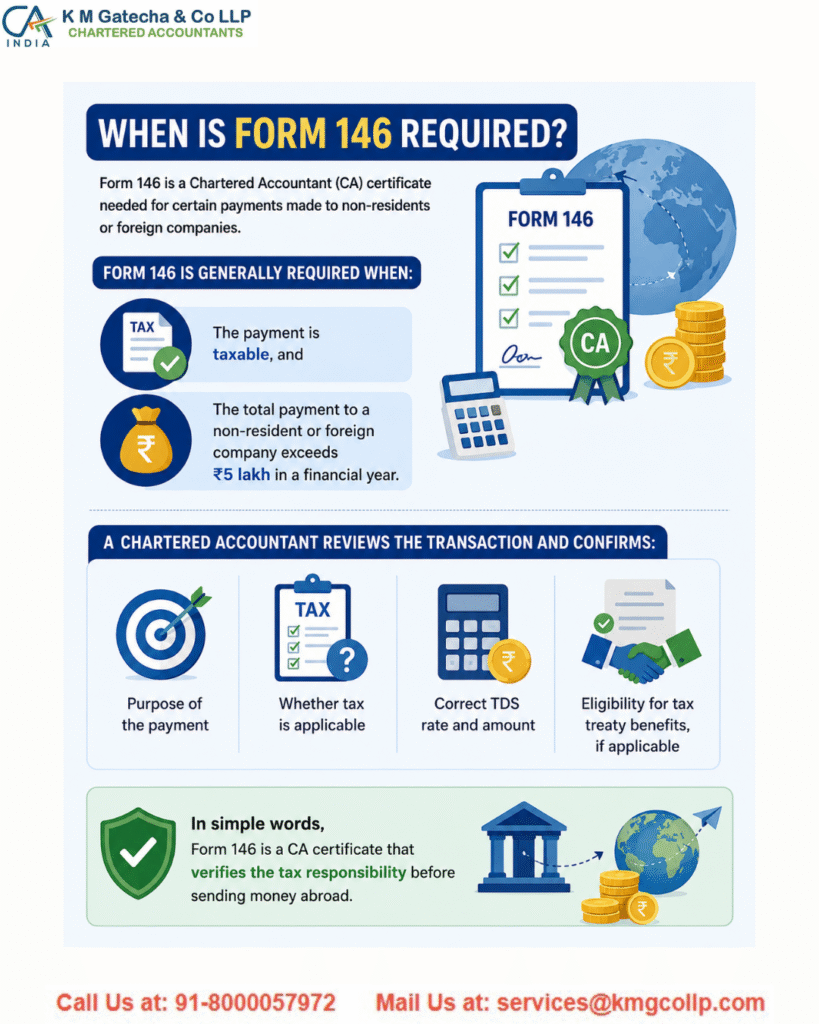
When is Form 146 Required?
Form 146 is generally required when:
- The payment is taxable, and
- The total payment to a non-resident or foreign company exceeds ₹5 lakh in a financial year.
A Chartered Accountant reviews the transaction and confirms:
- Purpose of the payment
- Whether tax is applicable
- Correct TDS rate and amount
- Eligibility for tax treaty benefits, if applicable
In simple words, Form 146 is a CA certificate that verifies the tax responsibility before sending money abroad.
What Has Changed Under the New Rules?
Under the new tax system, some important updates have been introduced to make compliance easier.
No Duplicate Compliance for Certain Cases
Earlier, taxpayers had to complete multiple compliance steps even after obtaining approval from the tax officer. Under the new rules:
- If Part B of Form 145 is filed using approval from the tax officer,
- Then Part C and Form 146 are not required.
This reduces extra paperwork, compliance burden, and professional costs.
Introduction of Unique Verification Number
A Unique Document Identification Number (UDIN) is now required for Form 146. This helps verify the authenticity of the Chartered Accountant’s certificate in real time.

More Details Now Required in Form 145
The new form requires additional details of the person making payment, such as:
- Address
- Tax deduction account details
- Email ID and contact number
- Status of the taxpayer
Additional Information for Foreign Recipient
The following details of the non-resident recipient are also required:
- Tax Identification Number (TIN) in the country of residence
- Principal place of business or address
- If TIN is not available, another government-issued identification number may be required.
Tax Treaty Benefit Details
If tax treaty benefits are claimed, details of the Tax Residency Certificate (TRC) must be provided to support the claim.
Extra Details for Capital Gains Payments
Where foreign remittance relates to capital gains, additional information may need to be provided, such as:
- Date of sale
- Sale amount received
- Date of purchase
- Cost of acquisition
These changes aim to improve transparency and ensure correct tax reporting for foreign remittances.
How to Fill Form 145?
If you are sending money abroad to a non-resident individual or foreign entity, the compliance process has changed slightly under the new tax rules. However, the overall process remains almost the same. The main difference is that the old forms have been replaced with new form numbers.
Form 145 is divided into four parts, and the part you need to fill depends on your payment type and amount.
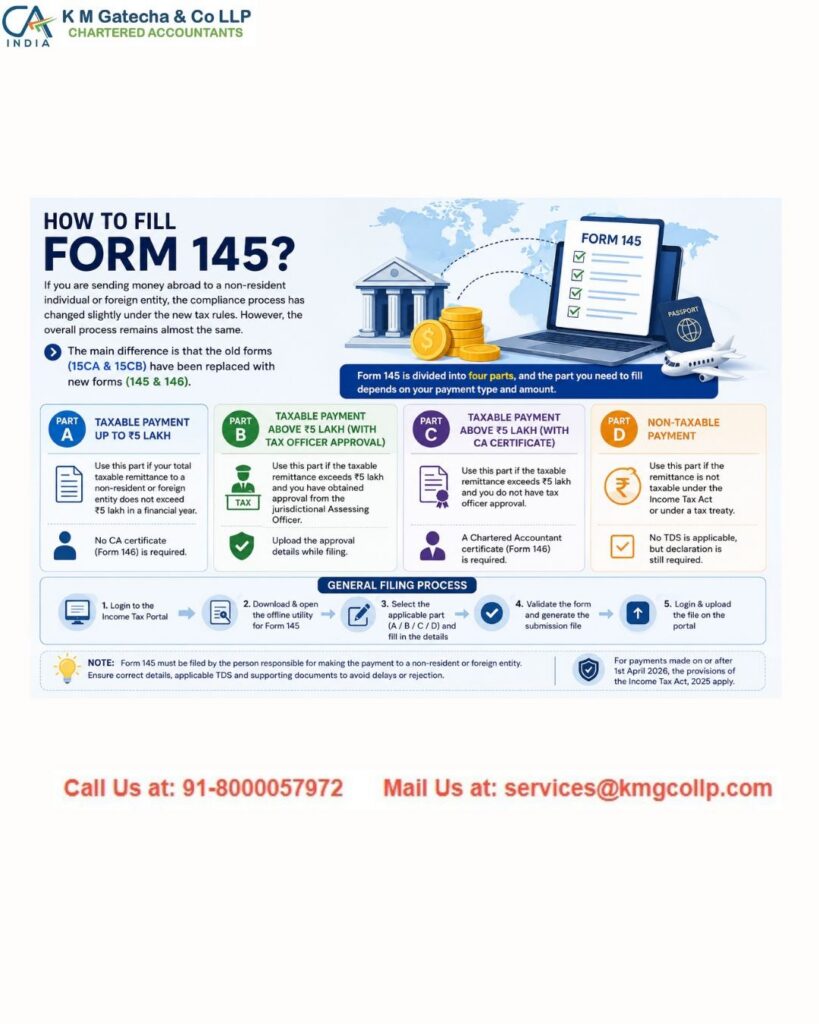
Part A – Taxable Remittance up to ₹5 Lakh
You need to fill Part A when:
- The payment is taxable, and
- The total remittance amount does not exceed ₹5 lakh during the financial year.
Part B – Taxable Remittance Above ₹5 Lakh with Tax Officer Approval
Choose Part B when:
- The remittance amount exceeds ₹5 lakh, and
- You have received approval or a certificate from the tax officer.
A major benefit under the new rules is that if Part B is filed, you do not need Form 146 (CA certificate). This reduces extra compliance and paperwork.
Part C – Taxable Remittance Above ₹5 Lakh with CA Certificate
You should fill Part C when:
- The remittance amount is more than ₹5 lakh, and
- You have obtained a Chartered Accountant certificate (Form 146) instead of approval from the tax officer.
This is the most commonly used option for higher-value foreign remittances.
Part D – Non-Taxable Remittance
Fill Part D when:
- The remittance is not taxable under Indian tax law.
In this case, no Chartered Accountant certificate is required.
In simple words, the part of Form 145 you select depends on whether the payment is taxable, the remittance amount, and whether you have a tax officer approval or a CA certificate.
Disclaimer: The content on this website is for informational purposes only and does not constitute legal, financial, or professional advice. Please consult qualified experts before acting on any information. K M GATECHA & CO LLP accepts no liability for errors, omissions, or outcomes from the use of this content. This site is not an advertisement or solicitation.