Private Limited vs LLP vs Sole Proprietorship: Which Business Structure is Best for You?
Starting a business is an exciting journey. Whether it begins as a passion project, a side venture, or a long-term business idea, the early stages are often filled with excitement and ambition. However, before focusing on branding, products, or marketing, there is one important decision every entrepreneur must make—choosing the right business structure.
Although it may seem like a legal formality that can be handled later, your business structure plays a major role in shaping your future. It affects taxation, compliance, fundraising opportunities, legal protection, and even how investors or customers view your business.
In India, the three most commonly chosen business structures are Private Limited Company, Limited Liability Partnership (LLP), and Sole Proprietorship. Each comes with its own advantages, limitations, and suitability depending on business goals.
This guide explains the differences between these structures in a simple and practical way, helping you decide which option is best for your business.
1. Understanding the Basics
Choosing the right structure can feel confusing at first. While these business forms may seem similar, they function very differently in practice.
Private Limited Company
A Private Limited Company functions like a small corporation and is registered with the Ministry of Corporate Affairs (MCA). It exists as a separate legal entity, independent of its founders.
A minimum of two shareholders and two directors is required, although the same individuals can hold both roles. Since the company has its own legal identity, it can own assets, sign agreements, and continue operating even if ownership changes.
This structure is widely preferred by startups planning to expand, raise investment, or build a stronger market reputation.
Limited Liability Partnership (LLP)
An LLP combines the operational flexibility of a partnership with the benefit of limited liability. Partners are responsible only for their agreed contribution, helping protect personal assets from business-related liabilities.
This structure is commonly chosen by professionals such as consultants, designers, legal experts, and service providers who want partnership flexibility without extensive corporate compliance.
Sole Proprietorship
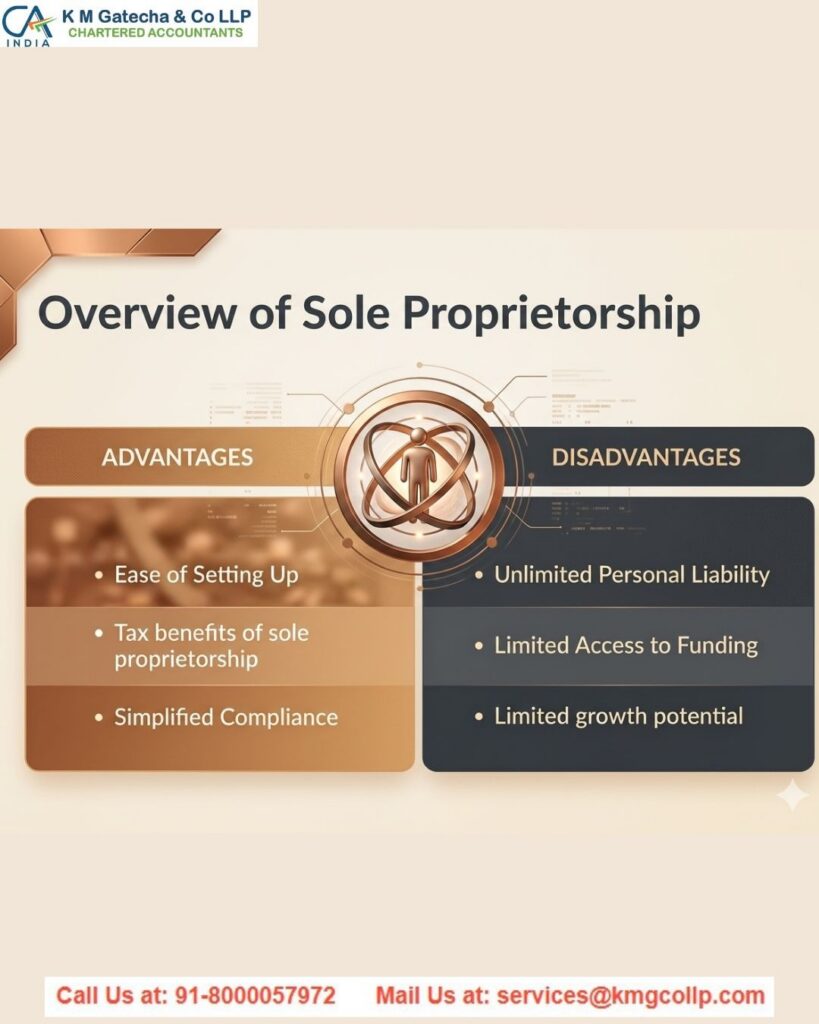
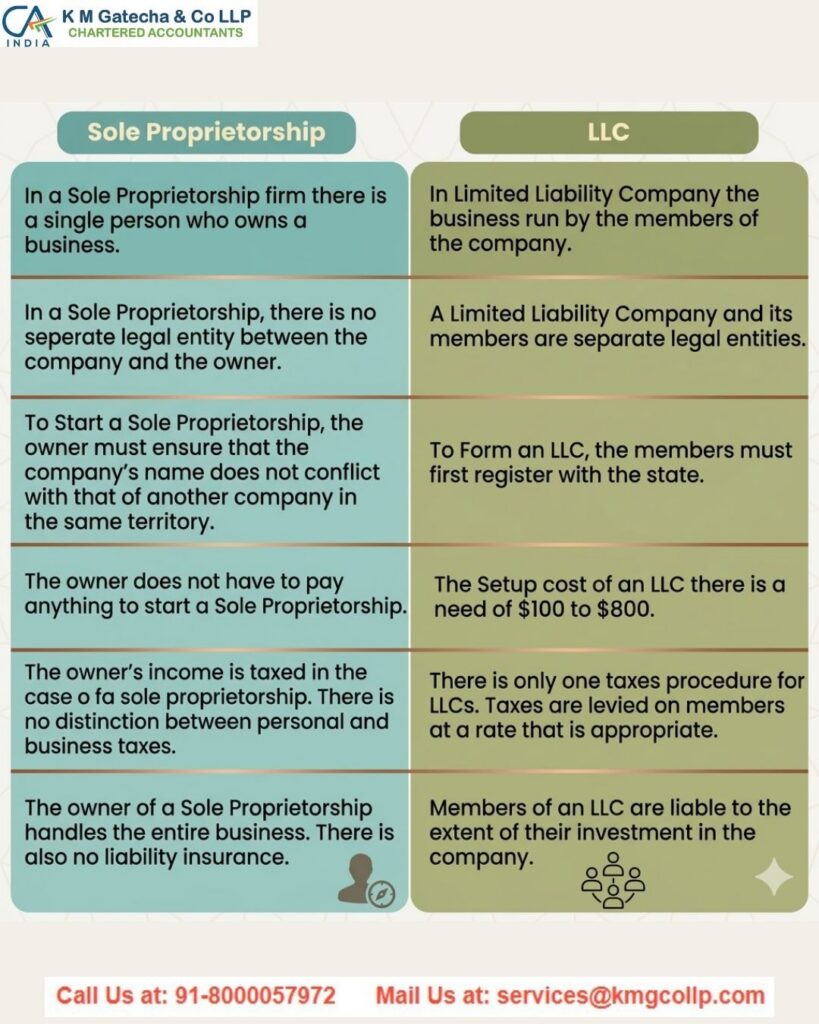
A Sole Proprietorship is the simplest form of business. There is no separate legal entity, meaning the owner and business are treated as the same.
There are no partners, no board meetings, and no MCA registration. It is generally suitable for freelancers, local businesses, and individuals testing a new business idea.
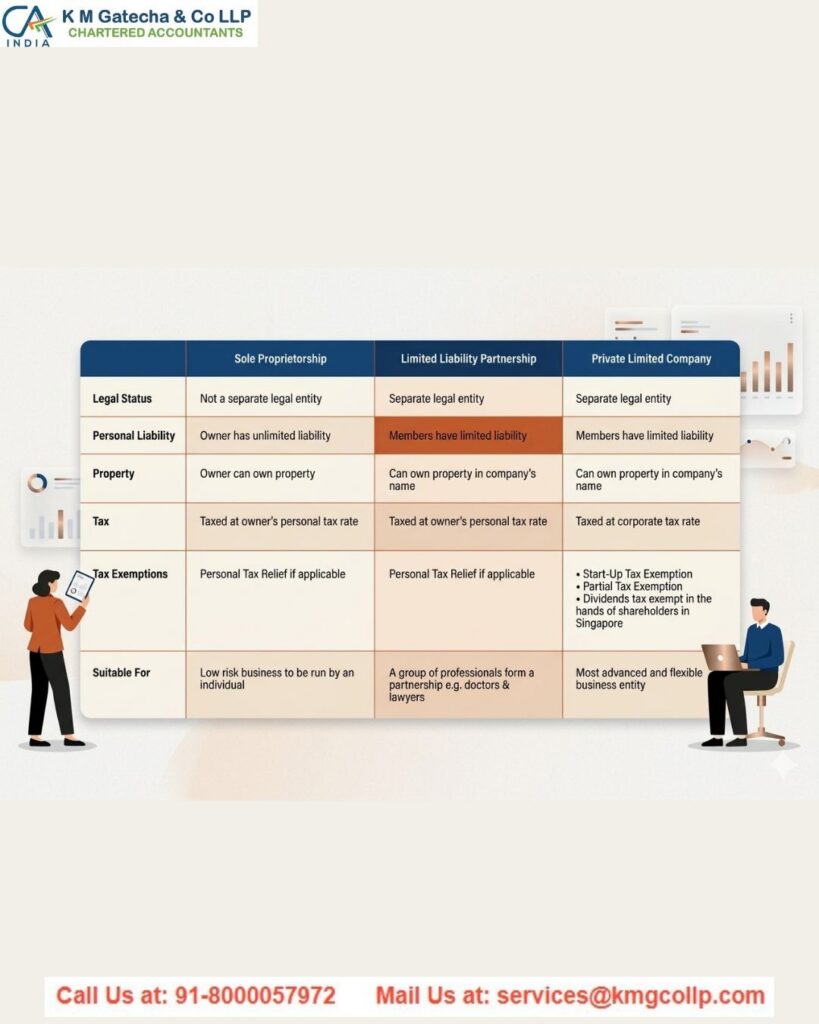
2. Legal Identity
An important factor when selecting a business structure is whether you want your business to exist independently from you.
Private Limited Company
A Private Limited Company has its own legal identity, separate from its shareholders and directors. It can own property, sign contracts, open bank accounts, and continue operations even if ownership changes.
This legal separation increases credibility and is one reason banks and large clients often prefer dealing with companies.
LLP
An LLP also has a separate legal existence. The business and partners are treated as distinct entities under law, giving partners better legal protection while maintaining operational flexibility.
Sole Proprietorship
In a Sole Proprietorship, there is no legal distinction between the owner and the business. All business activities, profits, and obligations directly belong to the proprietor.
While simple to manage, it may involve higher personal financial risk.
3. Liability Protection
Liability determines who becomes responsible if the business faces debts, losses, or legal disputes.
Private Limited Company
Shareholders in a Private Limited Company enjoy limited liability protection. Their financial risk remains restricted to the unpaid value of shares held.
Personal assets generally remain protected unless personal guarantees or legal violations are involved.
LLP
LLPs also provide limited liability protection. Each partner’s risk remains restricted to the amount they contribute to the business.
This makes LLPs suitable for businesses wanting partnership flexibility without exposing personal wealth.
Sole Proprietorship
In a Sole Proprietorship, liability is unlimited. Since the business and owner are legally the same, personal assets may be used to settle business obligations or debts.
While easy to start, this can become risky for growing businesses.
4. Compliance and Paperwork
Compliance requirements differ significantly across business structures and directly affect time, cost, and administration.
Private Limited Company
Private Limited Companies involve comparatively higher compliance obligations, including:
- ROC filings
- Board meetings
- Statutory audits
- Annual filings and documentation
Even inactive companies are required to maintain compliance.
LLP
LLPs involve relatively lower compliance requirements. Annual returns and financial statements are mandatory, but audits apply only if turnover exceeds ₹40 lakh or contribution exceeds ₹25 lakh.
For many businesses, this offers a balance between structure and simplicity.
Sole Proprietorship
Sole Proprietorships require minimal compliance. Owners generally file personal income tax returns and comply with GST or local business registrations where applicable.
This makes it ideal for individuals wanting a simple setup.
5. Taxation
Taxation differs depending on the chosen business structure and can significantly impact profits.
Private Limited Company
Private Limited Companies are taxed separately from owners. Eligible domestic companies may pay corporate tax at applicable rates.
However, profits distributed as dividends may also attract tax in shareholders’ hands, resulting in an additional layer of taxation.
LLP
LLPs are generally taxed at a flat rate of 30% plus applicable surcharge and cess. However, profits withdrawn by partners are not taxed again personally, avoiding dividend-related complications.
Sole Proprietorship
Business income is treated as the proprietor’s personal income and taxed according to applicable income tax slab rates.
This can be beneficial for small businesses with lower earnings.
6. Setup Cost and Flexibility
The cost and complexity of starting a business vary across structures.
Private Limited Company
A Private Limited Company usually involves higher incorporation costs due to:
- Digital Signature Certificate (DSC)
- Director Identification Number (DIN)
- Registration fees
- Compliance setup costs
However, it provides stronger long-term growth opportunities.
LLP
LLPs are comparatively affordable to register and maintain. They involve fewer legal formalities while still offering liability protection.
Sole Proprietorship
This structure is the easiest and most affordable to start. Registration requirements are minimal, making it suitable for small-scale businesses or first-time entrepreneurs.
Private Limited Company
Registering a Private Limited Company involves multiple formalities, including obtaining a Digital Signature Certificate (DSC), Director Identification Number (DIN), selecting a company name, and preparing legal documents like the Memorandum of Association (MOA) and Articles of Association (AOA).
Most businesses seek support from a Chartered Accountant (CA) or Company Secretary (CS) to manage registrations, approvals, and legal documentation. The overall cost may vary depending on the professional engaged and the business location, but expert assistance often simplifies the process and helps avoid errors.
In terms of flexibility, a Private Limited Company follows a more structured framework. It requires adherence to regulations related to board meetings, resolutions, statutory records, and compliance procedures. However, this formal structure can prove beneficial as the business expands.
LLP (Limited Liability Partnership)
Compared to a Private Limited Company, an LLP is easier and more affordable to establish. Although registration with the Ministry of Corporate Affairs (MCA) is still necessary, the documentation and compliance process is comparatively simpler, making registration quicker and less expensive.
An LLP also provides greater operational flexibility, as partners can decide roles, duties, and profit-sharing arrangements through an LLP agreement.
Sole Proprietorship
A Sole Proprietorship is the easiest and most affordable business structure to start. In many cases, basic documents such as a PAN card, Aadhaar card, and local registrations like GST or Shop Act licenses are sufficient to begin operations. Businesses can often start functioning within a day.
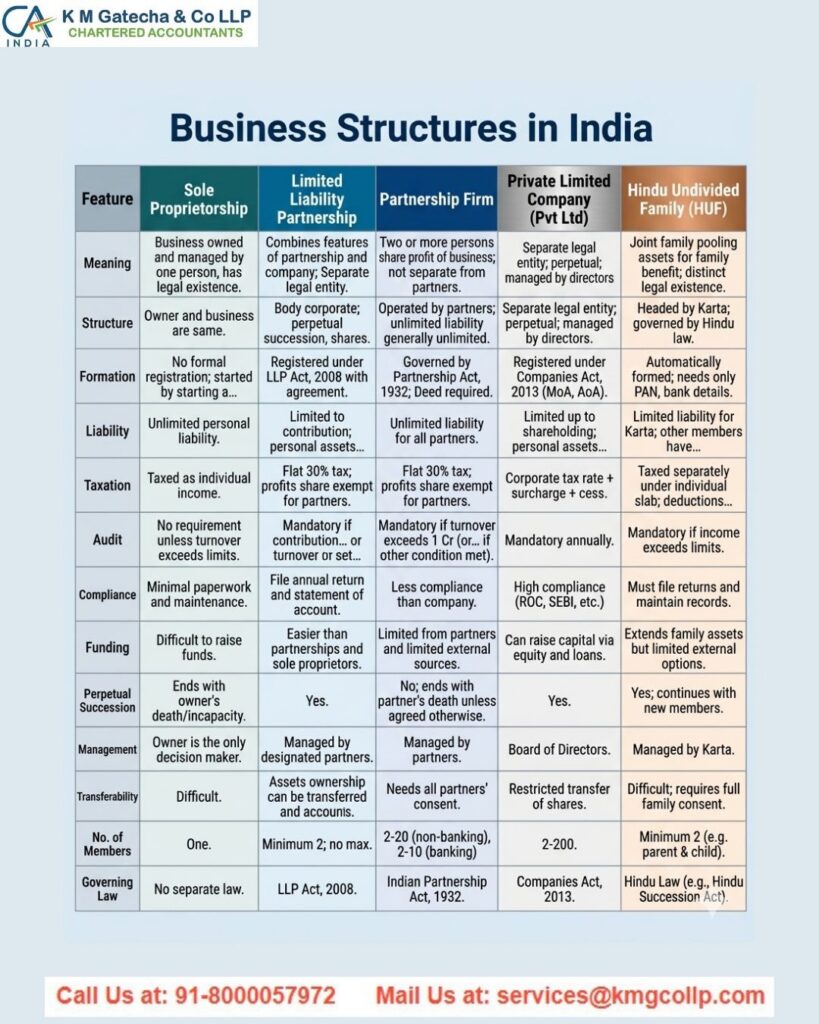
7. Fundraising and Investment Readiness
Private Limited Company:
Best suited for raising external funds. It allows businesses to issue equity shares, ESOPs, and convertible instruments. Most angel investors and venture capital firms generally prefer this structure.
LLP:
Less attractive for investment since LLPs cannot issue shares, making it harder to bring in equity investors.
Sole Proprietorship:
Not ideal for external investment, as ownership cannot be formally divided or transferred.
Tip: Even if fundraising is not part of your immediate plan, it is worth considering your future business goals before selecting a structure.
8. Control and Ownership
Private Limited Company:
Follows a formal decision-making structure where major decisions are governed by directors and shareholders.
LLP:
Provides shared management with flexible arrangements that can be customized through the LLP Agreement, making it suitable for partnerships.
Sole Proprietorship:
Offers complete control to the owner, where all decisions are taken independently.
The key consideration here is balancing flexibility with structured governance.
9. Credibility and Brand Perception
Private Limited Company:
Generally carries higher credibility, as the “Pvt Ltd” status reflects a formal and professionally managed business.
LLP:
Viewed as a reliable and professional structure, particularly among service-based and consulting businesses.
Sole Proprietorship:
Often seen as a simple and economical setup, though it may not offer the same level of professional image as registered entities.
For businesses dealing with large corporations or government clients, the chosen structure can significantly influence perception.
10. Closure Process
Private Limited Company:
Closing a company involves a formal strike-off process with the ROC, clearances, and professional documentation, which may take several months.
LLP:
Closure is comparatively easier but still requires ROC filings and proper winding-up procedures.
Sole Proprietorship:
The simplest to close, usually requiring only the cancellation of licenses and discontinuation of business activities.
For temporary or experimental ventures, the simplicity of a Sole Proprietorship can be beneficial.
Real-Life Examples
- Aarav, an independent graphic designer, initially started as a Sole Proprietorship and later shifted to an LLP after partnering with a strategist to expand operations.
- Sneha, building a technology-based healthcare platform, opted for a Private Limited Company from the beginning to attract funding.
- Imran, operating a family-run garment business, continued as a Sole Proprietorship for years due to its simplicity and ease of management.
Key Takeaway: Your business structure should support your goals and operations rather than create unnecessary complexity.
Summary
Selecting a business structure is more than a legal requirement—it directly impacts taxation, growth, funding opportunities, and business credibility. The right choice depends on your long-term vision and operational needs.
If your objective is rapid expansion, investor funding, or building a scalable company, a Private Limited Company is generally the better option despite higher compliance requirements.
If you are working with partners and want a balance between flexibility and legal protection without excessive compliance, an LLP may be the right fit.
For individuals testing a business idea or running a small venture independently, a Sole Proprietorship offers simplicity and lower costs.
Keep in mind that business structures can evolve. Many businesses begin with a simpler model and later convert to a different structure as they grow.
Conclusion
At KMG & CO LLP, we assist businesses in selecting the most suitable business structure and completing company registration in India efficiently. Beyond incorporation, we support startups and established businesses with ongoing compliance requirements, including accounting, bookkeeping, audit, tax compliance, and related professional services.
Disclaimer: The content on this website is for informational purposes only and does not constitute legal, financial, or professional advice. Please consult qualified experts before acting on any information. K M GATECHA & CO LLP accepts no liability for errors, omissions, or outcomes from the use of this content. This site is not an advertisement or solicitation.