
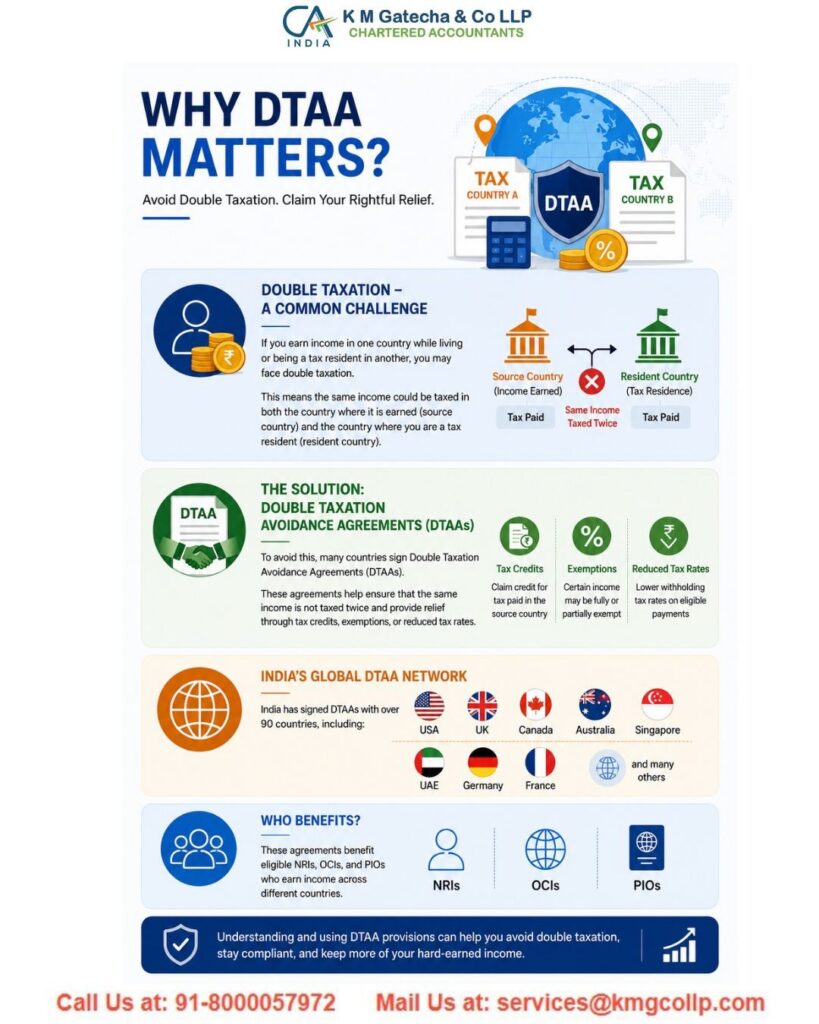
If you earn income in one country while living or being a tax resident in another, you may face double taxation. This means the same income could be taxed in both the country where it is earned (source country) and the country where you are a tax resident (resident country).
To avoid this, many countries sign Double Taxation Avoidance Agreements (DTAAs). These agreements help ensure that the same income is not taxed twice and provide relief through tax credits, exemptions, or reduced tax rates.
India has signed DTAAs with over 90 countries, including the USA, UK, Canada, Australia, Singapore, UAE, Germany, France, and many others. These agreements benefit eligible NRIs, OCIs, and PIOs who earn income across different countries.
Key Features of DTAA
Some important features of the Double Taxation Avoidance Agreement include:
- Prevents double taxation on the same income.
- Helps eligible taxpayers claim tax relief.
- Encourages cross-border investments and business activities.
- Provides clarity on which country has the right to tax specific types of income.
- Supports better international tax compliance.
Is Claiming DTAA Benefits Mandatory?
No. Claiming DTAA benefits is optional. Taxpayers can choose whichever option is more beneficial—either the provisions of the Income Tax Act or the applicable DTAA.
If domestic tax laws provide lower tax liability or better exemptions, taxpayers may choose those instead of claiming DTAA benefits.
Ways to Claim DTAA Benefits
The India DTAA generally provides relief through the following methods:
1. Foreign Tax Credit (FTC)
Under this method, taxes paid in one country can be claimed as a credit while filing a tax return in the other country, subject to the applicable tax laws.
For Indian residents, Foreign Tax Credit is generally claimed by filing Form 67 along with the income tax return.
2. Exemption Method
Certain types of income may be fully exempt from tax in one of the countries, depending on the provisions of the applicable DTAA.
3. Reduced Tax Rates
Some DTAAs provide concessional tax rates on income such as:
- Interest
- Dividends
- Royalties
- Fees for technical services
The reduced rate depends on the treaty signed between India and the respective country.
Examples of DTAA Benefits
Example 1: Foreign Tax Credit
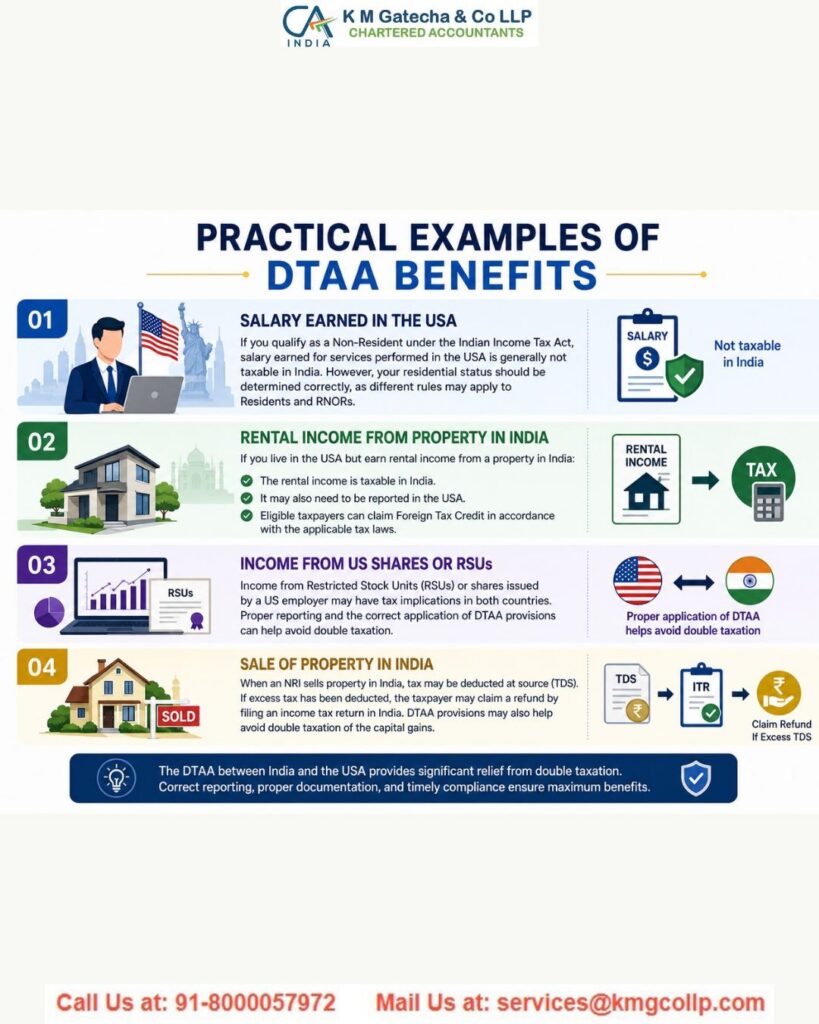
An NRI living in the USA earns interest income from India. The income is taxed in India, and the same income may also be taxable in the USA. Under the India-USA DTAA, the taxpayer can generally claim credit in the USA for taxes already paid in India, helping avoid double taxation.
Example 2: DTAA Exemption
An NRI residing in the UAE sells certain investments in India. Depending on the applicable provisions of the India-UAE DTAA, capital gains on specific investments may qualify for exemption or favourable tax treatment.
Example 3: Reduced Tax Rate
A tax resident of Canada earns interest income from India. Instead of paying tax at the normal domestic rate, the India-Canada DTAA may allow taxation at a reduced treaty rate, subject to eligibility conditions. If excess tax has been deducted, the taxpayer may claim a refund by filing an income tax return in India.

DTAA Rates for NRIs
The tax rates available under DTAA vary from country to country and depend on the type of income. Eligible taxpayers should refer to the applicable DTAA and the relevant tax provisions before claiming treaty benefits.
Steps to Claim DTAA Benefits
To claim benefits under the DTAA, taxpayers should generally follow these steps:
- Determine your tax residential status.
- Obtain a valid Tax Residency Certificate (TRC) from your country of residence.
- Submit Form 10F, if required.
- Understand the relevant DTAA provisions for your type of income.
- File your income tax return and claim the eligible relief.
Documents Required for DTAA Benefits
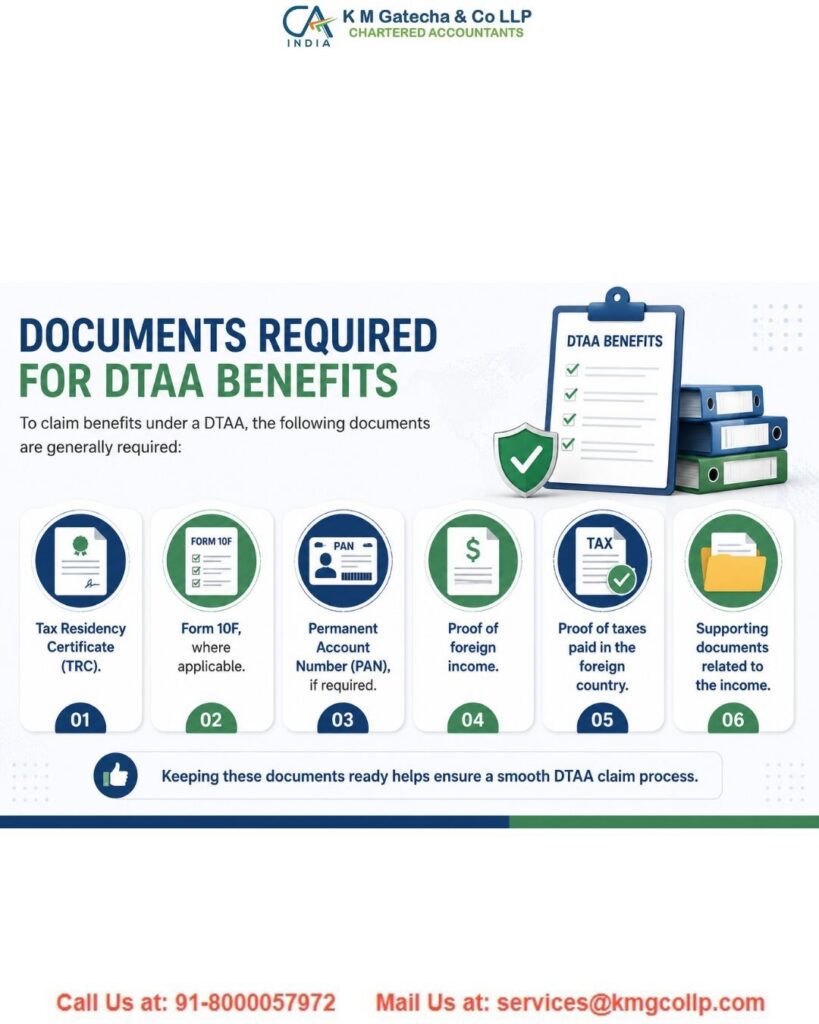
To claim benefits under a DTAA, the following documents are generally required:
- Tax Residency Certificate (TRC).
- Form 10F, where applicable.
- Permanent Account Number (PAN), if required.
- Proof of foreign income.
- Proof of taxes paid in the foreign country.
- Supporting documents related to the income.
Keeping these documents ready helps ensure a smooth DTAA claim process.
Importance of the Tax Residency Certificate (TRC)
A Tax Residency Certificate (TRC) is one of the most important documents for claiming DTAA benefits. It confirms that you are a tax resident of a particular country and allows tax authorities to verify your eligibility for treaty benefits.
Without a valid TRC, the applicable DTAA benefits may not be available.
Conclusion
The Double Taxation Avoidance Agreement (DTAA) helps NRIs, OCIs, and PIOs avoid paying tax twice on the same income. Depending on the applicable treaty, eligible taxpayers can claim relief through Foreign Tax Credit, exemptions, or reduced tax rates. Understanding the provisions of the relevant DTAA, maintaining the required documents, and filing tax returns correctly can help reduce tax liability and ensure compliance with the tax laws of both countries.
Disclaimer: The content on this website is for informational purposes only and does not constitute legal, financial, or professional advice. Please consult qualified experts before acting on any information. K M GATECHA & CO LLP accepts no liability for errors, omissions, or outcomes from the use of this content. This site is not an advertisement or solicitation.