What is ROC Compliance for Private Limited Companies?
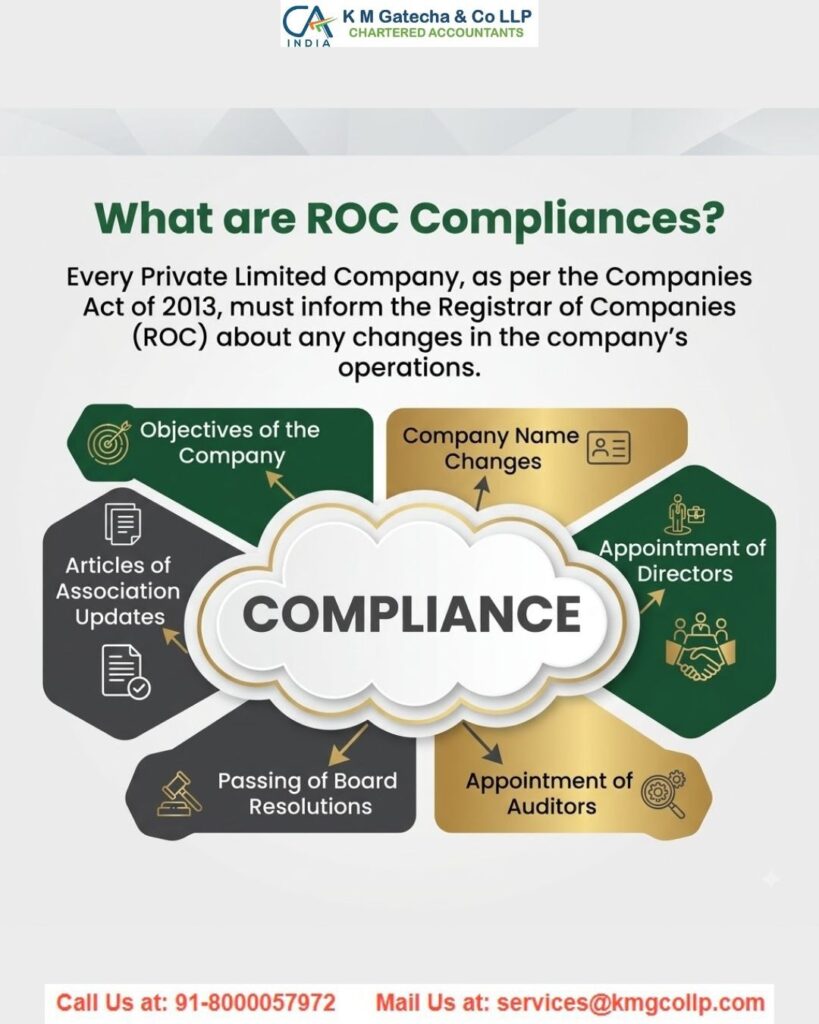
ROC compliance for Private Limited Companies is not limited to fulfilling legal requirements; it also plays an important role in building trust and supporting long-term business growth. Under the Companies Act, 2013, these compliances include filing annual returns, maintaining updated statutory records, conducting regular board meetings, and ensuring appropriate disclosures.
Mandatory Compliances for Private Limited Companies
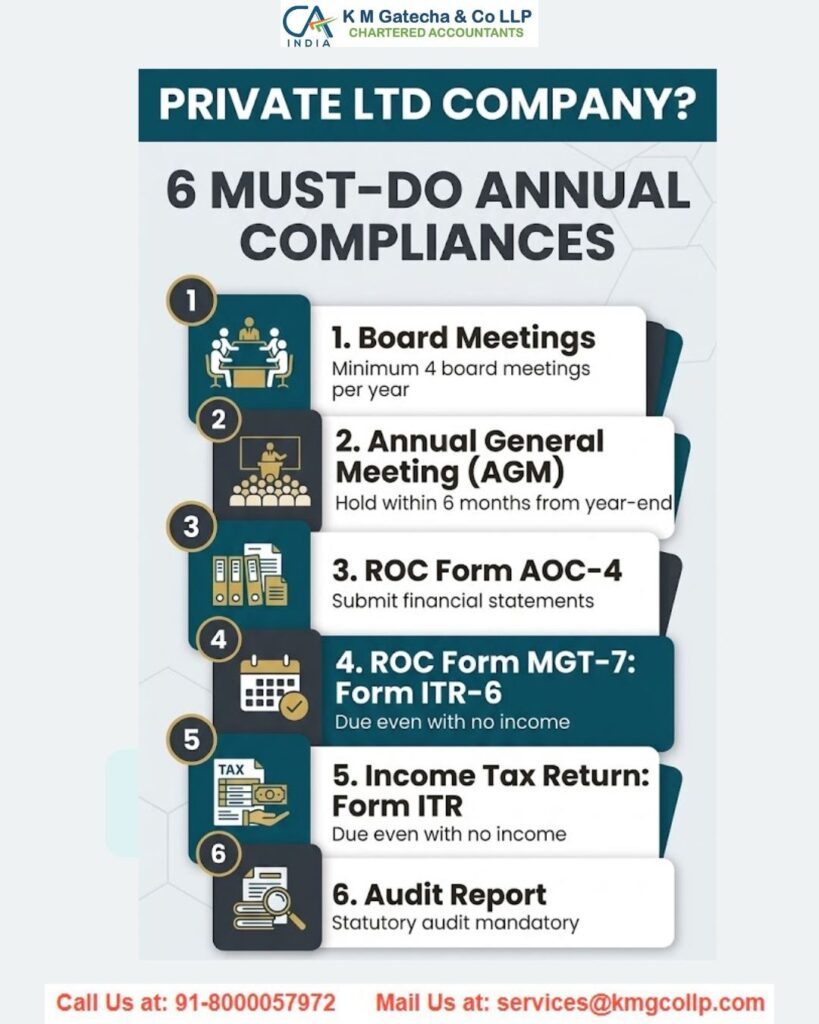
Board Meetings
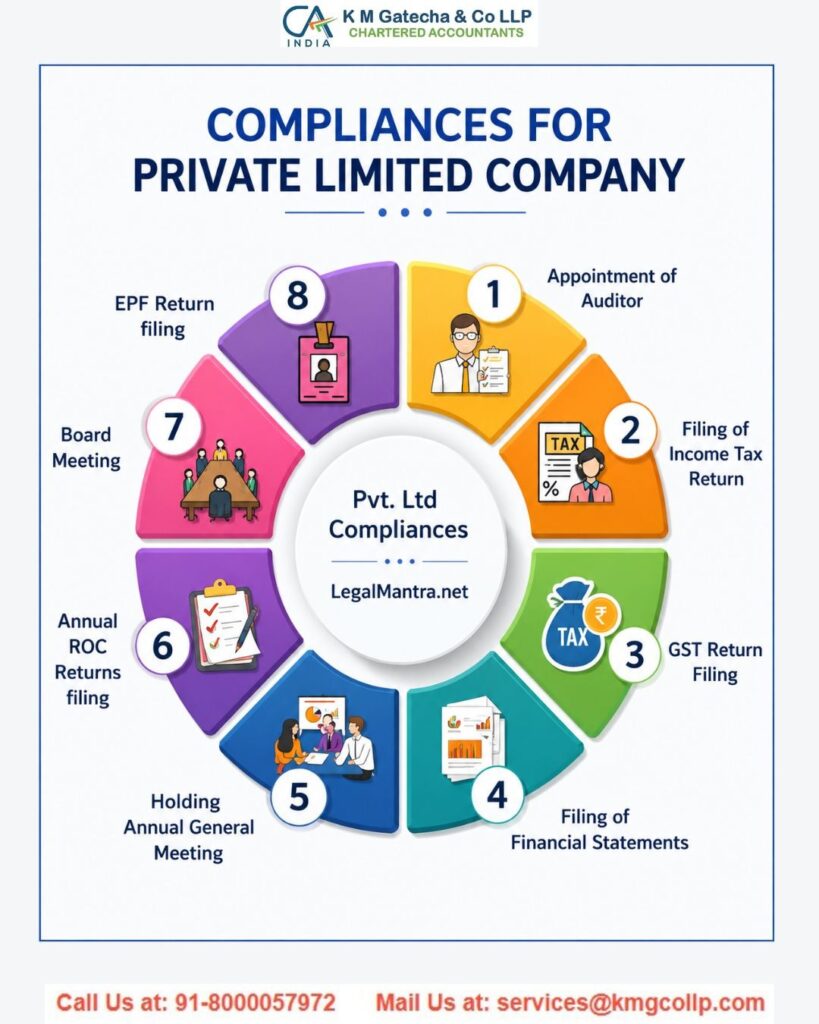
Private limited companies are required to conduct regular board meetings to discuss important corporate matters and maintain effective governance. These meetings support proper decision-making, regulatory compliance, and strategic planning. Regular meetings allow the board to establish objectives, review financial performance, and address operational matters effectively.
Annual General Meeting
An Annual General Meeting (AGM) is a mandatory legal meeting where shareholders and directors discuss the company’s performance, financial position, and future plans. AGMs promote transparency and accountability by giving shareholders an opportunity to participate in decision-making and remain informed about the company’s activities.
Statement of Interest
Directors of private limited companies are required to disclose potential conflicts of interest arising from their involvement in other businesses or transactions that could affect the company. Such disclosures promote transparency, help avoid conflicts, and support the directors’ responsibility to act in the best interests of the company and its shareholders.
Filing of Tax and Annual Returns
Private limited companies must file their annual income tax returns to meet applicable tax compliance requirements. In addition, filing an annual report with the Registrar of Companies is necessary to update public records concerning the company’s financial position, directors, and shareholders.
Statutory Registers
Private limited companies must maintain various statutory registers, including registers of members, directors, and charges. These records contain important corporate information and help the company meet its legal obligations while maintaining transparency and accountability.
Director Identification Numbers (DIN)
Directors are required to have a Director Identification Number (DIN). They must also file Form DIR-3 KYC with the Registrar of Companies (RoC) to provide their KYC details for the relevant financial year. Non-compliance can result in deactivation of the DIN along with a late filing penalty of ₹5,000.
Commencement of Business
Private limited companies incorporated after the specified date are required to obtain a Certificate of Commencement of Business (COCB) only once. The COCB serves as official confirmation of the company’s legal existence and commencement of business operations.
By complying with these essential ROC requirements, private limited companies can maintain legal compliance, transparency, and effective corporate governance. This helps build stakeholder confidence and supports the company’s overall operational integrity.
Event-Based Compliances
Event-based compliance is an important responsibility for private limited companies when specific events or changes take place within the organization. These compliance requirements are triggered by significant corporate developments and require timely filing of the relevant information with the Registrar of Companies (ROC) to maintain legal compliance and transparency.
Some key event-based compliances and the applicable forms for private limited companies include:
Change in Directors
- Requirement: Private limited companies must notify the ROC of changes in their directors, including appointments, resignations, or transfers.
- Form: Form DIR-12 is generally used for this purpose.
- Purpose: To keep the company’s director-related information accurate and updated while meeting applicable legal requirements.
Change in Authorized Share Capital
- Requirement: Any change in the authorized share capital of a private limited company must be reported to the ROC within 30 days of passing the required ordinary resolution.
- Form: Form SH-7 is used for this filing.
- Purpose: To inform the ROC about the revised share capital structure, maintain accurate records, and ensure compliance with legal requirements.
Return of Allotment
- Requirement: When a private limited company issues new shares, it is required to file a return of allotment with the ROC.
- Form: Form PAS-3 is used for this purpose.
- Purpose: To provide details of the share allotment, including the number of shares issued, names of the allottees, and amount paid up.
Creation and Modification of Charge
- Requirement: Private limited companies must file the applicable form to report the creation or modification of charges on company assets.
- Form: Form CHG-1 is used for this purpose.
- Purpose: To disclose details of the charge, maintain transparency, and comply with the Companies Act.
Registration of Satisfaction of Charge
- Requirement: When a charge on company assets is satisfied or released, the company must file the relevant form with the ROC to record the satisfaction.
- Form: Form CHG-4 is used for this filing.
- Purpose: To confirm that the charge has been discharged, update the company’s records, and maintain legal compliance.
By meeting these event-based compliance requirements, private limited companies can demonstrate their commitment to legal compliance, transparency, and effective corporate governance.
Overview of ROC Compliance for Private Limited Companies
ROC compliance for private limited companies involves several requirements, which can make it difficult to keep track of every filing. To make the compliance process easier to understand, the table below highlights the relevant forms, their purposes, and applicable due dates.
| Compliance | Form | Purpose | Due Date |
| Incorporation | DIR-12 | Notifying ROC about the appointment of a new director | Within 30 days of appointment |
| Change in Directors | DIR-12 | Notifying ROC about changes in directors, including resignation or transfer | Within 30 days of change |
| Change in Registered Office | INC-22 | Notifying ROC about a change in the registered office | Within 30 days of change |
| Increase in Authorized Share Capital | SH-7 | Notifying ROC about an increase in authorized share capital | Within 30 days of passing the resolution |
| Decrease in Authorized Share Capital | SH-7 | Notifying ROC about a decrease in authorized share capital | Within 30 days of passing the resolution |
| Allotment of Shares | PAS-3 | Notifying ROC about the allotment of shares | Within 30 days of allotment |
| Return of Allotment | PAS-3 | Filing the return of share allotment with ROC | Within 30 days of allotment |
| Transfer of Shares | SH-7 | Notifying ROC about the transfer of shares | Within 60 days of transfer |
| Creation of Charge | CHG-1 | Notifying ROC about the creation of a charge on company assets | Within 30 days of creation |
| Modification of Charge | CHG-1 | Notifying ROC about the modification of a charge on company assets | Within 30 days of modification |
| Satisfaction of Charge | CHG-4 | Notifying ROC about the satisfaction of a charge on company assets | Within 30 days of satisfaction |
| Annual Return | MGT-7A | Filing the annual return with ROC | Within 60 days of the last day of the financial year |
| Income Tax Return | ITR | Filing the income tax return with the Income Tax Department | As per the Income Tax Act |
| GST Returns | GSTR | Filing GST returns with the GST Department | As per the GST Act |
| Annual General Meeting (AGM) | Minutes of AGM | Filing AGM minutes with ROC | Within 30 days of AGM |
| Audit Report | Audited Financial Statements | Filing audited financial statements with ROC | Within 30 days of AGM |
| Statement of Account | Statement of Account | Filing the statement of account with ROC | Within 30 days of AGM |
| Form DIR-3 KYC | KYC details of directors | Filing KYC details of directors | Before the due date of annual return |
Disclaimer: The content on this website is for informational purposes only and does not constitute legal, financial, or professional advice. Please consult qualified experts before acting on any information. K M GATECHA & CO LLP accepts no liability for errors, omissions, or outcomes from the use of this content. This site is not an advertisement or solicitation.