TAX HOLIDAY FOR STARTUPS (SECTION 80 IAC OF INCOME TAX ACT)
Startups in India:
Startups play a significant role in driving innovation, creating employment opportunities, and contributing to economic growth. Recognizing their importance, the Indian government has introduced favourable tax provisions to reduce the financial burden on entrepreneurs and encourage innovation.

Section 80 IAC:
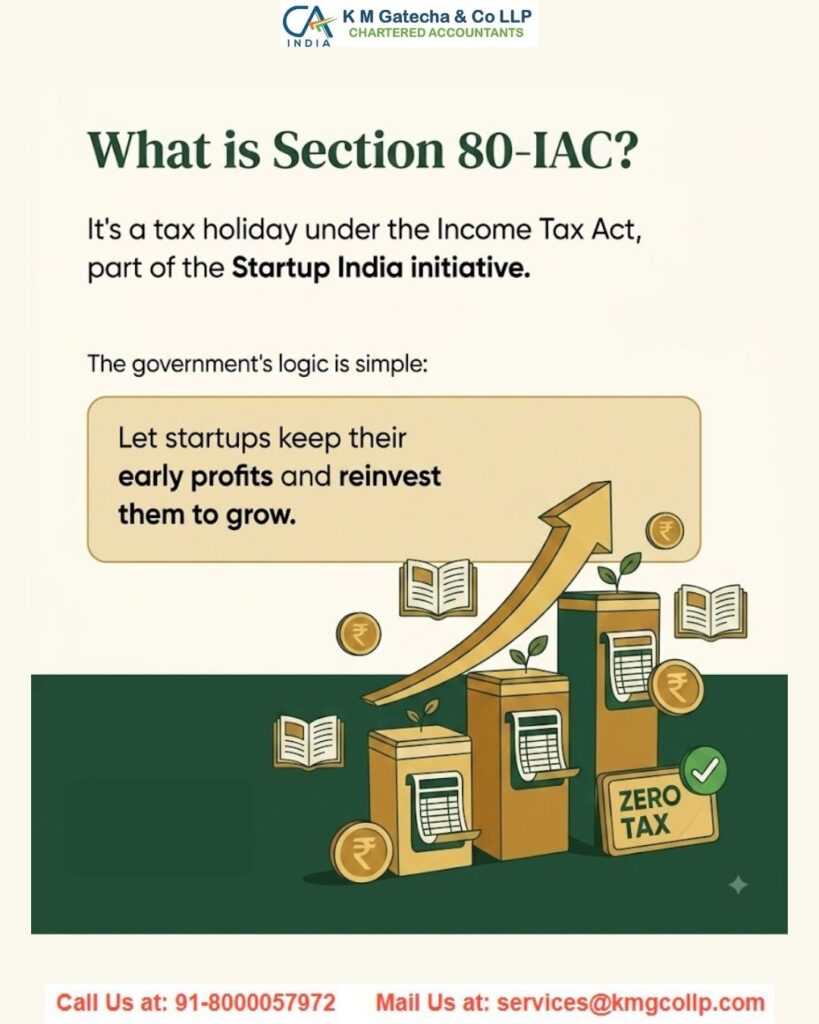
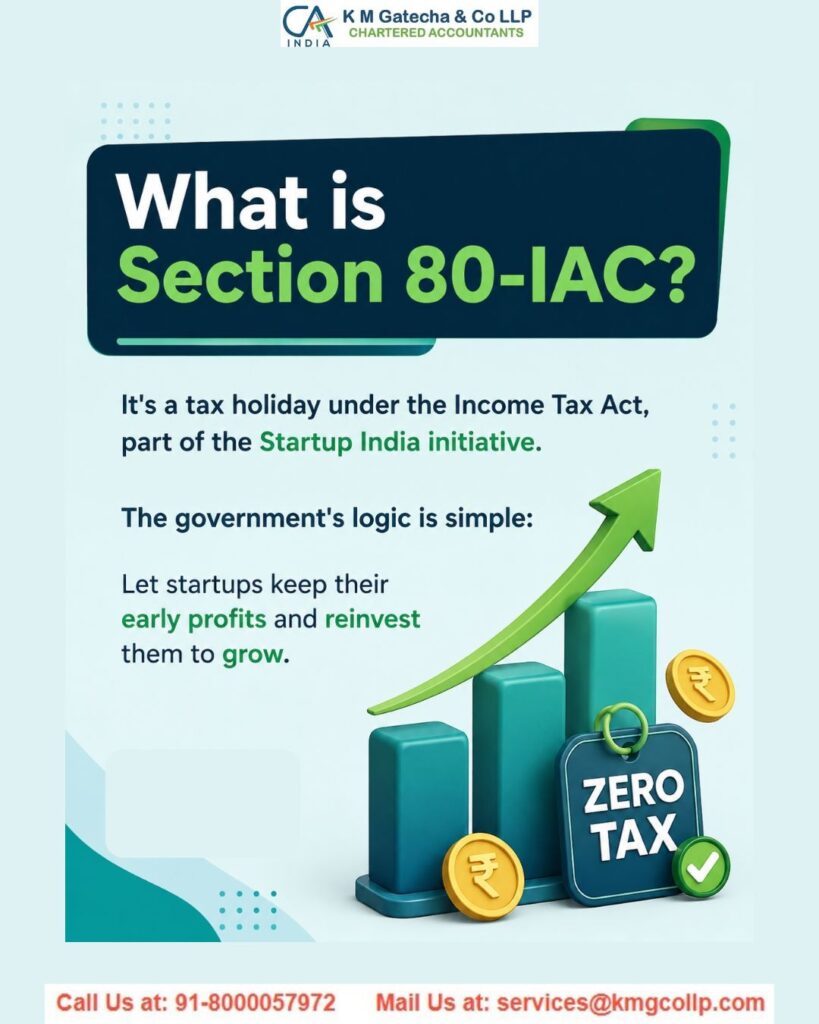
Section 80IAC of the Income Tax Act, 1961 is a special provision applicable to eligible startups. It came into effect from 1st April 2017. Under Section 80-IAC, eligible startups can claim a tax deduction equal to 100% of the profits and gains earned from their eligible business.
The objective of this provision is to reduce tax evasion while encouraging young entrepreneurs in India to comply with tax regulations and become responsible taxpayers.
Eligible Startups as per Section 80 IAC:
- Must be incorporated as a Private Limited Company or registered as a Limited Liability Partnership.
- Must hold a certificate of eligible business issued by the Inter-Ministerial Board of Certification.
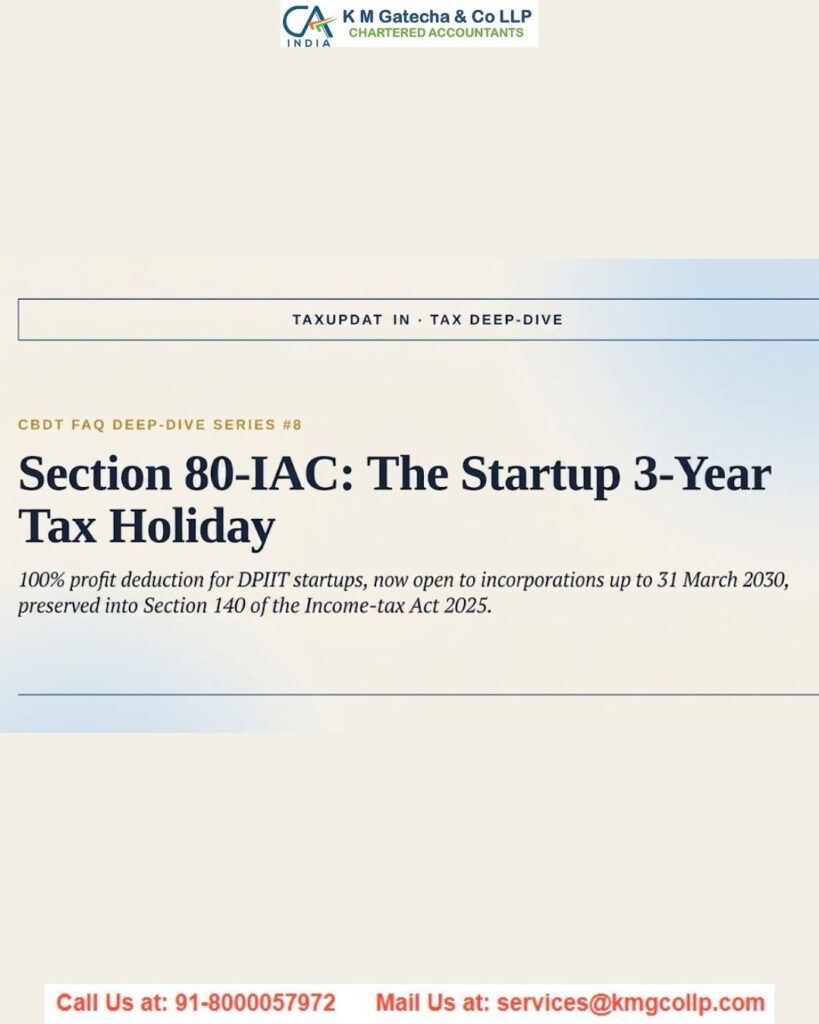
- Must be incorporated on or after 01-04-2016 but before 01-04-2025.
- The annual turnover should not exceed Rs. 100 crore in the previous year relevant to the assessment year for which the deduction is claimed.
Eligible Business as per Section 80 IAC:
For the purpose of Section 80 IAC, an eligible business refers to a business operated by an eligible startup that is engaged in the innovation, development, or improvement of products, processes, or services, or a scalable business model with significant potential for employment generation or wealth creation.
Quantum of Exemption Available to Startups:
Eligible startups can claim a deduction equal to 100% of the profits derived from the eligible business for any three consecutive financial years of their choice out of the first ten years beginning from the year of incorporation.
Who Can Apply for 80 IAC Tax Exemption?
Eligibility for the Section 80IAC tax exemption depends on factors such as DPIIT recognition, the age of the startup, and its overall turnover. Businesses that qualify as eligible startups and are engaged in an eligible business can apply for the exemption, provided all prescribed conditions are satisfied.
Conditions Relating to Formation and Transfer of Plant and Machinery
- The startup must not be formed through the transfer of existing plant and machinery that has already been used.
Exception:
Imported second-hand plant and machinery that has not been used by the assessee may qualify if the following conditions are satisfied:
- The plant and machinery is imported.
- It was not used in India before being installed by the entity.
- No depreciation was claimed in India by the assessee or any other person before its installation by the entity.
- The value of the second-hand plant and machinery does not exceed 20% of the total value of the plant and machinery used in the business.
- The startup must not be established by splitting up or reconstructing an existing business.
Exception:
A reconstructed business may claim the 80IAC exemption if it falls under Section 33B of the Income Tax Act. This provision allows a reconstructed industrial undertaking to claim the 80IAC tax exemption where the business was discontinued due to damage or destruction caused by:
- Natural calamities
- Riots or civil disturbances
- Accidental fire or explosion
- An act of the enemy
Eligibility Summary for Applying for 80 IAC Exemption
A startup must meet the following conditions:
- Be incorporated as a company or LLP.
- Have startup recognition from the DPIIT.
- Be incorporated after 1st April 2016.
- Not have completed 10 years from the date of incorporation.
- Be a new and original entity.
- Operate with new plant and machinery.
- Have turnover not exceeding Rs. 100 crores.
- Have an objective of generating employment or creating wealth.
- Be engaged in innovative products, services, or processes.
Process to Claim 80 IAC Tax Exemption
Step 1: Log in to the Startup India Portal
The first step towards claiming the tax deduction is to create a login on the Startup India portal. The startup must then apply for a DPIIT recognition certificate by following the Startup India registration process.
Step 2: Fill in the Required Details
After logging into the portal and selecting “Claim Tax Exemption,” the startup needs to provide the required information, including:
- Name of the startup
- Date of incorporation
- Incorporation/registration number
- Address and business location
- Nature of business, whether LLP or PLC
- DIPP number
- Contact details, including phone number, email ID, and PAN of the entity
Step 3: Submit Documents Required for 80 IAC Tax Exemption
Along with the above information, the startup applying for the 80IAC deduction must submit the following documents in PDF format:
- Memorandum of Association, in case of a PLC
- Limited Liability Partnership Deed, in case of an LLP
- Board Resolution, if applicable
- Balance sheet and profit and loss account for the immediately preceding three financial years, certified by a Chartered Accountant
- Income Tax Returns for the previous three years or from the date of incorporation
- Startup video link and pitch deck
Applicability of MAT for Startups Covered Under Section 80 IAC
The applicability of Minimum Alternate Tax (MAT) under Section 115JB of the Income Tax Act can create challenges for eligible startups because these provisions operate despite other tax benefits. As a result, startups may be required to pay tax at 15%, along with applicable surcharge and health and education cess, on their profits.
However, taxes paid under MAT during the years in which the Section 80IAC exemption is claimed are converted into MAT credit. This credit can subsequently be used to set off the difference between the tax calculated under the normal provisions and the tax payable under Section 115JB.
Conclusion
Section 80-IAC of the Income Tax Act, 1961 provides an important tax incentive for eligible domestic startups, supporting innovation and creating a favourable environment for business growth. However, claiming this deduction requires startups to undergo detailed financial verification by Chartered Accountants.
Disclaimer: The content on this website is for informational purposes only and does not constitute legal, financial, or professional advice. Please consult qualified experts before acting on any information. K M GATECHA & CO LLP accepts no liability for errors, omissions, or outcomes from the use of this content. This site is not an advertisement or solicitation.