

Capital Gains on Property Sale — LTCG Calculation, Section 54/54EC/54F Exemptions, NRI TDS and Repatriation Guidance
Capital Gains on Sale in India
Selling property, land, or a business asset in India can create a capital gains tax liability that many sellers underestimate until it is time to file their income tax returns. By that stage, opportunities to plan and reduce the tax burden may already have been missed. Calculating capital gains on the sale of immovable property in India involves five key considerations: determining the correct gain (including indexation and Section 50C stamp duty valuation rules), selecting the appropriate exemption (Section 54 for reinvestment in a residential house, Section 54EC for bonds, or Section 54F for sellers of non-residential assets), deciding whether to use the Capital Gains Account Scheme to preserve the exemption during the reinvestment period, understanding the buyer’s TDS obligations, and, for NRI sellers, repatriating the net sale proceeds in accordance with Form 15CA/15CB requirements and FEMA regulations.
Budget 2024 introduced a major change to the taxation of property capital gains. With effect from 23 July 2024, the LTCG tax rate on property was revised from 20% with indexation to 12.5% without indexation. Transitional relief was also introduced for properties acquired before 23 July 2024, allowing eligible sellers to compare both methods and pay tax under the option that results in the lower amount.
N D Savla & Associates offers comprehensive capital gains on sale services for residents and NRIs throughout Mumbai and India. These services include property LTCG calculations with and without indexation, Section 54/54EC/54F exemption planning, CGAS deposits, NRI TDS guidance under Sections 195 and 194IA, Form 26QB, Form 15CA/15CB for repatriation, Section 197 certificates for lower TDS, and ITR-2/ITR-3 filing, including complete disclosure under Schedule CG.
How Is Capital Gain on the Sale of Property Calculated?
Capital gains from selling immovable property, such as a house, flat, plot of land, or commercial property, are calculated using the following components:
- Full Value of Consideration: The agreed selling price between the buyer and seller, or the stamp duty value (circle rate), if the latter is higher, as prescribed under Section 50C.
- Less: Indexed Cost of Acquisition: For long-term capital gains (LTCG), the purchase cost is adjusted for inflation using the Cost Inflation Index (CII) ratio: (CII for the year of sale ÷ CII for the year of purchase). This adjustment accounts for inflation and reduces the taxable gain.
- Less: Indexed Cost of Improvement: Eligible capital improvement expenses, such as renovation, construction of additional floors, and structural alterations, are similarly adjusted using indexation.
- Less: Expenses on Transfer: Deductible transfer-related costs may include brokerage paid on the sale, registration and stamp duty charges on the sale deed, and legal expenses directly connected with the transaction.
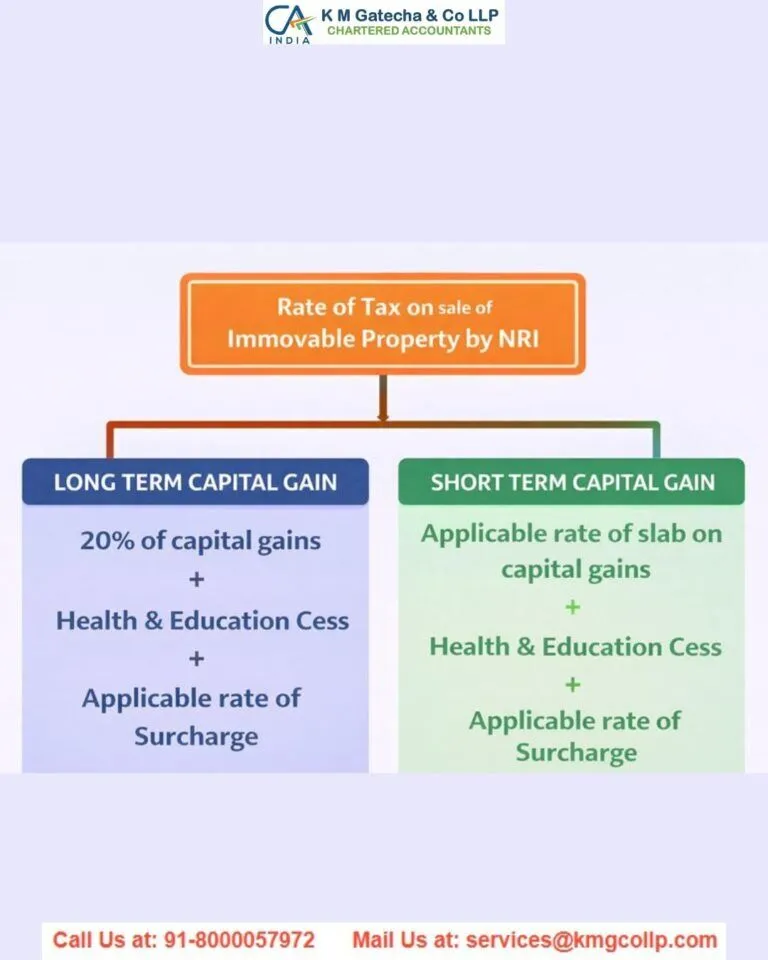
- = Long-Term Capital Gain: The applicable tax treatment is 20% with indexation for transactions covered by the pre-23 July 2024 rules or the transitional option, or 12.5% without indexation under the revised rules.
What Are the Budget 2024 Changes to Property Capital Gains?
Effective 23 July 2024, Budget 2024 revised the LTCG tax rate on immovable property from 20% with indexation to 12.5% without indexation. The government introduced transitional relief under the following conditions:
- Properties purchased BEFORE 23 July 2024: Sellers can choose between 12.5% without indexation and 20% with indexation, opting for the method that results in a lower tax liability.
- Properties purchased ON OR AFTER 23 July 2024: The 12.5% rate without indexation applies exclusively. Sellers cannot choose the indexation option.
The transitional provision requires sellers of properties acquired before 23 July 2024 to calculate their tax liability under both methods to identify the more beneficial option. For example, a property purchased in 1995 for ₹20 lakh and sold today for ₹2 crore could produce significantly different results under the two methods, as indexation can substantially reduce taxable gains on properties held for a long period. Conversely, a property purchased in 2022 for ₹80 lakh and sold for ₹1 crore would likely result in a lower tax liability under the 12.5% rate without indexation.
What Is Section 50C, and How Does Stamp Duty Value Affect Capital Gains?
Section 50C of the Income Tax Act applies when the sale price of an immovable property is lower than its stamp duty value. This value is determined by the state government for calculating stamp duty and is also known as the circle rate or ready reckoner value. In such situations, the stamp duty value is generally considered the full value of consideration when calculating capital gains. Our capital gain computation services explain the calculation process in detail, including the application of Section 50C.
Section 50C provides two significant safeguards for sellers:
- 10% tolerance limit: If the actual sale consideration is more than 90% of the stamp duty value, meaning the difference is less than 10%, Section 50C does not apply. The actual sale price is considered without substituting the stamp duty value.
- Disputed stamp duty valuation: If a seller challenges the stamp duty value, they can request the Income Tax Officer to refer the property for valuation by a Valuation Officer. If the Valuation Officer determines a value lower than the stamp duty value but higher than the actual sale consideration, the Valuation Officer’s valuation is adopted.
Capital Gains Exemptions for Property Sales
The Income Tax Act offers several exemptions based on reinvestment that can reduce or eliminate capital gains tax on property sales. The appropriate exemption depends on the asset being sold and the seller’s intended reinvestment:
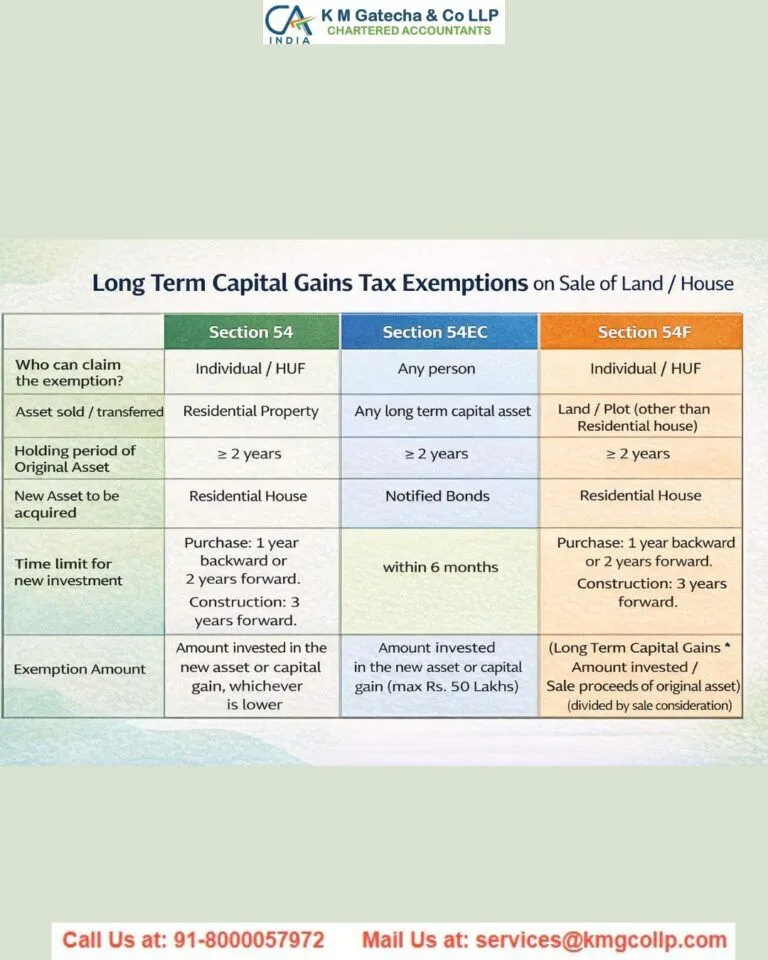
| Section | Asset Sold | Reinvestment Requirement | Time Limit | Limit / Key Condition |
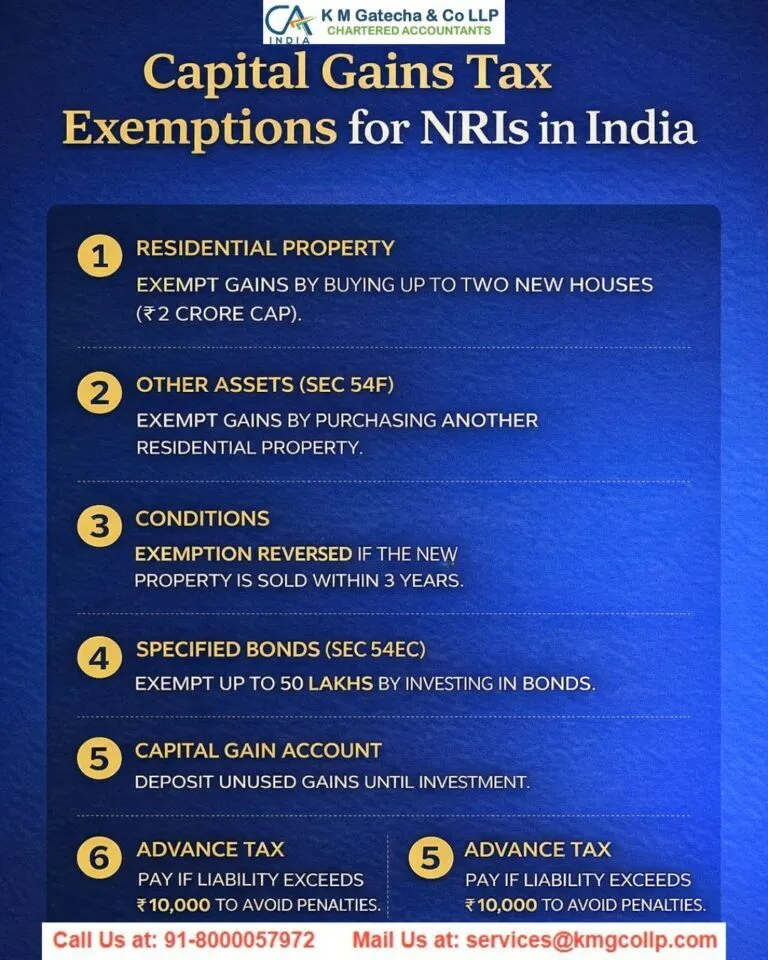
| Section 54 | Residential house property held for the long term (more than 24 months) | Purchase one new residential house in India within 1 year before or 2 years after the sale, or construct one within 3 years after the sale. | Purchase: 1 year before or 2 years after the sale. Construction: 3 years after the sale. | Exemption is capped at ₹10 crore under Budget 2023. The new house must be located in India. One house qualifies for the full exemption, while two houses may be considered once in a lifetime if the LTCG does not exceed ₹2 crore. |
| Section 54EC | Any long-term capital asset, including property and land | Invest in specified long-term capital gains bonds, currently issued by NHAI and REC, within 6 months of the transfer date. | Within 6 months of the transfer date. | Maximum investment of ₹50 lakh per financial year. Bonds have a 5-year lock-in period. Early redemption or taking a loan against the bonds results in the loss of the exemption. |
| Section 54F | Any long-term capital asset other than a residential house, such as land, commercial property, shares, or jewellery | Purchase a new residential house in India within 1 year before or 2 years after the sale, or construct one within 3 years after the sale. | Purchase: 1 year before or 2 years after the sale. Construction: 3 years after the sale. | A proportionate exemption applies if the entire net sale consideration is not reinvested. On the transfer date, the seller must not own more than one residential house apart from the new property. The exemption is capped at ₹10 crore. |
| Section 54B | Agricultural land used for agricultural purposes for at least 2 years before the sale | Purchase new agricultural land, whether urban or rural, within 2 years after the sale. | Within 2 years of the transfer date. | The new land must be used for agricultural purposes. There is no monetary cap, and the land must be situated in India. |
| Section 54G / 54GA | Machinery, plant, buildings, or land used by an industrial undertaking in an urban area | Invest in new plant, machinery, land, or buildings in a rural or semi-urban area under Section 54G, or in a Special Economic Zone (SEZ) under Section 54GA. | Within 3 years of the transfer date. | Applies when relocating an industrial undertaking to a rural area under Section 54G or to an SEZ under Section 54GA. |
The most critical decision to make before selling a property is how the proceeds will be reinvested. Sellers planning to purchase another residential house under Section 54 should account for the permitted period of 1 year before or 2 years after the sale. Those investing in Section 54EC bonds must complete the investment within 6 months. Planning and completing the reinvestment within the prescribed deadlines is much more effective than trying to obtain tax relief after the relevant time limits have expired.
The Capital Gains Account Scheme (CGAS) — When Is It Required?
The Capital Gains Account Scheme, 1988 (CGAS), provides a deposit facility for sellers who have earned long-term capital gains (LTCG) from selling a capital asset and qualify for an exemption under Section 54, 54F, or 54B but have not yet completed the required reinvestment. By depositing the unutilised capital gains into a CGAS account, the seller can claim the exemption in the ITR for the year of sale without waiting until the reinvestment is completed.
- Where and when to open a CGAS account: The account must be opened at a branch of a nationalised bank before the income tax return filing deadline (31 July for individuals and 31 October for cases requiring an audit).
- Types of CGAS accounts: Type A is a savings account intended for funds required within 3 months, while Type B is a term deposit account for funds that will be used after 3 months. Interest earned on CGAS deposits is taxable.
- Withdrawals from CGAS: Funds can be withdrawn only for the specified reinvestment purposes, such as purchasing or constructing a residential house or acquiring agricultural land. Supporting evidence of the reinvestment must be submitted to the bank.
- If the CGAS amount remains unused: Any amount not reinvested within the prescribed period becomes taxable as LTCG in the financial year in which the applicable time limit expires.
TDS on NRI Property Sales — Sections 195 and 194IA
When an NRI sells immovable property in India, the buyer is legally required to deduct Tax Deducted at Source (TDS) from the sale consideration before making the payment. Further details are available in our TDS and tax liability advisory.
Section 195 — TDS on Property Sales by NRIs
- LTCG (property held for more than 24 months): TDS applies at 12.5% of the sale consideration under the post-Budget 2024 provisions, along with the applicable surcharge (10% for income exceeding ₹50 lakh and 15% for income exceeding ₹1 crore) and health and education cess at 4%. Depending on the NRI’s income level, the effective rate may therefore exceed 13% and reach 16% or more.
- STCG (property held for 24 months or less): TDS applies at the flat rate of 30% applicable to NRI income, plus the relevant surcharge and cess. For NRIs with higher incomes, the effective STCG TDS rate may exceed 34%.
- TDS applies to the entire sale consideration, not just the capital gain: Under Section 195, TDS is deducted from the full sale consideration rather than only the capital gain. As a result, the amount withheld can be substantially higher than the actual tax liability, particularly when the NRI qualifies for significant exemptions under Sections 54, 54EC, or 54F. The NRI must file an ITR to claim a refund of any excess TDS.
Section 194IA — TDS When a Resident Buyer Purchases from a Resident Seller
Section 194IA applies when a resident buyer purchases property from a resident seller, not when the seller is an NRI. Under this provision, the buyer must deduct TDS at 1% of the sale consideration if the amount exceeds ₹50 lakh. This is a separate and simpler provision than Section 195, with a considerably lower TDS rate than the rates applicable to NRI property sellers.
Lower TDS Certificate Under Section 197
An NRI seller whose actual tax liability, after claiming exemptions under Sections 54, 54EC, or 54F, is lower than the standard TDS rate under Section 195 can apply to the jurisdictional Assessing Officer for a Lower Tax Deduction Certificate under Section 197. The certificate specifies the reduced TDS rate applicable to the transaction, helping the NRI avoid excessive tax deductions and the subsequent wait for a refund.
The application under Section 197 must be submitted before the property transaction takes place. The process generally takes 2–4 weeks.
Form 15CA/15CB — Repatriation of Property Sale Proceeds by NRIs
After selling property in India, an NRI may need to transfer the net sale proceeds abroad. Under FEMA regulations, repatriation from an NRI’s NRO account is permitted up to USD 1 million per financial year. The process requires Form 15CA, a declaration by the remitter confirming the nature of the remittance, and Form 15CB, a certificate issued by a Chartered Accountant confirming that the applicable taxes have been paid or adequately provided for. Our comprehensive Form 15CA/15CB certification services assist NRIs with repatriating proceeds from property sales.
- Form 15CA: The remitter submits this form online through the income tax portal. It specifies the nature and amount of the remittance and its tax treatment.
- Form 15CB: A Chartered Accountant prepares and signs this certificate to confirm that TDS has been deducted, no TDS is applicable, or appropriate provisions have been made for the tax liability. The CA calculates the tax payable and verifies whether the TDS deducted is sufficient.
- Annual USD 1 million limit: Total repatriation from an NRO account for any purpose is limited to USD 1 million per financial year. If property sale proceeds exceed this limit, the amount may need to be transferred over multiple financial years.
Historical Overview — Evolution of Capital Gains Tax on Property in India
When the Income Tax Act 1961 was introduced, capital gains from property were initially taxed as ordinary income at the applicable slab rates, without a distinction between short-term capital gains (STCG) and long-term capital gains (LTCG). Indexation benefits were introduced in the mid-1980s and subsequently became a standard part of LTCG calculations for property.
Budget 2014 introduced Section 194IA, requiring 1% TDS on property transactions exceeding ₹50 lakh as a compliance measure to bring high-value property transactions within the tax system. Budget 2023 placed a ₹10 crore cap on exemptions under Sections 54 and 54F, preventing high-net-worth individuals from eliminating unlimited capital gains tax through repeated property reinvestments.
Budget 2024 brought one of the most significant recent changes to property capital gains taxation by removing the indexation benefit under the revised rules and standardising the LTCG tax rate at 12.5% without indexation.
Our 7-Step Process for Handling Capital Gains on Sale
- Asset Classification and Holding Period — We identify the type of capital asset being sold, whether residential property, commercial property, agricultural land, or industrial land, and calculate the precise holding period from the acquisition date to the sale date. For inherited or gifted assets, the previous owner’s holding period is also considered. This period determines whether the gain is classified as short-term capital gains (STCG) or long-term capital gains (LTCG).
- Sale Consideration and Section 50C Evaluation — We compare the actual sale price with the stamp duty value (circle rate) to assess the applicability of Section 50C. If the actual consideration is less than 90% of the stamp duty value, we explain the implications of Section 50C and guide the seller on available options, including challenging the stamp duty valuation or accepting the deemed consideration.
- Capital Gains Calculation — Indexation and Budget 2024 Options — For properties acquired before 23 July 2024, we prepare two separate tax calculations: (a) 20% tax with indexation, using the Cost Inflation Index (CII) for the acquisition and sale years; and (b) 12.5% tax without indexation. We compare both calculations to determine the lower tax liability and recommend the more beneficial option. For properties acquired after 23 July 2024, only the 12.5% rate without indexation applies.
- Exemption Planning — Sections 54 / 54EC / 54F — Based on the calculated LTCG and the seller’s reinvestment intentions, we recommend the most suitable exemption strategy: Section 54 for reinvestment in a residential house; Section 54EC for investment in NHAI/REC bonds within six months, up to ?50 lakh; or Section 54F for sellers of non-residential assets who reinvest the entire sale consideration in a residential house. If the seller has LTCG from both property and other assets, we optimise the allocation of available exemptions.
- Capital Gains Account Scheme (CGAS), Where Necessary — If reinvestment cannot be completed before the ITR filing due date, we guide the seller through opening a CGAS account, determining the deposit amount (the unutilised LTCG), selecting the appropriate account type (A or B), and arranging the required documentation. We also monitor the deposit and ensure that withdrawals are used for eligible reinvestment within the prescribed time limits under Sections 54/54F.
- NRI TDS and Forms 15CA/15CB (for NRI Sellers) — For NRI sellers, we guide the buyer on calculating TDS under Section 195, assist with filing Form 27Q, and advise the seller on whether a lower deduction certificate under Section 197 is required. Following the sale, we prepare Forms 15CA and 15CB to facilitate the transfer of net sale proceeds to the NRI’s overseas bank account while addressing applicable FEMA repatriation requirements.
- ITR Filing with Schedule CG — We prepare ITR-2 for individuals earning capital gains or ITR-3 for individuals with business income, including a complete Schedule CG (Capital Gains) disclosure covering asset details, acquisition cost, indexed cost, sale consideration, capital gains, exemptions claimed, and net taxable gains. For NRI sellers, we also handle NRI ITR filing, including TDS credit claims and applicable DTAA benefits. If the TDS deducted exceeds the actual tax liability, we claim the excess amount as a refund.
Disclaimer: The content on this website is for informational purposes only and does not constitute legal, financial, or professional advice. Please consult qualified experts before acting on any information. K M GATECHA & CO LLP accepts no liability for errors, omissions, or outcomes from the use of this content. This site is not an advertisement or solicitation.

