In this guide, we’ll explain when GST registration becomes mandatory for a private limited company, the relevant turnover thresholds and other registration triggers, how the simplified three-working-day registration process applies to eligible applicants, what the revised GST rate structure means for businesses, and when registration may not be necessary. By the end, you’ll have a clearer understanding of your GST registration requirements under India’s updated tax framework.
What Makes GST Registration Mandatory in 2026?
Let’s clarify one important point first: registering a private limited company does not automatically make GST registration mandatory. The requirement depends on the company’s business activities, turnover, and applicable GST rules—not simply its legal structure. This principle continues to apply under the GST reforms.
GST registration generally becomes mandatory when a business’s aggregate turnover exceeds the applicable threshold, commonly ₹40 lakhs for businesses exclusively supplying goods and ₹20 lakhs for service providers, subject to the relevant conditions and exceptions. In certain special category states, lower thresholds may apply.
However, turnover is not the only factor to consider. Some businesses may be required to register for GST even when their turnover remains below the prescribed limit, depending on the nature of their activities and the provisions applicable to them.
The easiest way to understand this is that GST registration requirements are determined by what a business supplies, its turnover, and the circumstances in which it operates—not whether it is a sole proprietorship, an LLP, or a private limited company.
What has changed is the broader GST framework, including the revised rates for various goods and services and measures intended to simplify registration for eligible businesses. Understanding these changes can help founders determine whether they need GST registration and what steps they should take next.
The Major GST Reforms of September 2025
Before looking at the GST registration requirements in detail, it is important to understand the significant changes introduced in September 2025. The 56th GST Council meeting, held on September 3, 2025, announced one of the most substantial revisions to India’s GST rate structure since the tax system was introduced in 2017.
The Revised GST Rate Structure (Effective September 22, 2025)
- 0% (Exempt Rate): Selected essential food items, including fresh milk, UHT milk, paneer, chhena, chapati, roti, and paratha, along with individual life and health insurance premiums, as specified under the revised provisions.
- 5% (Merit Rate): Products and services such as hair oil, soaps, shampoos, toothpaste, processed foods, medicines, medical devices, beauty and wellness services, and handicrafts, subject to the applicable GST classifications.
- 18% (Standard Rate): A broad range of consumer goods and services, including electronics, restaurant services, small cars, motorcycles with engine capacities up to 350cc, and cement, which was reduced from the earlier 28% rate.
- 40% (Demerit Rate): Selected goods, including pan masala, gutkha, tobacco products, cigarettes, aerated beverages, caffeinated drinks, and luxury vehicles, as covered by the revised rate structure.
What Do These GST Changes Mean for Businesses?
The revised rates can have a direct impact on businesses across different industries. Companies operating in food processing, healthcare, wellness, and manufacturing may benefit from lower GST rates on eligible products and services. In contrast, businesses dealing in certain luxury products, tobacco items, and other demerit goods may face higher tax rates.
For private limited companies, understanding the revised GST classifications is important for accurate invoicing, tax calculations, pricing decisions, and compliance. However, these rate changes do not automatically determine whether a company must register for GST. Registration requirements continue to depend on applicable turnover thresholds, business activities, and other provisions under GST law.
Understanding Aggregate Turnover Under the New System
When explaining aggregate turnover, it is important to clarify what it includes. It is not limited to sales revenue, and changes to GST rates do not alter how aggregate turnover is calculated.
Aggregate turnover includes:
- All taxable supplies, including regular sales
- Exempt supplies that do not attract GST
- Exports of goods and services
- Interstate supplies
Aggregate turnover excludes:
- Inward supplies on which tax is payable under the Reverse Charge Mechanism (RCM)
- Central GST (CGST), State GST (SGST), and Integrated GST (IGST) charged on supplies
Consider an example from early 2026. A wellness centre owner earned ₹15 lakh from local services and ₹8 lakh from product sales to customers in other states. She assumed that only her ₹15 lakh in local service revenue mattered for GST registration. However, her aggregate turnover was ₹23 lakh because the relevant supplies had to be considered together.
This example illustrates why businesses should calculate aggregate turnover carefully rather than assessing registration eligibility based on one revenue stream alone. The applicable registration threshold depends on the nature of the business, the type of supplies, the state in which it operates, and any other relevant provisions.
Changes to GST rates may affect pricing and tax calculations, but they do not automatically determine whether registration is required.
When GST Registration Becomes Mandatory Regardless of Turnover
Certain business activities may require GST registration even when turnover is below the applicable threshold. These requirements are separate from the general turnover-based rules. Although the September 2025 GST reforms introduced changes to the tax structure and registration process, businesses must still assess whether any mandatory registration provision applies to them.
Interstate Supply: An Important Consideration
Interstate supplies can affect GST registration requirements, but the rules depend on the type of supply and the applicable exceptions.
For example, a handicraft business in Jaipur selling products worth ₹8 lakh annually to customers in Delhi, Mumbai, and Bengaluru should not assume that its turnover alone determines whether registration is necessary. The business must assess the nature of its supplies and the relevant GST provisions before deciding whether registration is mandatory.
Applicable GST rates may also influence product pricing. However, a change in the rate for a particular category does not, by itself, establish whether a business must register.
E-commerce Sellers: Check the Applicable Registration Rules
Businesses selling through platforms such as Amazon, Flipkart, or Meesho should review the GST registration requirements applicable to their products, business model, and sales arrangements.
Registration requirements for e-commerce sellers can vary depending on whether they supply goods or services and whether specific conditions or exemptions apply. Businesses should not assume that every seller must register from the first sale, nor should they assume that a low turnover automatically exempts them.
The September 2025 reforms included measures intended to simplify GST registration for eligible small suppliers using e-commerce platforms. Businesses should verify the current eligibility conditions and registration procedure before relying on these provisions.
Other Mandatory Registration Scenarios
Depending on the applicable GST provisions, registration may be required for businesses or individuals operating in certain categories, including:
- Input Service Distributor (ISD): An office responsible for distributing eligible input tax credit among branches or units, where the applicable ISD requirements are met.
- TDS deductor under GST: A person or entity required to deduct tax at source under the relevant GST provisions.
- Casual taxable person: A person who occasionally undertakes taxable transactions in a state or union territory where they do not have a fixed place of business, subject to applicable rules.
- Non-resident taxable person: A person residing outside India who occasionally makes taxable supplies in India and meets the relevant legal conditions.
- Reverse Charge Mechanism (RCM): A recipient who is liable to pay GST on specified supplies under reverse-charge provisions may also need to assess the applicable registration requirements.
Not every private limited company will fall into these categories. However, understanding the relevant provisions can help businesses determine their registration obligations and avoid compliance issues.
Important: GST registration requirements depend on the applicable law, the nature of the supply, turnover, and any relevant exceptions. Businesses should verify the current provisions before making a registration decision.
The New GST Registration Process in 2026
India’s GST registration process has become more streamlined, with technology-enabled verification and faster approvals for eligible applicants. One important change introduced in November 2025 was the simplified registration scheme for qualifying small taxpayers.
Here is how the process works, what documents you may need, and which common mistakes can delay your application.
The Streamlined 3-Day Registration Timeline
Eligible applicants can benefit from electronic GST registration within three working days, subject to the applicable conditions and successful Aadhaar authentication. The simplified scheme is optional and is intended for qualifying small, low-risk taxpayers. One of its key eligibility conditions concerns self-assessed monthly output tax liability on supplies to registered persons not exceeding ₹2.5 lakh.
What may help an application qualify for faster processing?
- Meeting the prescribed eligibility conditions for the simplified registration scheme
- Providing complete and accurate application details
- Successfully completing the required Aadhaar authentication
- Ensuring that the application and supporting documents meet the applicable requirements
Applicants should check their eligibility before selecting the simplified registration option on the GST portal.
Step-by-Step: How to Register for GST in 2026
Step 1: Assess Your Registration Requirements
Before applying, determine whether your private limited company is required to register for GST or intends to register voluntarily. Review your turnover, business activities, types of supplies, and applicable registration provisions.
You should also check whether your company qualifies for the simplified registration scheme. Eligibility depends on the prescribed conditions rather than an informal assessment of whether the business appears low-risk.
Step 2: Gather the Required Documents
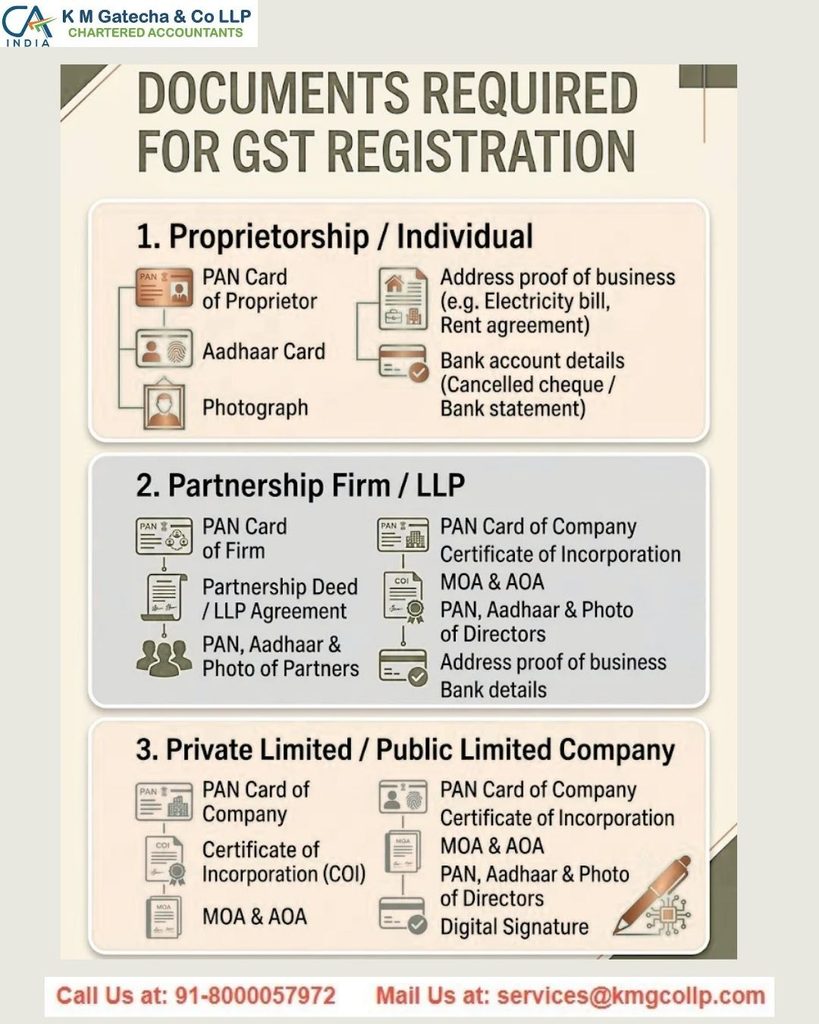
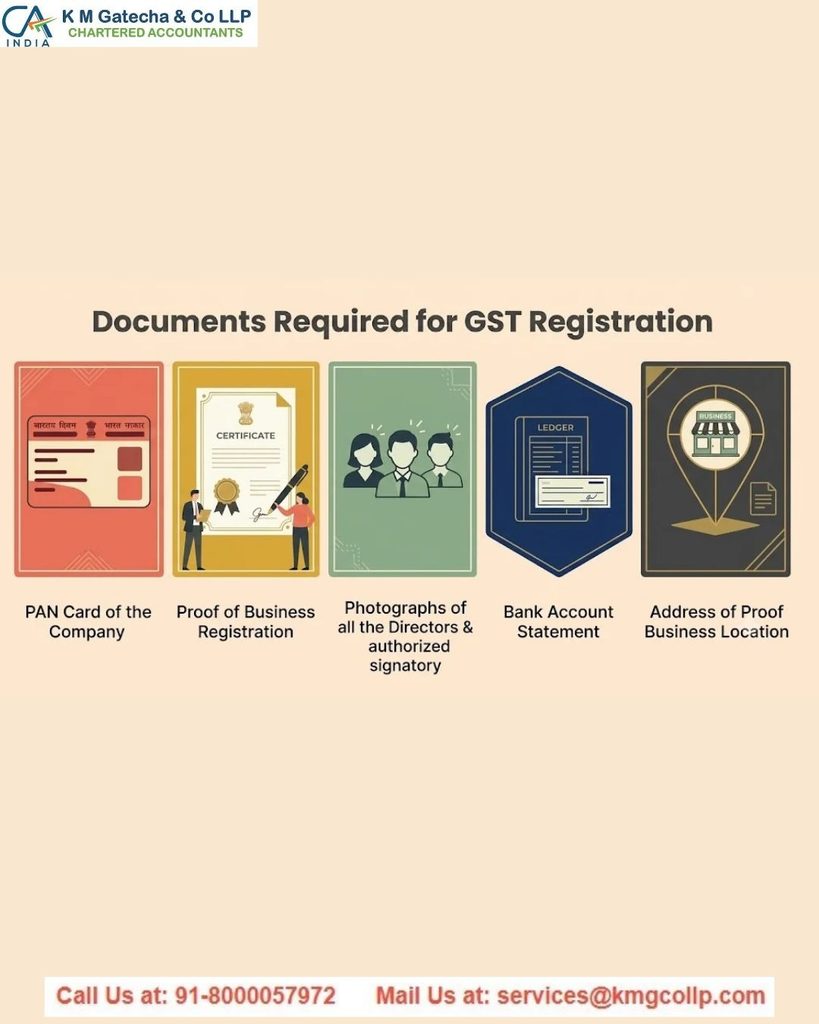
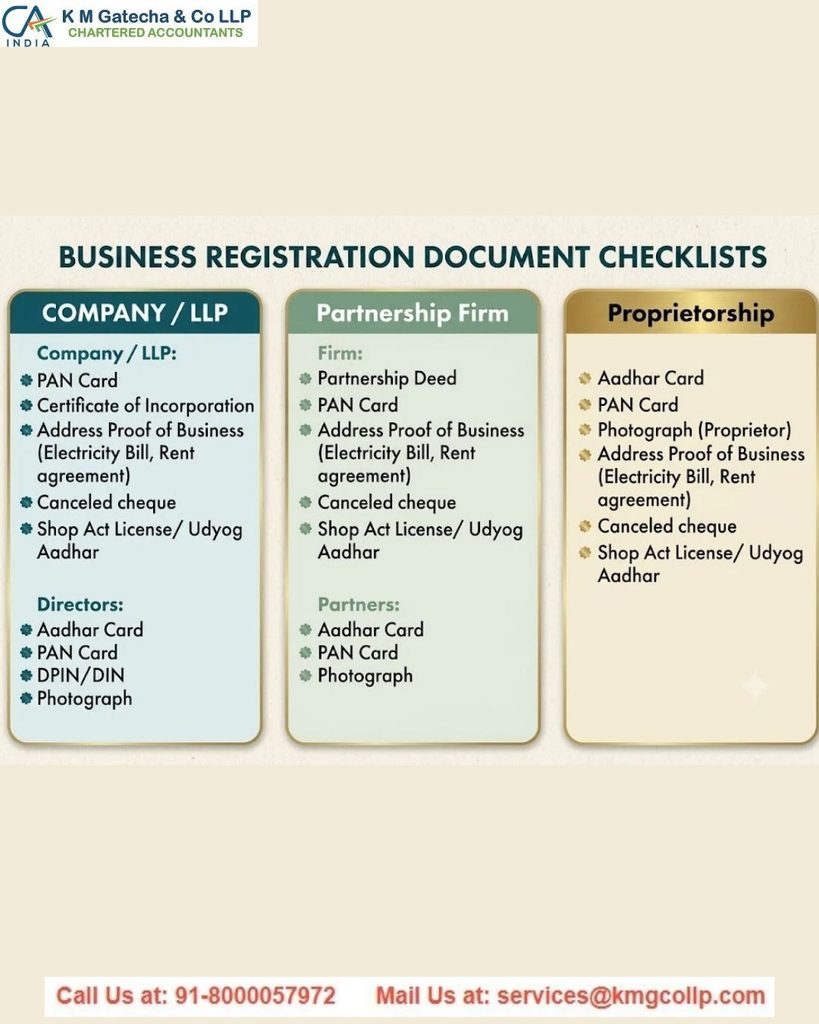
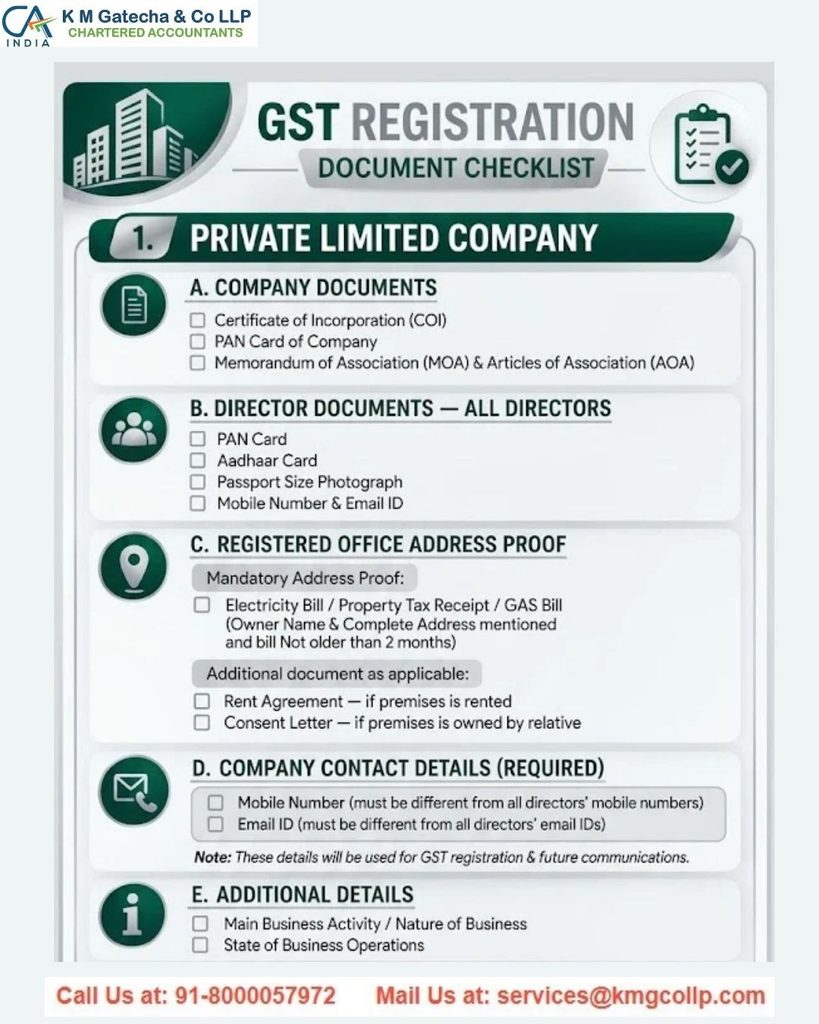
The documents required may vary depending on your company’s circumstances and the information requested through the GST portal. Commonly required details and documents include:
- Company PAN: The company’s Permanent Account Number and legal name as recorded in the PAN database.
- Proof of business address: Documents such as a rent or lease agreement, electricity bill, or property ownership documents, as applicable.
- Bank account details: Bank information and supporting documents where required under the applicable registration process.
- Director and authorised signatory details: Identity and address information, along with the details requested for the relevant individuals.
- Digital Signature Certificate (DSC): The authorised signatory’s DSC where electronic signing requirements apply to the company.
- Authorisation documents: A board resolution, letter of authorisation, or other applicable document establishing the authorised signatory’s authority, as required.
Ensure that the company name, PAN, address, and other details are consistent across the application and supporting records. Depending on the application, Aadhaar authentication, OTP verification, or biometric verification may also be required.
Step 3: Apply Through the GST Portal
Visit the official GST portal at www.gst.gov.in and select Services → Registration → New Registration.
Complete Part A of Form GST REG-01 by entering the required details, including:
- The type of taxpayer
- State and district
- Legal name of the business
- PAN details
- Email address and mobile number of the primary authorised signatory
Complete the required OTP verification. After the initial details are validated, the portal provides a Temporary Reference Number (TRN) that you can use to continue the application.
Step 4: Complete Part B and Submit the Application
Log in using your TRN and complete Part B of Form GST REG-01. Enter the relevant business details, provide the required supporting documents, and complete the applicable verification and authentication steps.
Before submitting the application, check that:
- The business address and other particulars are accurate.
- The uploaded documents are clear and legible.
- The authorised signatory’s details are correct.
- The applicable Aadhaar, biometric, or DSC requirements have been completed.
After submission and completion of the required authentication, an Application Reference Number (ARN) is generated. Use it to track the application status on the GST portal.
Step 5: Track the Application and Respond to Queries
The time required for approval depends on the applicable registration route and whether further verification is necessary.
- Eligible simplified-scheme applications: Electronic registration within three working days, subject to the prescribed conditions and successful Aadhaar authentication.
- Other applications: Processing depends on the applicable rules, verification requirements, and whether the officer requests clarification.
- Applications requiring additional information: The applicant may need to provide further documents or explanations before a decision is made.
If the proper officer identifies deficiencies or needs clarification, a notice may be issued in Form GST REG-03. The applicant must respond through Form GST REG-04 within the prescribed period, generally seven working days from receipt of the notice. If the application is rejected, the rejection order is communicated in Form GST REG-05, with reasons.
Once registration is approved, the GST registration certificate is made available through the portal. Check the official application status and notices rather than relying on a fixed approval estimate for every case.
Common Mistakes That Can Delay GST Registration
Even with a more streamlined process, errors in the application can lead to clarification requests or delays. Watch out for these common issues:
- Mismatched addresses: Ensure that the business address in the application is supported by the relevant premises documents and is entered correctly.
- Insufficient proof of premises: Submit appropriate address evidence based on whether the premises are owned, rented, leased, or used with permission. Additional documents, such as a consent letter, may be needed depending on the circumstances.
- Incorrect director or signatory details: Check names and identification details against the relevant records.
- Incomplete bank information: Provide accurate bank details and any supporting documents requested under the applicable process.
- Unclear or incomplete documents: Upload legible files and ensure that all required pages and information are included.
- Missed verification steps: Complete the applicable OTP, Aadhaar, biometric, or digital-signature requirements.
- Unanswered portal notices: Monitor the application status and respond to any clarification request within the prescribed deadline.
The New GST Rate Structure: What It Means for Your Registration Decision
The GST reforms introduced in 2025 changed the tax rates applicable to various goods and services. For private limited companies, these changes can influence pricing, profit margins, invoicing, and business-to-business transactions. However, a lower GST rate does not automatically make registration mandatory or beneficial. The decision depends on applicable registration rules, turnover, input tax credit eligibility, and the needs of your customers.
Food and Daily Essentials
Several everyday products moved to lower GST rate categories under the revised structure. These include items such as hair oil, toilet soap, shampoo, toothpaste, toothbrushes, namkeen, bhujia, sauces, noodles, chocolates, certain preserved meat products, dairy products, coffee, and cornflakes, subject to the applicable product classifications.
For example, a snack food manufacturer supplying products to business customers may find that a lower GST rate affects its pricing and competitiveness. If the manufacturer chooses to register voluntarily, registration may help it issue GST-compliant invoices and, where eligible, allow customers to claim input tax credit.
However, the commercial benefits depend on the product’s applicable rate, the company’s costs, its customers, and the relevant input tax credit rules. A change in GST rate alone does not guarantee a particular increase in revenue.
Healthcare: Lower Rates on Selected Products
The 2025 GST changes reduced rates on several healthcare-related products, including certain drugs, medicines, medical devices, and spectacles, depending on their classification.
The reforms also exempted individual life and health insurance policies from GST, subject to the applicable provisions. These changes may affect the final price paid by consumers and the tax treatment of businesses operating in the healthcare and insurance sectors.
Companies dealing in these products should verify the applicable GST classification and rate before updating invoices, accounting systems, or pricing policies.
Wellness and Beauty Services
The revised rate structure also changed the GST treatment of certain services and products. Businesses such as gyms, salons, barbers, and yoga centres should check the applicable classification and rate for each service they provide.
Lower rates can create opportunities to review pricing and strengthen competitiveness, particularly in price-sensitive markets. However, service providers must assess their GST registration obligations separately, based on turnover, the nature of their activities, and any applicable exceptions.
Vehicles and Construction
The revised GST structure reduced the rates applicable to certain categories of vehicles and construction materials. Small cars, motorcycles with engine capacity up to 350cc, and cement moved from the earlier 28% rate to 18%, subject to the relevant classifications and effective-date provisions.
These changes may affect purchase costs, consumer pricing, construction budgets, and business planning. Companies in the automotive, real estate, and infrastructure sectors should ensure that their invoices and accounting systems reflect the rates applicable to the relevant transactions.
Products Subject to the Higher 40% GST Rate
The revised structure introduced a 40% rate for specified goods classified within the demerit category. These include products such as pan masala, gutkha, certain tobacco products, aerated beverages, and caffeinated drinks, as covered by the applicable rate notifications. Certain luxury goods and vehicles may also fall within higher-tax categories, depending on their classification.
Businesses dealing in these products should pay close attention to the applicable GST rates, invoicing requirements, pricing strategies, and compliance obligations.
How These Rate Changes Affect Your Registration Decision
Before deciding whether to register for GST, a private limited company should consider:
- Applicable registration threshold: Determine whether aggregate turnover and the nature of your supplies require registration.
- Mandatory registration provisions: Check whether any specific business activity triggers registration regardless of turnover.
- Customer requirements: Business customers may require GST-compliant invoices for their purchases.
- Input tax credit: Assess whether your company is eligible to claim credit on business inputs and whether the applicable conditions are satisfied.
- Pricing and profitability: Calculate how the relevant GST rate affects your final selling price, costs, and margins.
- Compliance responsibilities: Consider the returns, records, and other obligations associated with registration.
The key takeaway is that GST rate changes can influence a company’s commercial decisions, but they do not replace the legal tests for registration. Confirm the current rate notifications and registration provisions before making a decision.
Benefits of GST Registration Under the New System
Even when GST registration is not mandatory, some private limited companies choose to register voluntarily. The GST reforms introduced in 2025 brought changes to tax rates, registration procedures, and refund mechanisms. However, whether voluntary registration is worthwhile depends on your business model, customers, expenses, and compliance costs.
Legal Collection of GST and Business Credibility
Once your company is registered under GST, it can collect GST on taxable supplies and issue valid tax invoices in accordance with the applicable rules.
This can be particularly useful when dealing with business-to-business (B2B) clients. Registered customers may prefer suppliers who can issue GST invoices because eligible purchases may allow them to claim Input Tax Credit (ITC), subject to the relevant conditions.
GST registration can also help establish a more structured invoicing and accounting process. However, registration alone does not guarantee more customers or higher business credibility.
The revised GST rate structure may simplify the applicable rates for certain products and services, but businesses must still classify their supplies correctly and apply the appropriate rate.
Input Tax Credit: A Potential Cost-Saving Benefit
One of the main advantages of GST registration is the ability to claim Input Tax Credit (ITC) on eligible business purchases. This can help reduce the GST payable on your sales.
Eligible purchases may include inventory, raw materials, equipment, and certain business services. However, ITC is not automatically available on every expense. Claims must satisfy the applicable GST provisions, documentation requirements, and restrictions.
Example:
Suppose your company purchases inventory worth ₹1 lakh, excluding GST, at an 18% rate. You pay ₹18,000 in GST on that purchase.
Later, your company sells taxable products worth ₹2 lakh, excluding GST, at the same 18% rate and collects ₹36,000 in GST.
| Particulars | Amount |
| GST collected on sales | ₹36,000 |
| Eligible ITC on purchases | ₹18,000 |
| Net GST payable, assuming full eligible credit | ₹18,000 |
In this simplified example, the company pays ₹18,000 after adjusting eligible ITC rather than the full ₹36,000 collected on sales.
The actual calculation depends on the company’s transactions, eligibility for ITC, and applicable GST rules.
The 2025 reforms also introduced measures to improve cash flow through provisional refunds in eligible cases involving inverted duty structures. Under the relevant risk-based mechanism, 90% of eligible refund claims may be sanctioned provisionally, subject to applicable conditions and exclusions. This is not an automatic refund for every registered business.
Enhanced Digital Features and Process Improvements
The GST system continues to use digital tools to facilitate registration, return filing, verification, and refunds. The 2025 reforms introduced or advanced several measures intended to make compliance more efficient.
Key developments include:
- Simplified registration: Eligible low-risk applicants can benefit from an optional registration scheme designed to provide automated registration within three working days, subject to prescribed conditions.
- Digital return filing: Registered taxpayers can prepare and submit returns through the GST portal, with system-generated information and data from other GST records helping support compliance.
- Risk-based provisional refunds: Eligible refund claims may qualify for provisional sanction based on system-based risk evaluation.
- GST Appellate Tribunal (GSTAT): The tribunal’s operationalisation is intended to strengthen the GST dispute-resolution framework.
These measures may reduce some administrative difficulties, but they do not eliminate the need to maintain accurate records, reconcile transactions, and file returns on time.
Interstate Trade and Business Expansion
GST registration can support business expansion by helping companies meet the tax requirements applicable to their transactions across state boundaries.
However, not every interstate transaction automatically requires GST registration. The requirement depends on the type of supply, the applicable provisions, and any relevant exceptions.
For a company planning to expand into new markets, GST registration may make it easier to manage tax invoices, eligible ITC claims, and transactions with registered business customers.
It can also help create a more organised financial record for lenders, suppliers, and business partners. Nevertheless, loans, favourable credit terms, and new contracts are determined by several factors; GST registration alone does not guarantee them.
Drawbacks of GST Registration in 2026
Although GST registration offers potential advantages, it also creates ongoing compliance responsibilities. Businesses should consider these obligations before opting for voluntary registration.
Compliance Burden and Return Filing
Once registered, a company must comply with the applicable GST return-filing, payment, recordkeeping, and invoicing requirements.
The frequency of return filing depends on the taxpayer’s category and eligibility for schemes such as the Quarterly Return Monthly Payment (QRMP) scheme. Eligible regular taxpayers with aggregate annual turnover of up to ₹5 crore may be able to file specified returns quarterly under QRMP, subject to the scheme’s conditions.
Digital tools can make filing more convenient, but businesses still need to maintain accurate accounts, reconcile sales and purchase records, and address discrepancies.
For a company with annual revenue of ₹25 lakh, the compliance workload and cost may be significant relative to its size. The company should compare the cost of managing GST internally with the fees charged by a chartered accountant or other qualified professional.
Professional fees vary according to transaction volume, return requirements, industry, and the level of support needed.
Penalties for Non-Compliance
GST registration also brings legal responsibilities. Failure to file returns, pay tax, maintain required records, or register when legally required can result in late fees, interest, penalties, or other consequences under the applicable provisions.
The amount depends on the nature of the default, the relevant GST provision, the tax involved, and any applicable caps or relief.
Businesses should not rely on one fixed penalty figure for every situation. Instead, they should verify the rules applicable to their specific default and ensure that returns and tax payments are completed within the prescribed deadlines.
Registering on time, maintaining accurate records, and responding promptly to portal notices can help reduce avoidable compliance risks.
Disclosure and Audit Requirements
GST registration requires businesses to report relevant transactions and maintain records in accordance with the law. These records may be examined by tax authorities as part of applicable verification, scrutiny, or audit procedures.
This level of transparency is a routine part of tax compliance, but it means that businesses must keep their financial records accurate and consistent.
It is also important to distinguish between different types of audits. GST registration does not automatically mean that a company must obtain a separate GST audit solely because its turnover exceeds ₹5 crore. Businesses should assess the statutory audit requirements applicable to them, along with any tax audit obligations under other laws and any specific GST scrutiny or audit requirements.
When Should You Consider Voluntary GST Registration in 2026?
If your company has not reached the applicable registration threshold, voluntary registration may still be worth considering. The right decision depends on how your business earns revenue, who your customers are, and whether the benefits outweigh the additional compliance costs.
You Primarily Serve B2B Clients
If most of your customers are registered businesses, they may prefer receiving GST-compliant invoices so that they can claim eligible ITC on their purchases.
For example, an IT services company earning ₹18 lakh annually may choose voluntary registration if its major clients require GST invoices and the company’s services and circumstances make registration commercially worthwhile.
Before registering, the company should compare the expected benefits with the additional tax, filing responsibilities, accounting costs, and the applicable rules for its services.
Your Products or Services Have Become Eligible for Lower GST Rates
Businesses in sectors affected by the 2025 rate changes may want to reassess their pricing and tax strategy.
If the applicable GST rate on a product or service has decreased, the change may affect customer prices, margins, and competitiveness. A registered business must apply the correct rate and issue compliant invoices.
However, a lower rate does not automatically make voluntary registration advantageous. The business should also consider its eligibility for ITC, customer expectations, and the cost of compliance.
You Make Significant Business Purchases
Companies that purchase substantial quantities of inventory, raw materials, equipment, or business services may benefit from eligible ITC.
For example, a small manufacturing unit spending ₹8 lakh annually on raw materials could evaluate whether the eligible ITC available after registration would meaningfully reduce its tax costs.
The calculation should include the applicable tax rates, the proportion of eligible purchases, any blocked credits, the company’s output tax liability, and professional compliance fees. The potential credit should be estimated from actual records rather than assumed to be available on every purchase.
You Plan to Expand Quickly
If your company expects to grow significantly, voluntary registration may help prepare it for future transactions with registered businesses and for applicable GST compliance requirements.
Eligible applicants may also benefit from the simplified registration scheme introduced in 2025, which provides for automated registration within three working days when the prescribed conditions are met.
However, early registration should be based on a practical assessment of expected turnover, customer requirements, eligible ITC, and the cost of maintaining compliance. It is not necessary for every company that expects future growth.
When Voluntary Registration May Not Make Sense
Voluntary registration may be less attractive for a small business that mainly sells to individual consumers, has limited eligible ITC, and does not receive a meaningful commercial benefit from issuing GST invoices.
For example, a business operating on thin margins should evaluate whether it can absorb GST-related compliance costs and how registration could affect its final selling price. It should also consider whether it would be able to claim eligible ITC on its expenses.
The decision should not be based solely on whether customers are individuals or businesses. The applicable registration provisions, nature of supplies, pricing strategy, and overall financial position must also be considered.
Ultimately, voluntary GST registration is a business decision as well as a compliance decision. Assess the potential benefits against the tax and administrative responsibilities, and confirm the applicable GST rules before registering.
Real-World Scenarios: Should You Register for GST in 2026?
Understanding GST registration rules becomes easier when you apply them to real-world business situations. The following examples illustrate how turnover, customer type, interstate transactions, and the revised GST rate structure can influence a private limited company’s registration decision.
Scenario 1: A Freelance Designer Incorporates a Company
Priya runs a freelance design business generating ₹12 lakh in annual revenue. She decides to incorporate her business as a private limited company.
Does she need GST registration?
Not necessarily. If her business provides services, her aggregate turnover remains below the applicable registration threshold, and no compulsory registration provision applies, she may not need to register immediately. She should assess her business activities, customer locations, and the relevant exceptions before making a decision.
Should she register voluntarily?
Probably not yet, if most of her customers are individual consumers or small businesses that do not require GST invoices and she has limited eligible input tax credit to claim.
However, if she begins serving larger businesses that require GST-compliant invoices, voluntary registration may become worth considering. She should compare the potential benefits with the additional tax and compliance responsibilities.
Scenario 2: A Wellness Studio Chain
Arjun operates yoga and wellness centres in Delhi NCR, generating ₹18 lakh in annual revenue.
Does he need GST registration?
If his aggregate turnover is below the applicable threshold and no compulsory registration provision applies, registration may not yet be mandatory. He should also check whether the activities are supplied within one state or across state boundaries and whether any other registration requirements apply.
Should he register voluntarily?
It depends on his business model. If the applicable GST rate on his services has decreased under the revised rate structure, he can review whether registration would improve his pricing strategy and relationships with corporate customers.
Registered business customers may value GST-compliant invoices because they may be eligible to claim ITC, subject to the applicable conditions. However, a lower GST rate does not automatically make voluntary registration the best choice.
What should he evaluate?
Arjun should compare his expected eligible ITC, customer requirements, pricing flexibility, and compliance costs before registering. Any claims about increased customer acquisition or revenue should be supported by the business’s actual results rather than assumed from the rate reduction alone.
Scenario 3: An E-commerce Apparel Brand
Neha launches a clothing brand and sells products through Amazon and her own Shopify store. Her combined monthly sales are ₹3 lakh.
Does she need GST registration?
She must assess the GST rules applicable to her products, sales channels, and business arrangements. Selling through an e-commerce platform does not, by itself, mean every seller must register regardless of turnover. Specific provisions and exceptions may apply to eligible sellers, including certain small suppliers of goods operating through e-commerce operators.
Neha should verify the applicable requirements before listing products or accepting orders.
What happens if she delays registration when it is required?
If registration is legally required, delaying the application can lead to compliance issues and potential tax liabilities. Platform onboarding and selling requirements may also depend on the platform’s current policies and the seller’s circumstances.
What should she know about the new registration process?
Eligible applicants may benefit from the simplified GST registration scheme introduced in 2025, subject to its prescribed conditions. However, approval within three working days is not guaranteed for every applicant.
Neha should also confirm the GST rate applicable to each clothing product based on its classification and value rather than assuming all apparel falls under one standard rate.
Scenario 4: A Manufacturing Unit Selling Interstate
Rajiv operates a small electronics manufacturing unit in Pune, generating ₹30 lakh in annual turnover. He sells products to distributors in Maharashtra, Gujarat, and Karnataka.
Does he need GST registration?
He should assess the applicable registration rules for his goods and interstate transactions. The general threshold for suppliers of goods may be ₹40 lakh in eligible states, subject to conditions and exceptions. However, interstate taxable supplies of goods can trigger compulsory registration, so Rajiv should verify the relevant provisions before relying on the threshold.
What if he sells only within Maharashtra?
If Rajiv sells exclusively within Maharashtra and qualifies for the applicable threshold, he may be able to operate without GST registration until registration becomes mandatory. This depends on his aggregate turnover, the nature of his supplies, and whether any other compulsory registration provision applies.
Can he benefit from input tax credit?
If Rajiv registers and meets the applicable ITC conditions, he may be able to claim credit on eligible business purchases. This could include certain raw materials, equipment, and other inputs used in manufacturing.
However, he should not assume that every input cost has become cheaper under the revised GST structure. The applicable rate depends on the product or service classification and the relevant rate notification.
Scenario 5: A Snack Food Processing Business
Meera operates a food processing unit in Karnataka that generates ₹25 lakh in annual revenue. All her sales take place within the state.
Does she need GST registration?
If her business supplies goods, qualifies for the applicable higher registration threshold, and has no other compulsory registration obligation, she may not need to register immediately. She must calculate aggregate turnover correctly and verify the applicable provisions.
Should she register voluntarily?
Voluntary registration may be worth considering if Meera supplies retailers or distributors that prefer GST invoices and if she has significant eligible ITC on raw materials, packaging, equipment, or other business purchases.
She should also check the revised GST rate applicable to each packaged snack product. Not every food product necessarily falls under the same rate, so classification is important.
What should she consider before deciding?
Meera should compare the potential ITC benefit and commercial advantages against the cost of return filing, accounting, and other compliance obligations. Improved pricing may help her compete for business customers, but an increase in revenue is not guaranteed by registration alone.
Key Takeaway
These scenarios demonstrate why GST registration decisions should not be based on turnover alone. A private limited company should consider its aggregate turnover, type of supplies, customer locations, e-commerce arrangements, applicable GST rates, and any compulsory registration provisions.
Before making a decision, verify the latest GST rules and notifications applicable to your business. Where the position is unclear, consult a qualified tax professional to assess your registration obligations and the potential benefits of voluntary registration.
Disclaimer: The content on this website is for informational purposes only and does not constitute legal, financial, or professional advice. Please consult qualified experts before acting on any information. K M GATECHA & CO LLP accepts no liability for errors, omissions, or outcomes from the use of this content. This site is not an advertisement or solicitation.