

Summary
GST registration requirements for eCommerce businesses in India depend on the seller’s activities, the type of supplies made, and the applicable provisions of the CGST Act, 2017. Under Section 24, certain eCommerce operators and suppliers must register regardless of turnover. However, specific exemptions are available to eligible sellers who meet the prescribed conditions.
The usual turnover thresholds, such as ₹40 lakh for eligible suppliers of goods in certain states and ₹20 lakh for services in many states, do not apply in every situation. Eligible small sellers may qualify for exemptions when selling through eCommerce platforms, subject to applicable restrictions.
Many new online sellers assume that they can avoid GST registration simply because their monthly sales amount to only a few thousand rupees. However, low turnover alone does not determine whether registration is required.
Understanding the eCommerce GST registration rules for 2026 can help new and existing online sellers comply with their tax obligations and avoid unnecessary compliance issues.
Who Needs GST Registration for eCommerce in India?
The registration requirement depends on the type of business and the way it operates. Under Section 24 of the CGST Act, 2017, certain categories of businesses must obtain GST registration even if their turnover is below the usual threshold.
The following categories should understand their applicable requirements:
1. Sellers on Online Marketplaces
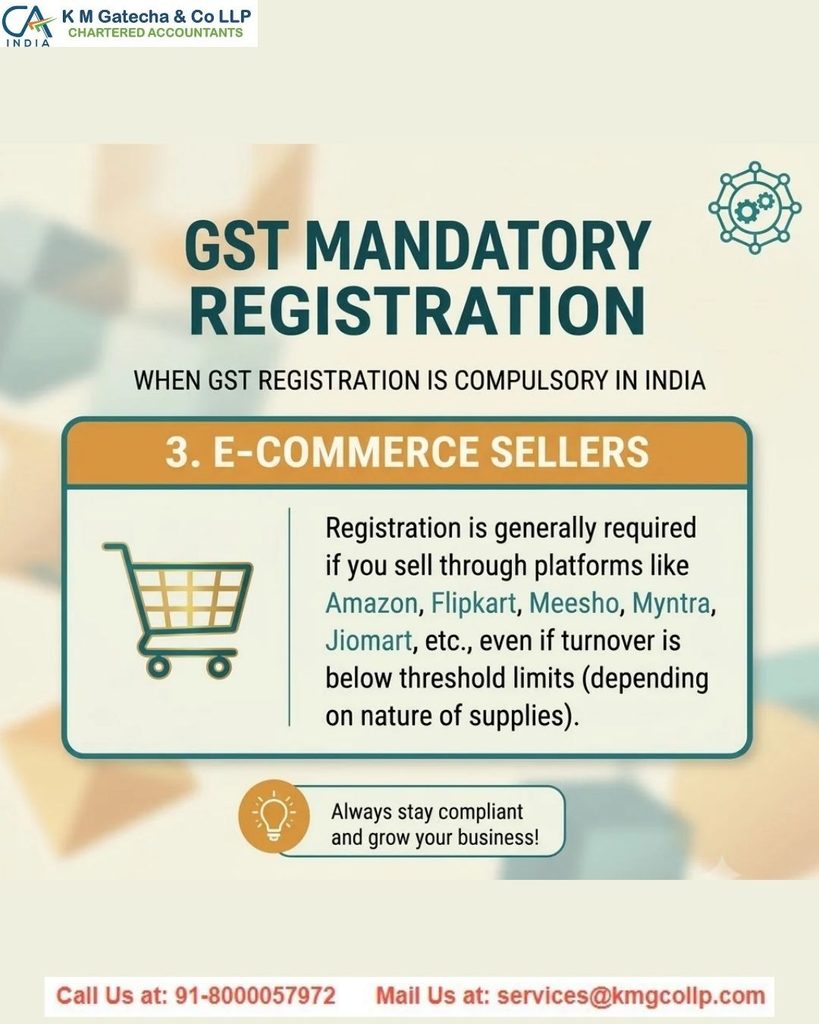
Businesses selling products through platforms such as Amazon, Flipkart, Meesho, Myntra, and JioMart may need GST registration. However, eligible small sellers of goods can qualify for a specific exemption if they meet the prescribed conditions, including restrictions relating to interstate supplies and enrolment requirements.
Therefore, sellers should not assume that registration is compulsory from their very first sale in every circumstance.
2. Service Providers Using Online Platforms
Service providers operating through platforms such as Urban Company, Practo, and similar applications must assess their registration obligations based on the nature of their services and the applicable GST provisions.
Certain service providers may qualify for threshold-based exemptions, while specific services covered under Section 9(5) of the CGST Act have different tax treatment. The platform’s involvement in collecting payments does not, by itself, determine whether the service provider must register.
3. eCommerce Operators
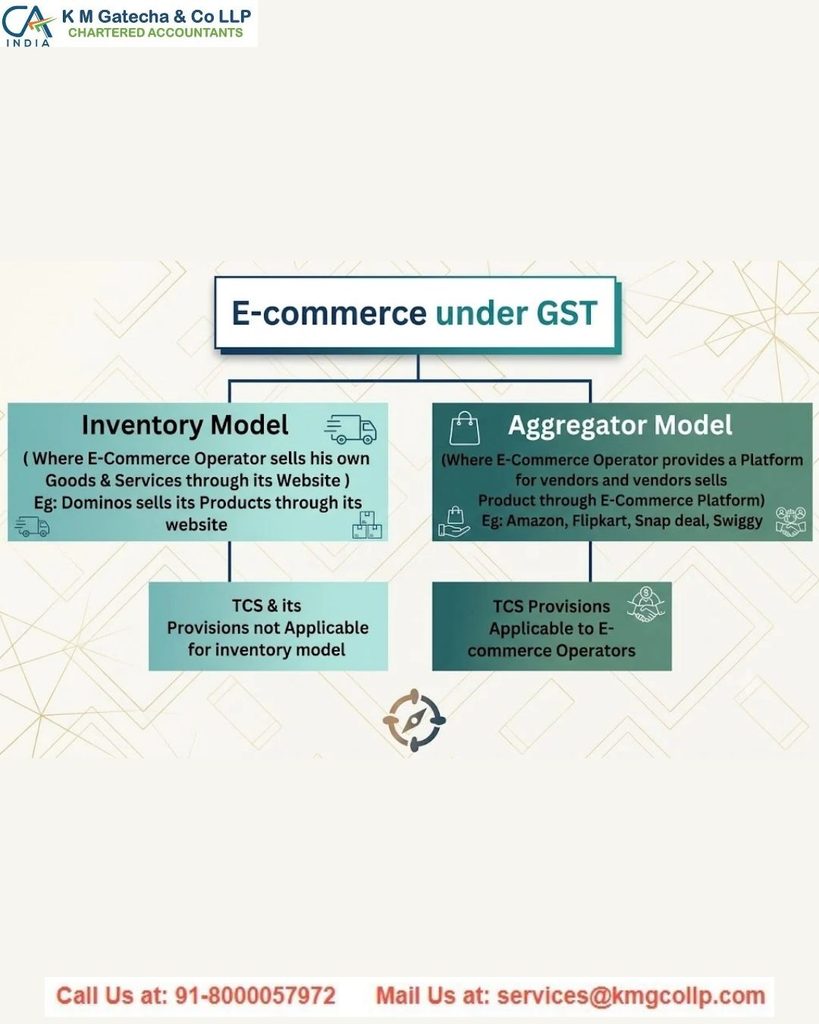
Businesses that own, operate, or manage digital platforms facilitating online supplies are generally required to obtain GST registration regardless of turnover, subject to the applicable law.
Operators covered by Section 52 must also comply with the relevant Tax Collected at Source (TCS) requirements. Their registration and tax obligations are distinct from those of the sellers using their platforms.
4. Foreign eCommerce Operators
Foreign operators facilitating supplies in India must assess their registration and tax obligations under the applicable GST and IGST provisions. The requirements depend on the nature of their activities, the types of supplies involved, and whether they have a physical presence or an authorised representative in India.
Registration is not automatically required in every Indian state or union territory merely because an operator facilitates online transactions there; the applicable statutory provisions determine where registration is necessary.
GST Registration for eCommerce Businesses: Step-by-Step Process
The GST registration process for an eCommerce business is similar to the standard registration procedure. However, applicants should ensure that they select the correct reason for registration and provide the documents relevant to their business structure.
Step 1: Complete Part A on the GST Portal
Visit the official GST portal and navigate to Services > Registration > New Registration.
Enter the required details in Part A of Form GST REG-01, including:
-
- Legal name of the business
-
- PAN
-
- Email address
-
- Mobile number
Verify the email address and mobile number using the OTPs provided. After successful verification, the portal generates a Temporary Reference Number (TRN).
The TRN is generally valid for 15 days, during which the applicant should complete and submit Part B of the application.
Step 2: Complete Part B of the Registration Application
Log in to the GST portal using the TRN and complete the remaining sections of the application. These generally include:
-
- Business Details: Provide the principal place of business, additional business locations, and the nature of business activities.
-
- Reason for Registration: Select the applicable reason based on the business’s actual circumstances. Where registration is mandatory under Section 24 of the CGST Act, select the relevant category. Eligible suppliers who qualify for an exemption should not select a mandatory-registration category unless it applies to them.
-
- Authorised Signatory: Enter the details of the person authorised to submit the application.
-
- Bank Account Details: Provide the required banking information in accordance with the applicable portal requirements.
-
- HSN or SAC Codes: Identify the relevant codes for the goods or services supplied, as applicable.
Ensure that the information entered matches the supporting documents.
Step 3: Upload the Required Documents
Upload the documents requested by the GST portal in the prescribed file formats and size limits. Requirements may vary depending on the business structure and the details provided in the application.
Before uploading, check that:
-
- Documents are clear and legible.
-
- The information matches the application.
-
- Files meet the portal’s current format and size requirements.
-
- Supporting documents are provided for the principal place of business and authorised signatory, where applicable.
Use descriptive file names to keep documents organised and make them easier to identify during the application review.
Step 4: Verify, Submit, and Track the Application
Complete the required verification and submit the application using an available method, such as Aadhaar authentication, e-Sign, EVC, or a Digital Signature Certificate (DSC), depending on the applicant’s category and applicable requirements.
After successful submission, an Application Reference Number (ARN) is generated. Use the ARN to track the application status through the GST portal.
Processing time can vary depending on the application details, verification requirements, and whether the GST officer requests additional information. Approval should not be assumed within a fixed number of working days.
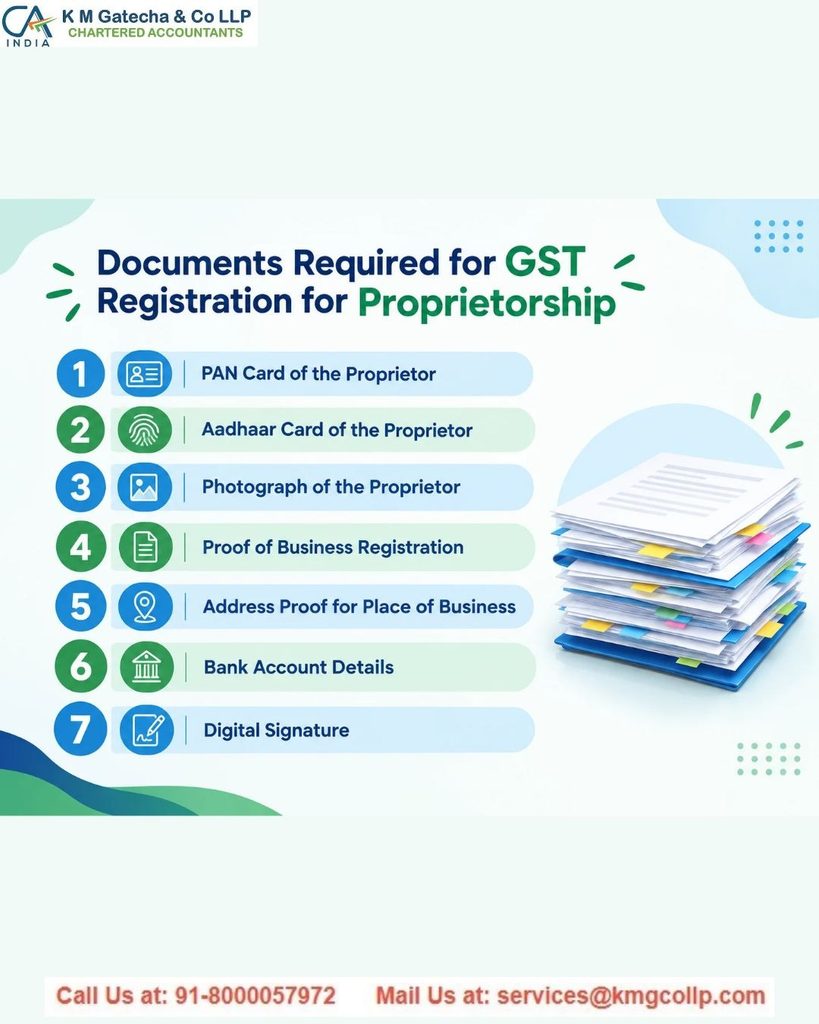
Documents Required for eCommerce GST Registration
The documents required for GST registration are generally similar to those required for other businesses. The exact checklist depends on the legal structure, business address, and details of the application.
For Sole Proprietors and Individuals
-
- PAN Card: PAN of the proprietor, which must match the information entered in the application.
-
- Aadhaar Card: Aadhaar details for identity verification and authentication, where applicable.
-
- Photograph: A recent photograph of the proprietor, if required.
-
- Principal Place of Business Proof: For owned premises, documents such as a property tax receipt, electricity bill, or ownership document may be accepted. For rented premises, a rent or lease agreement and supporting ownership or consent documents may be required. Home-based sellers may provide residential address proof where permitted.
-
- Bank Account Details: Banking documents, such as a cancelled cheque or bank statement, may be required in accordance with the applicable GST portal requirements.
 For Partnership Firms
Partnership firms may need to provide the following documents:
-
- PAN and identity details of the relevant partners or authorised persons, as applicable.
-
- Partnership deed.
-
- Authorisation letter or other proof appointing the authorised signatory.
-
- Proof of the principal place of business.
-
- Other supporting documents required by the GST portal.
For Companies and Limited Liability Partnerships (LLPs)
Companies and LLPs may need to submit the following documents:
-
- PAN Card: PAN of the company or LLP.
-
- Identity Details: PAN and Aadhaar details of directors or designated partners, as applicable.
-
- Certificate of Incorporation: Issued by the Ministry of Corporate Affairs.
-
- MOA and AOA: Memorandum of Association and Articles of Association for companies, where applicable.
-
- LLP Agreement: For limited liability partnerships.
-
- Authorisation Document: Board resolution, letter of authorisation, or another applicable document appointing the authorised signatory.
-
- Registered Office Proof: Documents supporting the address of the registered office, along with ownership, tenancy, or consent documents where required.
Applicants should check the latest requirements on the official GST portal before submitting their applications, as the documents and verification procedures may vary by applicant category.
Additional Tips for eCommerce Sellers
Choose the Correct HSN or SAC Codes: Select the appropriate HSN codes for goods and SAC codes for services. Incorrect classification may result in tax-rate errors and discrepancies in GST returns, including GSTR-1. Check the applicable classification and tax rate before submitting your registration application.
Understand Multi-State Warehouse Requirements: If you use fulfilment services such as Amazon FBA or Flipkart Fulfilment, your inventory may be stored in warehouses across multiple states. Depending on the business arrangement and applicable GST provisions, holding stock or making supplies from another state may require separate GST registration in that state.
Understanding TCS and Its Impact on eCommerce Sellers
Under Section 52 of the CGST Act, eCommerce operators covered by the TCS provisions must collect tax at source on the applicable net value of taxable supplies made through their platforms by other suppliers.
The applicable TCS rate should be verified against the current GST provisions. Where the rate is 0.5%, it is generally divided into 0.25% CGST and 0.25% SGST or UTGST for intra-state supplies, or collected as IGST for inter-state supplies, as applicable.
How TCS Works in Practice
Suppose a registered seller makes ₹1,00,000 in eligible net taxable supplies through an eCommerce platform during a month. If TCS applies at 0.5%, the operator collects ₹500, subject to the statutory calculation and applicable adjustments, and deposits the amount with the government.
The collected amount is reported through the applicable TCS mechanism and reflected in the seller’s electronic cash ledger or relevant GST records, subject to the prescribed procedures. The seller can use the available balance to discharge eligible GST liabilities in accordance with the rules.
TCS is generally not an additional tax on the seller’s sales. It is an amount collected and deposited on the seller’s behalf under the GST framework. However, sellers should reconcile their marketplace settlements, sales records, and GST records regularly to identify discrepancies.
TCS requirements are governed by Section 52 of the CGST Act. The registration obligations of individual sellers and eCommerce operators must be assessed separately, as the rules do not make GST registration compulsory for every online seller in every circumstance.
Do eCommerce Sellers Need Multi-State GST Registration?
Multi-state GST registration is an important consideration for online sellers who store inventory or conduct business through warehouses in different states.
A seller may need a separate GST registration in each state where the business has a place of business or is otherwise required to register under the applicable provisions. The requirement depends on the nature of the business operations, the location of inventory, and the relevant GST rules.
Example
Suppose a seller operates from Jaipur, Rajasthan, and uses a fulfilment service that stores inventory in Maharashtra, Karnataka, and Tamil Nadu.
If the arrangements establish taxable business locations or otherwise trigger registration requirements in those states, the seller may need GST registrations in Rajasthan, Maharashtra, Karnataka, and Tamil Nadu.
However, the requirement should be assessed based on the actual warehousing and supply arrangements. Using a third-party fulfilment service does not, by itself, establish every registration obligation in all circumstances.
GST Returns eCommerce Sellers May Need to File
Obtaining GST registration is only the first step. Registered sellers must file the returns applicable to their business and registration category within the prescribed deadlines. Return requirements may vary depending on the filing scheme and the nature of the supplies.
-
- GSTR-1: Reports outward supplies. Eligible monthly filers generally submit it by the 11th of the following month, while quarterly filers follow the applicable QRMP deadlines.
-
- GSTR-3B: Summarises supplies, input tax credit, and tax liability. Monthly filers generally submit it by the 20th of the following month. Eligible quarterly filers follow the applicable QRMP schedule.
-
- GSTR-9: The annual return for taxpayers required to file it. Where applicable, it is generally due by 31 December following the relevant financial year, subject to any notified extensions or exemptions.
-
- GSTR-8: Filed by eCommerce operators required to collect TCS under Section 52. Individual sellers do not file GSTR-8 merely because they sell through an online marketplace.
Sellers should reconcile their sales records, GSTR-1, GSTR-3B, marketplace statements, and relevant GST records regularly. This helps identify mismatches and resolve them before they create compliance issues.
Filing obligations, due dates, and exemptions should be checked against the current GST rules and notifications.
Conclusion
GST registration and compliance are important considerations for eCommerce businesses selling in India. Whether registration is compulsory depends on the seller’s business activities, turnover, type of supplies, and eligibility for any applicable exemption. Certain eCommerce operators and suppliers must register under specific provisions, while qualifying small sellers may be eligible for relief.
Before selling through platforms such as Amazon, Flipkart, or Meesho, businesses should confirm their registration requirements, prepare the necessary documents, and understand their ongoing GST obligations.
Disclaimer: The content on this website is for informational purposes only and does not constitute legal, financial, or professional advice. Please consult qualified experts before acting on any information. K M GATECHA & CO LLP accepts no liability for errors, omissions, or outcomes from the use of this content. This site is not an advertisement or solicitation.

