GST Registration Process for Pvt Ltd: A Complete, Hassle-Free Guide
GST Registration Process for a Pvt Ltd Company: Complete 2026 Guide
Businesses operating in India must comply with the tax laws and regulations applicable to their activities. Whether an organization operates as a private limited company, public limited company, partnership firm, sole proprietorship, or limited liability partnership (LLP), it must understand and meet its relevant tax obligations.
The Goods and Services Tax (GST) is India’s indirect tax system governing the supply of most goods and services. Registration requirements depend on factors such as aggregate turnover, the nature of business activities, and specific provisions under GST law.
A private limited company is a popular business structure among startups and growing enterprises. It is a separate legal entity, and its shares are subject to restrictions on transfer under company law. A private company can generally have up to 200 members, subject to applicable legal provisions.
This guide explains the GST registration process for a private limited company in India, including eligibility criteria, the benefits of registration, the application procedure, and post-registration compliance requirements.
Overview of GST Registration for Private Limited Companies
GST registration enables an eligible business to obtain a unique identification number, comply with applicable tax obligations, and collect GST on taxable supplies where required.
The general turnover thresholds for GST registration are:
- ₹40 lakh for eligible suppliers exclusively dealing in goods in many states, subject to applicable conditions and exceptions.
- ₹20 lakh for service providers in many states.
- Lower thresholds may apply in certain states and circumstances.
These limits are not universal. The applicable threshold depends on the state, the nature of supplies, and the relevant GST provisions. Certain businesses may also be required to register regardless of turnover, while specific exemptions are available in some cases.
Once registration is granted, the company receives a Goods and Services Tax Identification Number (GSTIN), a unique 15-digit number used to identify the registered taxpayer. The company must then comply with the GST requirements applicable to its business and registration status.
What Is GST and Why Is It Important for Pvt Ltd Companies?
The Goods and Services Tax (GST) is a destination-based indirect tax introduced in India on 1 July 2017. It replaced several earlier indirect taxes, including central excise duty, service tax, and state-level value-added tax (VAT), for many categories of goods and services.
GST is generally levied at different stages of the supply chain, with eligible businesses able to claim Input Tax Credit (ITC) on qualifying purchases, subject to prescribed conditions. The ultimate tax burden generally falls on the final consumer.
For private limited companies, GST registration can be important for both legal compliance and business operations.
Key advantages include:
- Legal Compliance: Companies required to register can meet their statutory GST obligations and reduce the risk of penalties for non-compliance.
- Input Tax Credit: Eligible registered businesses can claim credit for GST paid on qualifying business purchases, subject to applicable rules.
- Simplified Tax Administration: The GST system provides an online framework for registration, return filing, and tax payments.
- Business Opportunities: GST registration can help companies work with GST-registered customers, suppliers, and business partners.
- Interstate Transactions: Registration helps businesses meet applicable GST requirements when supplying goods or services across state boundaries.
- E-commerce Operations: Depending on the business model and applicable rules, GST registration may be necessary for selling through online marketplaces.
GST registration is not automatically mandatory for every private limited company. Businesses should assess their turnover, supplies, and applicable exemptions before applying. Once registered, they must also understand the ongoing filing, invoicing, and tax payment responsibilities associated with their GSTIN.
Benefits of GST Registration for Pvt Ltd Companies in India
GST registration offers several benefits to Private Limited companies in India, particularly those required to register under applicable GST laws. Key advantages include:
- Legal Compliance: Helps businesses meet their GST obligations and avoid applicable penalties for non-compliance.
- Input Tax Credit (ITC): Eligible businesses can claim credit for GST paid on qualifying purchases, subject to applicable conditions, reducing their overall tax liability.
- Improved Business Credibility: Maintaining proper GST records and filing returns on time can strengthen a company’s credibility with customers, suppliers, and business partners.
- Reduced Cascading Effect of Taxes: The input tax credit mechanism helps reduce the tax-on-tax effect by allowing eligible businesses to offset GST paid on inputs against GST payable on supplies.
- Greater Business Opportunities: GST registration can help companies work with GST-registered clients, larger enterprises, and suppliers that require compliant tax documentation.
- Simplified Online Compliance: The GST portal enables businesses to complete registration-related activities, file returns, and make tax payments online.
- Transparent Supply Chain: GST invoicing and reporting requirements encourage accurate documentation and improve transaction transparency.
- Access to Interstate Markets: GST registration can facilitate interstate business operations where registration is required under applicable GST provisions.
- Improved Financial Record-Keeping: GST invoices, returns, and tax records help businesses maintain organized financial documentation and support accounting processes.
- Better Cash Flow Planning: Input tax credit, where available, and proper tax management can help businesses plan their working capital more effectively.
Note: GST registration does not automatically guarantee a better credit rating, lower taxes, or improved cash flow. These benefits depend on the company’s business model, eligibility for input tax credit, and compliance practices.
GST Registration Documents for a Pvt Ltd Company
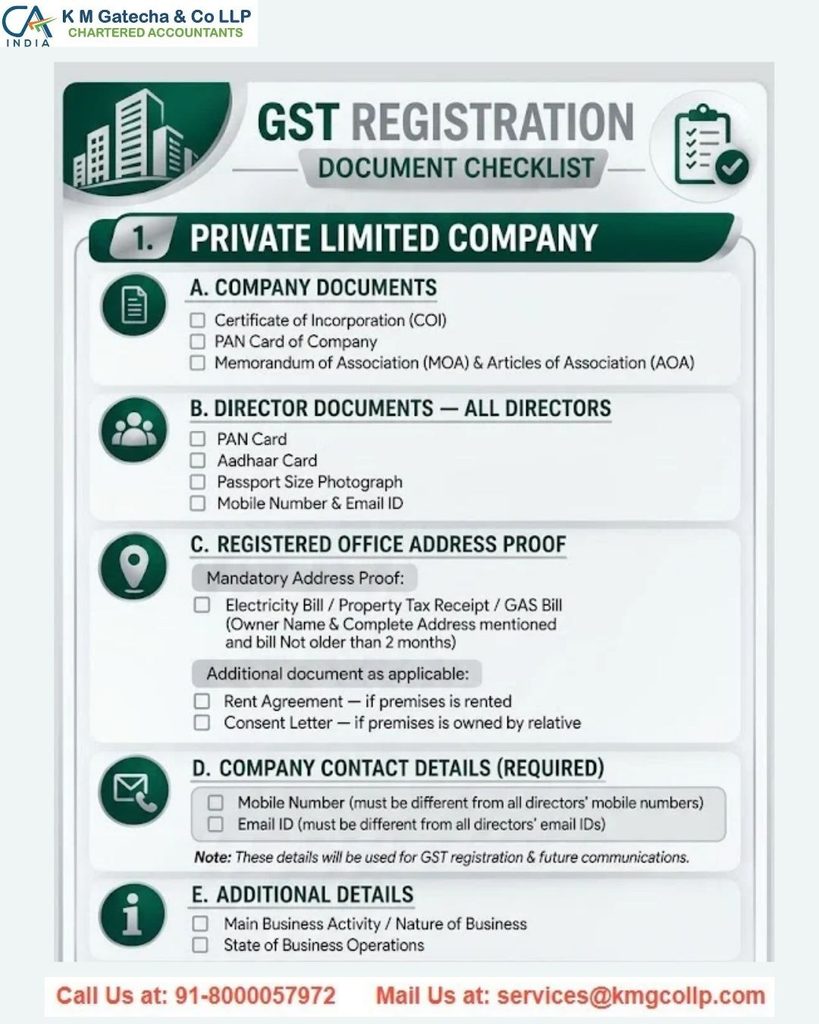
Before applying for GST registration, a Private Limited company should prepare the relevant business, identity, address, and authorization documents. The exact requirements may vary depending on the company’s circumstances and the nature of its business.
Essential Documents for GST Registration
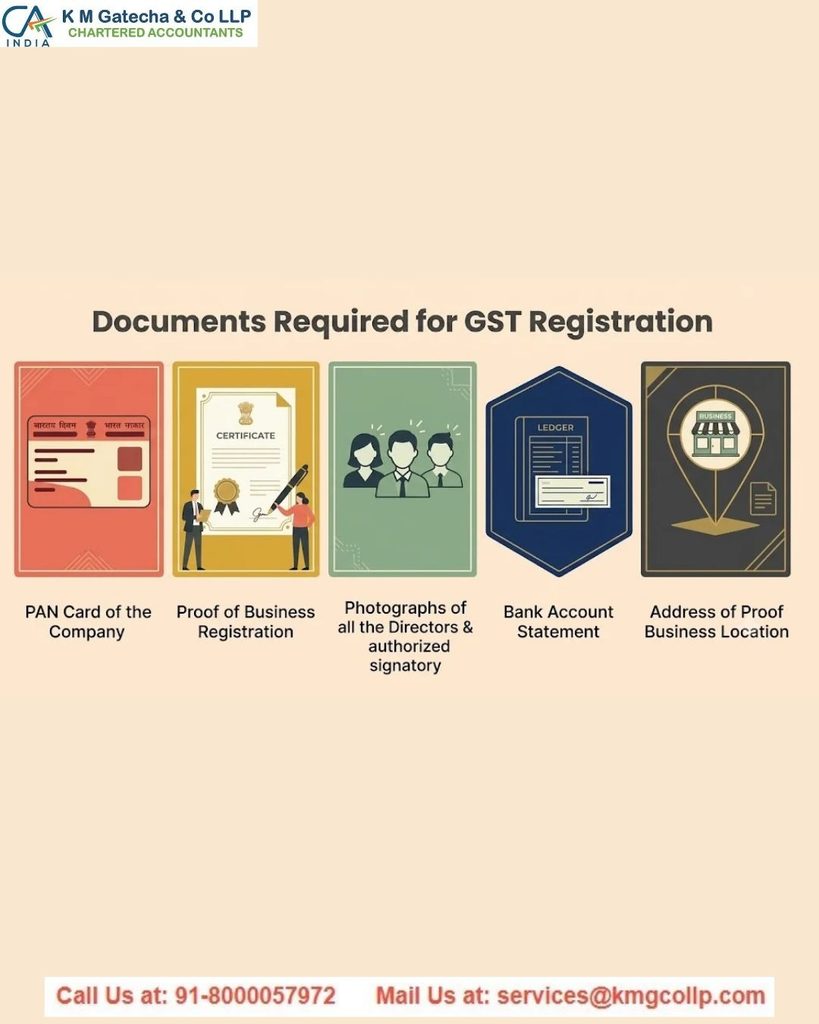
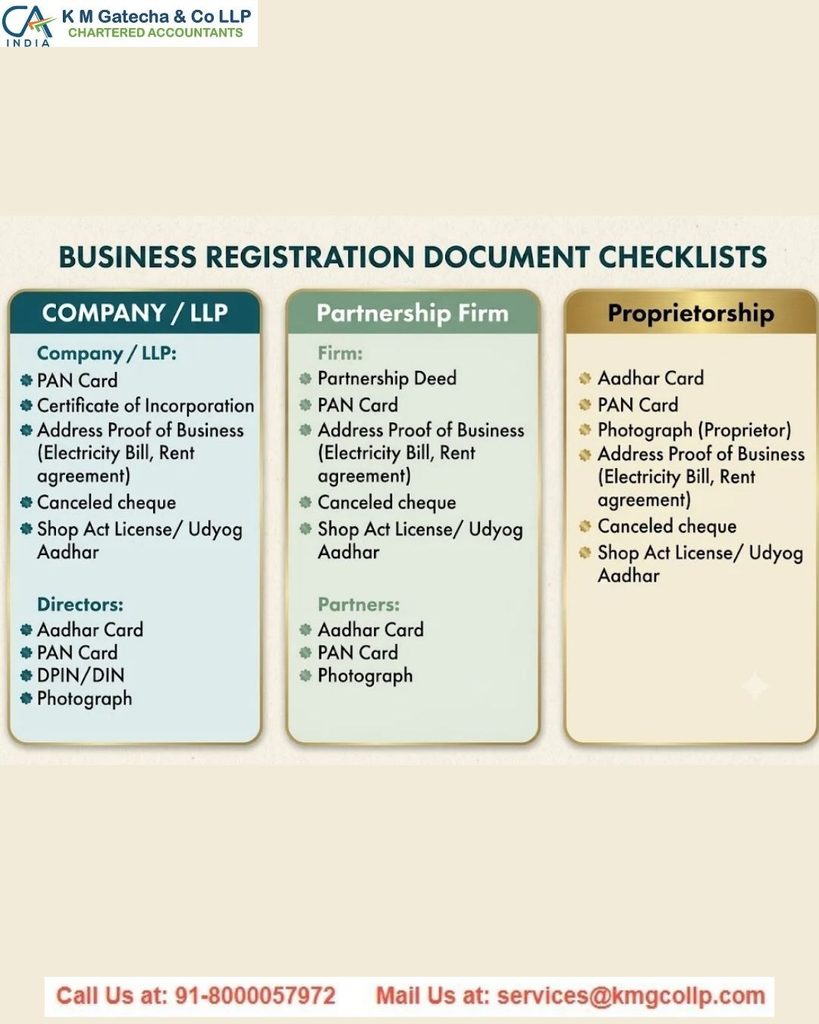
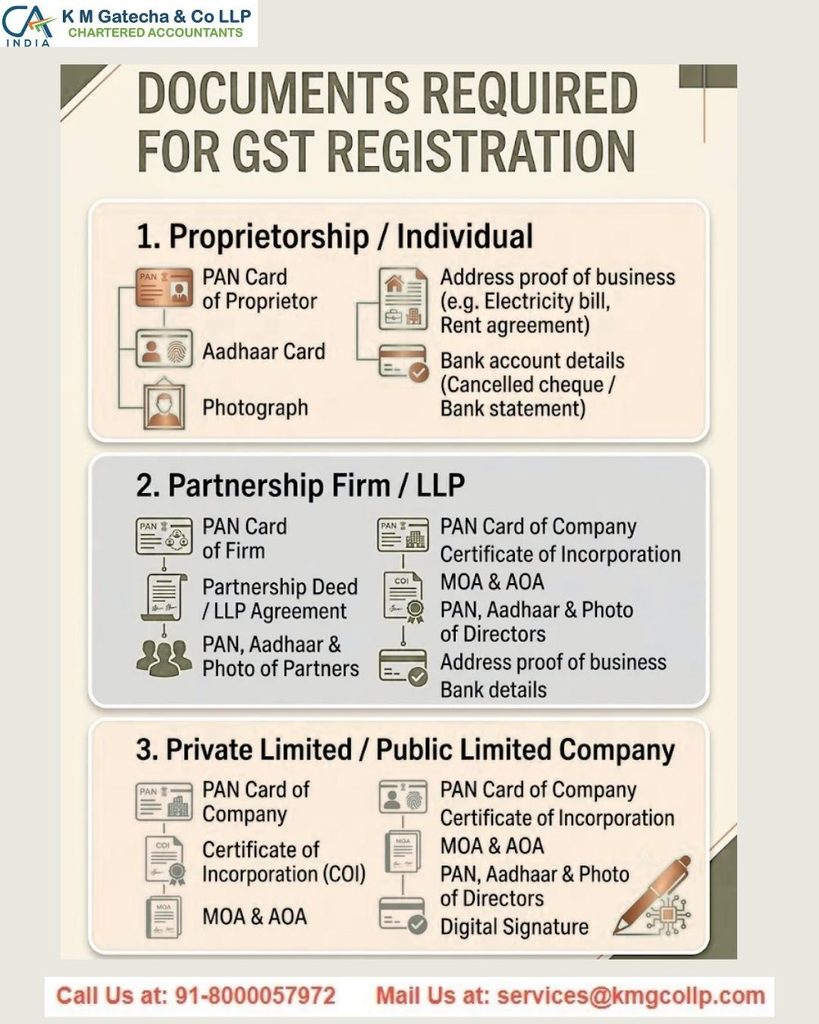
- Company PAN Card: The company’s Permanent Account Number (PAN) is mandatory for GST registration.
- Certificate of Incorporation: The certificate issued by the Ministry of Corporate Affairs (MCA) serves as proof of the company’s legal incorporation.
- Memorandum and Articles of Association (MOA/AOA): These documents describe the company’s objectives, internal governance, and operational framework. They may be required where applicable.
- Identity and Address Proof of Directors and Authorized Signatory: PAN and other prescribed identity or address documents, such as Aadhaar or a passport where applicable, may be required for verification.
- Proof of Business Address: Depending on the premises arrangement, acceptable documents may include:
- An electricity bill, water bill, or other prescribed utility bill.
- A rent or lease agreement for rented premises.
- Ownership documents or other acceptable proof for owned premises.
- A No Objection Certificate (NOC) from the property owner, where applicable.
- For more details, refer to this guide on address proof for GST registration.
- Bank Account Details: Bank account information may be required during or after registration, depending on the applicable rules and stage of the process. Supporting documents can include a cancelled cheque, bank statement, or passbook showing the relevant account details.
- Board Resolution or Authorization Letter: A board resolution or authorization document may be needed to appoint the person responsible for handling GST-related matters on behalf of the company.
- Photographs: Photographs of the relevant directors or authorized signatory may be required as prescribed by the GST registration process.
- Additional Business Registration Documents: Depending on the company’s activities, supporting registrations or licenses may be useful or required under other applicable laws. These may include a trade license, Shop and Establishment registration, or MSME registration, where applicable.
- Digital Signature Certificate (DSC): A valid DSC is generally required for a Private Limited company to authenticate and submit its GST registration application electronically.
- Proof of Business Activities, Where Required: Additional supporting documents, such as invoices, purchase orders, or other business records, may be requested if necessary to clarify the nature of the company’s activities.
Preparing the relevant documents in advance can help reduce errors, prevent avoidable delays, and make the GST registration process smoother. Before submitting the application, verify the latest document requirements on the official GST portal and ensure that the company details match the records held by the MCA and other relevant authorities.
GST Registration Steps for Pvt Ltd Companies: How to Register for GST
A Private Limited company can apply for GST registration online through the official GST portal. The process involves submitting company details, providing the required documents, and completing the verification process.
Step 1: Visit the Official GST Portal
- Visit the official GST portal.
- Navigate to Services → Registration → New Registration to begin the application.
- Keep the company’s PAN, contact details, and other relevant information ready.
Step 2: Complete the Initial Registration
- Select the appropriate taxpayer category and enter the required details, including the company’s legal name, PAN, state, and district.
- Provide a valid mobile number and email address for communication.
- Verify the contact details using the OTPs sent to the registered mobile number and email address.
After successful verification, the portal generates a Temporary Reference Number (TRN), which can be used to continue the registration application.
Step 3: Complete the GST Registration Application (GST REG-01)
Log in to the GST portal using the TRN and complete the remaining sections of Form GST REG-01. Enter accurate information about the company, including:
- Legal name and PAN of the company.
- Business constitution and principal business activities.
- Details of directors and the authorized signatory.
- Principal place of business and additional places of business, where applicable.
- Bank account and other details requested by the portal.
Step 4: Upload the Required Documents
Upload the supporting documents requested in the application. These may include:
- Company PAN and Certificate of Incorporation.
- Identity and address details of the directors and authorized signatory, as applicable.
- Proof of the principal place of business, such as a utility bill, rent agreement, or ownership document.
- An NOC or consent document from the property owner, where required.
- Board resolution or authorization letter for the authorized signatory.
- Bank account proof, if requested at the relevant stage of registration.
Ensure that the documents are legible and that the information matches the company’s official records.
Step 5: Submit and Verify the Application
- Review the application carefully before submitting it.
- Authenticate the application using the method applicable to the company. Private Limited companies generally need a valid Digital Signature Certificate (DSC) to submit the application.
- After submission, the portal generates an Application Reference Number (ARN) that can be used to track the application status.
- A GST officer may review the application and request additional documents or clarification if necessary. Respond within the specified time to avoid delays.
Step 6: Receive the GSTIN
Once the application is approved, the company receives its GST registration certificate and Goods and Services Tax Identification Number (GSTIN).
The GSTIN is a unique 15-character alphanumeric identification number assigned to a registered taxpayer in India. It must be used for applicable GST invoices, returns, and other tax-related activities.
Step 7: Track the Application and Complete Registration
- Check the application status regularly through the GST portal.
- Respond promptly to any notice or clarification request from the GST department.
- After approval, download the GST registration certificate and verify the details, including the legal name, GSTIN, and registered business address.
How long does GST registration take?
The processing time depends on the accuracy and completeness of the application, document verification, and whether the GST department requests further information. Some applications may be approved within a few working days, while others can take longer. Therefore, a fixed turnaround time of 7–10 working days should not be treated as guaranteed.
Cost of GST Registration for Pvt Ltd Companies
The cost of GST registration depends on whether the company applies independently or seeks professional assistance.
- Government Fee: There is no government application fee for obtaining GST registration through the official GST portal.
- Professional Assistance Charges: A company may choose to hire a chartered accountant, tax consultant, or other qualified professional to help prepare and submit the application. Professional fees vary according to the scope and complexity of the work.
- Additional Service Costs: If the company uses a third-party service for documentation or business-address solutions, separate charges may apply for those services.
A Private Limited company can apply directly through the official GST portal without paying a government registration fee.
Post-GST Registration Requirements for Pvt Ltd Companies
Obtaining a GSTIN is only the first step. After registration, a Private Limited company must follow the GST compliance requirements applicable to its business, turnover, and type of registration.
1. Filing GST Returns
Registered businesses must file the GST returns applicable to them within the prescribed deadlines. The frequency and type of return depend on the company’s eligibility and registration category.
- Quarterly Return Filing and Monthly Payment of Taxes (QRMP) Scheme: Eligible taxpayers with aggregate annual turnover of up to ₹5 crore can generally opt to file GSTR-1 and GSTR-3B quarterly while paying tax monthly, subject to the scheme’s conditions.
- Monthly Filing: Taxpayers who are not eligible for or have not opted into the QRMP Scheme generally follow the applicable monthly filing requirements.
- Other Returns: Additional returns or statements may apply depending on the nature of the company’s transactions and activities.
Refer to the official GST return filing guidance for further information.
Companies should monitor filing deadlines carefully because late filing can result in applicable late fees, interest, and other consequences.
2. Issuing GST-Compliant Invoices
A registered company must issue tax invoices or other prescribed documents, as applicable, for its taxable supplies. A GST tax invoice generally includes:
- Supplier’s name, address, and GSTIN.
- A consecutive invoice number and invoice date.
- Recipient’s name, address, and GSTIN or UIN, where applicable.
- Description, quantity, and value of goods or services, as applicable.
- Taxable value and applicable tax rates and amounts.
- Place of supply and state details for interstate supplies, where required.
- Other particulars prescribed under the GST rules.
Depending on the transaction, the invoice may need to show CGST and SGST/UTGST or IGST. Businesses should follow the invoicing requirements relevant to their supplies.
3. Maintaining GST Records
Private Limited companies should maintain accurate and complete records to support their GST returns, tax payments, and input tax credit claims. These records may include:
- Sales and purchase registers.
- Tax invoices, bills of supply, debit notes, and credit notes.
- Records of input tax credit claimed and reversed.
- GST returns and tax payment records.
- E-way bills and other transportation documents, where applicable.
- Stock, production, and other prescribed business records, where relevant.
Under GST law, records generally need to be retained for 72 months (six years) from the due date of filing the annual return for the relevant year. A longer retention period may apply in cases involving appeals, investigations, or other proceedings, as prescribed by law.
Maintaining organized records and reconciling them regularly can help a company meet its GST obligations and reduce the risk of errors or compliance issues.
Common Issues and Troubleshooting in GST Registration
During the GST registration process, a Private Limited company may encounter application errors, document discrepancies, or processing delays. Identifying these issues early and taking corrective action can help prevent unnecessary complications.
Common Reasons for GST Registration Rejection or Delays
Some common issues that may affect a GST registration application include:
- Incorrect Application Details: Errors in the company’s legal name, PAN, business address, or director details may lead to verification issues.
- Incomplete or Mismatched Documents: Missing documents, unclear uploads, or inconsistencies between the application and supporting records may delay processing.
- Business Address Verification Issues: Insufficient proof of ownership, tenancy, or permission to use the business premises may result in queries from GST authorities.
- Non-Compliance with Registration Requirements: Failure to meet applicable eligibility or documentation requirements can affect the application outcome.
- Pending Clarifications: Delays may occur if the applicant does not respond to a notice or request for additional information within the prescribed timeframe.
How to Resolve GST Registration Issues
Companies can take the following steps to reduce errors and address registration-related problems:
- Verify All Details: Check the company’s PAN, legal name, business address, and other information against official records before submitting the application.
- Submit Complete Documents: Ensure that all required documents are uploaded in the prescribed format and are clear and legible.
- Check Business Address Proof: Confirm that the documents adequately establish the company’s right to use the declared premises.
- Respond to GST Notices Promptly: Review requests for clarification on the GST portal and submit the required explanation or supporting documents within the specified deadline.
- Correct Errors Where Permitted: If a discrepancy is identified, follow the correction or resubmission procedure specified by the GST portal or the relevant GST authority.
What to Do If GST Registration Is Delayed
If the application remains pending, the company should check its status and determine whether any action is required.
- Track the Application: Use the Application Reference Number (ARN) on the official GST portal to check the current status.
- Review Pending Actions: Check for notices, verification requests, or additional document requirements.
- Contact the GST Helpdesk: If the status does not provide sufficient information, contact the official GST helpdesk or the relevant GST officer for assistance.
- Keep Supporting Records Ready: Retain the ARN, acknowledgment, submitted application, and supporting documents for reference during follow-up.
Processing times may vary depending on verification requirements and the circumstances of the application. If an application is rejected, review the stated reasons and follow the applicable procedure for addressing the rejection or submitting a fresh application, as appropriate.
By preparing accurate information, submitting the correct documents, and responding promptly to GST department requests, Private Limited companies can reduce avoidable delays and complete the registration process more smoothly.
Conclusion
GST registration is an important compliance requirement for Private Limited companies in India when they meet the applicable registration criteria. By understanding the GST registration process, preparing the required documents, and submitting accurate information, businesses can obtain their GSTIN and meet their tax obligations more efficiently.
Proper GST registration helps eligible companies claim input tax credit, maintain transparent financial records, and conduct business in accordance with applicable GST regulations. After registration, companies should also ensure timely return filing, issue GST-compliant invoices, pay taxes when due, and maintain the required records.
Disclaimer: The content on this website is for informational purposes only and does not constitute legal, financial, or professional advice. Please consult qualified experts before acting on any information. K M GATECHA & CO LLP accepts no liability for errors, omissions, or outcomes from the use of this content. This site is not an advertisement or solicitation.