

GST Registration Process for Private Limited Company: A Complete Guide
For startups and growing businesses in India, GST registration is an important tax compliance step after incorporating a private limited company. Depending on the nature of its business and applicable GST rules, registration enables a company to collect GST on taxable supplies, claim Input Tax Credit (ITC) on eligible purchases, and meet its tax obligations when operating across states or through online marketplaces.
However, getting the application right is essential. Errors in company details, business address documents, or authorized signatory information can lead to clarification requests, processing delays, or rejection.
GST registration is completed online through the official GST portal. Once the application is approved, the company receives a Goods and Services Tax Identification Number (GSTIN). It must then comply with the GST requirements applicable to its business, including invoicing, tax payments, and return filing.
This guide explains the GST registration process for a private limited company, covering eligibility, compulsory registration, required documents, application steps, and common mistakes to avoid.
Key Takeaways
- GST registration is mandatory for private limited companies that cross the applicable turnover threshold or fall under a category requiring registration.
- The general turnover threshold is ₹40 lakh for eligible suppliers exclusively dealing in goods and ₹20 lakh for service providers, subject to state-specific rules and other conditions.
- Interstate supplies and e-commerce activities do not automatically make registration compulsory in every case; applicable exemptions and special provisions must be considered.
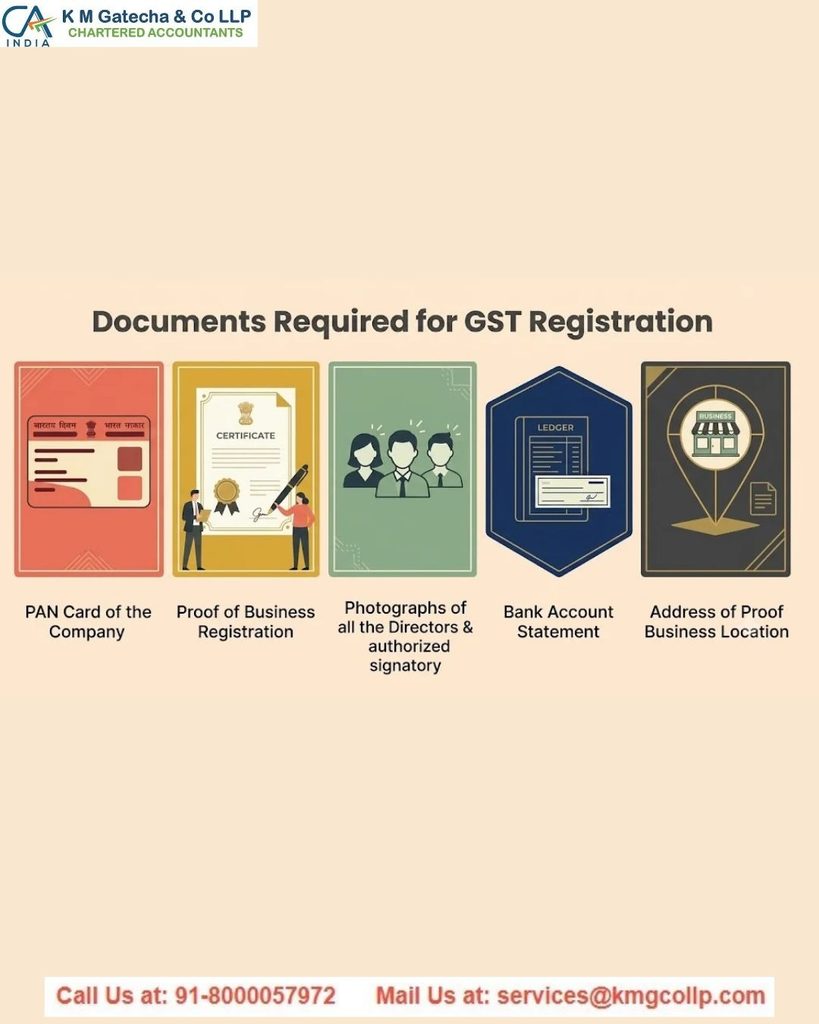
- Essential documents generally include the company’s PAN, Certificate of Incorporation, business address proof, and authorized signatory details.
- Applications are submitted online and can be tracked using the Application Reference Number (ARN).
- Once registered, the company must meet the GST compliance obligations applicable to its business and registration status.
Is GST Registration Mandatory for a Private Limited Company?
A private limited company must obtain GST registration when it meets the applicable registration criteria under the Central Goods and Services Tax Act and related rules. The requirement depends on its aggregate turnover, the type of supplies it makes, the states in which it operates, and whether any compulsory registration provisions apply.
Mandatory vs. Voluntary GST Registration
GST registration generally becomes mandatory when a company’s aggregate turnover exceeds the applicable threshold or when its activities fall within a category for which registration is compulsory.
The general turnover thresholds are:
- ₹40 lakh for eligible businesses supplying goods: This threshold applies in many states to businesses exclusively engaged in supplying goods, subject to prescribed conditions and exceptions.
- ₹20 lakh for service providers: This is the general threshold in many states, although lower limits apply in certain states and circumstances.
Aggregate turnover is calculated at the all-India level for a person having the same PAN and generally includes taxable supplies, exempt supplies, exports, and interstate supplies, as specified under GST law.
Some companies also opt for voluntary GST registration before crossing the applicable threshold. This may be useful when dealing with GST-registered business customers, seeking eligible Input Tax Credit, or meeting commercial requirements imposed by clients and suppliers.
However, voluntary registration also brings ongoing compliance responsibilities. A company should assess the costs and benefits before applying.
Common Situations Where GST Registration May Be Compulsory
Even when a company has not crossed the applicable turnover threshold, registration may be required in certain circumstances.
Common situations to evaluate include:
- Turnover exceeding the applicable threshold: Registration is generally required when aggregate turnover crosses the relevant limit.
- Interstate taxable supplies: Certain interstate supplies can trigger compulsory registration, although specific exemptions and exceptions apply.
- E-commerce activities: Businesses selling through e-commerce operators may need registration depending on the goods or services supplied, the role of the platform, and the applicable provisions. Certain eligible suppliers benefit from specific exemptions subject to conditions.
- Specified categories of businesses: Certain persons and activities are covered by compulsory registration provisions under GST law.
- Other business-specific circumstances: Registration requirements may depend on the company’s supply model, place of business, and other applicable legal provisions.
A company should not assume that every interstate transaction or online sale automatically requires GST registration. The relevant statutory provisions and exemptions should be checked before deciding whether registration is mandatory.
Eligibility and Prerequisites Before Applying
Before beginning the GST registration process, a private limited company should confirm that its business information and supporting documents are ready. Preparing these details in advance can reduce errors and help avoid unnecessary clarification requests.
Information to Finalize Before Applying
The company should prepare the following information:
- Business activities: Identify whether the company is engaged in manufacturing, trading, services, or a combination of activities.
- HSN and SAC codes: Identify the relevant Harmonized System of Nomenclature (HSN) codes for goods and Service Accounting Codes (SAC) for services.
- Principal place of business: Finalize the business address and ensure that the supporting documents establish the company’s right to use the premises.
- Authorized signatory details: Decide who will represent the company for GST registration and subsequent compliance.
- Company records: Keep the company’s PAN, Certificate of Incorporation, and other relevant incorporation details available.
- Banking information: Keep the company’s bank account details ready for the applicable post-registration or compliance requirements.
The company should also ensure that the information entered in the application matches its official records.
Who Can Apply for GST Registration on Behalf of the Company?
A GST registration application may be completed by a director or another individual duly authorized to act on behalf of the company.
The authorized representative may include:
- A company director: A director can act as the authorized signatory if appropriately designated.
- An authorized signatory: Another individual, such as an employee or professional representative, may handle the application when authorized by the company.
If someone other than a director is appointed as the authorized signatory, the company should prepare the appropriate authorization documents, such as a board resolution or letter of authorization, as applicable.
The authorized signatory’s details must be entered accurately, and the required verification and digital signature procedures must be completed in accordance with the GST portal’s current requirements.
Documents Required for GST Registration for a Private Limited Company
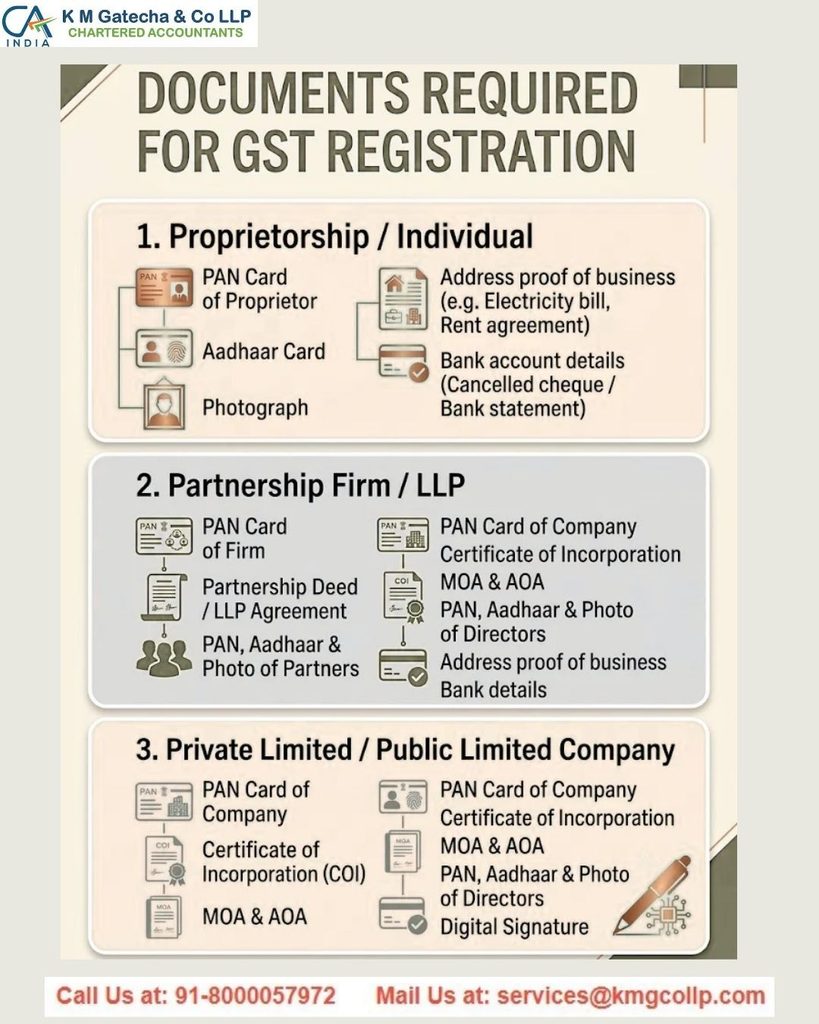
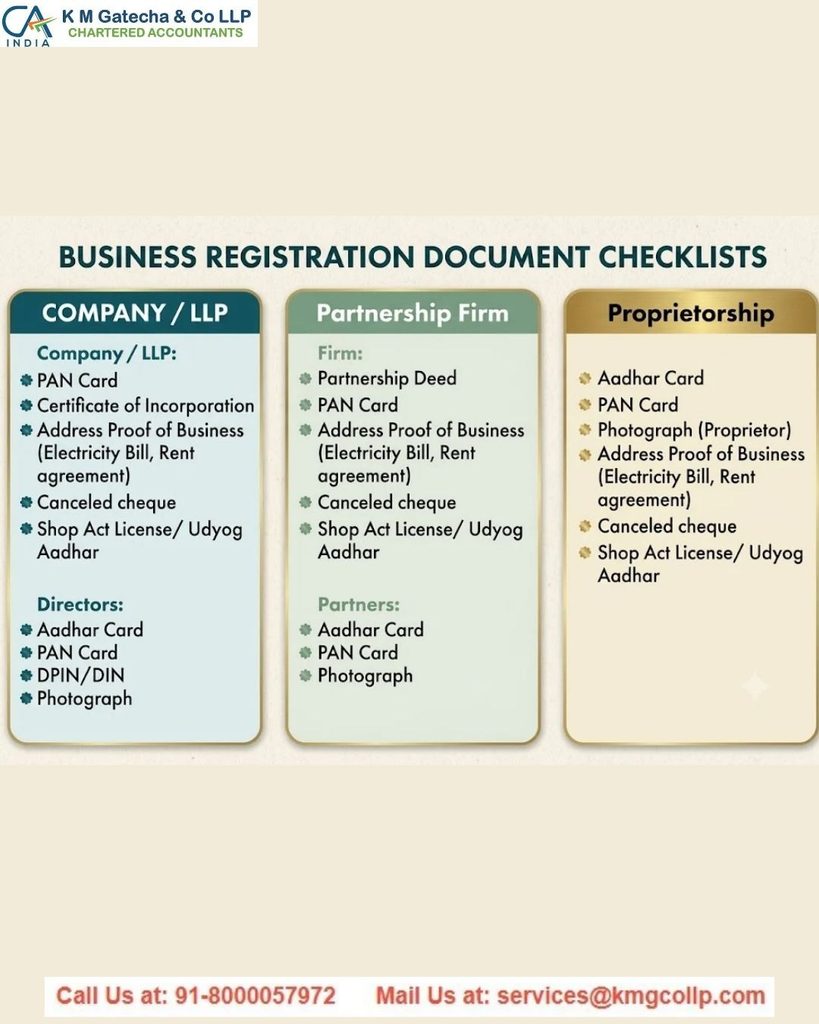
A private limited company must prepare the relevant company records, identity details, authorization documents, and proof of its principal place of business before applying for GST registration. Having these documents ready can help minimize errors and reduce the chances of receiving clarification requests from the GST department.
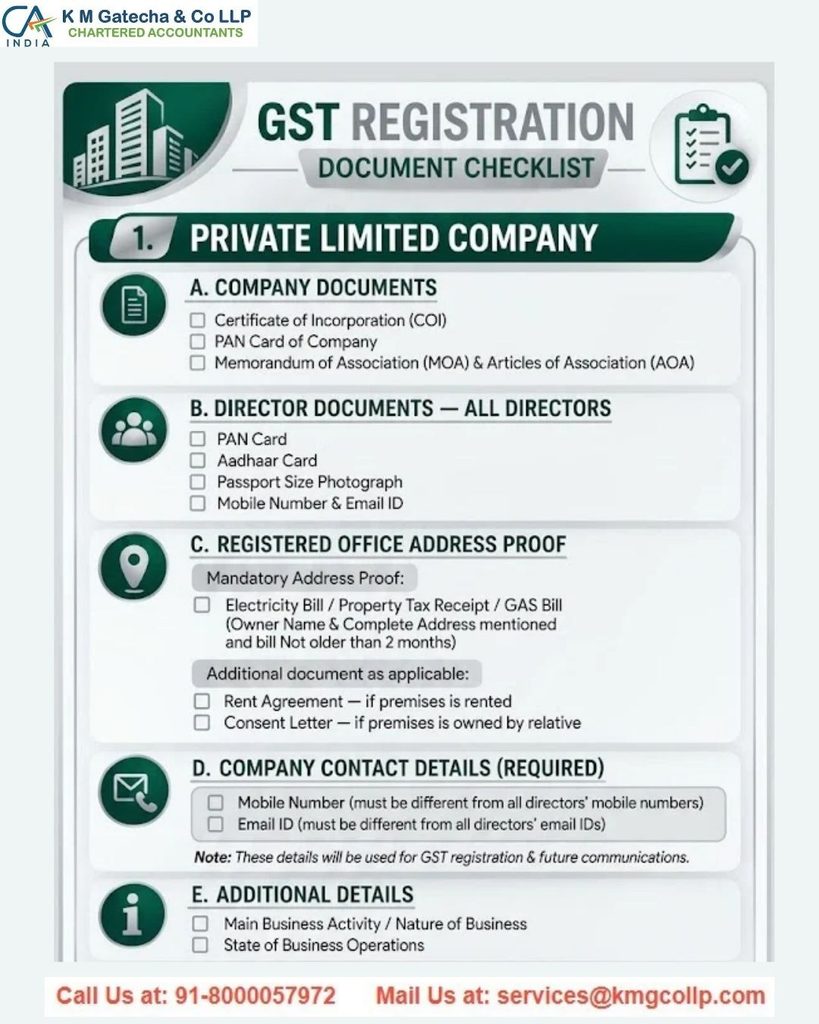
Company Documents
The following company-level documents are commonly required for GST registration:
- Certificate of Incorporation: Issued by the Ministry of Corporate Affairs (MCA), this confirms the company’s legal incorporation.
- PAN Card of the Company: The company’s PAN is essential for GST registration and must match the official company records.
- Memorandum of Association (MOA): Describes the company’s objectives and scope of activities.
- Articles of Association (AOA): Sets out the company’s internal management rules and governance framework.
- Proof of Business Address: Documents establishing the company’s principal place of business, depending on the premises arrangement.
Authorized Signatory and Director Documents
The company must provide the relevant information for its directors and authorized signatory, as requested during the application process.
Commonly required details include:
- PAN and Aadhaar Details: Identification information for the relevant individuals, subject to applicable verification requirements.
- Recent Photograph: A photograph of the authorized signatory or other individuals where requested.
- Email Address and Mobile Number: Contact details used for communication and verification.
- Proof of Authorization: A board resolution or letter of authorization, where applicable, confirming the individual’s authority to represent the company.
The authorized signatory handles relevant GST registration activities and may manage subsequent compliance tasks on behalf of the company.
Principal Place of Business Address Proof
The documents required to establish the principal place of business depend on whether the premises are owned, rented, leased, or shared.
If the Office Is Owned
Depending on the circumstances, the company may provide:
- Property tax receipt or sale deed.
- Electricity bill or another acceptable utility bill.
- Municipal records or other ownership documents.
These documents help establish the location and the company’s right to use the premises.
If the Office Is Rented or Leased
For rented or leased premises, the company may need:
- Rent or Lease Agreement: Establishes the company’s right to occupy or use the premises.
- Electricity Bill or Other Address Proof: Supports the declared business address.
- No Objection Certificate (NOC) or Consent Letter: May be required depending on the circumstances and supporting documents provided.
If You Use a Virtual Office or Co-working Space
Startups sometimes use virtual offices or shared workspaces as their business address. In such cases, the company should ensure that the arrangement meets the applicable GST requirements.
Documents may include:
- Virtual office agreement, lease agreement, or allotment letter.
- Property address proof.
- Consent letter or NOC from the property owner or service provider, where applicable.
- Other supporting documents requested by the GST department.
The company must be able to substantiate its declared principal place of business. Merely obtaining an address service does not automatically guarantee GST registration approval.
Bank Account Proof
Bank account details may be required under the applicable GST registration and post-registration procedures. Supporting documents can include:
- Cancelled cheque.
- Bank statement.
- First page of the bank passbook, where applicable.
Ensure that the account details are accurate and that the account belongs to the company. Bank account details have generally not been mandatory at the initial registration application stage, but the company must provide the required details within the applicable prescribed period after registration.
Tips to Avoid GST Registration Delays
Incomplete or inconsistent address documents can lead to additional verification requests. To reduce this risk:
- Ensure that the business address matches the supporting documents.
- Include the appropriate rent agreement, consent letter, or NOC when applicable.
- Upload clear, readable copies of all required documents.
- Check that the company’s legal name and PAN details are consistent across the application.
- Confirm that the authorized signatory’s details and authorization documents are correct.
Step-by-Step GST Registration Process for a Private Limited Company
GST registration for a private limited company is completed online through the official GST portal. Follow these steps to submit the application.
Step 1: Start a New GST Registration Application
Visit the official GST Portal and navigate to Services → Registration → New Registration.
Select Taxpayer as the applicant type and provide the required state, district, company PAN, email address, and mobile number. Complete the OTP verification to receive a Temporary Reference Number (TRN).
Step 2: Complete the Business Details
Log in using the TRN and complete Part B of Form GST REG-01.
Provide the company’s legal name, trade name if applicable, state and jurisdiction details, and business constitution. Select Private Limited Company as the constitution of business.
Ensure that the company information matches its official incorporation and PAN records.
Step 3: Add Directors and the Authorized Signatory
Enter the required details for the company’s directors and other relevant individuals.
Next, provide the authorized signatory’s information and upload the applicable board resolution or letter of authorization, if required.
The authorized signatory should be correctly designated because this individual will handle relevant GST registration and compliance activities on behalf of the company.
Step 4: Enter the Principal Place of Business
Provide the complete address of the company’s principal place of business, including the applicable location and contact details.
Select the nature of possession, such as owned, rented, leased, or shared, and upload the appropriate supporting documents.
If the company has additional places of business, enter those details where required.
Step 5: Add Goods and Services Details
Specify the goods and services supplied by the company and enter the relevant HSN codes for goods and SAC codes for services, as applicable.
Select the business activities that accurately reflect the company’s operations. Classification and reporting requirements should be checked against the current GST rules.
Bank account details should also be furnished when required under the applicable registration or post-registration process.
Step 6: Verify and Submit the Application
Review all sections of the application before submitting it.
Complete the applicable verification process using a valid Digital Signature Certificate (DSC). A DSC is generally required for private limited companies. Other verification methods, such as EVC, may be available only where permitted under the applicable GST portal rules.
After successful submission, the portal generates an Application Reference Number (ARN). Use the ARN to track the application status.
Step 7: Receive the GSTIN and Download the Registration Certificate
The GST department reviews the application and may request additional information or clarification if necessary. Respond to any notice within the prescribed period.
Once the application is approved, the company receives its 15-digit Goods and Services Tax Identification Number (GSTIN) and can download its GST registration certificate from the portal.
The company should then meet its applicable GST obligations, including issuing compliant tax invoices, paying tax where due, and filing returns from the relevant effective date of registration.
GST Registration for a Private Limited Company Using a Virtual Office
When Can a Virtual Office Be Used?
Many startups and emerging businesses use virtual offices to establish a business address while operating remotely. This arrangement can be useful for companies that do not require a dedicated physical office for their day-to-day operations.
Common situations include:
- Startups operating without a conventional office.
- Businesses with remote or distributed teams.
- Companies seeking a business address for administrative and compliance purposes.
- Businesses using shared workspaces or serviced office facilities.
A virtual office address may be accepted for GST registration if the arrangement meets applicable legal requirements and the company provides adequate supporting documentation. Approval is not automatic, and the GST department may verify the premises or request additional information.
Additional Documents and Best Practices
When applying for GST registration using a virtual office address, consider the following requirements:
- Valid Agreement or Allotment Letter: Keep the virtual office agreement, lease, or allotment letter showing the company’s right to use the premises.
- No Objection Certificate (NOC): Obtain consent from the property owner or authorized service provider when required.
- Address Proof: Maintain acceptable supporting documents, such as an electricity bill or other proof relating to the premises.
- Consistent Address Details: Ensure that the address entered in the GST application matches the supporting documents.
- Provider Documentation: Retain invoices, service agreements, and other records that establish the nature of the arrangement.
Before applying, confirm that the virtual office arrangement satisfies the applicable GST requirements for establishing a principal place of business. The company should be able to substantiate its declared address if the GST department requests verification.
Common GST Registration Errors and How to Avoid Them
Even small errors in a GST registration application can result in clarification requests, processing delays, or rejection. Reviewing the application carefully before submission can help prevent common problems.
Here are some frequent mistakes to avoid:
- Company Name Mismatch: Ensure that the legal name and PAN details match the company’s official records and Certificate of Incorporation.
- Incorrect Authorized Signatory: Verify that the correct individual has been designated and that the required authorization documents are available.
- Address Proof Errors: Check that the declared business address matches the supporting documents and that all uploaded files are clear and readable.
- Incorrect Premises Classification: Select the correct nature of possession, such as owned, rented, leased, or shared.
- Incorrect Business Activity Classification: Choose business activities that accurately reflect the company’s operations and enter the applicable HSN or SAC codes.
- Inconsistent Bank Details: When bank information is required, ensure that the account details and supporting documents correspond to the company.
- Incomplete Application: Review every mandatory field and document before submitting the application.
- Delayed Responses to Notices: If the GST department requests additional information, respond within the prescribed timeframe.
Taking these precautions can help make the registration process more efficient and reduce avoidable compliance issues.
After GST Registration: What Should a Private Limited Company Do Next?
Receiving a GSTIN is only the beginning of the company’s GST compliance responsibilities. After registration, the company should establish appropriate systems for invoicing, accounting, tax payments, and return filing.
Immediate Compliance Tasks
Once the GSTIN is issued, the company should take the following steps:
- Prepare GST-Compliant Invoices: Set up invoice formats that contain the particulars required under GST law, including the GSTIN and applicable tax details.
- Configure HSN and SAC Codes: Map the relevant codes and GST rates to the goods or services supplied by the company.
- Create a Compliance Calendar: Track applicable return filing deadlines, tax payment dates, and other statutory obligations.
- Track Vendor Invoices: Maintain purchase records and supporting documents for eligible Input Tax Credit claims.
- Update Business Records: Ensure that accounting systems reflect the company’s GST registration details and effective date.
The company should also display its GST registration certificate at its principal place of business and other places where required under applicable rules.
Ongoing GST Compliance Requirements
Private limited companies must continue to meet the GST obligations applicable to their registration and business activities.
Key responsibilities include:
- Regular Return Filing and Tax Payments: File the applicable GST returns and pay tax within the prescribed deadlines.
- Input Tax Credit Reconciliation: Review purchase records and reconcile eligible ITC with the relevant GST records and statements.
- Proper Record-Keeping: Maintain invoices, credit notes, debit notes, payment records, and other supporting documents as required.
- Sales and Purchase Reconciliation: Compare accounting records with GST returns and available portal information to identify discrepancies.
- Compliance Monitoring: Track changes in GST rules, rates, filing requirements, and other obligations relevant to the company.
The frequency and type of returns depend on the company’s registration, turnover, and applicable filing scheme. A suitable accounting process or professional support can help the company manage these responsibilities consistently.
Disclaimer: The content on this website is for informational purposes only and does not constitute legal, financial, or professional advice. Please consult qualified experts before acting on any information. K M GATECHA & CO LLP accepts no liability for errors, omissions, or outcomes from the use of this content. This site is not an advertisement or solicitation.

