

Is GST Registration Required for LLP in India?
A Limited Liability Partnership (LLP) is a popular business structure in India because it combines the flexibility of a partnership with the limited liability protection of a corporate structure. However, one common question among LLP partners and business owners is whether GST registration is mandatory for an LLP.
The answer is not always. An LLP does not automatically need GST registration simply because it is registered as an LLP. GST registration depends on factors such as the nature of its business, aggregate turnover, type of supplies, and other conditions under GST law.
This guide explains when an LLP needs GST registration, the benefits of having a GSTIN, documents required, the registration process, and other important registrations and compliances that an LLP may need.
What Is an LLP?
A Limited Liability Partnership is a separate legal business entity that combines certain features of a partnership firm and a company.
An LLP provides:
- Limited liability: The liability of partners is generally limited, subject to the applicable legal provisions.
- Separate legal identity: The LLP can own property, enter into contracts, and sue or be sued in its own name.
- Flexible structure: Partners can decide their rights, responsibilities, and profit-sharing arrangements through the LLP agreement.
- No prescribed minimum capital requirement: An LLP can generally be established without a mandatory minimum capital contribution.
- Relatively simpler compliance: Compared with a private limited company, an LLP generally has a more flexible compliance structure.
LLPs are commonly used by professional firms, consultants, service providers, startups, and small and medium-sized businesses.
Is GST Registration Mandatory for LLPs?
GST registration is not mandatory for every LLP.
An LLP generally needs to obtain GST registration when it becomes liable under the GST law. One of the primary factors is the aggregate turnover of the business.
For many businesses, the applicable registration threshold is:
- ₹40 lakh for suppliers of goods in most states.
- ₹20 lakh for suppliers of services in most states.
Lower thresholds can apply in certain specified states and situations.
However, turnover is not the only factor. Certain categories of businesses may have compulsory registration requirements under GST law, while specific exemptions and exceptions may also apply.
Therefore, an LLP should examine the nature of its supplies and the applicable GST provisions instead of assuming that registration is automatically required or unnecessary.
When Does an LLP Need GST Registration?
An LLP may become liable for GST registration in the following situations.
1. When Aggregate Turnover Crosses the Applicable Threshold
If the LLP’s aggregate turnover exceeds the applicable GST registration threshold, it generally becomes liable to register.
For example, an LLP providing taxable services may need to register once its aggregate turnover crosses the applicable service-provider threshold.
The threshold is based on aggregate turnover, which is considered at the PAN level as prescribed under GST law.
2. Interstate Supply
Interstate supplies can trigger GST registration requirements, but the rules are not identical for every type of supplier.
Certain suppliers of services may benefit from threshold-based exemptions subject to the applicable conditions and notifications. Therefore, an LLP providing services to customers in another state should check whether the particular supply and business circumstances require registration.
For taxable interstate supplies where compulsory registration applies, GST registration becomes necessary even if turnover is otherwise below the normal threshold.
3. Supplies Through E-Commerce Platforms
LLPs selling goods or services through e-commerce platforms should examine the GST registration rules applicable to their particular type of supply and the platform.
The law provides specific provisions for suppliers using e-commerce operators, along with certain exemptions and exceptions.
Therefore, an LLP should not assume that every e-commerce transaction automatically requires GST registration regardless of turnover. The nature of the supply and applicable GST provisions must be considered.
4. Reverse Charge Mechanism
GST registration and tax liability under the Reverse Charge Mechanism (RCM) depend on the specific transaction and provisions applicable to it.
An LLP receiving supplies covered by RCM should determine whether registration is required under the relevant GST provisions.
Simply purchasing one item or service that may involve RCM does not, by itself, mean that every LLP must automatically obtain GST registration. The specific nature of the transaction and applicable rules need to be examined.
5. Export of Goods or Services
LLPs involved in exports should understand their GST obligations carefully.
Exports are generally treated as zero-rated supplies under GST, and registered exporters can use the applicable mechanisms for claiming benefits such as refunds or supplying under a Letter of Undertaking (LUT), subject to the relevant conditions.
An LLP involved in international trade may also need an Import Export Code (IEC) from the Directorate General of Foreign Trade (DGFT).
6. Specific Categories Requiring Compulsory Registration
GST law specifies certain categories of persons who may be required to obtain registration even when their turnover is below the normal threshold.
Therefore, an LLP operating in a regulated or specifically covered category should check whether compulsory registration provisions apply to its activities.
Benefits of GST Registration for an LLP
Even when GST registration is not compulsory, an eligible LLP may consider voluntary registration depending on its business requirements.
Some important benefits include the following.
1. Input Tax Credit
A registered LLP can claim Input Tax Credit (ITC) on eligible GST paid on business purchases and expenses, subject to the conditions under GST law.
This can help reduce the effective GST cost of business operations.
For example, if an LLP pays GST on eligible business-related purchases and subsequently collects GST on taxable supplies, eligible input tax credit can generally be used against its output tax liability.
2. Better Business Credibility
A GST registration gives the LLP a formal GST identity through its GSTIN.
Many customers, vendors, and larger businesses prefer dealing with GST-registered suppliers because they can receive proper tax invoices and, where eligible, claim input tax credit.
3. Easier Business Expansion
GST registration can make it easier for an LLP to conduct taxable business across different states where registration is required and comply with applicable GST requirements.
This can be particularly useful for businesses planning to expand their customer base beyond their home state.
4. Ability to Issue GST Tax Invoices
A GST-registered LLP can issue tax invoices containing its GSTIN and the required GST details.
This can be important when dealing with registered business customers that require GST-compliant invoices.
5. Access to Input Tax Credit for Business Customers
When an LLP supplies taxable goods or services to eligible GST-registered customers, a proper GST tax invoice can allow those customers to claim eligible input tax credit.
This can make the LLP more attractive to B2B customers.
6. Useful for Growing Businesses
For startups and growing LLPs, voluntary GST registration may be useful when the business expects to cross the registration threshold, work extensively with GST-registered customers, or expand its operations.
However, voluntary registration also creates ongoing GST compliance responsibilities, so it should be taken after considering the business’s actual requirements.
Documents Required for GST Registration of an LLP
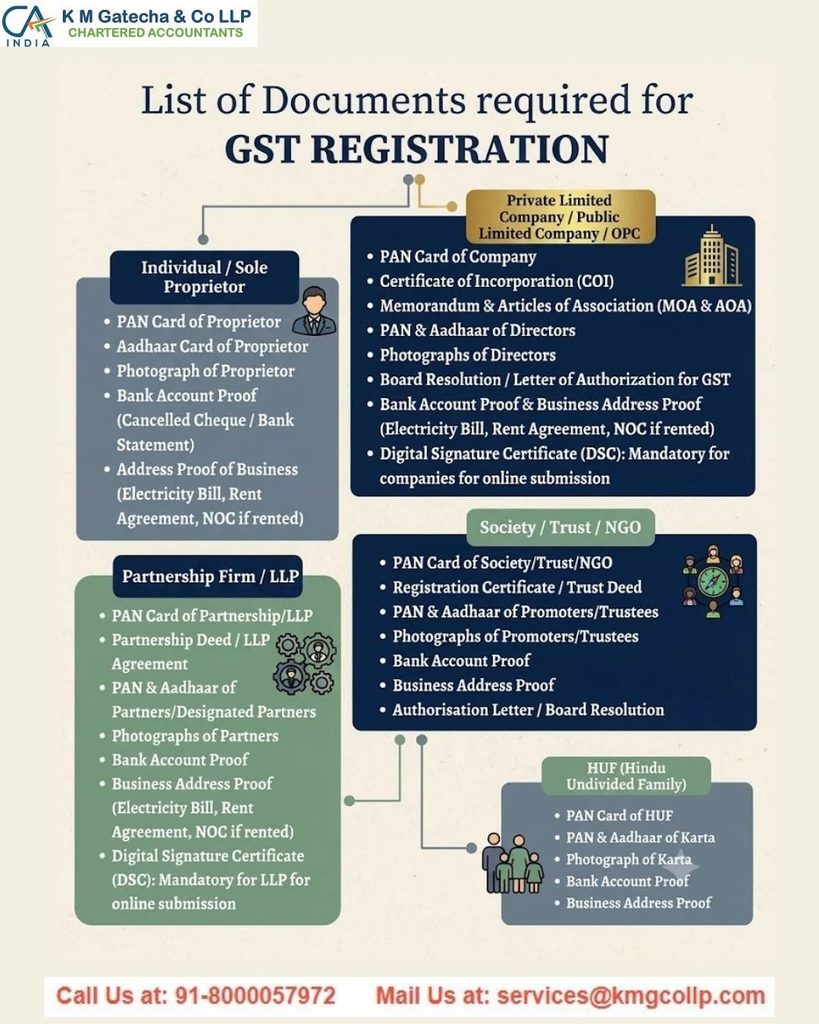
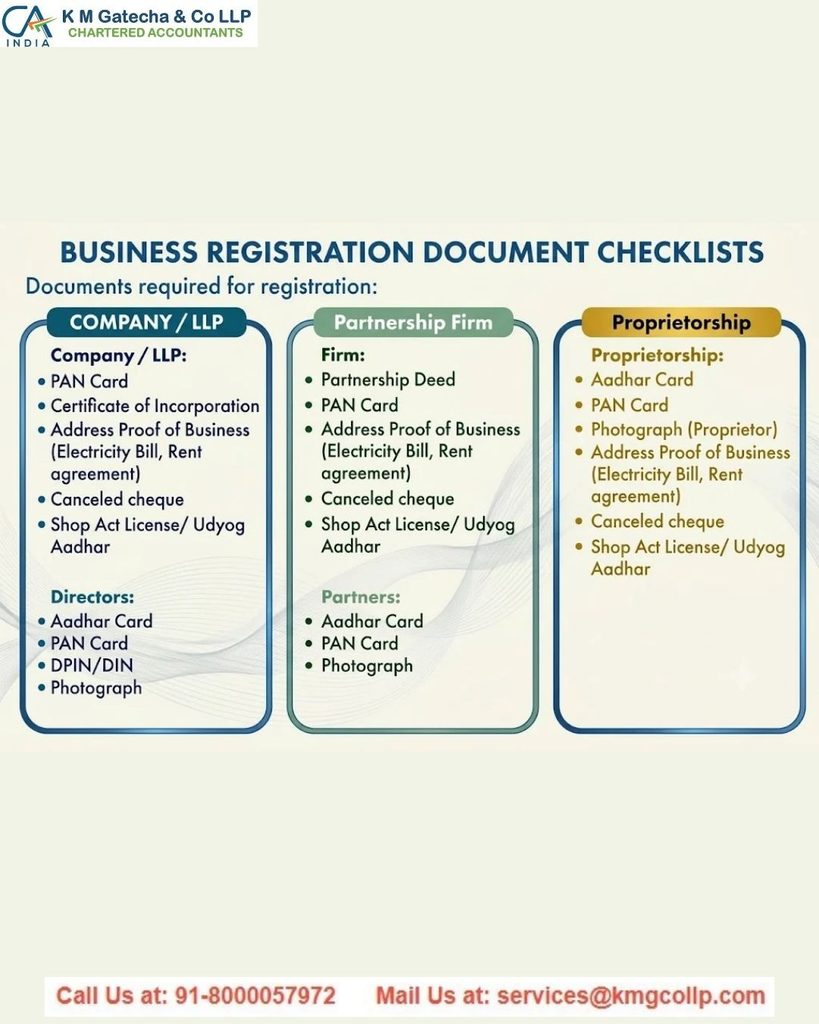
The exact documents can vary depending on the circumstances of the LLP and the registration application. Commonly required documents include:
- PAN of the LLP
- LLP Certificate of Incorporation issued by the MCA
- LLP Agreement
- PAN and identity details of partners or designated partners
- Aadhaar details where applicable
- Proof of business address
- Electricity bill or other utility bill
- Rent or lease agreement, where applicable
- NOC from the property owner, where required
- Bank account details
- Cancelled cheque or bank statement
- Digital Signature Certificate of the authorised signatory
- Details of the authorised signatory
Additional documents or clarification may be required by the GST authorities depending on the application.
How to Register for GST for an LLP?
The GST registration process is completed online through the GST portal.
Step 1: Keep the Required Documents Ready
The LLP should first collect its incorporation documents, PAN, LLP agreement, partner details, business address proof, bank details, and other required documents.
Step 2: Start the GST Registration Application
The authorised person can apply for GST registration through the GST portal.
The application requires basic details such as:
- Legal name of the LLP
- PAN
- State
- Mobile number
- Email address
- Business details
An OTP-based verification is required during the initial application process.
Step 3: Enter LLP and Business Details
The applicant needs to provide information about the LLP, partners, authorised signatory, principal place of business, additional places of business where applicable, and the nature of business activities.
Step 4: Upload Supporting Documents
The required documents and supporting information are uploaded with the application.
The application is then submitted using the applicable authentication method, such as DSC or Aadhaar-based authentication, depending on the requirements.
Step 5: Verification by GST Department
The GST department may verify the application and documents.
If additional information or clarification is required, the applicant may receive a notice and need to provide a response.
Step 6: Receive GST Registration Certificate
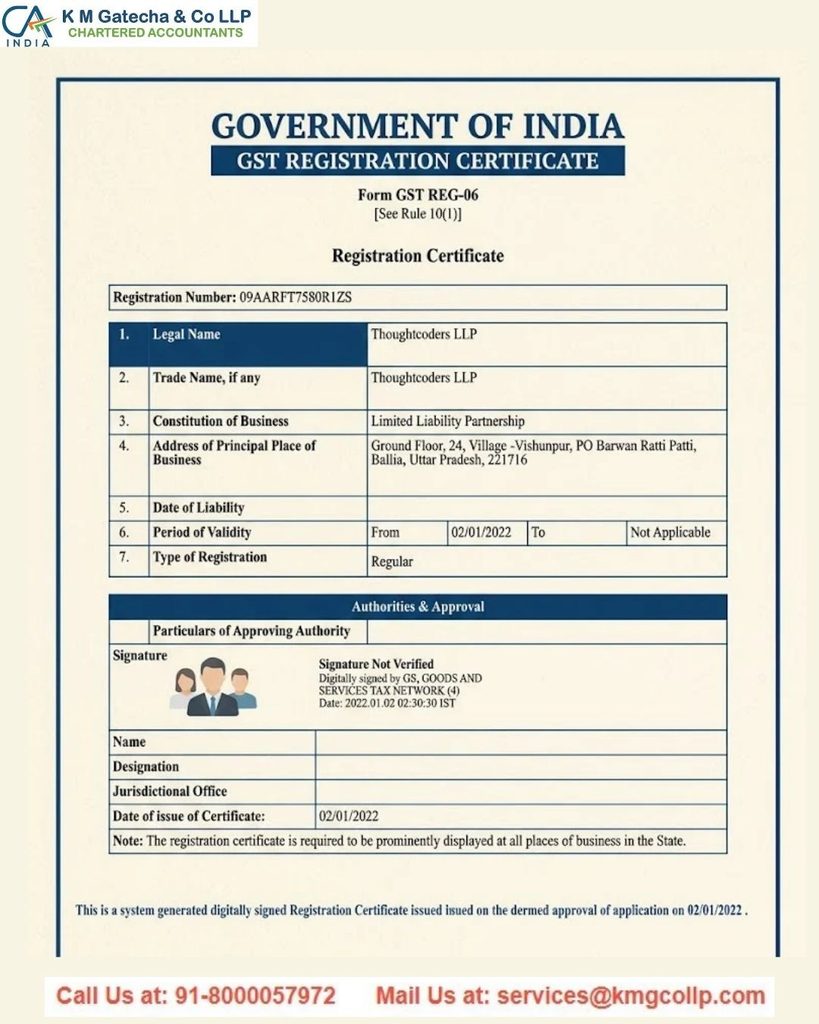
After successful approval, the LLP receives its GST registration certificate in Form GST REG-06 along with its GSTIN.
The GSTIN is then used for GST invoicing, return filing, tax payments, and other applicable GST compliance.
LLP Registration and Other Compliance Requirements
GST registration is separate from the incorporation of an LLP.
An LLP must first be incorporated under the applicable LLP law through the Ministry of Corporate Affairs (MCA).
The broad LLP incorporation process includes:
1. Obtain Digital Signature Certificates
Digital signatures are required for filing various documents electronically with the MCA.
2. Obtain Partner Identification Details
The required identification numbers and details of designated partners must be obtained and provided as part of the incorporation process.
3. File the LLP Incorporation Application
The incorporation application is filed with the MCA using the prescribed form and supporting documents.
4. Prepare the LLP Agreement
The LLP agreement sets out important terms such as:
- Partner contributions
- Profit-sharing ratio
- Roles and responsibilities
- Decision-making powers
- Admission of new partners
- Retirement or resignation
- Dispute resolution
- Other operational arrangements
5. Receive the Certificate of Incorporation
Once the application is approved, the MCA issues the LLP’s Certificate of Incorporation.
6. Open a Business Bank Account
The LLP should maintain a separate bank account for its business transactions.
An LLP must also meet its applicable annual filing, accounting, income-tax, and other statutory compliance requirements.
If the LLP is GST-registered, it must additionally comply with applicable GST return filing, tax payment, invoicing, record-keeping, and other GST requirements.
Startup India Registration for LLPs
Eligible LLPs involved in innovative or qualifying business activities may apply for DPIIT recognition under Startup India.
An eligible startup may receive benefits such as:
- Access to certain government schemes
- Easier participation in eligible funding opportunities
- Certain tax benefits where the required conditions are satisfied
- Self-certification benefits for specified labour and environmental laws
- Opportunities relating to government procurement and tenders
However, Startup India recognition does not automatically mean that every LLP receives all available benefits. Each benefit has its own eligibility conditions.
Eligible LLPs can apply through the Startup India system for DPIIT recognition.
IEC Registration for LLPs Involved in Import and Export
An LLP engaged in international trade may need an Import Export Code (IEC) issued by the Directorate General of Foreign Trade.
IEC is generally required for businesses involved in activities such as:
- Exporting goods from India
- Importing goods into India
- Other transactions for which IEC is prescribed
For an LLP involved in exports or imports, GST compliance and IEC requirements should be considered separately because they serve different regulatory purposes.
GST Compliance After Registration
Obtaining GST registration is only the beginning of GST compliance.
A registered LLP may need to:
- Issue GST-compliant invoices
- Collect and pay applicable GST
- File applicable GST returns
- Maintain proper books and records
- Reconcile eligible input tax credit
- Maintain records of purchases and sales
- Comply with e-invoicing requirements where applicable
- Comply with e-way bill requirements where applicable
- Respond to GST notices, if received
- Follow applicable GST rules for exports and refunds
The exact compliance requirements depend on the LLP’s turnover, business activities, type of supplies, and other applicable conditions.
Penalty for Not Obtaining GST Registration
If an LLP becomes legally liable to register under GST but fails to obtain registration, it may face a penalty under the applicable GST provisions.
The penalty can depend on the nature of the default and the tax involved. Therefore, an LLP should not delay registration once its liability arises.
It is also important to understand that the commonly stated penalty of 10% of tax due or ₹10,000, whichever is higher, is subject to the applicable statutory provisions and minimum penalty rules. The actual consequences can vary depending on the circumstances.
Conclusion
GST registration is not automatically mandatory for every LLP in India. The requirement depends on factors such as aggregate turnover, the nature of taxable supplies, interstate transactions, e-commerce activities, compulsory-registration provisions, and applicable exemptions.
An LLP that becomes liable for GST registration should complete the registration process and comply with the applicable GST requirements. Even where registration is not compulsory, voluntary registration may provide benefits such as eligible input tax credit, GST-compliant invoicing, and easier dealings with GST-registered business customers.
Apart from GST, an LLP may also need to complete MCA compliances, income-tax requirements, Startup India or DPIIT recognition where eligible, and IEC registration when involved in international trade.
The right approach is to examine the LLP’s specific business activities before deciding whether GST registration is required.
Disclaimer: The content on this website is for informational purposes only and does not constitute legal, financial, or professional advice. Please consult qualified experts before acting on any information. K M GATECHA & CO LLP accepts no liability for errors, omissions, or outcomes from the use of this content. This site is not an advertisement or solicitation.


